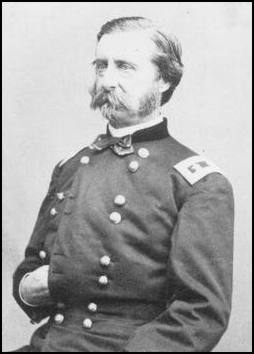
Report of the Operations of the First Division, Fourteenth Army Corps, in the Battle of Chickamauga Creek, September 19�21, 1863.
Being encamped upon Chickamauga Creek, between Bird�s Mill and Owens� Ford, with the divisions of General Brannan on my right and General Negley on my left, I received orders on the 18th instant from the major-general commanding to move immediately to the left, lower down the creek, for the support of General Crittenden�s corps, as the enemy appeared to be gathering in that direction.
The road being encumbered by troops in advance, I did not reach Crawfish Spring, the headquarters of the army, until near midnight, when we halted a short time until the way was clear, and then I received my final orders from the general commanding.
Under the direction of a guide, I was to take a road which, leaving the Chattanooga road near Widow Glenn�s, came into the State road from Chattanooga to La Fayette at Kelly�s, about 3 miles north of Lee�s Mills. I would thus pass around the rear of General Crittenden�s corps, located about that mill, and come into position on his left. I was to post one brigade on the west of the State road, facing toward the south, and my other two brigades om the east of it. General Brannan, following me was to post his division on the prolongation of my left. I reached the point indicated about daybreak, and posted General Starkweather on my right, Colonel Scribner in the center, the right of his brigade upon the road, and the regular brigade, General King, upon the left. General Thomas arrived upon the ground almost immediately after these dispositions were made, and General Brannan soon followed. While the latter was getting into position,Colonel McCook, who commanded a brigade of the Reserve Corps, came in and reported a brigade of the enemy not far distant upon our left, with which he had been skirmishing. General Brannan was then formed facing to the eastward, and I was directed to change my front to the left, conforming my line to his, and at the same time to watch well upon my right flank against an approach from that direction. We were then in a thick wood interspersed with thickets and openings, which extended in front, I believe, as far as the Chickamauga.
I formed General King�s brigade upon the left, with orders to dress and close upon General Brannan, and a portion of Colonel Scribner�s force upon the same line to be guarded by King�s right, and the rest of his force I had bent to the rear so as to march by flank in rear of his right, and be ready to front in that direction or toward the south should it be required. To General Starkweather I gave orders to move in column in rear, holding his brigade as a reserve. I had particularly in view the support of our right flank.
The artillery could not advance in line with the infantry, nor, indeed, could it have been used except at rare intervals. It could not, at the same time, be left behind for want of protection, and it was directed to follow closely the brigades, making its way through the trees.
I had scarcely got my line formed when General Brannan� s men, a little in advance, began to skirmish hotly. My men were soon after engaged. We drove the eiiemy before us, and covered the ground quite thickly with his dead and wounded, besides sending 200 prisoners to the rear, some just from the Army of Virginia. During this forward movement, I received orders from the general commanding to push rapidly toward the left to support Colonel Croxton�s brigade of Brannan�s division, then hard pressed by the enemy and almost out of ammunition.
About the same time, General Starkweather, as will be seen by his report, received an order of similar effect, and at once acted upon it. I was not, until subsequently, aware of this, and thus lost my knowledge of his position. Before I had closed up with General Brannan�s left, word was brought me that General Palmer had arrived upon my right, and that his skirmishers were then passing across my front. I sent a caution, in consequence, to my men not to fire into them. The evidence seems clear that men of our forces were in the position indicated; but to whom they could have belonged, or how they came there, I cannot now conjecture. Arrived close up to General Brannan, and the enemy having disappeared from our front, I halted to readjust my line. We had now advanced about three-fourths of a mile from where we first became engaged, and the troops had behaved admirably. While arranging my line, I learned from prisoners that there had been but one division in oar front, while the main body of the rebel force, which they exaggerated at 90,000, had crossed the river at Alexander�s Bridge, above us, and was then upon my right flank. I immediately ordered General King to change his front so as to face the south; his left being supported by General Brannan�s troops, in order to face the new danger. I also dispatched staff officers to General Starkweather to bring him to the same point, but having moved toward the left, as before stated, they failed for some time to find him. I went my self toward Colonel Scribuer to see his command properly posted, but before I could reach him, the attack had beeu made in such force that he was unable to withstand it, and I met his men coming back in disorder, driven by the enemy across the rear of what had been our previous position. For the particulars of this attack, and the manner in which it was met, I refer to the lucid report of Colonel Scribner. Our troops behaved with gallantry and yielded only to overwhelming force. Assisted by my staff officers, Major Fitch, Captain Cary, anid Captain Williams, I strove to restore confidence to these men, and induce them to make another stand, but it was only after they had passed far to the rear that I could do so. Complete destruction seemed inevitable. Four pieces of Colonel Scribner�s battery were captured after firing sixty-four rounds, and the enemy, sweeping like a torrent, fell upon the regular brigade before it had got into position, took its battery, and after a struggle in which whole battalions were wiped out of existence, drove it back upon the line of General Brannan. We are indebted to the Ninth Ohio Regiment, of Brannan�s division, for recapturing this battery.
In this onslaught of the enemy General Starkweather was brought into action a little after Scribner, and more to his rear and right. His brigade suffered severely, and his battery was almost entirely disabled by the loss of horses and men; the guns, however, were saved. The appearance of other forces upon the left of the enemy caused further pressure upon us to cease, and probably saved us from destruction.
Having collected my forces, they were united to those of General Brannan, in a strong position on the road leading from McDonald�s house to Reed�s Bridge, and this post we were ordered by General Thomas to hold to the last extremity. A period of quiet to us then ensued, during which a fierce conflict was going on upon the ground we had fought over in the morning, and, as we learned later, with the division of General Johnson.
I would here testify to the high qualities for a commander exhibited by General Brannan, for the moment (a trying one) the commander of our united divisions. Toward evening I received orders to support General Johnson, while General Brannan was withdrawn for the assistance of General Reynolds, to the right of the cross-roads, near Kelly�s. Leaving the small brigade of King to hold the road where we were, I moved with those of General Starkweather and Colonel Scribner to the right, and caused them to be posted under the direction of a staff officer of General Johnson, nearly in prolongation of his left. We were then upon the very ground from which we had driven the enemy in the morning, and from which we had subsequently to fall back. We found a number of our dead there stretched upon the ground. With the exception of an occasional shot from rebel sharpshooters, entire quiet prevailed along the line, and I remained with General Johnson until toward dark, when the general commanding arrived, and directed us to retire some half mile to a better position for the night. Orders were given accordingly to have the troops withdraw after nightfall, and General Johnson and myself rode back with the general to ascertain the position we would occupy. I was returning, when, just as the light of day began to disappear, I heard the sounds of a fierce battle in front. The enemy attacked with both artillery and infantry, in apparently large force, and with greater determination than previously, shelling at the same time the entire woods which we occupied, as far back even as the road where my ammunition was parked. This attack came first upon General Johnson�s division, and then extended to the left on to mine. It was quite dark before it was repulsed, when we remained in possession of the ground. Quiet being again restored, we fell back as had been designed. Thns ended the first day.
At 3 o�clock on the morning of the 20th, I put my men in position, ready to meet the enemy. We were posted upon a wooded ridge running parallel to the State road, and about one-fourth of a mile to the east of it. An open field extending along the east side of the road, from near one-fourth of a mile south of McDonald�s to a point beyond Kelly�s, lay a short distance in our rear. The rest of the country as far as the Chickamanga, in all directions, was thickly wooded. My division was posted around the northeast corner of the field, but about 150 yards in advance of it, in the woods. General Johnson�s division was on my right, and beyond him, I think, General Palmer�s. My Second Brigade, Brigadier-General Starkweather,was placed next to Johnson, facing to the east, with four guns in position, so as to enfilade our front, besides having a direct fire. The First Brigade, Colonel Scribner, was upon the turn, a portion of his force facing in the same direction as Starkweather, and the rest sloping to the rear, so as to face partially to the north. The Third Brigade. Brigadier-General King, was upon the left of Scribner. When the line was established there was no force whatever upon King�s left, and no natural obstruction, and I was compelled thus to refuse or en echelon that flank in order to cover it.
I formed my men generally in two lines; King�s brigade was even more concentrated, and I used only the four pieces of artillery of General Starkweather; the rest, much of it disabled, indeed, was held in reserve in rear.
About 7 o�clock General Beatty�s brigade, four regiments, of Negley�s division, came up and formed line on time north side of the field, and then passed into the woods, when I had his right joined on to King�s left; but subsequent orders caused him to move farther to the left, and, as he informs me, he posted one of his regiments on the west of the State road, looking toward McDonald�s, and time other three on the east in line with it, and all looking toward the north. This arrangement gave General Beatty a long, thin line, easily brushed away, and at the same time left an important gap between him and King. To fill this gap I had no troops, but finally I induced a regiment�perhaps the Seventy-ninth Indiana�coming to this quarter with only general instructions, to move into it. I am sorry to have lost the name of the colonel of this regiment.
During the interval between daylight and time first attack our men worked vigorously and covered themselves with a hastily constructed breastwork of logs and rails, which proved of vast service to them during the day.
I believe that the battle began upon my front at about 8.30 a. m. Previous to this there had been some sharp skirmislming along the front, and our skirmishers were at times compelled to fall back, but as often returned to their original position, and continued throughout the day to reform their first line whenever the assaults of the enemy were repulsed. It was also reported to me that distinct words of command were heard by our advanced pickets, as in the formation of bodies of rebel troops, both upon our front and flank, and we awaited their attack, quietly working upon our defenses.
At about 9 o�clock time enemy, in force, advanced upon us through the woods, and attempted, by throwing strong bodies of infantry upon King and Scribner on the left, while they likewise assailed Starkweather furiously in front, to crush that portion of our line. I judge the general direction of all the attacks made upon us to have been from the northeast. This attack continued about an hour, during which repeated efforts were made to dislodge us from our position, but in vain. The battle-flags of the rebel generals, borne with the lines of troops, approached quite close to our position, but each time those lines exposed themselves they were broken and driven back. When they withdrew, our skirmishers were thrown to the front and took many prisoners, by whom we were informed that it was the division of Breckinridge which we had been fighting, together with troops from Virginia.
An interval of about an hour now elapsed, during which there was but little fighting upon our portion of the line. Warned, however, by the previous attack, of the vulnerability of my left, I strove to obtain forces to secure it. There were regiments lying in reserve in rear of General Johnson�s division, I know not what, which I thought might be of more service on the left. I went to their commanders, and explaining to them the danger of an attack from that quarter, and that it might certainly be looked for, I asked them to keep a lookout in that direction, and, should the regiments on the left seem to waver, to rush to their assistance. As all had different orders, I received no satisfactory reply. I then went to General Johnson and got him to visit with me the left of his own line, where I pointed out the condition of things, and asked him to take his left regimeiit of the second line and place it in column in rear, so as to be ready to move to whatever point should require it the most.
While speaking of this matter the attack came, as I had anticipated, and was made with large force and great impetuosity. General Beatty�s line was cut in two in the middle, two regiments being driven beyond the road to the west; the other two were forced back into the open field toward my rear. My own left was also forced back, and our line seemed ready to crumble away on this flank. The rebels were already in the field behind us, and the column which had forced Beatty�s center was pushing down the road toward Kelly�s house. I immediately caused the second line to rise and face about, and then to wheel forward toward the right, so as to support our men and meet the advancing enemy. This line was composed of regiments from various commands, a part only my own. The unexpected direction of the attack, the facing to the rear, and the crowd of our retiring troops coming upon them caused some disorder in their line, but, riding to their front with a cheer, two regiments took it up, formed a good line, and advanced gallantly. The rest followed, and the rebels were driven back into the woods. The column upon the road was at the same time driven back by troops, I believe, of General Brannan�s division, and at this juncture Colonel Barnes, commanding a brigade of General Wood�s division, came up and pushed his brigade in line into tIme woods on the north side of the field.
I saw at once that this attack was at an end, antI requested Colonel Barnes to withdraw two of his regiments, to be held in reserve in the northeast corner of the field, near my own position, to be used upon the next point assailed. He complied, and brought the two regiments commanded by Colonel Swaine, which remained near me until the close of the fight.
My line was re-established as it had been in the morning, and was not for some four hours again attacked in force. Immediately that this assault upon my left ceased, the sound of a tremendous conflict reached us from the southwest, beyond Kelly�s house. I could not tell how it was progressing, but, knowing it must be a desperate struggle, Ii sent word to General Thomas that I held the two regiments under Colonel Swaine in reserve, and that if he required them there more than we did that they were disposable. The fighting in the direction I have named was continued throughout the afternoon, with only intervals, when it was partially suspended. During this period re-enforcements seemed to arrive from the direction of Chattanooga, and about 4 o�clock the firing seemed more vigorous than before. At 5 o�clock it had almost ceased, but I was still ignorant of the course of events upon the right, and had no idea that any portion of the troops had given way. An officer then arrived, with orders for myself and General Johnson to withdraw our troops and fall back in the direction of the hills and of Rossville.
Just as this order reached me the heavy firing on the right ceased, and it seemed to be the signal for another attack, the most violent of all, upon my portion of the line. This time the enemy used artillery, and concentrated the fire of three batteries upon us, while his infantry pressed on with the utmost vigor. Still we held our postion, yielding not an inch, and I am confident could have continued to do so; to fall back was more dlifficult than to remain, and I should have taken the responsibility of holding on for a time had I not seen the troops on my right, first those of General Palmer and then those of General Johnson, passing off to the rear. I saw then that no time was to be lost and transmitted the order to my brigade commanders. I am indebted to Captain Forsyth, of General King�s staff, for assisting Captain Cary, of my own staff, in bearing this order. The remainder of my staff officers I had sent away upon other missions.
As my men fell back the enemy pressed after them, and in crossing the open field very many were struck down. They reached the woods, west of the road, in as good order as could be expected, but then, uncertain which direction to take, and having no landmark to guide them, many became separated from their regiments, and in groups joined other commands, with which they fell back to Rossville, where all were united during the night. A number, doubtless, became confused at this time and marched into the lines of the rebels. We had, during the day, been fired into from every point of the compass, and when we fell back, no other portions of our troops being in sight, it was impossible to tell where they could be found or when we would encounter the enemy. My loss, up to the time of falling back, was small compared with the punishment inflicted on the rebels. In retiring, it was great. A list of those lost is appended. Brave men, their names will live, the pride of their children and a monument of glory for their country.
On the 21st, at Rossville, my division was again put upon duty to defend one of the main approaches to that position, and I believe it was the only one that was attacked. The gorge which we occupied was shelled during the afternoon, and I lost 5 men in killed and wounded from the brigade of regulars.
During the same afternoon Major-General Rousseau arrived and resumed command of this, his old division, inspiring it with new life after the arduous duties it had performed. By his courtesy I have since remained with it, co-operating with him.
On the night of the 21st our army was withdrawn from Rossville to this place, and the First Division was selected to bring up the rear. Under its protection the pickets of all commands were withdrawn and marched here, Colonel Scribner�s brigade, the last, arriving abont sunrise.
The campaign thus terminated, although brilliant, has been one of unusual hardship upon the soldier. The labor in marching and transporting our trains over the mountain ridges has been enormous, and from Satnrday morning until late Sunday night, throughout two days� of battle, my horses and most of my men were without water. The First Division, thus sorely tried, has not murmured, but with its thinned ranks stands proudly ready to meet any foe. Its record is as bright as any, amid all may be proud to have belonged to it. Its losses are heavy, but they were incurred in gallant resistance to overwhelming force. We report 1,034 killed and wonnded, and 1,319 missing. Many of the latter we know were left dead or wounded on the field, and in exchange for our prisoners lost we have captured and brought back over 400 of the enemy.
Some of our artillery was lost, but it has all been recovered, a part of it, it is true, temporarily disabled. In the battery of Starkweather�s brigade, one limber box was blown up and two axles broken by the recoil of guns during the fight of Sunday. And I must here thank the officer in command, Lieutenant Willits, for the service it rendered.
To my brigade commanders, Brig. Gen. John H. King, Brigadier-General Starkweather, and Colonel Scribner, the country owes a debt of gratitude for the courage with which they maintained the fight, and the good judgment with which their troops were handled. The performance of General King�s command upon Saturday morning was particularly brilliant. In the fight upon Sunday, General Starkweather, holding one of the key points of our position, rendered distinguished service by his own coolness, inspiring his men with confidence. He received a slight wound in the leg, but I am happy to say not such as to make him quit the field. Colonel Scribner, who has long commanded one of the best brigades in the army, and has been recommended for promotion after previous battles, has again distinguished himself. Two missiles from the enemy passed through his clothes, one inflicting a slight wound in the face, and another a bruise on the shoulder. I renew the recommendation for his promotion as a reward for the good conduct of his brigade. I would be glad to name to the general commanding the officers in command of troops belonging to other divisions, who were brought into action in the neighborhood of my own, but I do not know them all. Colonel Barnes, commanding a brigade of General Wood�s division, and Colonel Swaine, who reported to me with two regiments of the same brigade, were among the number.
To the officers of my staff I tender my thanks for the efficient service they rendered, and commend them to the notice of the general commanding for their gallant bearing on the field.
A tabular statement of the killed, wounded, and missing is annexed, and the reports of brigade, commanders are likewise inclosed.
Respectfully submitted.
A. BAIRD,
Brigadier-General, Commanding.
Lieut. Col. George E. Flynt,
Assistant Adjutant-General.
Reports of Brig. Gen. John H. King, U. S. Army, commanding Third Brigade.
Hdqrs. Third Brig., First Div., 14th Army Corps,
Chattanooga, Tenn., September 24, 1863
General: I have the honor to report that I joined the division (having been detached with the brigade guarding the railroad between Tantallon and Bridgeport) at Cooper's Gap on the 15th day of September, 1863. My brigade marched with the rest of the, division toward the left and Chattanooga on the 17th of September; went into camp same afternoon at Cave Spring.
On the 18th September I broke up my camp at about 6 p. m., and took up my line of march, my brigade having been detailed as rear guard the division still moving to the left. I arrived on the ground and placed my brigade in its position in line of battle on the left of the division, and at that time on the left of the corps, at about 6 a. m. on the 19th of September, the command having marched all night with a rest of about two hours at Crawfish Spring. About 9 o�clock on the same morning my command was ordered to engage the enemy.
My first line was composed of First Battalion Eighteenth Infantry, Capt. G. W. Smith commanding; First Battalion Sixteenth Infantry, Maj. Sidney Coolidge commanding; First Battalion Nineteenth Infantry, Maj. S. K. Dawson commanding; leaving on the second line First Battalion Fifteenth Infantry, Capt. Albert B. Dod commanding; Second Battalion Eighteenth Infantry, Capt. Henry Haymond commanding; Battery H, Fifth Artillery, First Lieut. H. M. Buruham commanding.
I pushed everything tothe front, my first line driving the enemy before them for a mile, and meeting General A. Baird, division commander, at about 10 a. m., was ordered to make a new front at right angles with the other. I only had time, however, to get the Sixteenth Infantry and battery in position before being assailed by an overwhelming force; at this time the troops on my right were giving ground to the enemy in confusion. I immediately gave orders for the battery to limber up, but it could not be done as the horses as they were brought up to the gnus were shot down.
The officers and men, finding it impossible to retire, remained with their pieces (firing) until they were forcibly taken from them by the enemy. It was at this time that I lost the First Battalion Sixteenth Infantry (made prisoners), with the exception of 5 commissioned officers and 62 men. The losses of the battery will be attached to this report.
I reformed my command some 400 yards in the rear of the battery and a short distance in the rear of the Ninth Ohio Volunteers. I then changed my position and formed on the left of General Brannan�s division, where I again met General Baird, attaching the Ninety-fourth Ohio to my command, numbering some 200 men. I had been informed by General Brannan that my battery was recaptured at the point of the bayonet by the Ninth Regiment Ohio Volunteers (Col. G. Kammerling), of the Third Brigade, Third Division, Fourteenth Army Corps, commanded by Colonel Van Derveer. The Fifteenth Infantry of my command was detailed to go forward and bring the battery to the rear. On the arrival of the Fifteenth Infantry on the ground where Battery H was left, they found no men of the Ninth Ohio Volunteers, or any other regiment present with said battery or in charge of the same. The pieces were much scattered; four were pointing toward our front and two in the direction of the enemy. The Fifteenth Infantry also brought off a piece of artillery belonging to a Mississippi battery, which was afterward abandoned by Lieutenant Fessenden, commanding Battery H, as it was impossible to take it with him to Rossville.
I am happy to say that my battery is now complete, with the exception of caissons, four of them having been abandoned for the want of horses.
Late in the afternoon General Baird, with the other two brigades of his division, moved forward to assist General Johnson�s division of McCook�s corps, leaving me to guard ground immediately in my front. At dark, finding no troops in my vicinity, I changed the position of my command and remained in the woods without fires until 2 o�clock in the morning, when I fell back to General Thomas� headquarters, where I found General Baird, division commander.
At daylight on the 20th my brigade went into position on the left of the First Brigade, First Division, Colonel Scribner commanding. I formed my command in four lines, the First Battalion Eighteenth Infantry, Capt. G. W. Smith commanding, in front, and behind a breastwork of logs 2 feet in height, connecting with Colonel Scribner�s. My brigade was thus again on the extreme left. Between 7 and 8 a. m. I moved Captain Smith�s command forward about 50 paces across an open piece of ground to a ridge skirted by timber; he took the logs forming the breastwork in his front forward, and placed them in front of his new position. The Second Battalion Eighteenth Infantry, commanded by Capt. Henry Haymond, moved to the ground vacated by the First Battalion. The Fifteenth Infantry, Captain Dod commanding, Nineteenth Infantry, Capt. E. L. Smith commanding, were ordered to support the front line, or to wheel to the left in case of an attack on the flank.
About 9 a. m. the enemy drove in my line of skirmishers, and advancing in force, attacked my front and flank. Captain Haymond was sent forward to support Captain Smith, and the Fifteenth and Nineteenth Infantry wheeled to the left; after a contest of about an hour the enemy withdrew. I then relieved the First Battalion Eighteen Infantry by the Fifteenth Infantry; the Nineteenth Infantry was relieved by a regiment belonging to Colonel Dodge�s brigade, this regiment connecting with the left of the Fifteenth Infantry, the remnants of the Eighteenth and Nineteenth Infantry constituting a reserve. These dispositions were scarcely completed when the enemy again renewed his attack, pouring in a destructive direct and enfilade fire. This attack lasted an hour; the enemy was again repulsed, my command still retaining its original position. Heavy skirmishing continued along my entire front during the afternoon until half past 4 o�clock, at which time the enemy again made an attack upon my front and flank, using both artillery and infantry, my command being exposed to a terrific fire of musketry and canister. Notwithstamidimig all this, they held time enemy at bay and retained their position until about 5 p. m., at which time I was ordered by the division commander to fall back to the Rossville road.
About 7 a. m. on the 20th instant a brigade of General Negley�s, commanded by General Beatty, took up a position on my left and perpendicular to my front, but was forced to return early, thus exposing my left and causing me to wheel my reserve to the left and form two fronts at right angles to each other.
I take this occasion to speak in the highest terms of my battalion commanders, and the officers of Battery H, Fifth Artillery: Maj. S. K. Dawson, Nineteenth U. S. Infantry; Maj. Sidney Coolidge, Sixteenth U. S. Infantry; Capt. G. W. Smith, Eighteenth U. S. Infantry; Capt. Henry Haymond, Eighteenth U. S. Infantry; Capt. A. B. Dod, Fifteenth U. S. Infantry; First Lieut. H. M. Burnham, Battery H, Fifth U. S. Artillery; Second Lieut. Israel Ludlow, Battery H, Fifth U. S. Artillery; Second Lieut. J. A. Fessenden, Battery H, Fifth U. S. Artillery.
Capt. E. L. Smith took command of the Nineteenth Infantry after Major Dawson was wounded on the 19th instant. Lieutenants Burnham and Ludlow were shot down while gallantly fighting their guns. Lieutenant Fessenden was wounded, but continued in the field during the remainder of the day.
I also take pleasure in mentioning the members of my staff, viz: Capt. J. W. Forsyth, Eighteenth Infantry, acting assistant adjutant-general; Capt. J. B. Mulligan, Nineteenth Infantry, provost-marshal; Lieut. W. J. Lyster, Nineteenth Infantry, aide-de-camp; Lieut. H. G. Litchfleld, Eighteenth Infantry, inspector.
These officers were present with me during the entire engagement (19th and 20th September), and rendered prompt and effective aid during the two days� battle.
Capt. R. E. A. Crofton, Sixteenth Infantry, after the first day�s fight reported to me and acted as aide-de-camp on my staff, rendering great assistance during the 20th instant.
I have the honor to inclose reports of my battalion and battery commanders of the conduct of the officers and men of the same. I respectfully call your attention to their reports. I also forward special report showing the numuber of fighting me on the 18th instant, casualties during the two days� battle, and the number of men brought out of action; also a list of commissioned officers killed, wounded, and missing, and letter of Brigadier-General Brannan, concerning the recapture of Battery H.
In conclusion I have to state that my brigade captured 126 prisoners on the first day�s fight.
Very respectfully, your obedient servant,
John H. King,
Brigadier- General.
Brig. Gen. A. Baird,
U. S. Army.
Hdqrs. Third Brig., First Div., 14th Army Corps,
Chattanooga, Tenn., September 29, 1863
General: I have the honor to request that the following be included in my report of the part taken by my brigade in the battle of Chickamnauga Creek, Ga., viz:
Between 12 and 1 p. m. on the 20th instant, the First Battalion Eighteenth Infantry, Capt. G. W. Smith commanding, Second Battalion Eighteenth Infantry, Capt. Henry Haymond commanding, charged the enemy�s lines, driving them through an open field on the left of my position for 600 yards. to their second line of battle, but being unsupported they were obliged to retire to their original position, where they were relieved by the Fifteenth Infantry, Captain Dod commanding. This charge was the most gallant act of that day�s engagement.
My medical director, Asst. Surg. E. J. Darken, U. S. Army, devoted his whole time and attention to the wounded from the beginning to the end of the battle, reporting to me on the morning of the 20th instant.
Lient. J. J. Wagoner, brigade quartermaster, managed the brigade train with much care, arriving safely at Chattanooga without accident.
My brigade commissary of subsistence, Lieut. S. S. Culbertson, Nineteenth Infantry, by his activity succeeded in meeting me early in the morning at Rossville with a train of provisions, and not only supplied my brigade with rations but also General Sheridan�s division and Battery I, Fourth Artillery, General Brannan�s division, both of whom were entirely out.
I have the honor to be, general, very respectfully, your obedient servant,
John H. King,
Brigadier-General.
Brig. Gen. A. Baird.
Special report of effective force of the Third Brigade, First Division, Fourteenth Army Corps, commanded by Brig. Gen. John H. King, September 18, 1863.
15th United States, 1st Battalion, Capt. Albert B. Dod...14 Officers and 262 enlisted men; 278 total.
16th United States, 1st Battalion, Maj. Sidney Coolidge, Capt. R.E.A. Crofton...10 officers and 289 enlisted men; 308 total.
18th United States, 1st Battalion, Capt. George W. Smith...13 officers and 278 enlisted men; 300 total.
18th United States, 2d Battalion, Capt. Henry Haymond...13 officers and 274 enlisted men; 287 total.
19th United States, 1st Battalion, Maj. Samuel K. Dawson, Capt. Edmund L. Smith...14 officers and 185 enlisted men; 199 total.
5th United States, Battery H, Lieut. Howard M. Burnham, Lieut. Joshua A. Fessenden....3 officers and 127 enlisted men, 130 total; 117 horses.
Reports of Capt. Albert B. Dod, Fifteenth U. S. Infantry.
Hdqrs. First Battalion, Fifteenth U. S. Infantry,
Chattanooga, Tenn. September 25, 1863.
Sir: I have the honor to report that on Saturday morning, September 19, this battalion, Consisting of Companies A, C, E, F, G, and H, First Battalion; Fifteenth U. S. Infantry, and Company E, Second Battalion, was ordered to remain immediately in the rear of Battery H, Fifth U. S. Artillery. In accordance with these instructions I was following close on the battery, moving to the front in line of battle, when I was informed that the skirmishers of the enemy were about 80 rods on our right. I immediately deployed Lieutenant Galloway�s company as skirmishers, and took up position to the right and a little in rear of the battery. These dispositions had hardly been made when I received information from one of General Baird�s staff that General Reynolds� division had gone in that direction, and cautioning me not to fire. My skirmishers were at once recalled, and I followed the battery, marching by the left flank. We had proceeded about 100 yards, when the battery again umlimbered, and I took position immediately in rear of it. The enemy, vastly our superior in numbers, opened upon us a most terrific fire of musketry from in front and on our right flank. I marched to the right of the battery, but was compelled to fall back about 400 yards, where the battalion was reformed under a ridge, and again advanced, taking position on the left of General Brannan�s division. Captain Meredith was wounded while gallantly endeavoring to reform the battalion.
At about half past 8 o�clock on Sunday morning, as my battalion was in line of battle, I received orders from Brigadier-General King to change front forward on the left company, and move forward to the support of the Eighteenth U. S. Infantry, who were sorely pressed. This was done while under fire, but before we could engage the enemy they were repulsed. We were left in this position (the extreme left of the division) for about an hour, the Eighteenth having moved to our right and occupied the outermost breastworks. I was then ordered to relieve the Eighteenth in these breastworks, which were only a few logs raised about a foot and a half above the ground, and which were abont 100 yards beyond the woods, and while occupying it my left flank was entirely exposed. I had only occnpied this position a few moments when I perceived two regiments of the enemy marching in double-quick time to my left. I waited until they commenced fire and were pouring an enfilading fire down my ranks�which it was impossible for me to return�when I gave the order to rise up, and the battalion marched across the open field to the woods under a terrific fire as steadily and in as good order as if on drill or parade.
Upon arriving in the woods I was met by Captain Forsyth, who informed me that General Baird ordered those works held at all hazards, and promising that my left should be protected. Again I marched across that field, my left this time supported by a regiment sent out for that purpose by Colonel Dodge. The enemy made four efforts to take these works, but were each time repulsed with terrible slaughter, the ground in front being literally strewn with their dead and wounded.
At about 11 o�clock we were ordered back into the position we had occupied during the morning, where we remained until all our ammunition was exhausted and we were ordered to fall back on Rossville.
Nothing could exceed the coolness and steadiness manifested by both officers and men throughout the whole of Sunday.
At about 4 o�clock the enemy took the breastworks we had occupied in the morning, and were pouring an enfilading fire of canister down our lines, while a tremendous fire of musketry was being poured into us from in front and on our left. The obstinacy with which the men fought may be inferred from the fact that this battalion, numbering less than 200 men, held a whole division in check for over an hour, until their ammunition was exhausted and they were ordered to retire. [Thus earning the General Thomas the nickname "The Rock of Chickamauga"] We were the last to leave the breastworks.
Annexed I attach a list of casualties as nearly as they can be ascertained.
I have the honor to be, captain, very respectfully, your obedient servant,
Albert B. Dod,
Captain Fifteenth Infantry, Comdg. First Battalion.
Capt. James W. Forsyth,
Acting Assistant Adjutant-General, Third Brigade.
Report of Casualties, Third Brigade, First Division, Fourteenth Army Corps, commanded by Brig. Gen. John H. King, in the battle of Chickamauga Creek, of two days' duration, September 19 and 20, 1863.
15th United States, 1st Battalion, Capt. Albert B. Dod...Officers: 2 wounded, 6 missing, 8 total; Enlisted men: 9 killed, 31 wounded and 88 missing; 144 total.
16th United States, 1st Battalion, Maj. Sidney Coolidge, Capt. R.E.A. Crofton...Officers: 3 wounded, 10 wounded and missing, and 1 missing, 8 total; Enlisted men: 10 killed, 13 wounded, and 204 missing; 227 total.
18th United States, 1st Battalion, Capt. George W. Smith...Officers: 1 killed, 3 wounded, and 2 missing, 14 total; Enlisted men: 29 killed, 73 wounded and 39 missing; 141 total.
18th United States, 2d Battalion, Capt. Henry Haymond...Officers: 1 wounded, 3 wounded and missing, and 2 missing, 6 total; Enlisted men: 15 killed, 79 wounded and 48 missing; 142 total.
19th United States, 1st Battalion, Maj. Samuel K. Dawson, Capt. Edmund L. Smith...Officers: 1 killed, 2 wounded, 2 wounded and missing, and 6 missing, 11 total; Enlisted men: 5 killed, 36 wounded and 120 missing; 161 total.
5th United States, Battery H, Lieut. Howard M. Burnham, Lieut. Joshua A. Fessenden....Officers: 1 killed, 1 wounded, and 1 wounded and missing, 3 total; Enlisted men: 12 killed, 15 wounded and 14 wounded and missing; 41 total.
List of Commisioned officers killed, wounded, and missing.
First Battalion, Fifteenth U. S. Infantry
Wounded.�Capt. D. M. Meredith, Second Lieut. John Williams.
Missing.�First Lieut. E. M. Timony, First Lieut. Samuel S. Holbrook, First Lieut. William G. Galloway, First Lieut. Roman H. Gray, Second Lieut. Theodore Kendall, Second Lieut. James P. Brown.
Report of the casualties of enlisted men [in Company A] of the First Battalion, Fifteenth U. S. Infantry, at the battle of Chickamauga Creek, September 19, 20, and 21, 1863
6 wounded......2wounded and missing.......14 missing......22 total.