15th U. S. Infantry, First Battalion.......4 enlisted killed, 4 officers and 55 enlisted wounded
16th U. S. Infantry, First Battalion.......2 officers and 4 enlisted killed, 1 officer and 49 enlisted wounded
19th U. S. Infantry, First Battalion.......5 enlisted killed, 2 officers and 30 enlisted wounded
1st Ohio.............................................2 enlisted killed, 2 officers and 45 enlisted wounded
6th Indiana.........................................4 enlisted killed and 36 enlisted wounded
5th Kentucky......................................7 enlisted killed and 56 enlisted wounded
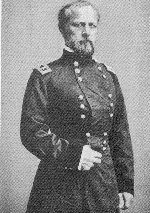
Report of Maj. John H. King, Fifteenth U. S. Infantry, commanding battalion of Fifteenth and Sixteenth U. S. Infantry
Hdqrs. Fifteenth and Sixteenth Infantry,
Battle-field, Pittsburg Landing, Tenn., April 13, 1862.
SIR: I went into battle on Monday, the 7th instant, in command of two battalions of the Fifteenth
and Sixteenth Infantry, the former numbering eight companies, the latter seven companies. After forming line of battle,
Maj. Stephen D. Carpenter, commanding five companies of the Nineteenth Infantry, formed on my left and continued with
me all day, or until half an hour before the enemy retreated, when he detached his command from me to support a battery
about to take a position some distance to on our left. I am under obligations to the officers and men of my command for
their brave and gallant conduct, and I feel assured that their services will be properly appreciated by our country. Capt. P. T.
Swaine, Fifteenth Infantry, and Capt. Edwin F. Townsend, Sixteenth Infantry, commanders of the two battalions, are entitled
to special notice for their discipline and maneuvering of their commands. I take pleasure in referring you to their reports, which
are herewith inclosed.
I am, sir, very respectfully, your obedient servant,
John H. King,
Major Fifteenth Infantry, Commanding
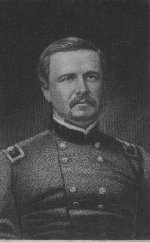
SIR: I have the honor to report that the First Battalion Fifteenth U. S. Infantry, in the battle of the 7th instant,
consisted of eight companies. From the commencement to the close of the battle we were exposed to an incessant fire, but
kept steadily advancing, compelling the enemy to yield ground to us. Three times we charged upon the foe, the last time with
the bayonet, capturing a battery. My officers displayed great bravery, and gallantly conducted their companies in the hottest of
the engagement with the regularity of a drill, and the men were cool, steady, and obedient, well exemplifying their discipline. Not
only did they keep gaining ground by driving the enemy before them, but at one time, when heavy re-enforcements were advanced
by the rebels, breaking and dispersing the ranks of two adjacent regiments, they stood their ground, and poured such a deadly
fire of rifle bullets into the ranks of the enemy that what bid fair at first to be a defeat was turned to a most glorious success.
Many of our enlisted man deserve special notice. Four of them came more particularly under my immediate observation. They are
Sergeant Major Gustavus E. Teubnes, First Sergeants Roman H. Gray and John Williams, and Lance Sergeant John Mars, corporal
of the permanent party at Newport Barracks.
I am, major, very respectfully, your obedient servant,
P. T. Swaine,
Captain, Fifteenth Infantry, Commanding Battalion.
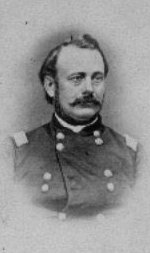
GENERAL: I have the honor to report to you, as commander of the Second Division of the Army of the Ohio, the
part taken by my brigade in the battle at this place on the 7th instant. After a very arduous march on Sunday, the 6th instant
during much of which I was forced to take fields and woods adjacent to the highway, from the narrowness of the latter and
its being filled with wagon trains and artillery and for me at that time impassable, we reached Savannah after dark. Under
your orders and superintendence we at once embarked on steamboats for this place. We reached the Landing here at daylight
and soon reported to you as ready for action. Under your order, and accompanied by you we marched out on the field of the day
before, a little after 6 o'clock a.m. Soon after, General Buell came up and directed you to deploy and form a line of battle,
our left resting on General Crittendon's right and our right extending in the direction of General McClernand's division, and to send out
a company of skirmishers into the woods in front. This was done at once, Major King detailing Captain Haughey for that purpose.
Within a half an hour after this you looked over the ground and decided to take a position some 200 or 300 yards to the front, on
the crest of a piece of risiing ground. I moved up the brigade accordingly, taking the new position indicated. In this line
of battalion of the Fifteenth U. S. Infantry, Captain Swaine, and a battalion of the Sixteenth U. S. Infantry, Captain Townsend,
both under the command of Major King, were on the right; a battalion of the Nineteenth U. S. Infantry, Major Carpenter, on the left
of King; the First Ohio, Col. B. F. Smith, on Carpenter's left, and the Sixth Indiana, Colonel Crittendon, on the left flank,
while the Louisville Legion, Colonel Buckley, was held in reserve 150 paces in rear of the line. Thirty or fourty minutes after
this line was formed Captain Haughey's skirmishers were driven in, several of his men shot, and my command fiercely assailed by
the enemy. The attack lasted perhaps twenty minutes, when the enemy were driven off. In this contest Captain Acker, of the Sixteenth
U. S. Infantry, was instantly killed, and many others of my brigade killed and wounded. The enemy soon rallied and returned
to the attack more fiercely than before, but was met by a very rapid and well directed fire from the commands of Major King
and Carpenter and Colonel Smith, the Sixth Indiana being out of range on the left. This attack was also, after a severe contest,
repulsed and the enemy driven off, our loss being much more than before. We were ignorant of the ground in front occupied by
the enemy, as it was covered with timber and thick underegrowth, but were informed that it was more open than where
we were. I decided to advance my lines after this attack, and at once cautiously felt my way forward, but had not gone far when
I again encountered the enemy in heavy force, and again drove him off, after yet severer contest than any before. About
this time I received several messages, announcing thath the United States forces to our right and front, after very hard fighting,
which we had heard all the morning, were giving way, leaving the center of the army exposed. I at once decided to move forward
the whole brigade to the open ground, except the Sixth Indiana, hich held a most important position on our left flank, which position the
enemy had menaced in strong force for several hours. I ordered Colonel Buckley, with the Louisville Legion, to move up to the
right and front and engage the enemy, who had rallied all his available forces and was moving down upon us. At the same
time Majors King and Carpenter and Colonel Smith were ordered to advance in line with Colonel Buckley. The advance was admirably
made, and with alacrity the brigade, steadily, briskly, and in excellant order, moved forward. We advanced about 200 yards
to the front, when we came in collision with the enemy. He was stronger at this point than either of the previous encounters.
I afterwards learned from wounded prisoners that the force at this time oipposed to us consisted of the Third, Fourth, Fifth,
and Sixth Kentucky Regiments, and several others from various States. The fire of musketry was the heaviest I ever heard.
My line when fired on halted of itself and went work. The issue was important, as my brigade was directly in the road of
the enemy to the Landing, and they were evidently pressing for that point. I was more fully impressed with the importance
of driving the enemy from this position by your words to me when you ordered a change to the front of your original line of
battle, which were, in substance, that my position was in the center, and must be held at every hazard, and that you would
support me with the balance of your divisionas it arrived on the field. This flight lasted about forty minutes, when the enemy gace way
and were at once pursued by the whole line up to the open ground in front, my brigade capturing several cannon, retaking
a battery of ours captured by the enemy the previous day, and retaking the headquarters of General McClernand. We also
took three flags from the enemy. At this time the 40 rounds of cartridges in the boxes of the men were exhausted and the
line was halted. Before I resolved to advance my whole brigade to the front I looked for the promised support, and found
Colonel Kirk, with his brigade, in my rear, within short supporting distance. He told me he was there by your order to
support me, and was ready for anything. He and his men were eager to move up with me. I requested that he would follow
at the proper distance, which he did. After we had exhausted our ammunition I called on Colonel Kirk, who was immediately
in rear of my lines, and informed him of that fact. He at once gallantly and eagerly offered to take my position in front, and did so
a portion of my command on the right passing quietly through his lines and halting in his rear. All was done without the least
confusion or even excitement. I told him that if needed before we received ammunition we would support him with the bayonet.
The part taken in the fight by Colonel Kirk and Colonel Gibson and their repective brigades after this, and also the part taken
by Colonel Willich, I leave them to narrate, with the single remark that they and their officers and men behaved gallantly.
About this time a battery of two or three guns - I do not know whose it was - took position about the center of my lines
and opened on the enemy in front, then forming for attack. This battery I directed Majors King and Carpenter and the Sixth
Indianain its old position had been exposed to heavy cannonading on our left and front and had lost several men in killed and wounded,
and I had ordered it back into the woods. The enemy soon after advanced in strong force and menaced the battery, and its
commander withdrew it; but the support just named stood firm against several times their number and gallantly beat off the enemy.
In the mean while a supply of ammunition for the whole command was received. When thus repulsed the enemy fell back and
his retreat began, soon after which I saw two regiments of Government troops advancing in double-quick time across the
open fields in our front, and saw that one of them was the First Ohio, which had been moved to our left to wait for ammunition.
I galloped to the regiment and ordered it to halt, as I had not ordered the movement, but was informed that it was advancing
by order of General Grant, whom I then saw in the rear of the line, with his staff. I ordered the regiment to advance with the other,
which it did some 200 or 300 yards farther, when it was halted, and a fire was opened upon it from one of our camps, then occupied
by the enemy. The fire was instantly returned, and the enemy soon fled, after wounding 8 men of the First Ohio.This closed the
fighting of the day, and a small body of cavalry was sent in pursuit of the enemy. I need not say to you, sir, that my brigade, officers,
and men, behaved well; for you were an eye-witness to the gallant conduct of them all, and you will join me in expressing
the opinion that men have seldom marched into battle under more unfavorable auspices and never bore themselves more gallantly.
During the whole of the long and terrific battle neither officer nor man wavered fo rone moment. When all behaved so well
there is little room for discriminative commendation of any. Many of them had been exposed, after great fatigue, to a heavy
rain the night before on the steamboats, and all of them were necessarily greatly crowded, so that they could not sleep, and
as they marched from the boats they passed through and among the ten thousand fugitives from the fight of the day before,
who lined the banls of the river and filled the woods adjacent to the landing, and directly on the way to our position on the field,
lay hundreds of dead men, mostly our own, whose mangled bodies and distorted features presented a horrible sight. Numerous dead
horses and our partially-sacked camps gave evidence of the havoc, and, which was far worse, of the reverses and disasters of the
day before. All around them impressed them with the belief that they must fight the battle for themselves. It must not be
forgotten that we fought this battle some miles within the lines of the encampment of General Grant's army and in the camps
occupied by his troops, and it was thereby rendered apparent to the most ignorant soldier that the army had been driven
in by the enemy till within a few hundred yards of the river and that the work before us was by no means easy. Under all
these unfavorable circumstances you will recollect, sir, the men were in no way appalled, but formed line of battle promptly
and with great coolness and percision. To Majs. J. H. King and S. D. Carpenter, of the Regular Army, who commanded the
regular troops in my brigade, I am especially indebted for the valuable aid which their long experienced as soldiers enabled
them to render. Capts. P. T. Swaine and E. F. Townsend, commanding battalions under Major King, and Col. B. F. Smith, First
Ohio Volunteers, a captain in the regular service, were likewise conspicuous for good conduct. I strongly recommend these officers
to the proper authorities as soldiers by profession, who have shown themselves amply fit for higher offices of usefulness. I
also return my thanks to Cols. T. T. Crittendon and H. M. Buckley; Lieut. Cols. E. A. Parrot, W. W. Berry, and Hiram Prather, and
Majs. E, B, Langdon, J. L. Treanor, and A. H. Abbott for their coolness and gallantry. Lieutenant-Colonel Parrott was on detached
service at the time, but joined his regiment during the action, and remained with it to the close. I also acknowledge my great
obligations to Lieutenants Armstrong and Rousseau, my regular aides; to E. F. Jewett, esq., of Ohio, volunteer aide; to Lieut. John W. Wickliffe,
of the Second Kentucky Cavalry, acting aide, and to Capt. W. M. Carpenter, brigade quartermaster, during the battle, for valuable
services in the field. It is due to Colonel Oliver, officers, and men of the Fifteenth Michigan that I say he joined us early in the
morning with about 230 officers and men of his regiment, and behaved well during the day of the battle. Accompanying this
report you have alist of casualties incident to the battle, and also the reports of the various commanders of battalions and
regiments of the brigade.
I am, general, very respectfully, your obedient servant,
Lovell H. Rousseau,
Brigadier-General.