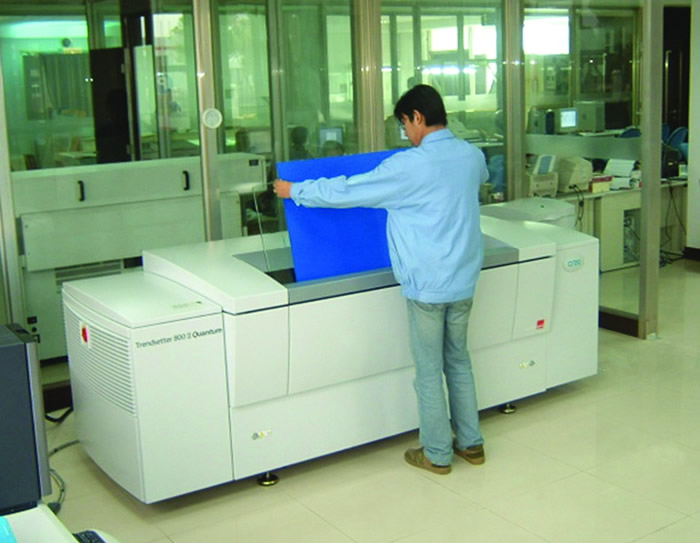
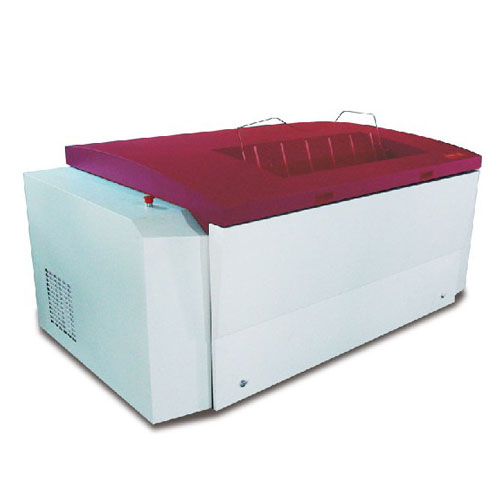
Computer-to-plate (CTP) or direct-to-plate (DTP) is a newer technology that allows the imaging of metal or polyester plates without the use of film. Eliminating the stripping, compositing, and traditional plate making processes, CTP revolutionized the printing industry and led to reduced prepress times, lower costs of labor, and improved print quality.
Most CTP systems used thermal CTP as opposed to violet CTP, though both systems are effective, depending on the needs of the printing job. Thermal CTP does have the advantage of extremely high quality, but violet CTP does cost significantly less. Thermal plates are generally used for longer runs, while violet CTP is employed for shorter runs, and popular with two-up and four-up applications.
Thermal CTP has the added bonus of utilizing binary exposure, which limits the risk of under or overexposure, and makes it possible to work under yellow light.
Thermal CTP involves the use of thermal lasers to expose and/or remove areas of coating while the plate is being imaged. This depends on whether the plate is negative, or positive working. These lasers are generally at a wavelength of 830 nanometers, but vary in their energy usage depending on whether they are used to expose or ablate material. Violet CTP lasers have a much lower wavelength, 405–410 nanometers. Violet CTP is “based on emulsion tuned to visible light exposure. The general trend of platesetters has been to move toward coatings whose success on press is independent of post imaging chemical bath processing.
Another process is CTCP (computer to conventional plate) system where you can use conventional offset ps plates to expose, which is very economical.
Offset lithography is one of the most common ways of creating printed matter. A few of its common applications include: newspapers, magazines, brochures, stationery, and books.
Many modern offset presses use computer to plate systems as opposed to the older computer to film workflows, which further increases their quality.
|