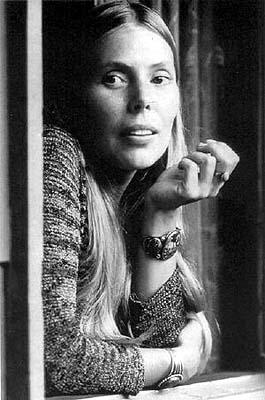
 Born
Roberta Joan Anderson, 7 November 1943, Fort McLeod, Alberta, Canada.
After studying art in Calgary, this singer-songwriter moved to Toronto
in 1964, where she married Chuck Mitchell in 1965. The two performed together
at coffee houses and folk clubs, playing several Mitchell originals including
"The Circle Game". The latter was a response to Canadian Neil Young who
had recently written "Sugar Mountain", a paean to lost innocence, which
Mitchell herself included in her sets during this period. While in Detroit,
the Mitchells met folk singer Tom Rush, who unsuccessfully attempted to
persuade Judy Collins to cover Mitchell's "Urge For Going". He later recorded
the song himself, along with the title track of his next album, The Circle
Game. The previously reluctant Collins also brought Mitchell's name to
prominence by covering "Michael From Mountains" and "Both Sides Now" on
her 1967 album Wildflowers.
Born
Roberta Joan Anderson, 7 November 1943, Fort McLeod, Alberta, Canada.
After studying art in Calgary, this singer-songwriter moved to Toronto
in 1964, where she married Chuck Mitchell in 1965. The two performed together
at coffee houses and folk clubs, playing several Mitchell originals including
"The Circle Game". The latter was a response to Canadian Neil Young who
had recently written "Sugar Mountain", a paean to lost innocence, which
Mitchell herself included in her sets during this period. While in Detroit,
the Mitchells met folk singer Tom Rush, who unsuccessfully attempted to
persuade Judy Collins to cover Mitchell's "Urge For Going". He later recorded
the song himself, along with the title track of his next album, The Circle
Game. The previously reluctant Collins also brought Mitchell's name to
prominence by covering "Michael From Mountains" and "Both Sides Now" on
her 1967 album Wildflowers.
Following her divorce in 1967, Mitchell moved to New York and for a time planned a career in design and clothing, selling Art Nouveau work. Her success on the New York folk circuit paid her bills, however, and she became known as a strong songwriter and engaging live performer, backed only by her acoustic guitar and dulcimer. At this time the astute producer Joe Boyd took her to England, where she played some low-key venues. On her return she appeared at the Gaslight South folk club in Coconut Grove, Florida. Her trip produced several songs, including the comical tribute to "London Bridge", based on the traditional nursery rhyme. The song included such lines as "London Bridge is falling up/Save the tea leaves in my cup . . ." Other early material included the plaintive "Eastern Rain", "Just Like Me" and "Brandy Eyes", which displayed Mitchell's love of sharp description and internal rhyme.Mitchell was initially discovered by budding manager Elliot Roberts at New York's Cafe Au Go-Go, and shortly afterwards in Coconut Grove by former Byrds member, David Crosby. She and Crosby became lovers, and he went on to produce her startling debut album Joni Mitchell aka Song To A Seagull. Divided into two sections, "I Came To The City" and "Out Of The City And Down To The Seaside", the work showed an early folk influence that was equally strong on the 1969 follow-up Clouds, which featured several songs joyously proclaiming the possibilities offered by life, as well as its melancholic side. "Chelsea Morning" presented a feeling of wonder in its almost childlike appreciation of everyday observations. The title of the album was borrowed from a line in "Both Sides Now", which had since become a massive worldwide hit for Judy Collins. The chorus ("It's love's illusions I recall/I really don't know love at all") became something of a statement of policy from Mitchell, whose analyses of love - real or illusory - dominated her work. With Clouds, Mitchell paused for reflection, drawing material from her past ("Tin Angel", "Both Sides Now", "Chelsea Morning") and blending them with songs devoted to new-found perplexities. If "I Don't Know Where I Stand" recreates the tentative expectancy of an embryonic relationship, "The Gallery" chronicles its decline, with the artist as the injured party. The singer, however, was unsatisfied with the final collection, and later termed it her artistic nadir.
part from her skills as a writer, Mitchell was a fine singer and imaginative guitarist with a love of open tuning. Although some critics still chose to see her primarily as a songwriter rather than a vocalist, there were already signs of important development on her third album, Ladies Of The Canyon. Its title track, with visions of antique chintz and wampum beads, mirrored the era's innocent na‹vety, a feature also prevailing on "Willy", the gauche portrait of her relationship with singer Graham Nash. Mitchell is nonetheless aware of the period's fragility, and her rendition of "Woodstock" (which she never visited), a celebration of the hippie dream in the hands of Crosby, Stills, Nash And Young, becomes a eulogy herein. With piano now in evidence, the music sounded less sparse and the lyrics more ambitious. portraying the hippie audience as searchers for some lost Edenic bliss ("We are stardust, we are golden . . . and we've got to get ourselves back to the garden"). With "For Free" (later covered by the Byrds), Mitchell presented another one of her hobbyhorses - the clash between commercial acceptance and artistic integrity. Within the song, Mitchell contrasts her professional success with the uncomplicated pleasure that a street performer enjoys. The extent of Mitchell's commercial acceptance was demonstrated on the humorous "Big Yellow Taxi", a sardonic comment on the urban disregard for ecology. The single was a UK number 11 hit and was even more surprisingly covered by Bob Dylan.Following a sabbatical, Mitchell returned with her most introspective work to date, Blue. Less melodic than her previous albums, the arrangements were also more challenging and the material self-analytical to an almost alarming degree. Void of sentimentality, the work also saw her commenting on the American Dream in "California" ("That was a dream some of us had"). Austere and at times anti-romantic, Blue was an essential product of the singer-songwriter era. On Blue, the artist moved from a purely folk-based perspective to that of rock, as the piano, rather than guitar, became the natural outlet for her compositions. Stephen Stills (guitar/bass), James Taylor (guitar), "Sneaky" Pete Kleinow (pedal steel) and Russ Kunkel (drums) embellished material inspired by an extended sojourn travelling in Europe, and if its sense of loss and longing echoed previous works, a new maturity instilled a lasting resonance to the stellar inclusions,cal restraint was thrown off with For The Roses, in which elaborate horn and woodwind sections buoyed material on which personal themes mixed with third-person narratives. The dilemmas attached to fame and performing, first aired on "For Free", reappeared on the title song and "Blonde In The Bleachers" while "Woman Of Heart And Mind" charted the reasons for dispute within a relationship in hitherto unexplored depths. "You Turn Me On, I'm A Radio" gave Mitchell a US Top 30 entry, but a fifteen month gap ensued before Court And Spark appeared. Supported by the subtle, jazz-based LA Express, Mitchell offered a rich, luxuriant collection, marked by an increased sophistication and dazzling use of melody. The sweeping "Help Me" climbed to number 7 in the USA in 1974, bringing its creator a hitherto unparalleled commercial success. The emergence of Mitchell as a well-rounded rock artist was clearly underlined on Court And Spark with its familiar commentary on the trials and tribulations of stardom ("Free Man In Paris"). The strength of the album lay in the powerful arrangements courtesy of Tom Scott, and guitarist Robben Ford, plus Mitchell's own love of jazz rhythms, most notably on her amusing cover version of Annie Ross' "Twisted".
The
quality of Mitchell's live performances, which included stadium gigs during
1974, was captured on the live album Miles Of Aisles.In 1975, Mitchell
produced the startling The Hissing Of Summer Lawns, which not only displayed
her increasing interest in jazz, but also world music. Her most sophisticated
work to date, the album was less concerned with introspection than a more
generalized commentary on American mores. In "Harry's House", the obsessive
envy of personal possessions is described against a swirling musical backdrop
that captures an almost anomic feeling of derangement. The Burundi drummers
feature on "The Jungle Line" in which African primitivism is  juxtaposed
alongside the swimming pools of the Hollywood aristocracy. "Edith And
The Kingpin" offers a startling evocation of mutual dependency and the
complex nature of such a relationship ("His right hand holds Edith, his
left hand holds his right/what does that hand desire that he grips it
so tight?"). Finally, there was the exuberance of the opening "In Franc
"Carey", "River" and the desolate title track.Any lingering sense of musie
They Kiss On Main Street" and a return to the theme of "For Free" on "The
Boho Dance". The album deserved the highest acclaim, but was greeted with
a mixed reception on its release, which emphasized how difficult it was
for Mitchell to break free from her "acoustic folk singer" persona. The
Hissing Of Summer Lawns confirmed this new-found means of expression.
Bereft of an accustomed introspective tenor, its comments on suburban
values were surprising, yet were the natural accompaniment to an ever-growing
desire to expand stylistic perimeters. However, although Hejira was equally
adventurous, it was noticeably less ornate, echoing the stark simplicity
of early releases. The fretless bass of Jaco Pastorius wrought an ever-present
poignancy to a series of confessional compositions reflecting the aching
restlessness encapsulated in "Song For Sharon", an open letter to a childhood
friend. Though less melodic and textural than its predecessor, Hejira
was still a major work. The dark humour of "Coyote", the sharp observation
of "Amelia" and the lovingly cynical portrait of Furry Lewis, "Furry Sings
The Blues", were all memorable.The move into jazz territory continued
throughout 1978-79, first with the double album, Don Juan's Reckless Daughter,
and culminating in her collaboration with jazz player Charlie Mingus.
The latter was probably Mitchell's bravest work to date, although its
invention was not rewarded with sales and was greeted with suspicion by
the jazz community. On Mingus, she adapted several of the master musician's
best-known compositions. It was an admirable, but flawed, ambition, as
her often-reverential lyrics failed to convey the music's erstwhile sense
of spontaneity. "God Must Be A Boogie Man" and "The Wolf That Lives In
Lindsay", for which Mitchell wrote words and music, succeeded simply because
they were better matched.A live double album, Shadows And Light featured
Pat Metheny and Pastorius among the guest musicians. Mitchell signed a
long-term contract with Geffen Records and the first fruits of this deal
were revealed on Wild Things Run Fast in 1982; following this she married
bass player Larry Klein, and appeared to wind down her activities. A more
accessible work than her recent efforts, Wild Things Run Fast lacked the
depth and exploratory commitment of its predecessors. The opening song,
"Chinese Cafe", remains one of her finest compositions, blending nostalgia
with shattered hopes, but the remainder of the set was musically ill-focused,
relying on unadventurous, largely leaden arrangements. Its lighter moments
were well-chosen, however, particularly on the humorous reading of Leiber
And Stoller's "Baby, I Don't Care".The Thomas Dolby -produced Dog Eat
Dog was critically underrated and represented the best of her 80s work.
Despite such hi-tech trappings, the shape of the material remained constant
with "Impossible Dreamer" echoing the atmosphere of Court And Spark. Elsewhere,
"Good Friends", an up-tempo duet with Michael McDonald, and "Lucky Girl",
confirmed Mitchell's new-found satisfaction and contentment. Chalk Mark
In A Rain Storm continued in a similar vein, while including two notable
reworkings of popular tunes, "Cool Water", which also featured Willie
Nelson, and "Corrine Corrina", herein retitled "A Bird That Whistles".
Their appearance anticipated the change of perspective contained on Night
Ride Home, issued in 1991 following a three-year gap. Largely stripped
of contemporaneous clutter, this acoustic-based collection invoked the
intimacy of Hejira, thus allowing full rein to Mitchell's vocal and lyrical
flair. Its release coincided with the artist's avowed wish to pursue her
painting talents - exhibitions of her 80s canvases were held in London
and Edinburgh - leaving future musical directions, as always, open to
question.The creatively quiet decade that followed did little to detract
from her status, though many were pleased to witness her renaissance in
the 90s.
juxtaposed
alongside the swimming pools of the Hollywood aristocracy. "Edith And
The Kingpin" offers a startling evocation of mutual dependency and the
complex nature of such a relationship ("His right hand holds Edith, his
left hand holds his right/what does that hand desire that he grips it
so tight?"). Finally, there was the exuberance of the opening "In Franc
"Carey", "River" and the desolate title track.Any lingering sense of musie
They Kiss On Main Street" and a return to the theme of "For Free" on "The
Boho Dance". The album deserved the highest acclaim, but was greeted with
a mixed reception on its release, which emphasized how difficult it was
for Mitchell to break free from her "acoustic folk singer" persona. The
Hissing Of Summer Lawns confirmed this new-found means of expression.
Bereft of an accustomed introspective tenor, its comments on suburban
values were surprising, yet were the natural accompaniment to an ever-growing
desire to expand stylistic perimeters. However, although Hejira was equally
adventurous, it was noticeably less ornate, echoing the stark simplicity
of early releases. The fretless bass of Jaco Pastorius wrought an ever-present
poignancy to a series of confessional compositions reflecting the aching
restlessness encapsulated in "Song For Sharon", an open letter to a childhood
friend. Though less melodic and textural than its predecessor, Hejira
was still a major work. The dark humour of "Coyote", the sharp observation
of "Amelia" and the lovingly cynical portrait of Furry Lewis, "Furry Sings
The Blues", were all memorable.The move into jazz territory continued
throughout 1978-79, first with the double album, Don Juan's Reckless Daughter,
and culminating in her collaboration with jazz player Charlie Mingus.
The latter was probably Mitchell's bravest work to date, although its
invention was not rewarded with sales and was greeted with suspicion by
the jazz community. On Mingus, she adapted several of the master musician's
best-known compositions. It was an admirable, but flawed, ambition, as
her often-reverential lyrics failed to convey the music's erstwhile sense
of spontaneity. "God Must Be A Boogie Man" and "The Wolf That Lives In
Lindsay", for which Mitchell wrote words and music, succeeded simply because
they were better matched.A live double album, Shadows And Light featured
Pat Metheny and Pastorius among the guest musicians. Mitchell signed a
long-term contract with Geffen Records and the first fruits of this deal
were revealed on Wild Things Run Fast in 1982; following this she married
bass player Larry Klein, and appeared to wind down her activities. A more
accessible work than her recent efforts, Wild Things Run Fast lacked the
depth and exploratory commitment of its predecessors. The opening song,
"Chinese Cafe", remains one of her finest compositions, blending nostalgia
with shattered hopes, but the remainder of the set was musically ill-focused,
relying on unadventurous, largely leaden arrangements. Its lighter moments
were well-chosen, however, particularly on the humorous reading of Leiber
And Stoller's "Baby, I Don't Care".The Thomas Dolby -produced Dog Eat
Dog was critically underrated and represented the best of her 80s work.
Despite such hi-tech trappings, the shape of the material remained constant
with "Impossible Dreamer" echoing the atmosphere of Court And Spark. Elsewhere,
"Good Friends", an up-tempo duet with Michael McDonald, and "Lucky Girl",
confirmed Mitchell's new-found satisfaction and contentment. Chalk Mark
In A Rain Storm continued in a similar vein, while including two notable
reworkings of popular tunes, "Cool Water", which also featured Willie
Nelson, and "Corrine Corrina", herein retitled "A Bird That Whistles".
Their appearance anticipated the change of perspective contained on Night
Ride Home, issued in 1991 following a three-year gap. Largely stripped
of contemporaneous clutter, this acoustic-based collection invoked the
intimacy of Hejira, thus allowing full rein to Mitchell's vocal and lyrical
flair. Its release coincided with the artist's avowed wish to pursue her
painting talents - exhibitions of her 80s canvases were held in London
and Edinburgh - leaving future musical directions, as always, open to
question.The creatively quiet decade that followed did little to detract
from her status, though many were pleased to witness her renaissance in
the 90s.
Rumours abounded in the 90s that her addiction to cigarettes had caused
a serious throat ailment (her voice had become progressively lower and
huskier); although this was never confirmed she was told to quit smoking,
advice which she promptly ignored. After contributing a track, "If I Could",
to Seal's 1994 album, she embarked on her first live dates in 12 years
on a tour of Canada, before settling in to the studio once more to record
Turbulent Indigo with production support from ex-husband Larry Klein in
Los Angeles. Although it was not a major hit she won a Grammy in 1995
for Best Pop Album. Two contrasting compilations were released the following
year, chronicling the commercial and non-commercial sides of the artist's
ouevre. Mitchell subsequently returned to the studio to record Taming
The Tiger, a lush, textured album which echoed the sound of her mid-70s
work.Mitchell is one artist that deserves a detailed biography; while
we wait, Bill Ruhlmann's revealing 25,000 word interview for Goldmine
magazine will have to suffice. Still regarded as one of the finest singer-songwriters
of her generation, Mitchell has displayedmore artistic depth and lyrical
consistency than most of her illustrious contemporaries from the 70s.
Her remarkable body of work encompasses the changing emotions and concerns
of a generation: from idealism to adult responsibilities, while bearing
her soul on the traumas of already public relationships. That she does
so with insight and melodic flair accounts for a deserved longevity.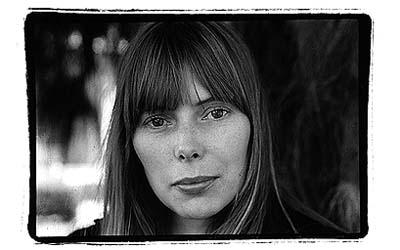
Discography
Joni Mitchell aka Song To A Seagull (Reprise 1968)
Clouds (Reprise 1969),
Ladies Of The Canyon (Reprise 1970),
Blue (Reprise 1971),
For The Roses (Asylum 1972),
Court And Spark (Asylum 1974),Miles Of Aisles (Asylum 1974),The Hissing Of Summer Lawns (Asylum 1975)
Hejira (Asylum 1976), Don Juan's Reckless Daughter (Asylum 1977),
Mingus (Asylum 1979), Shadows And Light (Asylum 1980),
Wild Things Run Fast (Geffen 1982), Dog Eat Dog (Geffen 1985),
Chalk Mark In A Rainstorm (Geffen 1988), Night Ride Home (Geffen 1991),
Turbulent Indigo (Warners 1994), Taming The Tiger (Warners 1998),
Both Sides Now (Reprise 2000). Compilations