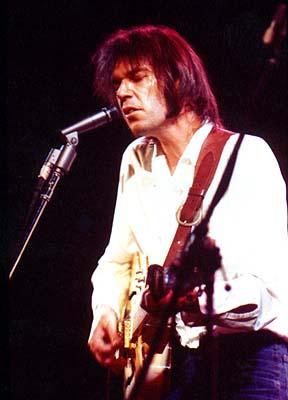
 Born.
12 November 1945, Toronto, Canada. Having moved to Winnipeg as a child,
Young began his enigmatic career as a member of several high-school bands,
including the Jades and Classics. He later joined the Squires, whose indebtedness
to the UK instrumental combo the Shadows was captured on Young's composition
"Aurora'/'The Sultan". In 1965, he embarked on a folk-based musical direction,
with appearances in Toronto's bohemian Yorkville enclave. A demonstration
tape from this era contains early versions of "Sugar Mountain", a paean
to lost childhood later placed on 10 different single releases, and "Don't
Pity Me", revived a decade later as "Don't Cry No Tears". Young then joined
the Mynah Birds, a pop-soul attraction that also featured Rick James,
but this act folded prematurely upon the latter's arrest for draft evasion.
Group bass player Bruce Palmer accompanied Young on a subsequent move
to California where they teamed with Stephen Stills and Richie Furay to
form the Buffalo Springfield.Young's tenure in this seminal "west coast"
act was tempered by several "sabbaticals", but two luxurious, atmospheric
compositions, "Broken Arrow" and "Expecting To Fly", established the highly
sculptured, orchestral-tinged sound prevalent on his debut solo record,
1969's Neil Young. Although originally blighted by a selfless mix that
buried the artist's vocals, the album contained several excellent compositions,
notably "The Loner", "The Old Laughing Lady", "I've Been Waiting For You"
and "Here We Are In The Years". The set also featured two highly effective
instrumentals, Young's evocative "Emperor Of Wyoming" and "String Quartet
From Whiskey Boot Hill", a sublime arrangement and composition by Jack
Nitzsche. The closing track, "The Last Trip To Tulsa", was unique in Young's
canon, an overlong, surreal narrative whose performance betrayed the strong
influence of Bob Dylan.Following his first album, Young was joined by
Danny Whitten (guitar), Billy Talbot (bass) and Ralph Molina (drums) -
three former members of the Rockets - in a new backing group dubbed Crazy
Horse. The now-classic Everybody Knows This Is Nowhere captured a performer
liberated from a previous self-consciousness with the extended "Down By
The River" and "Cowgirl In The Sand", allowing space for his stutteringly
simple, yet enthralling, guitar style. While the epic guitar pieces dominated
the set, there were other highlights, including the zestful "Cinnamon
Girl" and the haunting "Running Dry (Requiem For The Rockets)", a mournful
song featuring Bobby Notkoff on violin. The album underlined the intense
relationship between Young and Crazy Horse.
Born.
12 November 1945, Toronto, Canada. Having moved to Winnipeg as a child,
Young began his enigmatic career as a member of several high-school bands,
including the Jades and Classics. He later joined the Squires, whose indebtedness
to the UK instrumental combo the Shadows was captured on Young's composition
"Aurora'/'The Sultan". In 1965, he embarked on a folk-based musical direction,
with appearances in Toronto's bohemian Yorkville enclave. A demonstration
tape from this era contains early versions of "Sugar Mountain", a paean
to lost childhood later placed on 10 different single releases, and "Don't
Pity Me", revived a decade later as "Don't Cry No Tears". Young then joined
the Mynah Birds, a pop-soul attraction that also featured Rick James,
but this act folded prematurely upon the latter's arrest for draft evasion.
Group bass player Bruce Palmer accompanied Young on a subsequent move
to California where they teamed with Stephen Stills and Richie Furay to
form the Buffalo Springfield.Young's tenure in this seminal "west coast"
act was tempered by several "sabbaticals", but two luxurious, atmospheric
compositions, "Broken Arrow" and "Expecting To Fly", established the highly
sculptured, orchestral-tinged sound prevalent on his debut solo record,
1969's Neil Young. Although originally blighted by a selfless mix that
buried the artist's vocals, the album contained several excellent compositions,
notably "The Loner", "The Old Laughing Lady", "I've Been Waiting For You"
and "Here We Are In The Years". The set also featured two highly effective
instrumentals, Young's evocative "Emperor Of Wyoming" and "String Quartet
From Whiskey Boot Hill", a sublime arrangement and composition by Jack
Nitzsche. The closing track, "The Last Trip To Tulsa", was unique in Young's
canon, an overlong, surreal narrative whose performance betrayed the strong
influence of Bob Dylan.Following his first album, Young was joined by
Danny Whitten (guitar), Billy Talbot (bass) and Ralph Molina (drums) -
three former members of the Rockets - in a new backing group dubbed Crazy
Horse. The now-classic Everybody Knows This Is Nowhere captured a performer
liberated from a previous self-consciousness with the extended "Down By
The River" and "Cowgirl In The Sand", allowing space for his stutteringly
simple, yet enthralling, guitar style. While the epic guitar pieces dominated
the set, there were other highlights, including the zestful "Cinnamon
Girl" and the haunting "Running Dry (Requiem For The Rockets)", a mournful
song featuring Bobby Notkoff on violin. The album underlined the intense
relationship between Young and Crazy Horse.
An attendant tour confirmed the strength of this new found partnership, while Young also secured acclaim as a member of Crosby, Stills, Nash And Young. His relationship with Crazy Horse soured as Whitten grew increasingly dependent on heroin and the group was dropped following the recording of After The Goldrush. The set provided a commercial breakthrough and included several of Young's best-known compositions, including the haunting title track, "Only Love Can Break Your Heart", a US Top 40 hit, and the fiery "Southern Man". The highly commercial Harvest confirmed this new found ascendancy and spawned a US chart-topper in "Heart Of Gold"; it remains his best-selling album. This commercial peak ended abruptly with Journey Through The Past, a highly indulgent soundtrack to a rarely screened autobiographical film. A disastrous tour with new backing group, the Stray Gators, exacerbated the gap between the artist and his potential audience, although Time Fades Away, a collection of new songs culled from the concerts, reclaimed the ragged feistiness of the Crazy Horse era. The set included the passionate "Last Dance" and the superb "Don't Be Denied", an unflinching autobiographical account of Young's early life in Canada.The deaths of Whitten and road crew member Bruce Berry inspired the harrowing Tonight's The Night, on which Young's bare-nerved emotions were expounded over his bleakest songs to date. "I"m singing this borrowed tune, I took from the Rolling Stones, alone in this empty room, too wasted to write my own', he intoned in world-weary fashion on "Borrowed Tune", while in-concert Young would offer multiple versions of the grief-stricken title song. However, the final set was rejected by the record company in favour of On The Beach, released to coincide with a Crosby, Stills, Nash And Young reunion tour. The work was initially greeted coolly and Rolling Stone described it as one of the "most despairing albums of the decade". In common with John Lennon's Plastic Ono Band, On The Beach saw Young stripping away his personality in a series of intense songs. The undoubted highlight of the set was the closing "Ambulance Blues", arguably one of the most accomplished works of Young's career. In analyzing his place in the rock music world, Young offered a sardonic riposte to his detractors: "So all you critics sit alone/You're no better than me for what you've shown/With your stomach pump and your hook and ladder dreams/We could get together for some scenes". The belatedly issued Tonight's The Night was no longer a shock, but testified to Young's absolute conviction. The album sold poorly but was retrospectively acclaimed as one of the bravest and most moving albums of the decade.
Young next chose to team up Crazy Horse again - Talbot, Molina and new guitarist Frank Sampedro - for Zuma. The set's highlight was provided by the guitar-strewn "Cortez The Killer" but, despite often ecstatic reviews, the overall performance was generally stronger than the material it supported. Another gripping recording, "Like A Hurricane", was the pivotal feature of American Stars 'N' Bars, an otherwise piecemeal collection drawn from extant masters and newer, country-oriented recordings. The latter direction was maintained on Comes A Time, Young's most accessible set since Harvest, on which Nicolette Larson acted as a female vocal foil. The album's use of acoustic settings enhanced Young's pastoral intentions and the singer was moved to include a rare cover version: Ian Tyson's folk standard, "Four Strong Winds". Characteristically, Young chose to follow this up by rejoining Crazy Horse for Rust Never Sleeps. The album rightly stands as one of Young's greatest and most consistent works. The acoustic "My My, Hey Hey (Out Of The Blue)" and its electric counterpart "Hey Hey, My My (Into The Black)" explained the central theme of the work - the transience of rock stardom. "The Thrasher", one of Young's most complex and rewarding songs, reiterated the motif. "Ride My Llama", "Pocahontas" and "Powderfinger' were all worthy additions to Young"s classic catalogue. The album was preceded by a Young movie of the same name and was followed by the double live album, Live Rust.During the 80s the artist became increasingly unpredictable as each new release rejected the musical directions suggested by its predecessor. The understated and underrated Hawks And Doves was followed by excursions through electric R&B ( Re-Ac-Tor ), electro-pop ( Trans ) and rockabilly ( Everybody's Rockin' ), before embracing ol' timey country ( Old Ways ), hard rock ( Landing On Water ) and R&B ( This Note's For You ). The last-named achieved notoriety when a video for the title song, which attacked the intertwining of rock with corporate sponsorship, was banned by MTV. The R&B experiment using brass (Neil And The Blue Notes) also saw Young regain some critical acclaim. Young's next project was culled from an aborted release, tentatively entitled Times Square. Eldorado invoked the raw abandonment of Tonight's The Night, but the five-song set was only issued in Japan and Australia. Three of its songs were latterly placed on Freedom, an artistic and commercial triumph which garnered positive reviews and assuaged those viewing its creator as merely eccentric. The set was generally acclaimed as Young's finest work in a decade and included some of his most intriguing lyrics, most notably the lengthy "Crime In The City", itself an extract from an even longer piece, "Sixty To Zero". Young affirmed this regeneration with Ragged Glory, a collaboration with Crazy Horse marked by blistering guitar lines, snarled lyrics and a sense of urgency and excitement few from his generation could hope to muster. Contemporary new wave band Sonic Youth supported the revitalized partnership on the US Spook The Horse tour, cementing Young's affection for pioneers.An ensuing in-concert set, Weld (accompanied by an album of feedback experimentation, Arc ), was rightly applauded as another milestone in Young's often contrary oeuvre.
Following this, Young informed the media that he was making a return to a Harvest -type album, and the result was, for many, another one of his best albums. Harvest Moon captured the essence of what is now rightly seen as a great 70s album ( Harvest ) and yet it sounded perfect for the 90s. "From Hank To Hendrix" and the title track are but two in a collection of Young songs destined to become classics. As if this was not enough, less than a year later he produced Unplugged, which was a confident live set recorded for MTV. Sleeps With Angels mixed some of his dirtiest guitar with some frail and winsome offerings. His ability to juxtapose contrasting styles is extraordinary: "Piece Of Crap" finds Young in punkish and vitriolic form, whilst the gentle "My Heart" would not be out of place in a school church hall. In similar mood was his ethereal "Philadelphia", perfectly suited for the movie Philadelphia, for which it was composed.A collaboration with Pearl Jam produced a good album in 1995, on which once again Young thrilled, excited, baffled and amazed. Mirror Ball was a gripping rock album that bought him many new (younger) fans, although older devotees were by now wanting something special and were tired of the dirty grunge. Dead Man was a challenging and rambling guitar soundtrack to a Jim Jamursch movie, and neither a commercial nor a listenable excursion. Broken Arrow received a less than positive reception from the critics, although many newer fans saw little difference in quality from recent efforts, except for the dreadfully ramshackle bar-room version of Jimmy Reed's "Baby, What You Want Me To Do". The Year Of The Horse was yet another live album, tolerated by his fans but leaving a genuine appetite for some new material. In 1999, Young reunited with his CSN colleagues for a lucrative tour and an album. The lacklustre contributions he made to their album spilled over to Silver & Gold. Reception was mixed, but generally it was seen as a dull and at times ("Buffalo Springfield Again") downright corny set.Even with a less than perfect discography in recent years, at the time of writing Young's artistic standing remains at an all-time high. However, he retains the right to surprise, infuriate, and even baffle, while his reluctance to court easy popularity must be applauded. More than any other artist working in the rock field over the past 30 years, Young is the great chameleon. His many admirers never know what to expect, but the reaction whenever a new project or direction arrives is almost universally favourable from all quarters. He transcends generations and manages to stay hip and in touch with laconic ease, indifference and worldly style. In appraising grunge let it be said that it was Young who first wore check workshirts outside torn jeans, and played blistering distorted guitar (with Crazy Horse). And he did it all more than 30 years ago..
NEIL YOUNG ALBUMS
Neil Young
(Reprise 1969), Everybody Knows This Is Nowhere (Reprise 1969), After The
Goldrush (Reprise 1970), Harvest (Reprise 1972), Journey Through The Past
film soundtrack (Reprise 1972), Time Fades Away (Reprise 1973), On The
Beach (Reprise 1974), Tonight's The Night (Reprise 1975), Zuma (Reprise
1975), American Stars 'N' Bars (Reprise 1977), Comes A Time (Reprise 1978),
Rust Never Sleeps (Reprise 1979) Live Rust (Reprise 1979), Hawks And Doves
(Reprise 1980), Re-Ac-Tor (Reprise 1981), Trans (Geffen 1983), Everybody's
Rockin' (Geffen 1983), Old Ways (Geffen 1985), Landing On Water (Geffen
1986), Life (Geffen 1987), This Note's For You (Reprise 1988), Eldorado
mini-album (Reprise 1989), Freedom (Reprise 1989), Ragged Glory (Reprise
1990), Weld (Reprise 1991), Arc/Weld (Reprise 1991), Harvest Moon (Reprise
1992), Unplugged (Reprise 1993), Sleeps With Angels (Reprise 1994), Mirror
Ball (Reprise 1995), Dead Man film soundtrack (Vapor 1996), Broken Arrow
(Reprise/Vapor 1996), The Year Of The Horse (Reprise 1997), Silver & Gold
(Reprise 2000), Road Rock V. 1 (Reprise 2000). Compilations Decade (Reprise
1977), Greatest Hits (Reprise 1985), Lucky Thirteen (Geffen 1992).
The
Goldrush (Reprise 1970), Harvest (Reprise 1972), Journey Through The Past
film soundtrack (Reprise 1972), Time Fades Away (Reprise 1973), On The
Beach (Reprise 1974), Tonight's The Night (Reprise 1975), Zuma (Reprise
1975), American Stars 'N' Bars (Reprise 1977), Comes A Time (Reprise 1978),
Rust Never Sleeps (Reprise 1979) Live Rust (Reprise 1979), Hawks And Doves
(Reprise 1980), Re-Ac-Tor (Reprise 1981), Trans (Geffen 1983), Everybody's
Rockin' (Geffen 1983), Old Ways (Geffen 1985), Landing On Water (Geffen
1986), Life (Geffen 1987), This Note's For You (Reprise 1988), Eldorado
mini-album (Reprise 1989), Freedom (Reprise 1989), Ragged Glory (Reprise
1990), Weld (Reprise 1991), Arc/Weld (Reprise 1991), Harvest Moon (Reprise
1992), Unplugged (Reprise 1993), Sleeps With Angels (Reprise 1994), Mirror
Ball (Reprise 1995), Dead Man film soundtrack (Vapor 1996), Broken Arrow
(Reprise/Vapor 1996), The Year Of The Horse (Reprise 1997), Silver & Gold
(Reprise 2000), Road Rock V. 1 (Reprise 2000). Compilations Decade (Reprise
1977), Greatest Hits (Reprise 1985), Lucky Thirteen (Geffen 1992).