 James
Douglas Morrison was born on December 8, 1943, in Melbourne, Florida.
His father was a rear admiral in the U.S. Navy, and the family thus
moved around a great deal. A strict authoritarian, Morrison's father
was probably a major source of the outlandish rebellion that his son
later acted out on stage; when Morrison began his climb to stardom,
he would falsely claim that both of his parents were dead. After attending
St. Petersburg Junior College and Florida State University for a year
apiece, Morrison moved to the West Coast to study film and theater
at UCLA in 1964. He became infatuated with the poetry of William Blake
and the writings of philosopher Friedrich Nietzsche, and he gradually
drifted away from school to work on his poetry and experiment with
drugs, particularly LSD. In 1965, Morrison so greatly impressed film-school
classmate Ray Manzarek (a classically trained keyboardist and member
of a local blues band) with his early attempts at lyric writing that
the two decided to form a band. Robbie Krieger and John Densmore were
soon recruited from the Psychedelic Rangers, and the Doors were born;
the name was Morrison's idea, taken from The Doors of Perception,
Aldous Huxley's book on mescaline, and its introductory William Blake
quote. Morrison was a tentative frontman at first, avoiding eye contact
with the audience and sometimes even singing with his back to them,
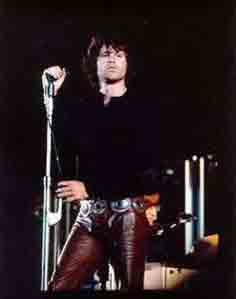
but he soon came out of his shell, flinging his mike stand around
and using it as a phallic symbol.
James
Douglas Morrison was born on December 8, 1943, in Melbourne, Florida.
His father was a rear admiral in the U.S. Navy, and the family thus
moved around a great deal. A strict authoritarian, Morrison's father
was probably a major source of the outlandish rebellion that his son
later acted out on stage; when Morrison began his climb to stardom,
he would falsely claim that both of his parents were dead. After attending
St. Petersburg Junior College and Florida State University for a year
apiece, Morrison moved to the West Coast to study film and theater
at UCLA in 1964. He became infatuated with the poetry of William Blake
and the writings of philosopher Friedrich Nietzsche, and he gradually
drifted away from school to work on his poetry and experiment with
drugs, particularly LSD. In 1965, Morrison so greatly impressed film-school
classmate Ray Manzarek (a classically trained keyboardist and member
of a local blues band) with his early attempts at lyric writing that
the two decided to form a band. Robbie Krieger and John Densmore were
soon recruited from the Psychedelic Rangers, and the Doors were born;
the name was Morrison's idea, taken from The Doors of Perception,
Aldous Huxley's book on mescaline, and its introductory William Blake
quote. Morrison was a tentative frontman at first, avoiding eye contact
with the audience and sometimes even singing with his back to them,
but he soon came out of his shell, flinging his mike stand around
and using it as a phallic symbol.
 As
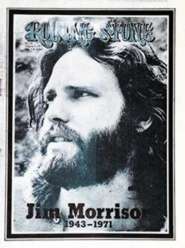
the lead singer and lyricist for the Doors, Jim Morrison is one of
the most legendary and influential figures in rock & roll history.
The disturbing, image-rich poeticism of Morrison's lyrics, perAfectly
supported by the Doors' swirling, eclectic psychedelic rock, have
assured him continuing icon status, while his fondness for theatrical
shock tactics and nihilistic angst have influenced countless imitators.
Unlike other psychedelic artists, who tended to favor whimsy or mysticism,
Morrison saw expansion of consciousness as a way of gaining access
to the subconscious mind's dark, unacknowledged desires; his rampaging
id dominated his songs with a lust for violence, sex, alcohol, drugs,
self-destruction, anything forbidden for any reason by the authority
of conservative middle America, and he tried to live out that lifestyle
as best he could. Some of Morrison's work has been criticized -- both
during his lifetime and afterwards -- as too melodramatic and calculatedly
outrageous, but even at his most frustrating, Morrison's ideas have
achieved a lasting resonance with newer generations as well as his
initial fans, and his best material remains some of the most original
and visionary rock music ever recorded.
As
the lead singer and lyricist for the Doors, Jim Morrison is one of
the most legendary and influential figures in rock & roll history.
The disturbing, image-rich poeticism of Morrison's lyrics, perAfectly
supported by the Doors' swirling, eclectic psychedelic rock, have
assured him continuing icon status, while his fondness for theatrical
shock tactics and nihilistic angst have influenced countless imitators.
Unlike other psychedelic artists, who tended to favor whimsy or mysticism,
Morrison saw expansion of consciousness as a way of gaining access
to the subconscious mind's dark, unacknowledged desires; his rampaging
id dominated his songs with a lust for violence, sex, alcohol, drugs,
self-destruction, anything forbidden for any reason by the authority
of conservative middle America, and he tried to live out that lifestyle
as best he could. Some of Morrison's work has been criticized -- both
during his lifetime and afterwards -- as too melodramatic and calculatedly
outrageous, but even at his most frustrating, Morrison's ideas have
achieved a lasting resonance with newer generations as well as his
initial fans, and his best material remains some of the most original
and visionary rock music ever recorded.
As the Doors
rose to stardom with their 1967 debut and struggled to maintain that
status, Morrison's ever-increasing withdrawal and simultaneous indulgence
in hedonistic excess threatened the band's stability. He destroyed
some of the band's studio equipment in a drunken outburst of temper,
and he designed his ever more erratic concert behavior -- miming sex,
barrages of profanity, and similar antics -- to provoke intense, frenzied
audience reactions. This did not go unnoticed by law enforcement officials
in the locales where Morrison performed; he was maced by police in
New Haven, Connecticut who caught him backstage with a female fan,
and after taking the stage and baiting the officers, he was arrested
on obscenity charges, of which he was later acquitted. Venues in Phoenix
and Long Island subsequently banned the Doors after Morrison allegedly
incited audience riots; the whole mess finally boiled over in March
1969, when Morrison exposed himself to an audience in Miami and was
arrested for displaying "lewd and lascivious behavior." 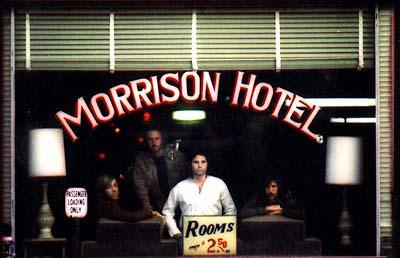
After
a two-month trial, he was found guilty, depleting the band financially
and mentally and nearly causing their breakup.
The
Doors retreated to the studio, where they sounded musically rejuvenated
on the hard-rocking Morrison Hotel (1970) and L.A. Woman (1971). Supporting
tours were marked by continued police harassment, and afterwards,
a depressed Morrison left the country with his wife Pamela, eventually
settling in Paris to unwind and write poetry (he had had his first
collection of poems, The Lord and the Creatures, published in 1970).
But without the support of his bandmates, Morrison spiraled irrevocably
out of control, and he was found dead in his bathtub on July 3, 1971,
the victim of an apparent heart attack. He was only 27 years old.
Morrison was buried in the Poets' Corner of Pere Lachaise Cemetery
in Paris, an area shared by Balzac, Moliere, and Oscar Wilde. Live
recordings, greatest-hits collections, and recordings and books of
Morrison's poetry have appeared frequently in the years since, and
his legend has only grown with the passing of time. -
Back
to Music Index