 |
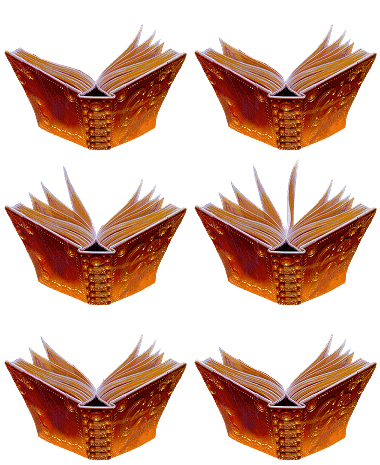
| Book Of Shadows A Book Of Shadows is a witch's best friend. Often refered to as B.O.S., it contains invocations, ritual patterns, spells, runes, rules governing magick, and so on. It is a constant work in progress as the witch is constantly adding to it. Each sect of witchcraft has it's own Book Of Shadow's. There is no one perfect book that has been handed down from antiquity. To start your own B.O.S. you will need a book you can add pages to with blank pages to write on in it. These can be purchased at almost any book store, or you can use a three-ring binder. |
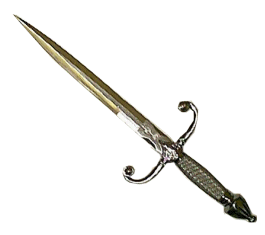 |
| Athame Phallic tool - associated with male energy/ God Energy A cleansed and consecrated ceremonial knife used in ritual work by Witches. The knife is never used for blood-letting, and rarely used for cutting anything on the material plane. It is used for commanding, and manipulating power. The blade is usually double edged and dull as it does not actually cut anything on the physical plane. It direct's energy in a dimension where real knives are useless. Most Athame's are black handled, this depends on the Witch's preference. The Athame and the Wand are basically interchangeable. The Athame stands for Intellect, Right Thinking, and Calculation. |
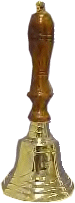 |
| Bell The bell is a ritual instrument of incredible antiquity. Ringing a bell unleashes vibrations which have powerful effects according to it's volume, tone, and material of construction. Bells are a feminine symbol, and is often used to invoke the Goddess. It is also rung to ward off evil spirits and spells, to halt storms. Bells are also hung in homes to guard them. |
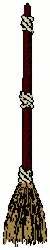
| Besom There are many uses for a witch's broom, or besom, these include decoration, magick, and ritual. It is used to sweep the ritual area clean of negativity. The besom is basically the symbol for a female Witch and it represents her vehicle for traveling into dreamtime. Often a name is given to the besom, because a besom can be used to temporarily house a particuliar spirit or entity. It is a marvelous instrument of protection to be hung on the front of back entrance's to your house. Besom's are laid at the gateway to a coven circle, used to send a message to friends via astral travel, and set outside with specific instructions to make friends with your local fairy folk. Should a mist surround your besom, you will know your message has been received. These make excellent gifts for the Hidden Children. Other names for this include, Bossume, Bossom. |
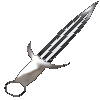 |
| Bolline A curved, usually white-handled knife used for practical magickal purposes such as cutting. For instance, the knife can be used to harvest herbs, cut a branch for a wand, inscribe candles, etc. It's use is purely for magickal workings. |
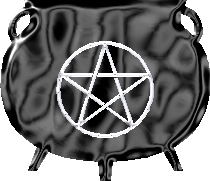 |
| The Cauldron The cauldron is a symbol of the Goddess and the womb, the container in which transformation takes place. Our ancestors believed that cauldrons had regenerative properties that would revive anything thrown into them, as in the case of warriors who could be brought back to life and full fighting power by immersion. And they saw the earth as a container in which the dead were laid in a fetal postition, like a child in the womb. They often surrounded the body with flowers and painted it with red ochre, a symbol of life giving blood. The transformative image of the cauldron offers us hope and fills us with anticipation that our souls seek new bodies and new life after the cessation of the old; that we renew in the womb of the Goddess. Cauldrons produced by Celtic ironworkers in 500 BC and earlier still exist. The Gundestrap cauldron, with its seated Cernunnos (a god of the forest) and his snakes, is a famous example. The Celtic and pre-Celtic cauldron imagery eventually evolved into the Arthurian cauldron, and later it was Christianized in the Grail legends, wherein the life-affirming properties in the cup could heal the land or bring the soul to redemption. Such a hold does this imagery of gestation, nurturing, and healing have on our collective psyche that similiar legends abound throughout stories and folklore, emerging in paintings, novels, and film. In the myth of Taliesin, for example, Ceridwen boils a potion for a year and a day to produce a magical elixir intended to transform her ugly son Avagaddu into someone who will be admitted among men of noble birth. But Gwoin Bach accidentally ingests the elixir when Morda, the blind man, upsets the cauldron. Gwoin Bach acquires the special powers intended for Avagaddu, and an angry Ceridwen chases after him until, finally, she catches and eats him. He is born again nine months later as Taliesin. Within witchcraft and Wicca the cauldron serves us as both a sacred vessel and a practical container that can be utilized withing ritual. A cast-iron cauldron is the most fireproof container, but even so, the legs should rest on fireproof tiles, or a large piece of slate. Some people choose to place the cauldron, containing a lit candle, in the center of a cast circle to represent the Goddess. When it is not possible or practical to have an outside bonfire, you can place a lit candle in a cauldron to represent the bonfire on Beltane or other festivals when the fire in traditionally leapt. Our group also places fruit, flowers, corn, greenery, or earth in teh cauldron. Poppies and wheat look sensational at Lammas: holly, ivy, and mistletoe are wonderful at Yule; roses at Midsummer; snowdrops and floating candles in water at Imbolc; and apples are good at Samhain. The cauldron's dark interior is the ideal container for water when you want to practice scrying. You can gaze into the flame of a candle floating upon the water, or you can put a silver coin in the bottom to give the eye a focal point while the mind disengages and becomes open. Other sources are Oriental shops, which often have copper or bronze containers with a cauldron-like shape; or garden centers and hardware stores, which will often sell metal cauldrons to contain logs or plants. While these are typically of flimsier construction than their iron counterparts, the shape is authentic. The cauldron is one of the best known symbols of the modern Craft. It is a profound metaphor for the creation of life itself. It's also a visual chiche' that evokes the image of Witches of old. In the very deepest sense, the cauldron represents the circle of life that contains and protects us all as it renews the seasons in nature and each phase within our lives. And in the end, the cauldron receives us when our present term on Earth has ended, cradling us once more until we are ready for rebirth. Elen Hawke |
 |
| Censer The censer is an incense burner. It can be fancy made out of metal on chains, or it can be a simple seashell. You can use a bowl filled with sand or salt. The sand and salt will absorb the heat from the charcoal disk and the incense, you can also use it to stand incense sticks in. |
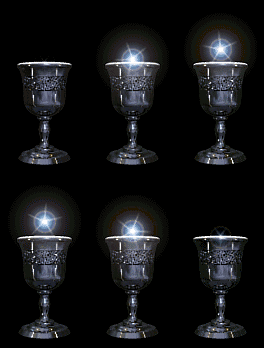 |
| Chalice The chalice is simply a cauldron on a stem. It symbolizes the Goddess and fertility, and is related to the element of water. The chalice can be made of any substance. It is used to hold water or drink for your rites. |
 |
| Crystal Ball The crystal ball is used as a divination tool used for scrying. It may be used to receive messages from the Gods, or to store raised energy. You can use it to call up images of the Goddess, or past lives. It is a magickal object touched by the divine, if you find one guard it carefully. In ritual it is placed on the altar to represent the Goddess. It may also be the centerpiece for full moon rituals. Periodic exposure to moonlight, or rubbing it with fresh mugwort, will increase it's ability. The Crystal Ball by Sibyl Ferguson ISBN 0-87728-483-0 |
 |
| Pentacle The pentacle has been used in magick for a millenia. It is borrowed from ceremonial magick. It is a symbol of protection, or a tool used to invoke spirits. It is sometimes used to summon the Goddess and God. The circle around the star represents love. Each point on the star represents an element: earth, air, fire and water. The point at the top represents Spirit. |
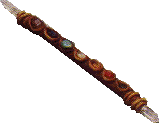 |
| Wand Wand's are a way to project your energy to a certain place, thing, person or dimension. Wand's made from wood should be taken from native trees in your area. You will need to research the magickal properties of these trees. We us native trees so that they will be in tune with the land forces around you. Energy patterns differ from place to place, and taking the wand from your local area with work in harmony with your surroundings. If you remove your wand from a living tree, you should check to determine what the pruning season is for that particuliar tree. If you are unsure call a nursery. When cutting the wand be sure to explain to the tree why you are taking the branch, also ask for permission from the tree. The wand should be about 12 to 18 inches in length, mostly straight, and a comfortable weight to wield. Remember to sever the aura of the branch you take and leave and offering at the base of the tree. Your wand can be either wood, or copper.You can add to it by adding a crystal, pine cone, feathers, and by wrapping it in leather, to name just a few things you can do. Wands are good for communication and matters of business. |
 |
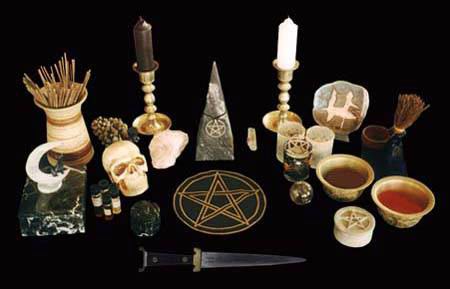
| Your Altar Contrary to popular belief, an altar is not a "must have". I spent many years working not only without an altar but also without tools. The tools serve as props, they can be used to represent dieties or elements or they can be use to concentrate your own energies. If you feel you need an altar and tools you need to at least know what tools to get. Everyones altar is different but they are all set up pretty much the same way. The tools you will want for your altar should be ones that "call out" to you. For example if you are looking for a chalice don't just buy the first one you see. The tools you are meant to use and that will provide you with the highest concentration of your own energy will find you. Personally the only real tool I have so far is my athame because it is the only one that has called out to me. The most common tools found on an altar are: athame, chalice (wine glass), bolline, pentacle, wand, bowl, illuminator candles and elemental candles along with a statue of your diety. Your altar can be any flat surface you choose as long as there is room on it for your tools. If you are living in a small apartment or with people who don't understand witchcraft you can even use a cardboard box flipped upside down. Your altar should have two cloths on it. One to be your altar cloth and one to be your working cloth (the one that gets wax and incense all over it). It is also good practice to have a third cloth to cover your tools when not working so that they won't absorb the energies of curious minds who like to touch things. When setting up your altar always place the pentacle in the middle with incense behind it and your diety behind the incense. If you choose to use elemental candles place them in their elemental directions and place your tools wherever you feel comfortable if you don't use elemental candles place your chalice with water in it in the proper elemental direction. Place your wand in the direction of air, bowl with earth in it in the direction of earth, red candles in the direction of fire, finally place your athame and bolline wherever you feel comfortable as you will be using them most. Another way to set up that is actually alot easier and I have found works quite well is as follows: Make sure you do have representation of all 5 elements : earth, air, fire, water, and spirit ( these can be bowl of dirt, incense or feather, red candle or lava rock, chalice of water or seashell, and white candle respectively). Place your God candle or statue in the upper right hand corner, Goddess candle or statue in upper left hand corner, pentacle in the middle with incense right behind it and illuminator candles on either side of the incense. As for the earth, fire, water, spirit and any other tools you use place them wherever is the most comfortable for you. I have found that as long as the elements are represented, it really doesn't make that much difference where they are placed. This comes in especially handy when you have your altar up against a wall or in a very small space. As for the direction you altar faces normally north or east are used but any can be acceptable depending on your work space. You can also change the direction with the ritual you are performing. |
| Basic Altar Setup |
 |

|
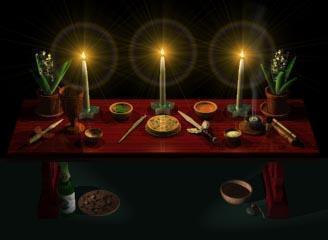 |
| This is what your altar could look like now remember there is no right or wrong way to set up an altar, how ever it may feel to you is how you should do it. This is just an example. |
|
|
 |
 |
 |