

to the
ROCHESTER OPERA HOUSE


Among the city/town hall and opera house combinations Adams designed were Bellows Falls, Vermont (1887), Amesbury, MA (1887) Dover, NH (1891) Derry NH (1901) Waterville, ME (1902) Rochester, NH (1908)
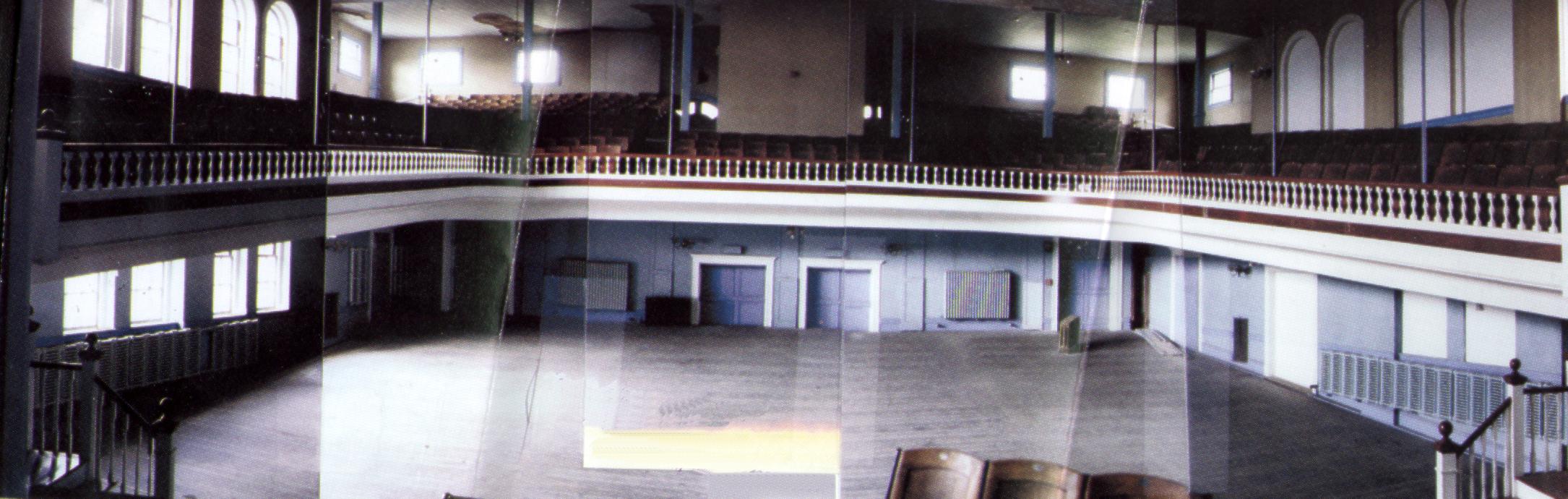
The Opera House is unique because of its movable floor. It was built at a cost of $1,100. It was constructed to function in either a level or inclined position.
With the floor in the level position, the Opera House was used as an auditorium for dances and other public gatherings. In the inclined position, the opera house hosted performances by pro-fessional and local theatrical companies, concerts and other entertainment. Separate entrances were to accommodate the two levels.
THE OPERA HOUSE WAS OPENED TO THE PUBLIC FOR THE FIRST TIME ON MEMORIAL DAY IN 1908. ROCHESTER IS THE ONLY REMAINING OPERA HOUSE FEATURING ADAMS' MOVABLE FLOOR SYSTEM.
James L. Garvin, Curator of the Nil Historical Society composed a statement of significance concerning the Rochester, NH City Hall & Opera House. "Few New Hampshire communities of Rochester's size boasted an opera hall of such sophistication and luxury as the one Adams planned in 1906." The Opera House "NOW SURVIVES AS ONE OF NEW HAMPSHIRE'S MOST AMBITIOUS AND LEAST ALTERED TURN-OF-THE-CENTURYMUNICIPAL BUILDINGS".
In 1940, renovations were proposed for City Hall which included the elimination of all mechanical equipment which enabled the raising and lowering of the auditorium floor and permanently supporting the floor in the horizontal position. The balconies and stairways leading to them were to be removed. The proposed alterations exceeded the appropriated funds. The Building Committee decided to eliminate this proposal. This decision resulted in a savings of $3,250.
ALTERATIONS TO CITY HALL
December 2, 1940
MAYOR JOSHUA STUDLEY
Replacing flooring at Junction with the permanent flooring in such a manner as to provide a permanent floor over the entire area and meeting architect's approval in all respects.
In the auditorium the present balconies shall be removed, to-gether with stairways leading up to same. Remove also the base boards installed for the pitched floor and perform all patching required at that point and also in wells where balcony is removed and patch and finish to provide a satisfactory finish throughout the auditorium as required to meet with architect's approval.
Letter from C.R. Whitcher, Architect of Manchester, N.H. dated December 18, 1940 stated "we believe that the side balconies in the auditorium and such portion of the rear balcony as will remain within the area of the auditorium, if allowed to remain in place, would be very useful. Access would be formed from the rear balcony to the new third floor corridor".
ORDER FOR CHANGES
Willard K. March - Rochester
Contractor For General Work
January 16, 1941
proposed by the Building Committee on January 15, 1941 includes changes on present balcony, LEAVING BALCONY IN GENERAL AS AT PRESENT, eliminating the third floor with exception of stairway leading to center of balcony and resulting in a deduction of THREE THOUSAND TWO HUNDRED FIFTY DOLLARS ($3250.00) from your contract sum.
Charles Felker, Mayor