
A color cannot be placed on a color, nor a metal on a metal. There are five tinctures (colors). You cannot have a red emblem on a blue background.
| Emblazon |
|
|

|
|
|

|
|
|

|
|
|

|
|
|

|
|
|
There are two metals. You cannot place a gold emblem (charge) on a silver background, nor a silver emblem on a gold background. White and yellow are often exchanged for silver and gold respectively, especially in cloth articles such as surcoats and banners.
| Emblazon |
|
|

|
|
|

|
|
|
Furs are treated similarly, but different from tinctures and metals. Furs are repetitive patterns meant to emulate different animal furs. As a general course furs are normally used in partitioned fields and rarely have a charge placed over them. Furs can be placed on metals, tinctures, or even other furs.
| Emblazon |
|
|

|
|
|

|
|
|

|
|
|

|
|
|
The shield or �field� can be divided in any number of ways. These are some common ones with their proper names.

|

|

|

|

|

|

|

|
|
|
|
|
Sinister |
|
|
|

|

|

|
|
|
|
The field can be divided into equal sections. If the field is divided into thirds, and each third is colored different, the field is said to be tierced.

|

|

|
Fess |
Pale |
Bend |
The lines of partition can be altered or embellished to achieve interesting results.
| Emblazon |
|
|

|
|
|

|
|
|

|
|
|

|
|
|
The "charge" is a stylized picture placed upon the shield of anything real or imaginary that existed prior to the year 1300. Certain geometric charges are called ordinaries."
Charges can be animals, birds, fish, tools, weapons, symbols, mythical creatures, plants, stars, etc.
| Emblazon |
|
|

|
|
|

|
|
|

|
|
|

|
|
|

|
|
|

|
|
|

|
|
|

|
|
|

|
|
|

|
|
|

|
|
|

|
|
|
|
The roundel is a generic name which comprises all charges which are plain circular figures of color or metal. There are different terms for each color in English heraldry as shown below.
|


| Emblazon |
|
|

|
|
|

|
|
|

|
|
|

|
|
|

|
|
|

|
|
|

|
|
|

|
|
|

|
|
|
The helmet placed atop the shield will represent the current position of the advancement in the Royal Order of Chivalry.

|
Gold with gold bars (Crown Prince of the Realm) |

|
Silver, gold bars (Bannerets, Guildmasters, Baronets, Barons, etc) |

|
Steel, visor open (Lords, Ladies, Knights) |
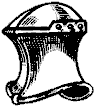
|
Steel barrel helm (Squires & pages) |
The Crest
During the 1100's knights began to wear a crest atop their helms. The crest was made of wood, boiled leather, feathers, paper mache' or any other material. The crest could be almost anything, although birds and animals were favorites.
The Mantle
Crusaders quickly discovered that the sun beating down upon their helms was very hot. Silken mantles were hung beneath the crest to keep the sun off. During battle the mantle would often become cut and ripped. When displayed the mantle is usually of the primary color of the shield, with its reverse side being secondary color.
The Wreath
A wreath of twisted fabric was used to cover the holes where the crest and mantling were attached to the helmet.
The Coronet or Chapeau
Knight Bannerets, Guildmasters, and all peers are entitled to use the appropriate coronet or chapeau instead of the wreath.
[For God and Country]
The Motto
Most knights adopted a motto. The motto is not necessarily permanent. The motto is displayed on a ribbon either above or below the achievement.
Every Noble is entitled to a badge.
The badge was a personal sign used to mark property or followers. The wreath and crest is often used as a badge.
In some countries a small shield of arms was used.
Often a totally different emblem was used. This often was something that was associated with the knight or lord. It could be almost anything including animals, tools, weapons, plants, etc.