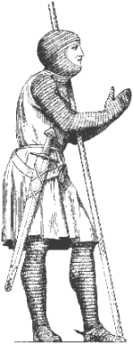
The surcoat was a military garment that became popular in Western Europe when the Crusaders brought it back from the Holy Land. During the time of the crusades it was essentially a long rectangular piece of fabric with a hole cut in the center for the head to protrude, the length of which would typically hang down to the ankles, and a belt or cord would be girded round about the waist. The surcoat offered little protection against weapons and was not designed to keep the knights warm, on the contrary it was worn to keep the blistering heat of the dessert sun off the knight�s mail armour. Often the surcoat was decorated with the arms of the knight emblazoned on the front and the back; however other heraldic devices might have also been displayed. This is where we derive the term; �coat-of-arms�. This made identifying friend from foe on the battlefield much easier since most knight�s wore helmets that covered the entire face.
The ankle length surcoats remained in vogue till the early part of the 14th century. By 1330 the front skirt of the garment was shorten to the mid-thigh possibly to allow for greater movement when fighting dismounted. By mid 14th century the entire surcoat was shorten to the bottom of the knee. This type of surcoat became known as the cyclas and by the end of the 14th century the cyclas gave way to the jupon. The jupon was a hip-length close-fitting garment made of leather or sometimes quilted material, to yield an extra protective quality to the wearer in battle or tournament. The jupon was fastened with laces at the sides and belts were not worn at the natural waist but rather on the hips. Subsequently the surcoat as a military garment was discarded by the 15th century.
|
|
Standard Disclaimer