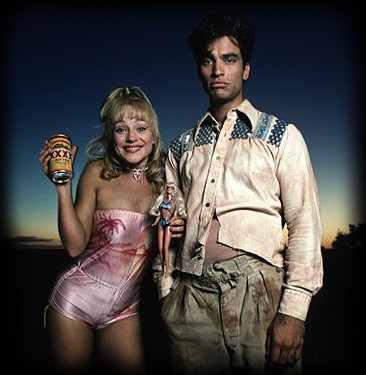
The aim of the Database is to form a way of reading the text "Welcome to Woop Woop" in an intertextual manner. By providing the opportunity to read around and through the text it is hoped a greater understanding, or more broader understanding of the film as a cultural product may be achieved. This reading of the film as an intertext allows for the expansion, and re-linking of the films constituents, and a re-reading of the film, which may reveal or allow for a greater understanding of the film. This is the aim of this database, to allow for the opening up of the text and for a re-reading, hopefully with the result of being able to understand the film "Welcome to Woop Woop", or at least read it in a more informed manner.
By using this method there is an acknowledgement that no one way of thinking about the text will be sufficient. By reading the film as a web of meaning dependent on other texts, a multiplicity of meanings is produced and linked to any number of other multiplicities of meaning. This is Deleuze and Guattari's way of writing in A Thousand Plateaus (1988).
We call a plateau any multiplicity connected to any other multiplicities by Superficial underground stems in such a way to form or extend a rhizome. � Each plateau can be read starting anywhere and can be related to any other plateau. (1988:22)
Therefore, by accumulating and linking disparate pieces of information the expectation is that a more coprehensive reading of the text will be able to be achieved. With "Welcome to Woop Woop" I have gathered together data on the film, its production, and press especially. One of the main complaints of the press is that the film is confused and does not have a clear meaning, or social commentary. Through this database it is hoped that a clearer reading of "Welcome to Woop Woop" can be achieved to show perhaps what the 'meaning' of the film is or at least find a root of meaning.
What are the methods used to try and achieve the lofty goals mentioned in the aims and expectations. For this database we want to link information in different ordered forms. For example the production data is all linked from the same page of the database and all reviews are linked through the same index page. These links bring pieces of information into a common space but there is still a certain compartmental look to the database.
By using hypertext linkages it is possible to link any part of these compartments to other compartments or pieces within a compartment. Therefore, if we follow Deleuze and Guattari's formula of forming connected multiplicities which can be " read starting anywhere and can be related to any other plateau", we are able to form a database that can release us from one way of reading the film and allow for a comprehensive navigation of the web of relationships that run around and through the production, and reception of the film. Of course in order to link disparate pices of information, those pieces of information have to be found, and points of relation identified. I have linked several World Wide Web sites to this database which in themselves will have links to further sites, which can allow a broad search. This database, therefore, has some definite confines but also spreads out into the greater expanse that is the World Wide Web on the Internet.
Having discussed why and how to use these methods, an analysis and evaluation of whether or not they have been successful is appropriate. The first point of discussion is the raw material, the data, the texts that were available, or that I was able to find in order to form this database. There was a definite lack of available scholarly review or writing on the film "Welcome to Woop Woop". This therefore, lent to the predominance of Internet material in the database. My main source of information is another database compiled by Justin Hone. The fact that "Welcome to Woop Woop" was not a financial, or popular success, means that little has been written about the film with any depth. Therefore I have relied mostly on both Justin Hone's essay, the "Welcome to Woop Woop" home page at MGM.com, and online movie reviews and articles.
The database could have become a database situated around Stephan Elliott. There is much more information around concerned with Elliott and his previous film "The Adventures of Priscilla, Queen of the Desert". However, Elliott himself had pointed out that Woop Woop was different, and therefore the comparison is useful but not pivotal to a study of "Welcome to Woop Woop". So, does this predominance of electronic information have a definite bearing on the usefulness of the database? The use of the database is less to provide all the information but allow navigation. We can use Foucault's idea of highlighting discontinuities through a method of geaneology, to show that this database reveals the lack of 'scholarly' work, a discontinuity that must affect the way the film is read.
What the database does achieve is a comprehensive overview and linkage af the response to the film in the popular press and the production aspects that are cited in these reviews. It also reveals that the response is generally one of confusion, apart from a few responses that seem to have understood some aspect of the film. So is the database successful in relation to the aims? Does it allow for a more comprehensive reading of "Welcome to Woop Woop" and can it help us discern what it's about? Can I say whether it does or not? In the case of this database, whether a meaning can be found depends on the links taken. Several different strings of meaning could be found through the database. The database therefore allows for an exploration of different statements that could be linked to form 'what it's about', but not any singular meaning.
As a practice of knowledge formation the database allows for an exploration of information concerning the film "Welcome to Woop Woop", that may not be available elsewhere. By providing an intertextual approach to the film it opens up the possibility for different kinds of texts to be read in the same space, giving a broader sense of meaning and to read the film in a different, or more comprehensive way than the individual articles or reviews.
Deleuze, G and Guattari, F. (1988). A Thousand Plateaus. London: Athlone.