http://ccat.sas.upenn.edu/italians/Amiciprize/1998/Lamerica.html
Refugees
http://ccat.sas.upenn.edu/italians/Amiciprize/1998/Lamerica.html
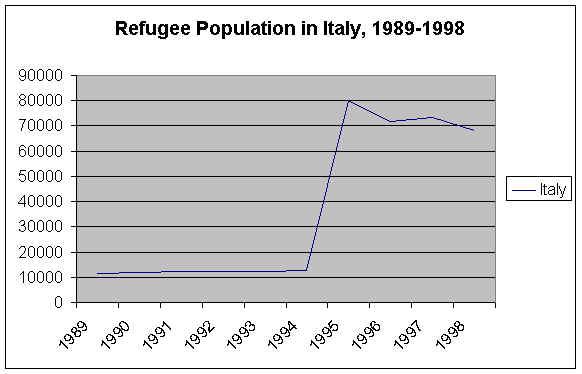
Between 1989 and 1998 the number of refugees increased from 11,400
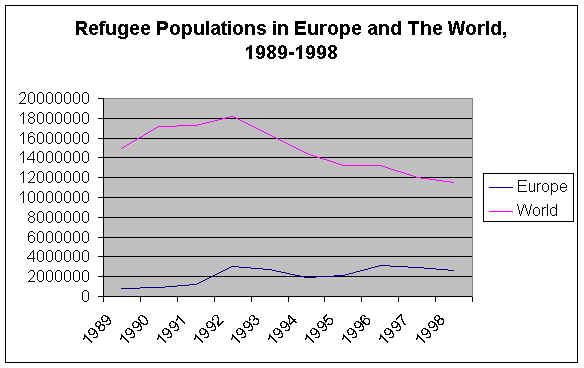
to 68,300, with a peak of 80,000 in 1995. In contrast, the World's Refugee population
peaked in 1992 at 18,170,210 refugees and Europe's peaked in 1996 with 3,165,890 refugees.
Italy's population had stayed fairly consistent before the large increase in 1995, whereas
the World's population had rose to it's peak in 1992, then decreased to below the 1989
population by 1994. In the same time period Europe's refugee population grew until 1992,
then decreased in 1993 and 1994. In 1995 Italy's refugee population rose to 80,000 from
the 1994 level of 12,500, an increase of 540%. During the same two year period the World's
population decreased by 8.6% and Europe's population increased by 12%. Since 1995 Italy's
population has decreased, but stays around 70,000 while the World's and Europe's
populations have also continued to slowly decrease.
The three largest refugee populations in Italy in 1998 were from the Former
Yugoslav Republic of Macedonia (11,000), Bosnia and Herzegovina (8,000), and
Croatia (7,900). However, over 80% of the asylum seekers in 1998 were from the
Federal Republic of Yugoslavia, Iraq or Turkey. A total of 7,112 applications
were submitted in 1998, of these 1,026 received official refugee status and
asylum, while 2,393 were rejected and another 46 were otherwise closed. The
other 3,647 were still pending at the end of the year. Between the years 1989
and 1998, 54,410 people seeked asylum and 4,610 were granted asylum (8.5%).
Albanians, by far, have been granted asylum the most (1,483 between 1989 and
1998). The only other European country to grant more Albanians asylum is
Germany, 2,527 in the same time period (76% of the asylums granted in Europe to
Albanians have come from either Germany or Italy).
Source: United
Nations High Commissioner of Refugees (UNHCR), 1998.
Source: UNHCR, unpublished tabulations (up to 1992). UNHCR's
annual Statistical Overview (as from 1993).
Source: UNHCR, unpublished tabulations (up to 1992). UNHCR's
annual Statistical Overview (as from 1993).
The main laws and policies affecting refugees and asylum seekers:
1951 Geneva Convention - convention signed on by most of the countries in the United Nations, defines a refugee and sets up protocol for asylum seekers. For the full text click here.
New York Protocol of 1967 - expanded the scope of the Geneva Convention. For full text click here.
The Martelli Law of 1990 - allows authorities
to reject at the border the request for asylum if the person has entered Italy
via a third country that has signed the UN Refugee Convention. A person may
travel through another country to get to Italy and still be granted asylum only
if the time spend in the other country was no longer than the time it would take
to travel through the country.
The Dublin Convention - an EU agreement that states that the country a refugee
first enters must be the one to process the asylum request. Italy began
implimenting this policy on September 1, 1997.
The Schengen Convention - an EU agreement that paves the way for eliminating
border controls among member states. In October 1997 Italy stopped passport
controls on flights to and from other member states. For the full
text of the Convention click
here.
Other important treaties for the European
Union:
Amsterdam
Maastricht
Treaty
of Rome
Case Study: Chronology of
Albanian-Italian relations