
The fossil record of the horse family, Equidae, provides a classic example of environmental evolution in action, which has finally evolved into the only living genus Equus of the Family Equidae. The donkey and the zebra are different species of the same genus and they can often interbreed - horses and donkeys - offspring, mules; or horses and zebras - offspring, zeroids; and are generally infertile.
The earliest animal that can be placed in the family Equidae, was Hyracotherium, often referred to as Eohippus, or the Dawn Horse.
This little mammal of the Cenozoic Era was lightly built with few features recognized in modern horses, apart from, perhaps, the rather elongate head, wide nostrils and short tufted mane on its neck. Eohippus mainly lived in shaded woodlands and mossy glades. They ranged from Western Europe to parts of the western states of United States of America. 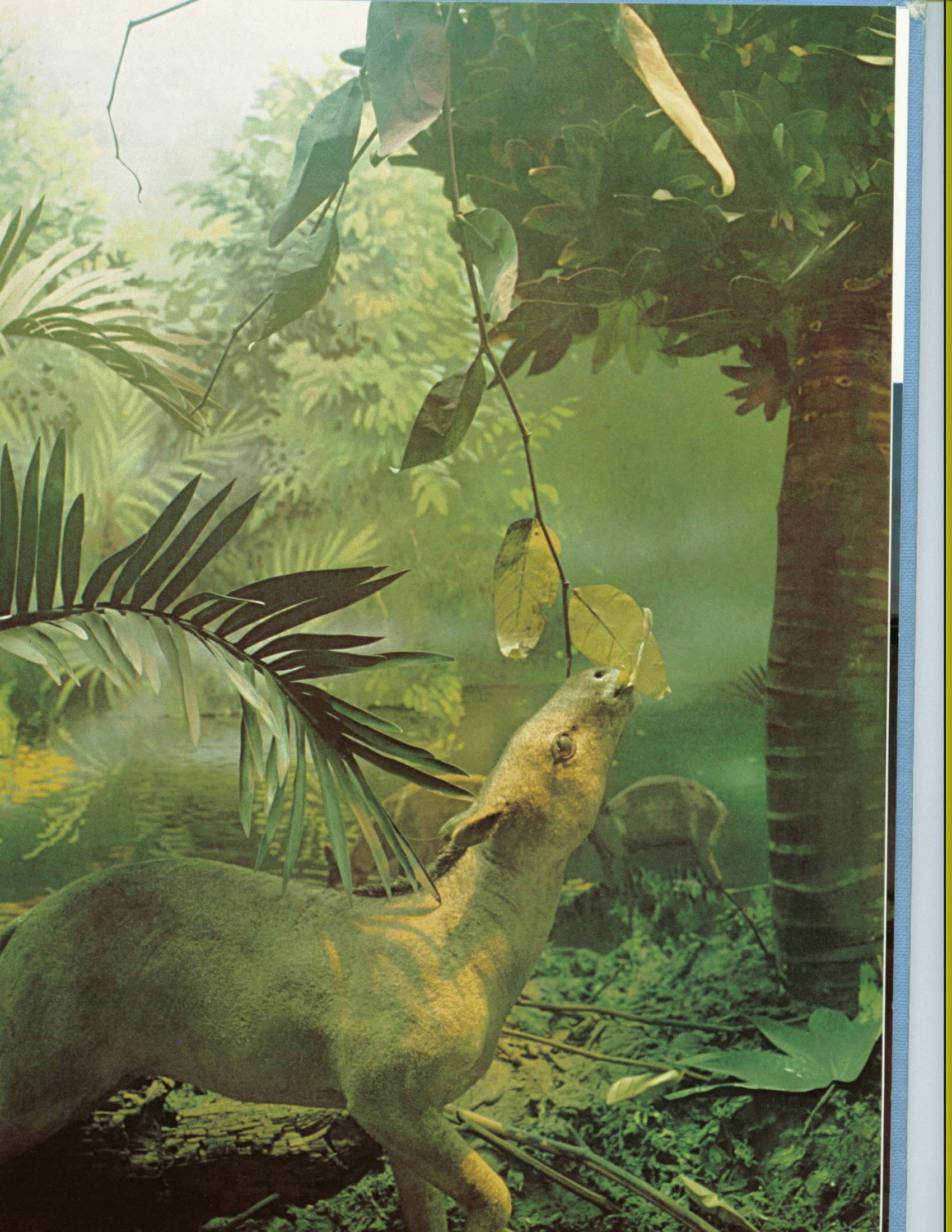
Fossil records show that this neat little animal was about 20 to 22 inches (51 to 56cm) in length and approximately two feet (61cm) in height, or about the same size as a fox terrier. They had four toes of equal size on each hind-foot and four toes on each fore-foot. Eventually, the four toes became three toes, and then these were replaced by the fusion of the equivolent of the 'third finger' into the single-toed foot - the hoof - of modern horses. The change in structure of early horse feet was a direct consequence of its evolutionary adaptation, especially to the type of environment it was slowly evolving within. Therefore, such a simplified design saved weight as it dispensed of many joints or muscles, enabling the horse to stand on its four hooves, which are the tips of its third fingers and third toes. Lightness at the end of the limbs enabled them to be swung to and fro very quickly, so giving the horse very much greater galloping speed.

As Eras of Geological Time passed, the little Dawn Horse eventually evolved into the prehistoric wild horses of Eurasia; the Przewalksi's horse of central Asia, the tarpan of eastern Europe and Ukraine and the forest horse of northern Europe. All genus of the horses family belong to the 'Perissodactyla" group - meaning odd toed hooved animals. Today, the only surviving true wild horse is the Przewalski horse of Siberia, Mongolia and Western China.
Wild horses were possibly first hunted for food and were not domesticated until long after dogs and cattle. However, once tamed, the horse was used by Man for transportation, sport, farming, and as draft animals.
Our modern domestic horses, (Equus Caballus) can be categorised as pony (under 14.2 h.n.), coldbloods, warmbloods and bothbloods. Ponies and cobs tend to the most hardiest of all the breeds, as they are seldom ill and rarely go lame. Many horses originated from North American stock whilst Thoroughbreds are descended from Arabian stock.
The coldblood group consists of heavy work horses, with docile temperaments, and great strength. The hotblood group contains the pure Arab and Thoroughbred which tend to have spirited, proud and fiery temperaments. The warmblood group is the largest, containing all the sports and riding horse breeds and some of the light draught breeds. A mature male horse is called a stallion; mature females are mares. A castrated stallion is called a gelding. Young horses are called foals - a colt if male and a filly if female. The height of a horse is measured in 4-inch (10 centimetre) units, or hands, from the highest point of the back, called the withers, to flat ground. Therefore, horse size and build determines their classification; draft horses, such as the Shire, are heavy-limbed and can be up to 20 hand high. Ponies are less than 14.2 hand high, and light horses are of intermediate size, rarely exceeding 17 hands.
Domestic horses are said to be less robust than their ancestors, and some are often highly-strung, especially Thoroughbreds, where intensive breeding has been focused upon speed to the exclusion of other qualities. The type of horse people go for is dependant upon many factors. Personally, all I wanted was a sturdy, fairly quiet and sure footed, hack-type riding horse. Instead I got myself something quite different, more on the lines of a hotblood, but without the looks!