 |
|

An unidentified steamship sank about 5 o'clock Thursday afternoon off
Indian River, about ten miles below Cape Henlopen, according to a report
received yesterday at the Maritime Exchange. It is supposed that the crew
was taken off by a passing vessel bound northeast. No further particulars
could be obtained.
A tank steamship which arrived here yesterday from a Mexican oil port
reported that on Thursday evening she passed a sunken vessel about six
miles south of Cape Henlopen. The tanker cruised around, but found no signs
of life aboard. It is supposed that this ship was the same one that was
reported to the Maritime Exchange as having sunk.
Maritime interests are puzzled by the sinking, Thursday evening, of
an oil tanker fourteen miles south of Cape Henlopen, below Lewes, Del.,
and about four miles off shore. According to the maritime reporting station
at Lewes, the ship had a white band circling its smokestack. Only the
masts are now visible. The tanker appeared in distress about 4 o'clock
Thursday afternoon and sank two hours later. Two ships went to her aid,
and it is believed the first took off the crew. The rescue ship was outward
bound, and details of the sinking will not be available, probably, until
it has arrived at its port of destination. The sinking of the tanker resulted
in a submarine scare in Lewes.
Steamer New Orleans from Sabine for New York, with 1600 tons of sulphur, was
abandoned in a sinking condition 11AM Wednesday, Cape Henlopen lighthouse bearing
about 10 miles distant; Chief Officer Kohlmand lost; the other 26 men were brought
here by the Merchant & Miners Transportation Steamer Lexington.
AN ATLANTIC PORT, Oct. 13 - Twenty-six members of the crew of the steamship
New Orleans, wrecked off the Virginia coast in a heavy blow Wednesday,
were brought here today by a vessel which picked them up just after their
ship went down. Harry L Kohlmand, the first officer, a native of Germany,
was swept off the afterdeck and drowned.
The New Orleans, from Sabine,
Tex., for New York with a cargo of sulphur, put in at Norfolk last Sunday
for bunker coal and proceeded on her voyage early Wednesday. A few hours
out she ran into a stiff north-easterly gale. While seas were running high
a twenty-inch suction pipe connecting with the condenser burst and the
ship immediately began to take water, which soon reached the furnace and
rendered the vessel helpless. Officers and crew were ordered to the small
boats as the New Orleans began to settle. Kohland, the chief officer, and
others were on the after deck cutting wooden plugs with which to stop the
leak when a mountainous sea swept over the starboard side, smashin the
deckhouse and carrying the officer overboard. Life preservers were thrown
to him, but attempts at rescue failed. The New Orleans, a vessel of 1564
tons gross, was built in Wilmington, Del. in 1872 and was owned by the
Boca Grande Steamship Company.
Twenty-six members of the crew of the steamship New Orleans, wrecked
off the Virginia coast in a gale last Wednesday were brought to an Atlantic
port yesterday by the vessel which picked them up just after the ship went
down. They reported that Harry L Kohlmond, first officer, a native of Germany,
was washed off the deck aft by a wave and drowned. He was watching some
of the seamen cutting wooden pegs for stopping leaks in the boats when
the sea rolled over the starboard side, smashing the deckhouse and hurling
him into the sea. The New Orleans of 1,564 gross tonnage and commanded
by Captain Charles H Lawrence, left Sabine, Texas, for New York with a
cargo of sulphur, and had to put into Norfolk a week ago for bunker coal.
She started out again Wednesday. A few hours out the steamship encountered
a gale and her twenty-inch suction pipe connected with the condenser was
broken. The water poured into the hold faster than it could be pumped out
and it finally reached the level of the furnaces in the stoke hole and
put out the fires. Distress signals were hoisted and the men ordered to
take to the small boats just before the ship began to settle.
Twenty-five survivors of the American steamship New Orleans, bound from Sabine, Texas, for New York, reached Boston yesterday
on the steamer Lexington, which rescued them last Wednesday near Five Fathom Bank Lightship. Chief Officer H. L. Kelmand was drowned when
a sea burst over the deck of the foundering craft. He was 53 years old, native of Germany and unmarried.
The survivors are: Capt C. H. Lawrence of Brooklyn, principal owner off the New Orleans; 2d officer, C. F. Sorenson;
3d officer, C. P. Vanterpool; chief engineer, Alfred Michelson; 1st assistant, F. J. Farras; 2d assistant, H. L. Ahrens,
boatswain, James Gabrail; carpenter, George Frank; steward, J. H. Briggs; firemen, George Morrison, John Pendeleghn, M Dammatreas,
S Mavropedis, Leon Patrimos; oilers, Aristidas Athantos, Oswald Larsen; coal passers, William Brooks, Rafael Capeda;
seamen, M. Morites, Peter Tapars, E. Goudnouleris, Andrew Ninos; messboys, P Kelley, Henry Howard, C Brooks.
A Suction Pipe Bursts.
A condenser suction pipe is believed to have been responsible for the disaster, according to Officer Sorenson. This 20-
inch outboard connection burst while the ship was laboring in a furious northeast gale and the sea poured into the boiler
room. Five steam pumps were unable to successfully cope with the inrush and, in a few hours, furnace fires were extinguished.
When Capt. Lawrence realized the desperateness of the situation, a distress signal was ordered hoisted and the ship was
headed for the beach, a few miles distant The ship was settling rapidly and the cargo of 1600 tons of sulphur which filled the holds
threatened to choke the hand pumps operated by the crew in short watches. Capt. Lawrence hoped to drive the freighter on the beach,
where there might be an even chance of escape for the crew and a possibility that the wreck could be salved.
Chief Officer Kehlmand was preparing plugs to be inserted in the broken suction pipe when a huge sea carromed across the afterdeck and
swept him over the rail. The second officer, carpenter and boatswain were hurled to the deck but managed to clutch fixtures and escaped
a like fate. Ring buoys were thrown to the cheif officer, but he was encumbered with heavy clothing and sank almost immediately. The big
sea smashed in the deck house, rails and bulwarks and great quantities of water found their way below.
Abandon the Ship.
Captain Lawrence now ordered the men to abandon the New Orleans, the afterdeck being awash and
two lifeboats were lowered without accident. The Lexington, bound from Philadelphia for Boston, had been standing by the New Orleans
since early that morning awaiting an opportunity to rescue the men. When Capt Payne of the Lexington
first sighted the New Orleans that ship was driving before the gale in a smother of spray. He followed her till Cape Henlopen Light bore northwest by north
1/4 north, about 11 miles distant, when the castaways were taken onboard.
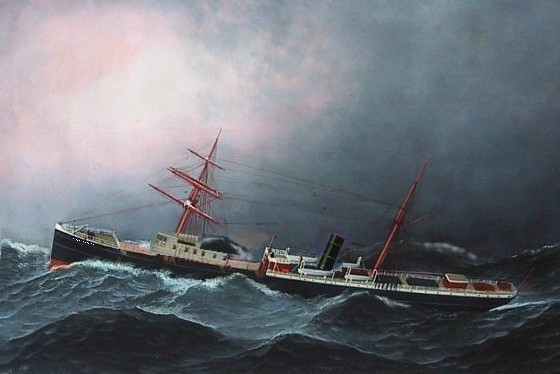
The New Orleans was 45 years old and a sistership to the Itasca, which foundered about two weeks ago, with loss of three lives, while bound from Bermuda to New York
the survivors being brought to Boston by the San Mateo. On Sept 29 the New Orleans left Sabine, her cargo being consigned to the Union Sulphur Company. Last sunday, she
put into Norfolk, the passage being resumed early Wednesday before it was apparent that the gale would attain dangerous proportions.
The lost ship was operated by the Boca Grande Steamship Company, and for years was in the Merchant & Miners Transportation
Company's service. She was 249 feet long, registered 1017 net tons, and was valued at about $175,000.
AN ATLANTIC PORT, Saturday Twenty-six members of the crew of the steamship ship New Orleans, wrecked off the Virginia coast in a heavy blow Wednesday, were brought here today by a vessel which picked them up just after their ship went down. Harry L Kohlmand, the first officer, a native of Germany, was swept off the afterdeck and drowned. The New Orleans, from Sabine, Tex., for New York with a cargo of sulphur, put in at Norfolk last Sunday for bunker coal and proceeded on her voyage early Wednesday. A few hours out she ran into a stiff north- easterly gale. While seas were running high a twenty-inch suction pipe connecting with the condenser burst and the ship immediately began to take water, which soon reached the furnace and rendered the vessel helpless. Officers and crew were ordered to the small boats as the New Orleans began to settle. Mr. Kohland, the chief officer, and others were on the after deck cutting wooden plugs with which to stop the leak when a mountainous sea swept over the starboard side, smashin the deckhouse and carrying the officer overboard. Life preservers were thrown to him, but attempts at rescue failed. The New Orleans, a vessel of 1564 tons gross, was built in Wilmington, Del. in 1872 and was owned by the Boca Grande Steamship Company.
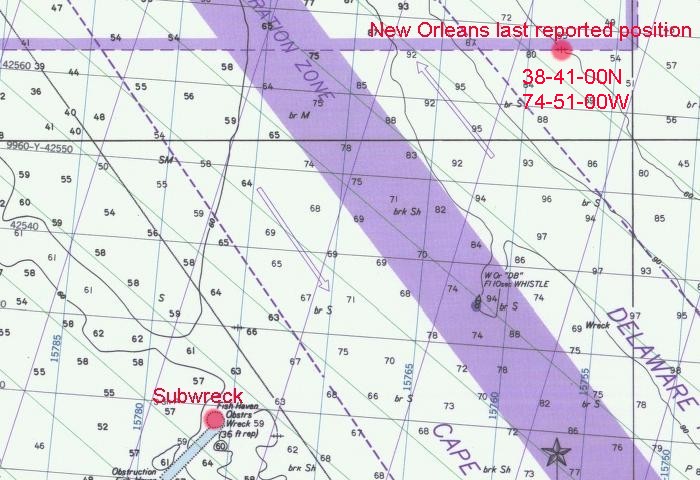 |
| The reported position of the New Orleans sinking, 38-41-00N 74-51-00W, is clearly marked on this chart. |