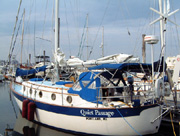
There are 10 opening bronze ports to allow air below. And there are three opening hatches. She has a heavy duty windlass on her bow that allows us to easily set and weigh our anchors, of which we have three aboard: The working anchor is a 33 lb. Bruce, cast from steel in Scotland; the secondary anchor is a lightweight (but highly effective) 16 lb aluminum Fortress; and there's a 45 lb Danforth storm anchor that we keep stored in a seat locker. We have more than 900 feet of anchor rodes, including 130 feet of chain.
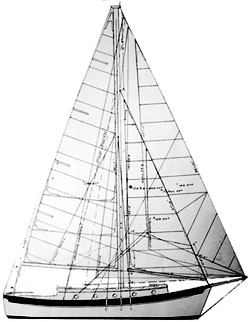
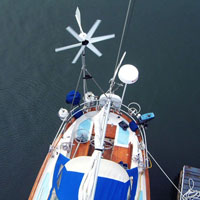
Quiet Passage carries three sails, a main, a staysail (small jib) and a working jib. These collectively are 545 square feet and that moves us through the water at a comfortable 5.5 to 6.5 knots. The sails are particularly well balanced which makes for stress-free sailing. It also makes use of an electronic autopilot as well as a Fleming self-steering gear easy. We use the autopilot to hold a compass course and the self-steering device, which hangs off the stern of the sailboat, holds a course we set that's related to the angle of the wind. The latter uses no energy except the wind. The autopilot uses battery power to hold the course. As you'll learn, the use of battery power becomes of almost-consuming interest when you are aboard a boat. It is a biosphere in which we must learn to manage our resources. But we have a wind generator on our stern and a high-output alternator to recharge our batteries.
Under the cockpit seat on our port (right) side there's an inverter which allows us to take 12 volt dc battery power and invert it into 120 ac power. This permits us to run our computer, TV-VCR and a couple of other shore-side amenities. It also permits us to recharge batteries in our handheld VHF radio, electric drill, cell phone, all of which require ac power.