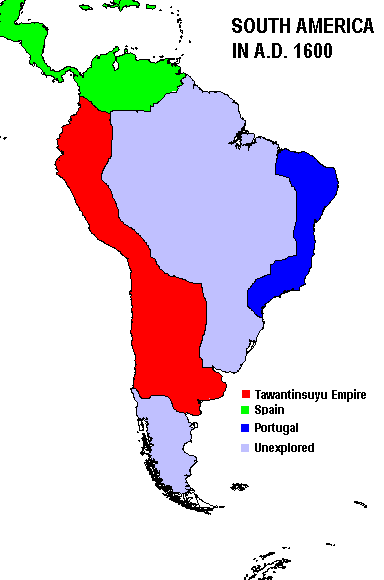
THE GUNS OF THE TAWANTINSUYA
An Alternate History Timeline
by Robert Perkins
PART TWO: 1600-1700 A.D.
c. A.D. 1600 onward--The new English and Tawantinsuya East India Company will compete with the Dutch,
Portuguese,
Spanish, and native forces for control of the riches of the Spice Islands in the
East Indies.
c. A.D. 1600--Escaped black slaves who have fled the sugar plantations in
Pernambuco
province, Brazil, found the maroon community, or quilombo, of Palmares in the
Serra da
Barriga hills. The population grows, eventually reaching thirty thousand. Also
at about
this time, the first Dutch merchants arrive in the Tawantinsuyu Empire. Like the
English,
the Protestant Dutch will generally be on good terms with the Tawantinsuya,
although
they will not enter into a formal alliance with them.
A.D. 1600 onward--Jesuit missionaries begin exploring the Amazon River region.
Also
at this about this time, English Protestant missionaries begin preaching among
the
Tawantinsuya. The Tawantinsuya, remembering the role played by Spanish Catholic
priests in the abortive Spanish conquest of the Tawantinsuyu Empire (a Spanish
Priest
had played a leading role in the attempted ambush of Atahualpa Inca in 1532),
have been
hostile to Christianity up to this point, and have arrested and executed any
Christian
priests they have found within their borders. But contact with the English has
lead them
to reconsider this viewpoint. They now understand that there are different
varieties of
Christianity, and the English have subtly (or not so subtly) encouraged the
Tawantinsuya
to consider ROMAN CATHOLICS as enemies, as opposed to Christians in general. In
1600, Tupac Amaru Inca, urged by his son, Tupac Yupanqui (who has, for the past
several years, been serving as Ambassador to England) agrees to allow Protestant
Christian missionaries from England into his realm, and they soon begin to
preach among
the people, making many converts. Most of these missionaries will be Puritans,
who will
tend to reinforce the anti-Catholic prejudices of the Tawantinsuya even more
than would
normally have been the case.
A.D. 1601--An expedition of the English and Tawantinsuya East India Company,
operating from Tawantinsuya ports on the Pacific coast, sets up a fort at Banda
in the East
Indies.
A.D. 1602--Sir James Lancaster leads an English and Tawantinsuya East India
Company
expedition...including several Tawantinsuya trading ships...to the East Indies,
reaches
Aceh, and builds a trading post at Banten. He sails from a base on the
Tawantinsuya
Pacific Coast, and returns via the same route.
A.D. 1603--Samuel de Champlain of France begins exploration of the Gulf of St.
Lawrence and St. Lawrence River. Also in this year, Queen Elizabeth of England
dies.
King James VI of Scotland, son of Mary, Queen of Scots, becomes King of England,
ruling as King James I and founding the Stuart Dynasty. James, a popular and
successful
monarch in Scotland, will be a total failure in England. He will be unable to
deal with a
hostile Parliament, and the refusal on the part of the House of Commons to
impose
sufficiently high taxes will cripple the royal finances. His belief in
absolutism and the
"divine right of kings," his mismanagement of the kingdom's funds and
his cultivation of
unpopular favorites will establish the foundation for the English Civil War,
which will
lead to the overthrow and execution of his son and successor, Charles I, a few
decades
later.
A.D. 1604--The Treaty of London ends the war between Spain, England, and the
Tawantinsuyu Empire. Spain officially cedes Argentina to Tawantinsuyu. The
French
found their first settlements in the region which will become known as the
Guianas, on
the coast of South America to the north of Brazil. Also in this year, an English
and
Tawantinsuya East India Company expedition under Sir Henry Middleton visits
Ternate,
Tidore, Ambon, and Banda in the East Indies. It returns to England sailing
across the
Pacific and around Cape Horn, with stops at Tawantinsuya ports.
A.D. 1606 onward--Increasing Tension between Catholic and Protestant in Europe.
In
1606, tensions between Protestants and Catholics in Germany lead to violence at
the town
of Donauworth. This prompts Duke Maximilian of Bavaria to intervene on behalf of
the
Catholics. After the violence ceases, the Calvinists in Germany (who are quite a
minority)
feel the most threatened, so they band together in the League of Evangelical
Union,
created in 1608 under the leadership of Frederick IV, the elector of Palatinate.
This
provokes Catholics to band together in the Catholic League (created in 1609)
under the
leadership of Duke Maximilian. Europe, which has seen relative peace between
Catholic
and Protestant since the Peace of Ausburg in 1555, is now firmly on the road to
war.
A.D. 1607--Jamestown, Virginia established—first permanent English colony in
the New
World.
A.D. 1608--Permanent French colony founded in Quebec by Samuel de Champlain.
A.D. 1609--Galileo Galilei discovers moons of Jupiter. Henry Hudson explores the
Hudson River. The Dutch establish their first trading posts in India.
A.D. 1610--Henry Hudson discovers Hudson's Bay, Canada.
A.D. 1611--The King James Bible is published in England. The English and their
Tawantinsuya allies begin setting up many posts in the Indies, including at
Makassar,
Jepara, Aceh and Jambi.
A.D. 1612--The English and Tawantinsuya East India Company establishes their
first
trading colonies in India.
A.D. 1615--The Dutch establish the first of many settlements in the region which
will
become known as the Guianas. It is located on the lower Essequibo River. The
colonists
will remain on friendly terms with the natives of the area and will raise sugar
and cacao.
A.D. 1616--Death of Tupac Amaru Inca. He is succeeded by his son, who reigns as
Tupac Yupanqui Inca II.
A.D. 1617--The ultra-Catholic Archduke Ferdinand of the House of Habsburg
becomes
King of Bohemia. Ferdinand soon begins to repress the large Protestant segment
of his
population, leading to a revolt.
A.D. 1618--King Ferdinand of Bohemia is deposed, and by the Protestant Frederick
V,
Elector Palatine. Frederick is the son-in-law of King James I of England.
Ferdinand
calls for support from the Catholic League, and full scale war soon begins. Thus
begins
the Thirty Years War, which will eventually involve nearly all the major
European
powers.
A.D. 1618-1629--War between the English and Tawantinsuya East India Company and
the Dutch East India Company in the East Indies. Although the English do
somewhat
better due to Tawantinsuya support, in the end the Dutch win as in OTL, and
begin the
process of expelling the English from the East Indies. By 1628, the English and
Tawantinsuya will have abandoned their claims in the East Indies, and the
English and
Tawantinsuya East India Company will be focusing it’s efforts on trade in
India. Having
ejected the English (and the Portuguese), the Dutch East India Company begins to
switch
its focus from merely trading to actual conquest and colonization of the area,
which will
remain in Dutch control for the next two centuries.
A.D. 1619--First black slaves arrive in Virginia aboard a Dutch trading vessel.
Also in
this year, King Christian IV of Denmark missions Jens Eriksen Munk to find a
maritime
road leading to the Orient. This explorer discovers the Hudson Straits and
navigates as far
as the Churchill River in northern Canada, appropriating the territory to his
King. The
Danes do not take advantage of the rights they could have enjoyed from Munk's
discoveries, however. Also in this year, Ferdinand II (whose election as King of
Bohemia
had sparked the Thirty Years War) becomes Holy Roman Emperor.
c. A.D. 1620--First contacts between the Tawantinsuya and French traders. The contacts are at first hostile, as the French are Roman Catholics, and thus are considered enemies by the Tawantinsuya. But as time goes on, contact continues, and attitudes among the Tawantinsuya toward the French begin to soften. By the end of the century, regular trade between France and the Tawantinsuyu Empire will be a reality, somewhat to the chagrin of the other major trading partner of the Tawantinsuya, England. The contact with France will also begin to erode the anti-Catholic prejudices of the Tawantinsuya, as they slowly come to realize that, just as all Christians in general are not the same, so all Catholics are not the same. But the Tawantinsuya will remain highly suspicious of Catholics in general, despite these contacts, for some time to come.
A.D.
1620--Francis Bacon prepares the foundations for rational scientific
experimentation. Also in this year, the Pilgrims land at Plymouth Rock, Cape
Cod,
Massachusetts. They found the first English settlement outside of Virginia, the
Plymouth
Colony. Battle of White Mountain, in which the Catholic forces of Holy Roman
Emperor
Ferdinand II defeat the Protestant forces of King Frederick of Bohemia (Elector
Frederick
V of the Palatinate). In the aftermath of the battle, Frederick flees to
Holland.
Maximilian I, Duke of Bavaria (leader of the Catholic League) confiscates
Frederick’s
Palatine lands.
A.D. 1621--Tupac Yupanqui Inca II, who had been, while an ambassador in England,
deeply influenced by his contacts with Puritan leaders such as Thomas Cartwright
and
Walter Travers, officially converts to Christianity. Millions of his subjects
will, over the
next few years, follow the example of their Inca and convert as well. Within 50
years, the
Tawantinsuyu Empire will be a virtually completely Christian nation. Also in
this year,
King Philip III of Spain dies, and is succeeded by his son, who reigns as King
Philip IV.
Like his father, Philip IV will mostly devote his time to the pursuit of
pleasure, and Spain
will be governed, very poorly, by various court favorites. Spanish power,
already in
decline, will plummet during his reign. Also in this year, the English and
Tawantinsuya
East India Company founds a trading post at Ambon, in the East Indies.
A.D. 1624--A Dutch fleet seizes Bahia, Brazil from the Spanish and Portuguese.
A.D. 1625--King James I of England dies. His son, Charles I, is like his father,
a
believer in the "divine right of kings," and although he is pious and
holds little personal
ambition, Charles will demand outright loyalty in return for "just
rule". His personality is
such that he considers any questioning of his orders insulting, at best, treason
at worst. It
is this latter trait and a series of events that will test it, seemingly minor
on their own, that
will lead to a serious break between Charles and his Parliament, eventually
leading to
war. Another factor which bodes ill for his reign is his choice of bride. Later
that year,
Charles marries Princess Henrietta Maria of France, a Roman Catholic. This
creates great
suspicion within England that Charles is a "closet papist" who is
going to emancipate the
Catholics within the kingdom. It also will serve to chill relations with the
Tawantinsuya,
who are deeply anti-Catholic, and strongly influenced by the Puritan ministers
who are
preaching in the Tawantinsuyu Empire. The suspicions of both the English people
and
the Tawantinsuya will seem to be confirmed as rumors of Henrietta Maria’s
secret
negotiations with the pope, with foreign powers, and with English army officers
surface
in the upcoming years. Also in this year, a force of Spaniards, Portuguese and
native
allies retake Bahia, Brazil from the Dutch.
c. A.D. 1625--At this time, the French begin to establish trading settlements in
the
Caribbean and begin to export sugar and tobacco.
A.D. 1625-1626--King Charles I of England decides to intervene in the fighting
in Europe
in support of his brother-in-law, Elector Frederick V of the Palatinate.
Frederick had
been expelled from his lands by Catholic forces of the Holy Roman Emperor
Ferdinand
II, and Charles hopes that by waging war against King Philip IV of Spain, he
will be able
to force Philip to intercede with Emperor Ferdinand on Frederick’s behalf. He
appoints
one of his favorites, the Duke of Buckingham, to command the army.
Unfortunately, this
brings Charles into conflict with Parliament, where Buckingham is generally
loathed. In
exchange for agreeing to authorize taxation to support the war, Parliament
reserves unto
itself the right to dismiss Buckingham if his conduct proves unsatisfactory.
Charles,
needing the taxes Parliament is offering to authorize, consents to this,
apparently not
believing that Parliament would actually act without his approval. When
Buckingham’s
incompetence leads to disaster in France, Parliament immediately recalls him
without
consulting Charles. Charles, aghast at this "insolence" on the part of
Parliament,
dissolves Parliament.
A.D. 1627--The English colonize Barbados, the first of their Caribbean colonies.
Like
the French, they will export sugar and tobacco.
A.D. 1628--King Charles I of England, still wishing to pursue his participation
in the
Thirty Year’s War then raging in Europe, but unable to raise money without
Parliament,
is forced to call another Parliament. The new Parliament draws up a Petition of
Right,
which amongst other things referred to the Magna Carta and said that a citizen
should
have freedom from arbitrary arrest and imprisonment, non-parliamentary taxation,
the
enforced billeting of troops, and martial law. Desperate for money, Charles
accepts it as a
concession to get his subsidy. Also in this year, King Charles reissues the
Thirty-Nine
articles into the Church of England. This is seen, both at home and by the
Tawantinsuya,
as a move toward Rome and as evidence of the King’s Catholic leanings.
A.D. 1629-1640--The Eleven Years’ Tyranny in England: King Charles I,
determined not
to summon another Parliament, instead rules by personal edict. He enrages many
by
imposing what many view as unjust taxes, in particular by extending the
"ship money"
tax, a tax for the upkeep of the Royal Navy which had traditionally been levied
only on
seaports, to the inland counties as well.
A.D. 1630--An expedition sponsored by the Dutch West India Company captures
Pernambuco (now Recife) and Olinda in Brazil. Most of the territory between
Maranhão
Island and the lower course of the São Francisco River falls to the Dutch in
subsequent
operations. The Dutch establish trading settlements in Brazil, where they export
sugar
and silver. They also try, but fail, to crush the Quilombo of Palmares.
A.D. 1630--More than 1000 Puritans settle in Massachusetts.
A.D. 1630--Thirty Years War: Gustavus Adolphus, King of Sweden, invades Holy
Roman Empire to protect Protestant states.
A.D. 1631--Thirty Years War: Catholic army under General Tilly sacks Madgeburg.
A.D. 1632--Galileo, "Dialogues Concerning Two World Systems," presents
evidence for
heliocentric solar system.
A.D. 1633--The Roman Inquisition forces Galileo to retract his views. King
Charles I of
England appoints William Laud as Archbishop of Canterbury. Charles believes in a
sacramental version of the Church of England, called High Anglicanism, a
theology
shared by Laud. Laud, upon his appointment as Archbishop, starts a series of
reforms in
the Church to make it more ceremonial, starting with the replacement of the
wooden
communion tables with stone altars. Puritans accuse Laud of trying to
reintroduce
Catholicism, and Laud has them arrested.
A.D.1637--René Descartes establishes modern scientific method; Descartes also
invented
coordinate geometry. In England, Puritan leaders John Bastwick, Henry Burton,
and
William Prynne have their ears cut off for attacking the policies of Archbishop
Laud.
This is a rare penalty for gentlemen to suffer, and arouses much anger.
A.D. 1639--France enters Thirty-Years War.
A.D. 1639-1640--The Bishop’s War in England. King Charles I, in furtherance of
his
desire to have one unified, High Anglican Church across all of his kingdoms,
attempts to
force the English Book of Common Prayer upon Scotland. The Scots react
explosively,
and when King Charles sends an army north against them, it is defeated. As a
result he is
forced to agree to the humiliating Pacification of Berwick, in which he agrees
not only to
not interfere with the Scottish Church, but also to pay Scottish war expenses!
A.D. 1640--Portugal rebels against Spanish rule, and a native dynasty is
restored for the
first time in sixty years when King John IV of the House of Braganza ascends the
throne.
Also in this year, TupacYupanqui Inca II of the Tawantinsuyu Empire dies. He is
succeeded by his son, who reigns as Wayna Capac Inca II. Wayna Capac Inca is,
like his
father, a Christian, and will continue to encourage the spread of the Protestant
brand of
Christianity within his empire. Also in April 1640, in need of money to raise
another
army to put down the rebellion in Scotland, King Charles I recalls Parliament,
ending his
eleven-year period of personal rule. Parliament takes this appeal for money as
an
opportunity to discuss grievances against the Crown, and to express opposition
to the
military option. Charles takes exception to this and dismisses the Parliament in
May...this
Parliament will be known to history as "The Short Parliament." Without
Parliament's
support, Charles attacks Scotland again and is comprehensively defeated; the
Scots,
seizing the moment, take Northumberland and Durham. Desperate, Charles is forced
to
recall Parliament in November 1640. None of the issues raised in the "Short
Parliament"
had been addressed, and again Parliament takes the opportunity to raise them,
refusing to
be dismissed...this Parliament will be known to history as "The Long
Parliament." The
Parliament passes laws stipulating that Parliament should be reformed every
three years
and refusing the king's right to dissolve Parliament. Other laws are passed
making it
illegal for the king to impose his own taxes, and giving members control over
the king's
ministers.
A.D. 1640--The English and Tawantinsuya East India Company builds a trading
center at
Madras. From its base in Madras Indian cottons are shipped to the East Indies to
buy
spices aboard both English and Tawantinsuya ships.
A.D. 1641--King Charles I of England, thinking he sees a way to continue his war
without having to ask Parliament for money, turns to Ireland, where his able
Viceroy, the
Earl of Strafford, had successfully raised much needed money for Charles by
granting
religious concessions to the Irish Catholic gentry in exchange for taxes.
Strafford had
raised an Irish Catholic army, and offers it to Charles for use against the
rebellious Scots.
The idea of using a Catholic army, based on Protestant English soil, against
Protestant
Scots, causes much outrage in Parliament, and the Earl of Strafford is arrested
and
charged with treason. Although Parliament is unable to prove it’s case, King
Charles is
forced to sign a Bill of Attainder ordering his execution. The execution of
Strafford leads
to rebellion in Ireland later that year, and rumors start that the Irish are
being supported by
King Charles.
A.D. 1642-1646--First English Civil War. Relations between King Charles I and
his
Parliament finally reach the breaking point, and war results. In January 1642,
Charles
attempts to arrest several of the most radical members of Parliament, but fails
when the
Parliament openly refuses to hand the men over. Everyone recognizes this as a
virtual
declaration of war, and both sides soon begin raising armies. Later in January,
Charles
sends his wife Henrietta Maria to the Continent to enlist Catholic support for
his cause
against Parliament. She is also to pawn the crown jewels to buy arms.
Incidentally, when
news of Queen Henrietta Maria’s mission reaches the Tawantinsuya, it deepens
their
suspicions about King Charles, and relations chill even further. The new Inca,
Wayna
Capac II, declares their neutrality and virtually ceases trading with England
(the one
major exception being continued participation in the English and Tawantinsuya
East India
Company). Thus a potential source of revenue for the King is cut off at the very
time he
most needs it. The war quickly spreads and eventually involves every level of
society
throughout the British Isles. Many areas attempt to remain neutral but find it
impossible
to withstand both the King and Parliament. On one side the king and his
supporters fight
for traditional government in Church and state. On the other, supporters of
Parliament
seek radical changes in religion and economic policy and major reforms in the
distribution of power at the national level. Despite some early royalist
victories, in the
end, the Parliamentarian forces are triumphant, and Charles is captured in the
summer of
1646, ending the war.
A.D. 1644-1654--Portuguese colonists in those areas of Brazil held by the Dutch,
urged
on by the restored native dynasty in Portugal, revolt against their Dutch
overlords. After
a bitter, ten-year struggle, the Dutch finally capitulate. Brazil is once again
under the rule
of Portugal.
A.D. 1644--The Portuguese attempt, and fail, to destroy the Quilombo of Palmares.
A.D. 1646-1648--The Interregnum in England. During this period, King Charles I
was a
prisoner and Parliament, lead by Oliver Cromwell, rules the country directly.
King
Charles is basically forgotten as Parliament and the Army squabbles over such
things as
arrearages of pay. The conservative faction within Parliament is also concerned
by the
strong Puritan contingent within the Army, which it views as a threat.
Parliament
attempts to disband the Army, the Army refuses to be disbanded and marches on
London.
Whilst all this is going on, King Charles, still a prisoner, is meanwhile
negotiating with
the Scots for support against Parliament.
A.D. 1646 onward--Wayna Capac Inca II, upon learning of the capture and
imprisonment
of King Charles I of England and the advent of direct Parliamentary rule over
England,
has mixed feelings. While he strongly disliked King Charles and felt he was
taking
England toward an alliance with the enemies of the Tawantinsuya (i.e. Roman
Catholicism), he happens to share Charles’ belief in the divine right of
kings. After all,
the Inca is considered the representative of God on earth in his own realm
(indeed, up
until a couple of decades ago, the Inca was considered to be A GOD ON EARTH, and
many in his realm still consider him so). Should not all Kings be considered
likewise?
So although relations and trade resume between the two realms at the conclusion
of war,
relations remain somewhat chilly.
A.D. 1647-1659--French-Spanish war.
A.D. 1647--The English colonize the Bahamas.
A.D. 1648--Peace of Westphalia ends Thirty-Years War. The results of the treaty
were
wide ranging. Among other things, the Netherlands gained independence from
Spain,
ending the Eighty Years War, and Sweden gained several territories in Germany.
The
power of the Holy Roman Emperor was broken, and the rulers of the German states
were
again able to determine the religion of their lands. The treaty also gave
Calvinists legal
recognition. Three new great powers arose from this peace: Sweden, the United
Netherlands and France. The Peace of Westphalia initiates the modern fashion of
diplomacy as it marks the beginning of the modern system of nation states (or
"Westphalian states"). Subsequent wars will not about issues of
religion, but will rather
revolve around issues of state. This will allow Catholic and Protestant Powers
to ally,
leading to a number of major realignments in the upcoming years.
A.D. 1648-1649--The Second English Civil War. A Scottish invasion in support of
King
Charles takes place in mid 1648, but is defeated. A series of royalist
rebellions also take
place, but all are defeated by the end of 1648. In the aftermath of the war and
what it
perceives as the betrayal by King Charles, and disgusted that Parliament still
countenances the King’s rule, the Parliament’s army turns on it, conducting
a purge in
which 45 members of Parliament are arrested and another 146 are refused to take
their
seats. A "Rump Parliament" of only 75 of the most radical members is
left, and this body
moves forward on a proposal to bring the King to trial on a charge of treason.
Charles I is
convicted, and condemned to be beheaded. The sentence is carried out on January
30,
1649.
A.D. 1648-1653--French civil war.
A.D. 1649--The "Rump Parliament" abolishes the Monarchy and the House
of Lords in
England. The House of Commons, through a Council of State, rules England.
England is
declared a "Commonwealth and a Free State." Wayna Capac Inca II is
utterly shocked
when he hears of this, following as it does upon the news of the execution of
Charles I.
Relations between England and the Tawantinsuya remain correct, but chilly.
A.D. 1649-1652--Oliver Cromwell bloodily suppresses Catholic and Royalist
resistance
in Ireland. Virtually all Irish Catholic land is seized and given to the English
Parliament’s
creditors, former soldiers, and Protestant residents of Ireland. The Irish
Catholic
majority is reduced to the status of tenant farmers...virtual serfdom...working
for English
Protestant landlords.
A.D. 1650--English settlers, sent by Lord Willoughby, Governor of Barbados,
settle in the
Guianas, on the South American coast north of Brazil (in OTL Suriname). Oliver
Cromwell defeats the Scots, who have rallied to the standard of Prince Charles
Stuart
(son of the executed King Charles I), at the Battle of Dunbar. Parliament passes
an act
prohibiting trade with the Royalist colonies in Virginia, Bermuda, Barbados and
Antigua.
General-at-Sea Ayscue is sent to recover Barbados.
c. A.D. 1650 onward--At about this time, Portuguese explorers from Sao Paulo
(Paulistas) first reach the upper course of the Paraná River. Because these
expeditions
are undertaken principally for the purpose of enslaving the Native Americans,
the
Paulistas encounter vigorous opposition from the Jesuits who have been exploring
the
interior of Brazil for decades. Supported by the Crown in their efforts to
protect the
Native Americans, the Jesuits finally triumph, and many Paulistas thereupon
become
prospectors. A feverish hunt for mineral wealth ensues.
A.D. 1651--Charles II is crowned at Scone, and is recognized by the English
Commonwealth as "King of the Scots." However, Charles refuses to give
up claim to the
English throne, and a Scottish army invades England later that year. It is
defeated, and
Charles flees to France. Parliament issues a Declaration for the incorporation
of Scotland
into a single commonwealth with England.
A.D. 1652--George Fox establishes the Society of Friends (Quakers). The Dutch
establish a colony called New Amsterdam in North America encompassing the area
of the
Hudson River.
A.D. 1652-1654--First Anglo-Dutch War. Friction had been increasing since the
early
17th century as both nations competed in maritime trade and colonial expansion.
However, the English Council of State regarded the Protestant Dutch Republic as
a
natural ally of the English Commonwealth in its apocalyptic struggle against
Monarchy
and Popery. A diplomatic team went to The Hague in October 1650 to negotiate an
alliance between the two nations. Dutch republicans were in favour, but
supporters of the
influential House of Orange vehemently opposed the alliance, expressing outrage
at the
execution of King Charles I and refusing to recognise the Commonwealth.
Furthermore,
the Dutch signed a treaty with Denmark in February 1651 which had the effect of
injuring
English trade in the Baltic. With the failure of his diplomatic mission,
Parliament drafted
the provocative Navigation Act of October 1651, which greatly increased tensions
between the two nations.
During the winter and spring of 1651-2, large numbers of Dutch vessels were
intercepted
and searched. French support for the Royalists had led the Commonwealth to issue
"letters of reprisal", which authorised English captains to seize
French cargoes carried in
Dutch ships. When George Ayscue arrived to claim the colony of Barbados for the
Commonwealth in October 1651, he seized 27 Dutch ships that were trading with
the
Royalists in contravention of a Commonwealth embargo. The Commonwealth also
continued the traditional claim to sovereignty of the "British Seas"
— from the North Sea
to Cape Finisterre — and required foreign ships in these waters to strike
their flags to
English men-of-war as a mark of respect. Dutch ambassadors in London tried to
ease the
growing tension, but war had become inevitable. The States General, which
governed the
United Provinces after the death of the Stadtholder William II, decided to
expand the fleet
by hiring and equipping 150 merchant ships as warships. The veteran admiral
Maarten
Tromp put to sea in April 1652 with orders to protect Dutch shipping from
English
aggression. After a confrontation between Tromp and Robert Blake off Dover in
May,
war broke out in July 1652.
During the course of the war, which was fought entirely at sea, both sides are
forced to
review naval administration and tactics. Following the English defeat at the
battle of
Dungeness in November 1652, an Admiralty Committee is established which
introduces
better rates of pay for seamen and greater efficiency in supplying the fleet.
Reliance upon
the hiring and arming of merchant vessels is phased out because captains and
owners are
often reluctant to risk damage to their ships in battle. The first official
Articles of War
and Fighting Instructions are issued to English naval commanders, which will
remain the
basis of naval tactics and discipline throughout the next century. The concept
of fighting
in line-of-battle to maximize the use of the broadside is established for the
first time. This
will give a definite advantage to the English fleet which has bigger and more
powerful
warships ("ships of the line") than the Dutch, who continue to rely on
armed merchant
vessels. The line-of-battle tactic will continue to be used in naval warfare for
centuries to
come.
The death in action of Admiral Tromp in July 1653 would prove a severe blow to
the
Dutch Orangist faction. The republican Jan de Witt succeeds in purging the Dutch
fleet of
supporters of the House of Orange. Increasing republican influence in town
councils
across the United Provinces created an atmosphere conducive to peace with the
Commonwealth. In England, peace negotiations began when moderates dissolved the
Nominated Assembly and handed power to Oliver Cromwell, who had never been in
favour of war against a Protestant nation. The Treaty of Westminster, signed in
April
1654, was aimed principally at limiting the powers of the pro-Stuart House of
Orange in
the United Provinces and at securing the expulsion of English Royalist exiles
from Dutch
territory.
A.D. 1653--Oliver Cromwell dissolves Parliament. In it’s place a new body is
formed,
called the Nominated Assembly. This, too, will not survive the year. In
December, the
Nominated Assembly surrenders its powers to Cromwell, who is installed as Lord
High
Protector. Cromwell will rule England as virtual Dictator for the next several
years.
A.D. 1654-1667--Russian-Polish war; Russia captures the Ukraine.
A.D. 1654-1660--Anglo-Spanish War. After the ending of the First Anglo-Dutch
War,
Cromwell turns his attention to England's traditional enemies, France and Spain.
Both are
Catholic countries and Cromwell fervently believes it to be God's will that the
Protestant
religion should prevail in Europe. Spain is selected as the principal target of
England's
aggressive foreign policy partly because war against France risks the
possibility of French
help in restoring the Stuarts to the throne of England. During the first year of
the
Protectorate, Cromwell negotiates with the French statesman Cardinal Mazarin,
resulting
in the drafting of an Anglo-French alliance against Spain in October 1655. He
also
negotiates with Wayna Capac Inca II, seeking to draw the Tawantinsuya into the
war
against the old common enemy, Spain. Wayna Capac Inca, although he deplores the
overthrow of the monarchy in England, nevertheless recognizes that Cromwell is
pursuing a policy which will benefit the Tawantinsuyu Empire by weakening Spain,
and
he joins the war in early 1656. Tawantinsuya armies invade Colombia and
Venezuela,
and by the end of the war have ejected the Spanish from all of South America.
Meanwhile, the Anglo-French army defeated it’s Spanish adversaries in Flanders
over the
course of several years. In the treaties which end the war, England gains
control of the
channel port of Dunkirk as well as of Jamaica in the West Indies, and
Tawantinsuya
control of the former Spanish colonies of Colombia and Venezuela (formally
called "New
Granada") is recognized.
A.D. 1655-1660--Brandenburg–Russian war.
A.D. 1655--An English force under Admiral Sir William Penn and General Robert
Venables captures the Spanish colony at Jamaica. Over the succeeding decades,
the
English will import thousands of African slaves, who will be primarily used
to raise sugar. The sugar produced will quickly make Jamaica the most valuable
of
Britain’s American colonies and one of the most valuable possessions in the
world for the
next 200 years.
A.D. 1655--Zumbi is born in a village in the Quilombo of Palmares.
A.D. 1656--Christiaan Huygens begins development of pendulum clock. This will be
a
major advance for navigation.
A.D. 1657--The Governor of Jamaica issues an invitation to buccaneers to base
themselves at Port Royal as a deterrent to Spanish aggression. Thus begins
Jamaica’s
career as a pirate haven. This creates much friction between England and the
Tawantinsuya, as the pirates of Jamaica are not at all shy about seizing
Tawantinsuya
ships in the Caribbean.
A.D. 1657-1658--The English defeat two Spanish attempts to retake Jamaica.
A.D. 1660--Oliver Cromwell dies, and the English monarchy is reestablished with
the
restoration of King Charles II. Also in this year, the English settlements in
the Guianas
are invaded by the Dutch under Abraham Crinjsen. The Dutch establish control
over the
region.
A.D. 1661--Louis XIV crowned King of France. By treaty between the Netherlands
and
Portugal, the Dutch formally renounce their claims to Brazil.
A.D. 1661--The English and Tawantinsuya East India Company occupies Bombay.
A.D. 1662--English Royal Society founded. Zumbi of Palmares is taken prisoner by
Portuguese soldiers. He is given to a Portuguese priest, who baptises him and
teaches
him Portuguese and Latin. King Charles II of England marries Catherine of
Braganza, a
Catholic Portuguese princess. Although this does not much affect his popularity
in
England, it does raise suspicions among the Tawantinsuya, and relations between
England and the Tawantinsuyu Empire chill measurably.
A.D. 1663--French crown takes direct rule of New France (Canada). Death of Wayna
Capac Inca II. He is succeeded by his son, who reigns as Atahualpa Inca II.
A.D. 1664--English capture New Amsterdam and rename it New York. The Dutch still
dispute ownership of the region, however.
A.D. 1664-1666--Isaac S. Newton develops laws of gravity.
A.D. 1665-1667--Second Anglo-Dutch War. After the Restoration of King Charles
II,
there is a general surge of optimism in England, accompanied by a great hope to
end the
Dutch dominance in world trade. English privateers begin to attack Dutch ships,
capturing about 200 of them by 1665. After incidents involving the English
capture of
Dutch trading posts and colonies in North America (including New Amsterdam) and
West Africa, the Dutch declare war in January 1665; in response, the English
declare war
on the Netherlands in March 1665. The Dutch greatly outproduce the English,
adding 80
warships to their fleet against English gains of only twelve new warships for
England.
The English are also beset by two great disasters...the Great Plague of 1665
(which killed
upwards of 60,000 people) and the Great London Fire of 1666, which destroyed
most of
the English capital city. Coupled with the pressures of the war, these disasters
practically
cripple the English. So, although there are some English victories, the Dutch
more than
hold their own, concluding with the humiliating Dutch raid on the Medway, in
which the
Dutch fleet burns much of the English fleet while at anchor in supposedly safe
harbor, as
well as capturing the English flagship, H.M.S. ROYAL CHARLES, and towing it back
to
the Netherlands. The psychological impact of this final humiliation is enough to
bring the
English to the negotiating table, and the Treaty of Breda is signed, by which
the Dutch
agree to give up their claims to the New Amsterdam colony in exchange for the
withdrawal of English claims to the Guianas. It is not a satisfying peace for
either power,
and it will not last long.
A.D. 1665--Death of King Philip IV of Spain. He is succeeded by his son, who
reigns as
King Charles II. Physically disabled and disfigured and mentally retarded, sadly
weak in
mind and body, barely able to walk and speak, he is not the leader Spain needs
at this
time to recover it’s lost glory. He will also prove to be impotent, and thus
will be the last
of the Spanish Habsburg dynasty.
A.D. 1666--Isaac Newton discovers the spectrum.
A.D. 1666--French Académie Royale des sciences founded.
A.D. 1667-1668--The War of Devolution. In 1667, King Louis XIV orders the French
army to invade the Spanish Netherlands, intent on seizing control of the rich
market cities
of the Catholic Low Countries and their long-established textile trade, which
competed
with French interests; the ports that offer advantageous positions opening on
the English
Channel and the North Sea; and opportunity to control river traffic at the mouth
of the
Rhine River. This naked aggression soon brings together an alliance of French
enemies...England, the Netherlands, and Sweden...which issues a decree granting
Louis
the territory he had demanded at the start of the war, but warns that if the
French continue
their offensive beyond those lines the three would join the Spanish in repelling
them.
Ill-positioned to oppose four of the great powers of Europe at once, Louis XIV
backs
down, and the Treaty of Aix la Chapelle is signed in 1668. France gains some
minor
territory in Flanders, but the Spanish Netherlands, as well as Franche-Comté,
are returned
to Spain.
A.D. 1668--First French trading post and factory, at Surat, established in India. This will be the beginning of a century of competition for dominance in India between the French East India Company and it’s counterpart, the English and Tawantinsuya East India Company.
A.D.
1670--Britain establishes the Hudson Bay Company in Canada. Zumbi runs away
from his Portuguese captors. He returns to the Quilombo of Palmares.
A.D. 1671--Isaac Newton invents the reflecting telescope. Leibniz invents an
adding
machine.
A.D. 1672-1674--The Third Anglo-Dutch War: The English, in alliance with the
French,
again attack the Netherlands in 1672, sparking a two-year war. In general, the
war goes
very badly for the English, who suffer several naval defeats, as well as losing
control of
the colonies of New York and New Jersey. But the Dutch are also hard pressed,
and in
the end, all agree to a peace based on "status quo ante bellum" at the
Treaty of
Westminster. Interestingly, the Stadholder of the Netherlands at the time was
William III
of Orange, who would later become (following the Glorious Revolution) King
William
III of England.
A.D. 1673--Jacques Marquette and Louis Joliet explore the Mississippi River for
France.
A.D. 1674--France establishes it’s first trading colonies in India.
A.D. 1675--Beginning of Construction of St. Paul's Cathedral, London;
establishment of
Greenwich Observatory (both designed by Christopher Wren). Olaus Roemer
calculates
speed of light. In battle against Portuguese soldiers, Zumbi proves himself as a
great
warrior and military planner.
A.D. 1677--Anton van Leeuwenhoek , inventor of single-lens microscope, discovers
protozoa; he will discover bacteria in 1683.
A.D. 1678--Deciding that the Palmares Quilombo is not worth the men and
resources it
would take to fully conquer it, Pedro Almeida, Portuguese governor of Pernambuco,
offers peace and freedom for all the runaway slaves in the Quilombo, if they
will agree to
submit to Portuguese rule and cease raiding Portuguese plantations. The chief of
the
Quilombo, Ganga Zumba, wants to agree to the terms, but is opposed by Zumbi, who
argues that the struggle to free the slaves of the plantations should go on. A
power
struggle between the two men ensues, which Zumbi will eventually win.
A.D. 1680--The Portuguese dispatch an expedition southward to the east bank of
the
estuary of the Río de la Plata (in what would, in OTL, become Uruguay) and
found a
settlement called Colonia. This is in territory claimed by the Tawantinsuya, and
an
extended period of undeclared warfare between the two powers over control of the
region
will rage for the next seven years. At about the same time, Zumbi triumphs in
the struggle
for control over the Palmares Quilombo, becoming the acknowledged chief of the
Quilombo. Zumbi knows that, in the end, the Quilombo cannot prevail against
Portugal...at least, not without allies. And while a prisoner of the Portuguese,
he had
heard of a strange power to the south and west...the Tawantinsuya...who might
just
become such an ally. By secret roads through the Amazon, Zumbi dispatches
messengers in search of the Tawantinsuya...who, just at this time, are coming
into conflict
with Portugal over the settlement at Colonia.
A.D. 1681--A messenger from the Palmares Quilombo makes contact with the
Tawantinsuya. He is taken to Cuzco, where he is allowed to present his proposal
to the
Inca himself. Atahualpa is amazed at the appearance of the man...the
Tawantinsuya have
heard rumors of the black men who work as slaves on the plantations of the
Spanish and
Portuguese, but up until now, have never seen them. He listens to the proposal
of alliance
brought by the man, and although he does not think the Quilombo will likely
succeed in
their struggle for freedom, he decides that it might be a good idea to help them
simply
because they will draw men and resources away from his own borders. He orders
regular
shipments of guns, powder, and other supplies to the Quilombo. Although it is
impractical to ship them overland, the Quilombo is quite near the seacoast, and
Tawantinsuya vessels will make secret rendezvous with men from the Quilombo at
pre-arranged times over the next several years. Some of these shipments will be
intercepted by the Portuguese, of course. Others, however, will not, and they
will greatly
strengthen the ability of the Quilombo to resist the Portuguese.
A.D. 1682--Louis XIV establishes French court at Versailles. The French claim
large
territories in Louisiana.
A.D. 1683--Turks besiege Vienna.
A.D. 1683-1689--Russia at war with China.
A.D. 1684--The infusions of Tawantinsuya guns, ammunition, and other weapons
emboldens Zumbi, who decides on a bold plan...nothing less than the total
expulsion of
the Portuguese from Brazil and the creation of a free black nation. Zumbi’s
plan is not as
crazy as it seems, as the total population of Brazil is, at this time, less than
200,000, of
which about 120,000 are African slaves, and only about 60,000 of which are white
(Portuguese, Spanish, or Dutch) with the remainder being native Indians and
mixed-bloods who are of dubious loyalty to their Portuguese overlords. If Zumbi
can arm
a large enough proportion of the slave population, he just may triumph. Once
again,
messengers are dispatched to Atahualpa Inca...
A.D. 1685--James II crowned King of England. Also in this year, messengers from
the
Quilombo reach Atahualpa Inca, who agrees to increase the shipments of arms and
powder to the Quilombo in support of Zumbi’s plan to raise a slave army and
expel the
Portuguese from Brazil. He also agrees to increase Tawantinsuya pressure on
Brazil’s
southern border, so as to draw away as many of the Portuguese defenders as
possible.
Also in this year, King Louis XIV of France revokes the Edict of Nantes.
A.D. 1687--Turks defeated at Mohacs. In Brazil, the Great Uprising, lead by
Zumbi,
takes place in conjunction with Tawantinsuya incursions along the southern
border of
Brazil. Massacres of Portuguese men, women, and children take place all over
Brazil as
the slaves...armed with Tawantinsuya weapons...rise against their masters. The
Portuguese military forces, occupied with stopping the Tawantinsuya invasion, is
unable
to protect the civilian populace. The fortunate flee to the ports, where they
escape by sea.
The unfortunate perish, often in horrible ways. The Portuguese military command,
afraid
of the alternative, surrenders to the Tawantinsuya, and most of the Portuguese
military are permitted to take ship home to Portugal. Portugal surrenders it’s
settlement at Colonia to the Tawantinsuya. The Tawantinsuya are somewhat
sickened by the horrors of the slave revolt, but nevertheless recognize the new
Brazilian Quilombo, and issue statements warning against any attempt by European
powers to interfere there.
A.D. 1687 onward--In the newly independent Brazilian Quilombo, the jubilant victorious ex-slaves are faced with a major problem, namely the formation of a government which will be acceptable to all. The former slaves of Brazil come from many different tribal backgrounds, many of which were hostile to each other back in Africa. To some extent, the shared experience of slavery has created a bond between them, but old hatreds still remain, and with the removal of the common Portuguese enemy, centrifugal forces threaten to tear the Quilombo apart. The charismatic personality of Zumbi, who is universally respected by all as the leader who brought freedom to all, for the time being keeps this from happening. Zumbi tries to instill a crusading zeal among his fellow freedmen, as he points to the neighboring Dutch and French colonies in the Guianas, where slavery is still being practiced, and argues that the Quilombo will never be truly safe until all slaves on the continent are freed. His fiery rhetoric stirs the hearts of the freedmen, and over the next decade, the Quilombo will be the springboard for numerous raids on the neighboring Dutch and French colonies in which whites are killed and slaves are freed and brought back to the Quilombo. The Dutch and French protest to the Tawantinsuya, but the Tawantinsuya refuse to intervene.
Zumbi also recognizes that in order for the Quilombo to survive, the population must be expanded. He hits on a novel solution. With Tawantinsuya aid, the Quilombo will build a small merchant fleet and begin trading the cacao, sugar, rum, and other products they produce to the Tawantinsuya...since no European nation will trade with the Quilombo, which will be an international pariah for quite some time...in exchange for cash (they also, as mentioned elsewhere, get a windfall when gold is discovered in 1697 in the Minas Gerais region of Brazil). Armed with this cash, Quilombo ships make regular visits to the great slave-trading ports of west Africa, where they buy slaves, transport them to the Quilombo, free them, and give them land to cultivate. Zumbi’s plan allows many thousands of Africans who would have ended up as slaves in various European colonies to avoid this sad fate, while also dramatically increasing the population of the Quilombo. By the end of the century, the population of the Brazilian Quilombo will have nearly doubled as a result of these efforts. In the short term, this is good, as it allows more land to be cleared and brought into cultivation, economic production to be increased, and a larger military force to be maintained. In the long term, however, the arrival of these people creates additional problems for the Quilombo, as the newly arrived "immigrants" have no shared experience of slavery under the Portuguese to balance against their old tribal loyalties. Thus, while their arrival adds to the population (good from an economic and military standpoint), it also adds to the centrifugal forces which lurk just beneath the surface of the Quilombo.
A.D. 1688--The Glorious Revolution in England. King James II is deposed, and
William
of Orange (who is married to Mary, daughter of King James) is given the throne
of
England. They reign as King William III and Queen Mary II.
A.D. 1688 onward--The accession of the firmly Protestant William III and Mary II
to the
throne of England leads to greatly thawed relations between England and the
Tawantinsuya. This is especially true after news of the Act of Settlement, which
prohibits
any Roman Catholic, or anyone who marries a Roman Catholic, from inheriting the
English throne, reaches the Tawantinsuya.
A.D. 1688-1697--War of the Grand Alliance between France and the Grand Alliance
(composed of most of Germany, Austria, the Netherlands, and England). In North
America, this will be known as "King William’s War," the first of
the so-called "French
and Indian Wars" fought between France and Britain for control of North
America. The
Tawantinsuya remain neutral during the conflict.
A.D. 1689--In December, one of the most important constitutional documents in
English
history, the Bill of Rights, is passed. The Act—which restates and confirms
many
provisions of the earlier Declaration of Right—establishes restrictions on the
royal
prerogative; it is provided, amongst other things, that the Sovereign can not
suspend laws
passed by Parliament, levy taxes without parliamentary consent, infringe the
right to
petition, raise a standing army during peacetime without parliamentary consent,
deny the
right to bear arms to Protestant subjects, unduly interfere with parliamentary
elections,
punish members of either House Parliament for anything said during debates,
require
excessive bail or inflict cruel or unusual punishments. King William III is
opposed to the
imposition of such constraints, but he wisely chooses not to engage in a
conflict with
Parliament and agrees to abide by the statute. The nature of English monarchy is
forever
changed. Also in this year, King William III defeats the first Jacobite uprising
in
Scotland.
A.D. 1690--Christiaan Huygens proposes wave theory of light. The English and
Tawantinsuya East India Company builds trading centers in Calcutta. Also in this
year,
King William III defeats the Irish supporters of the ousted King James II at the
Battle of
the Boyne.
Also in 1690, news of the successful slave revolt in Brazil, and Tawantinsuya support of it, has caused much consternation in England. Many in England are horrified that their erstwhile allies would support such an indiscriminate massacre of Christians, even if they are "papists." But even more fundamentally, the revolt in Brazil has pointed out a serious weakness inherent in the slave system of labor which is gradually spreading through England's colonies in the New World...the possibility that foreign powers could incite rebellions and massacres by the slaves. For example, in North America, the English share borders with both Spanish and French colonies, which could easily become conduits for smuggling of arms to the slaves. And the recent massacre carried out by the French and their Indian allies at Schenectady, New York, in January 1690 only serves to heighten fears as to what the French might resort to next...if the French are capable of butchering women and children by their own hands, or of using Native Americans to do the same, why would they be squeamish about using slaves for the same purpose? A debate in Parliament rages over this subject for several months in mid-1690 as lawmakers argue over the economic consequences of ending slavery versus the very real threat which foreign-supported slave rebellions cause. Finally, in September 1690, Parliament passes the Abolition Bill. The new law states that effective on January 1, 1691, it shall be illegal to import slaves into any English colony. New indentured servants may be imported, but black indentured servants shall enjoy all legal protections given to white indentured servants, and no indentured servant thus imported shall be indentured to labor for more than seven years. Furthermore, all children of slaves or indentured servants born after January 1, 1691 will be free. In order to cushion the economic impact of the abolition law, all slaves held in bondage prior to January 1, 1691 will become the indentured servants of their current masters for a term of twenty years, with all the legal protections given to white indentured servants.
There is much outcry in some of the colonies, especially in Jamaica, Barbados, and other Caribbean sugar islands which depend heavily on slavery, when news of this law reaches them. The outcry is much less in the North American colonies, where slavery has not yet taken deep root. But King William makes in known that he will enforce the law and deal with any who resist it as traitors, and the law does function as intended. Within twenty years, there are no African slaves in any of the British colonies (a trade in illegal Native American slaves does arise, as will be discussed elsewhere, however), and no indentured servants bound for more than seven years labor. Black indentured servants are not treated markedly differently than white ones are, and blacks who have completed their indentures are living in sizable numbers as free men throughout the colonies. Many will continue to work as paid laborers on the plantations and farms where they were formerly indentured, while others, not wishing to remain where they are and lacking land of their own, will take the westward trails in the upcoming century, forming a major part of the impetus for westward expansion of the British American colonies, alongside the Scots Irish and other major immigrant groups.
A.D. 1690 onward--The effect of the English Abolition Act on the development of the British colonies in America and the Caribbean is profound. The development of the some of the colonies in the southeastern portion of North America is significantly slowed, as sufficient numbers of men willing to labor in the hot, humid, malaria and yellow-fever infested region cannot be easily found. Plantation agriculture, which had begun in Virginia earlier, never spreads to any great degree to most of the other Southern colonies. Instead, the Carolinas and Georgia will be settled primarily by hardy, independent Scots-Irish, German, or freed African farmers who each till their own small farms.
Many of the plantations of Virginia itself do not continue much beyond the end of the 17th century, as the labor to make them economically viable is no longer to be had. Those that do survive (and this model applies also to the plantations of the Caribbean sugar islands) do so by instituting a system similar to the old manorial system which existed in Europe during the Middle Ages. The former indentured servants are given title to small plots of land by the plantation owner, which they can farm for their own profit and subsistence. In exchange, they agree to labor on the lands owned by the plantation owner on certain days of the week. This offer proves attractive to many former slaves and indentured servants, who have no means to acquire land of their own otherwise, and allows the plantation owner to continue to receive the benefits of labor without paying wages for it.
Another, less savory option for plantation and factory owners who refuse to give up the benefits of slave labor is an illegal trade in Native American "indentured laborers"...in actuality slaves...who are ruthlessly captured by English raiding parties, or more often, by the Native American allies of the English, and forced to work on the farms and in the industries of the English colonies. These laborers are brutally treated, and although they are technically given seven year indentures...as specified by law...in practice, many are held far longer than seven years. Ironically, many of the most successful and ruthless raiders are former African slaves who, having been set free, see this as a lucrative trade and a way to make a comfortable living (many of them come from slave-raiding cultures in Africa itself, so this is not a major moral dilemma for them). This trade has devastating impacts on the Native American tribes of the South especially, where it results in nearly constant inter-tribal warfare...for the purpose of capturing prisoners who can be sold to the English...and the decimation of whole tribes by slavers.
However,
for the most part, slavery ceases to be a major part of the South’s
agricultural system, and the lack of a slave-based agricultural system will
prevent the dominance of a "Planter Class" from arising in the South
in the ATL. Indeed, the South will begin to industrialize as entrepreneurs begin
to set up industries to exploit the region’s resources. Within a short time
major industries dealing in timber, rosin, turpentine, and other "naval
stores" derived from the South’s immense stands of pine trees will arise,
companies producing pottery and bricks from Southern clays, as well as many
others. There will even be attempts to produce silks for export (via the
introduction of mulberry trees and silkworms from China), with mixed results. As
a result, the economy, political structure, and population of the South will be
markedly different from that of OTL, and this will have dramatic impacts as time
goes on.
A.D. 1690 onward--The Tawantinsuya explore and occupy the lands at the southern
tip of
South America and encompassing the Straits of Magellan. A Tawantinsuya naval
base is
established in the region to control traffic through the Straits.
A.D. 1692--Port Royal, Jamaica is destroyed in an earthquake. The pirates who
based
themselves there are scattered.
A.D. 1692-1693--Witchcraft trials, Salem, Massachusetts.
A.D.
1693--Rich gold deposits are discovered in the region of what would, in OTL, be
present-day Minas Gerais in Brazil. The mineral wealth is jointly exploited by
the
Tawantinsuya and the Quilombo. Also in this year, King William III of England
writes a new charter for the English East India Company (the English portion of
the English and Tawantinsuya East India Company). He doubles the capital and
broadens the membership of the East India Company. This is a response to the
following objections to the Company: narrow membership, exorbitant profits, and
involvement in costly wars. The Tawantinsuya agree to the provisions of the new
charter, and continue their partnership in the company.
A.D. 1696--Thomas Savery invents first practical steam engine. However, it is
not
immediately successful. Also in this year, a rival company forms in England to
challenge the East India Company’s dominance over the Far Eastern trade.
A.D. 1697--By the Treaty of Ryswick which ends the War of the Grand Alliance,
King
Louis XIV of France formally recognizes William III as King of England,
signaling the
end of French support for ousted King James II and his Jacobite faction.
A.D. 1699--Austrians recapture Hungary from Turks. Death of Atahualpa Inca II.
He is
succeeded by his grandson, who reigns as Huascar Inca. The English and
Tawantinsuya
East India Company begins trading in China, importing silk, tea and porcelain.
In
England the demand for tea booms and by the late 1700s tea will account for more
than
60% of the Company's total trade. It will also become very popular in the
Tawantinsuyu
Empire as well.
GO TO PART THREE: 1700-1750 A.D.

Copyright 2005 by Robert Perkins. All Rights Reserved. Last Updated on 15 September 2005.