THE BLACK AND THE GRAY
An Alternate History Time-Line of the War of Secession
by Robert Perkins
PART ONE--"FROM A SINGLE ACORN..."
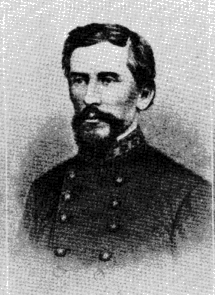
Patrick Cleburne
2 January 1864, Dalton, Georgia: Major General Patrick R. Cleburne, at a meeting of the General Officers of the Army of Tennessee, issues the "Cleburne Memorial," a document calling for the recruiting of slaves as soldiers for the Confederate armies, said slaves to be freed as a reward for faithful service. The Memorial also declares that the Confederacy should "guarantee freedom within a reasonable time to every slave who shall remain true to the Confederacy." Reaction to the document by his brother officers is mixed. While some such as General Joseph E. Johnston and Lt. Generals William Joseph Hardee and Benjamin Franklin Cheatham, are in agreement, most of the other Generals are bitterly opposed. General Johnston, despite his sympathy for the views espoused in the document, decides that the Memorial is "more political than military in tenor" and thus not a proper subject for discussion within the army. Cleburne, who is nothing if not a good soldier, obediently puts the document away.
12 January 1864, Dalton, Georgia: Major General William H. T. Walker, one of officers opposed to Cleburne’s proposal, had, immediately after it's presentation, asked Cleburne for a copy of the document. Cleburne, apparently unaware of Walker’s feelings about the proposal, gave him the requested copy. After having unsuccessfully attempted to gain permission from General Johnston to send the copy to the War Department in Richmond, on January 12 Walker acts on his own initiative and, contrary to orders, transmits the "incendiary document"...as he terms it...to the War Department.
13 January 1864, Richmond, Virginia: Secretary of War James Seddon, upon receiving the Cleburne Memorial, passes it on to President Jefferson Davis. Davis, "while recognizing the patriotic motives of its author," feels that the document will cause "distraction, discouragement and dissension" in the army and orders the document suppressed.
14 January 1864 (POINT OF DEPARTURE): An anonymous clerk in the Confederate War Department leaks a copy of the Cleburne Memorial to the RICHMOND ENQUIRER. The newspaper prints the document in full, accompanied by a very favorable editorial in support of it. The editor of the ENQUIRER writes...
"We believe that the negroes, identified with us by interest and fighting for their freedom here, would be faithful and reliable soldiers, and under officers who would drill them, could be depended on for much of the hardest fighting. It is not necessary now to discuss this matter, and may never become so, but neither negroes nor slavery will be permitted to stand in the way of the success of our cause. This war is for national independence on our side, and for the subjugation of the white and the emancipation of negroes on the side of the enemy. If we fail the negroes are nominally free, and their masters really slaves. We must, therefore, succeed, and we should be glad to see the Confederate Congress provide for the purchase of 250,000 negroes, present them with their freedom and the privilege of remaining in the States, and arm, equip, drill, and fight them."
The Cleburne Memorial and the ENQUIRER’S editorial are reprinted in newspapers throughout the South, and a nationwide discussion ensues as editors and opinion-makers line up for and against the proposal.1
14 January to 13 March, 1864: Debate over Cleburne’s proposal rages in newspapers across the South. Three different opinions garner large support...Group A, led by such newspapers as the RICHMOND EXAMINER and the CHARLESTON MERCURY, opposes the proposal because it will mean the end of slavery; Group B, led by such newspapers as the LYNCHBURG VIRGINIAN, supports the enlistment of slaves into the army, and agrees that any slaves who serve should be freed, but argues against the idea of general emancipation; and Group C, led by newspapers such as the RICHMOND ENQUIRER and MOBILE REGISTER, supports Cleburne’s proposal in its entirety...including the call for gradual and general emancipation.2
10 February 1864, Richmond, Virginia: Congressman Ethelbert Barksdale of Mississippi introduces onto the floor of the Confederate Congress "The Act to Increase the Military Force of the Confederate States." In this bill, Barksdale proposes that "...in order to provide additional forces to repel invasion, maintain the rightful possession of the Confederate States, secure their independence and preserve their institutions, the President be, and is hereby, authorized to ask for and accept from the owners of slaves the services of such number of able-bodied Negro men as he may deem expedient, for and during the war, to perform military service in whatever capacity he may direct." The bill goes on to specify that Confederate Negro troops are to receive pay, rations, and clothing equal to that provided for white troops, and that all such soldiers must be volunteers...the Conscription Act will not apply to blacks. There is no mention of freedom in the proposal, and indeed, the language of the bill seems to discourage the idea of emancipation by proclaiming that "Nothing in this act shall be construed to authorize a change in the relationship which the said slaves shall bear toward their owners."3
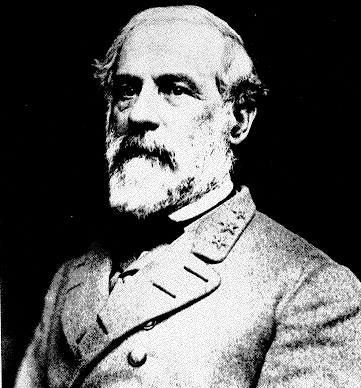
Robert E. Lee
18 February 1864, Richmond, Virginia: Following a recent visit by Congressman Barksdale to his headquarters, General Robert E. Lee sends Barksdale a letter in which he details his views on the proposed legislation. Lee writes: "We must decide whether slavery shall be extinguished by our enemy and the slaves be used against us, or use them ourselves at the risk of the effects which may be produced upon our social institutions. My own opinion is that we should employ them without delay. I believe that with proper regulation they can be made efficient soldiers." Furthermore, Lee adds, they should fight as free men, not as slaves. "In my belief," Lee writes, "the best means to secure the efficiency and fidelity of this auxiliary force would be to accompany the measure with a well-digested plan of gradual and general emancipation." Lee concludes by urging the Congress to act swiftly on the proposal, as "Every day’s time increases the difficulty. Much time will be required to organize and discipline the men and action may be deferred until it is too late." Barksdale reads the letter on the floor of the Confederate Congress, and many who were previously opposed to the bill reconsider their views.4
20 February 1864, Richmond, Virginia: Two days after Lee comes out in support of the measure, the Confederate House of Representatives passes the Barksdale bill. It then goes to the Senate. This body, however, is still bitterly divided, and passage is by no means certain.5
6 March 1864, Richmond, Virginia: The Virginia Legislature adopts legislation to allow recruitment of slaves into Virginia’s State Troops. In the same piece of legislation it orders its delegation to the Confederate Senate to vote in favor of the Barksdale bill.6
13 March 1864, Richmond, Virginia: The Confederate Senate passes the Barksdale bill by one vote. Senator Robert M.T. Hunter of Virginia casts the deciding ballot, even as he makes a passionate speech AGAINST the measure.7
14 March 1864, Richmond, Virginia: Negro hospital orderlies in Richmond enlist en masse. They are formed, along with convalescing white troops from the various hospitals, into an integrated battalion. They begin drilling shortly afterward in Capitol Square. 8
15 March 1864, Richmond, Virginia: President Davis, realizing that the passage of the Barksdale bill will inevitably lead to the emancipation of all the slaves in the South, heeds the urgings of Secretary of State Judah Benjamin and sends a diplomatic mission to the courts of Queen Victoria of England and Napoleon III of France. Headed by Louisiana Congressman Duncan Kenner, this mission will offer the emancipation of all the slaves within a short time after the war in exchange for immediate diplomatic recognition and support. The European governments are favorably impressed by this, but respond that they cannot recognize the Confederacy at this time, since the military fortunes of the South seem to be at a low ebb. They are not going to attach themselves to what appears to be a sinking ship. They leave open the possibility, however, of recognition at a later time, should the South’s military fortunes reverse their downward spiral.9
19 March 1864, Richmond, Virginia: The integrated battalion of Negro hospital orderlies parades through the streets of Richmond to Capitol Square, where they put on a drill exhibition. Reaction from the populace is mixed. Many cheer the Negroes as they march by, others hurl derisive remarks or even pelt them with mud. The march, and the skill demonstrated by the Negroes during the drill exhibition, are favorably reported on by the newspapers. Recruiting for Negro troops begins in earnest.10
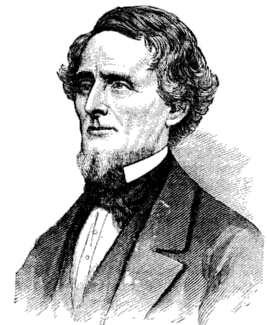
Jefferson Davis
23 March 1864, Richmond, Virginia: The Confederate War Department, at the direction of President Jefferson Davis, issues General Order No. 14, detailing the regulations under which Negro troops will be enlisted into the Confederate armies. One of the regulations states that no slave will be accepted into the army unless freed by his master first...so despite the wording of the Barksdale bill, enlistment in the Confederate army will mean emancipation for the Negro soldier. Another regulation states that no "Regiments, Brigades, or Divisions" will be formed of Negro troops...indicating an intention to use the new black recruits as replacements for the existing regiments of the Confederate armies (which was in accordance with standard Confederate practice throughout the war).11 Unlike the situation in the segregated Union armies, in the Confederate armies, white and black will fight side-by-side. A third regulation expands on the "equal pay, rations, and clothing" provision of the legislation to specify that Negro troops will receive equal TREATMENT.12 The Confederate regulations are much more enlightened than those in effect for the Negro troops of the Union army, a fact that will have significant impacts later on.
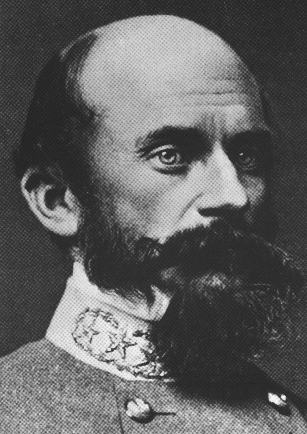
Richard Ewell
March to May 1864: Lt. General Richard Ewell is put in charge of the Confederate Negro Recruitment Bureau.13 C.N.R.B. Recruiting offices are opened in every major Southern city not under occupation by Union forces. The free black population of those cities responds immediately to the call for volunteers. Many if not most black slaveholders not only enlist, but recruit their own slaves as well.14 C.N.R.B. recruiting officers visit plantations throughout the South, attempting to persuade the slaves there to enlist, as well as to persuade the slave-owners to manumit those slaves who desire to enlist. Results are mixed. While the response from the slaves is generally positive, the response from many owners is less so, quite often an open refusal to cooperate.15 Newspaper editorials are soon branding such owners as "unpatriotic," and eventually, most decide to put their country’s interests above their own, and allow their slaves to enlist.16 By the end of April 1864, the number of recruits specified by the law (200,000) has been raised, and are being trained in camps throughout the South. By the end of May, the first of these new troops are joining their units, but they won’t be a major factor until late June, 1864.
April 1, 1864: President Jefferson Davis calls a conference of his main army commanders at Richmond. Attending are Generals Robert E. Lee, Joseph E. Johnston, P.G.T. Beauregard, and Braxton Bragg (who is President Davis’s military advisor). At this conference are hammered out the master plan for how the new infusion of strength into the Confederate armies can best be used. General Lee argues that the new strength should be concentrated so as to enable decisive blows to be struck in the two main theatres against the two main Union armies. "We are now at the bottom of the barrel, gentlemen," says Lee. "If we do not strike now, while we have this temporary advantage, we will surely lose this war. General Johnston and I will be forced back into the lines around Atlanta and Richmond, and it will become a siege, and then it will be a mere question of time."17 Lee’s argument sways the others, and the following plan is devised... It is decided to reinforce the two main Confederate armies (Northern Virginia and Tennessee) with 70,000 men each, the Transmississippi army with 30,000 men, with the remaining 30,000 enlistees to be distributed among the other lesser Confederate armies. A major problem faced by the Confederates is finding arms for the new recruits. There are perhaps 70,000 muskets immediately available in Confederate stocks, largely obsolescent smoothbores which have been phased out as the armies have been rearmed with Springfield and Enfield rifle muskets as these have become available.18 There is, of course, the hope that more of the modern rifles will be brought in through the blockade, but that can’t be counted upon to happen. The Confederates therefore face a choice...will they distribute the available arms among all the armies, or will they concentrate the new infusion of manpower in one theatre and hope to make a decisive blow there? The strategic decision is made to reinforce the Army of Tennessee first, then the Army of Northern Virginia, and then the other armies. The plan made, the various Generals return to their armies.
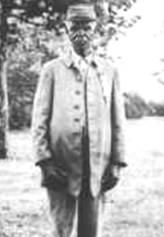
Private Louis Napoleon Nelson, 7th Tennessee Cavalry, shown in a postwar photo.
Nelson delivered General Nathan Bedford Forrest's proclamation to the Union garrison
at Fort Pillow, Tennessee on April 11, 1864.
11-12 April 1864, Fort Pillow, Tennessee: A Confederate force under Lt. General Nathan Bedford Forrest surrounds the Union garrison at Fort Pillow, Tennessee. About half of the Union troops are black, the other half are white Tennessee Unionists. Forrest, upon learning of the passage of the Barksdale bill, had freed his own slaves and recruited most of them into his command.19 He now issues a proclamation and has it read in front of the Union lines, under a flag of truce, by Private Louis Napoleon Nelson, a black trooper in Forrest’s command.20 The Proclamation states that the life of any Union Negro soldier who surrenders and takes an oath of allegiance to the Confederacy will be spared, and all such men will be accepted, should they be willing to volunteer, as enlistees in the Confederate army. But, ominously, the Proclamation also states that Forrest cannot be responsible for what might happen to those "traitors" who continue to serve as "Hessian mercenaries against their own country." During the course of the night almost all of the Union Negro troops desert to the Confederate lines. The Union commander, Major Booth, upon discovering this the next morning, decides to surrender the post without further resistance. Forrest, true to his word, enlists most of the former-Union Negroes into his command, where they serve honorably. Forrest will later write of them, "Better Confederates did not live."21
18 April 1864, Richmond, Virginia: President Jefferson Davis, upon hearing of Forrest’s actions at Fort Pillow, is impressed, and knowing a good idea when he hears one, issues a proclamation which empowers all Confederate military commanders to take identical actions when confronted by Union Negro troops. Over the next few months, as news spreads of this policy, as well as the more enlightened policy of treatment followed by the Confederacy toward its coloured troops, desertion rates among U.S. Colored Troops soar.
May 1864, Washington, D.C.: The news that the Confederacy is successfully recruiting black troops for its armies is discussed by President Lincoln and his cabinet. While some Cabinet members urge that measures be taken to disrupt the Confederacy’s recruiting effort, or to increase recruiting of Negroes for the Northern armies, President Lincoln dismisses the issue, replying glibly, "The Negroes cannot fight for them and at the same time work their fields for them. As a result this effort can have but little importance for us."22 No action is taken.
May 1864, Georgia and Virginia: The twin campaigns of Union Generals Grant and Sherman unfold much as they did in OTL.
--In Virginia, the Army of the Potomac, under General Ulysses S. Grant, crosses the Rapidan and enters the Virginia Wilderness on May 4. Grant’s army grapples with Robert E. Lee’s Army of Northern Virginia in major battles at The Wilderness, Spotsylvania Courthouse, and the North Anna River, as Grant relentlessly pushes southward toward Richmond. Meanwhile, Union cavalry under Major General Phillip Sheridan raid towards Richmond. On May 11, they are met by Lt. General J.E.B. Stuart’s Confederate Cavalry at Yellow Tavern, Virginia, where Stuart is mortally wounded. But the action at Yellow Tavern delays Sheridan enough that Richmond can be reinforced, so Sheridan turns aside and decides to link up with another Union Army under the command of Benjamin Butler, which is advancing up the James River from Fort Monroe, headed for Petersburg. Sheridan makes contact with Butler on May 14. On May 15, a Union army under the command of Franz Sigel which is invading the Shenandoah Valley is defeated by a Confederate force commanded by Major General John C. Breckinridge at the Battle of New Market, forcing the retreat of the Union forces from the Valley. On May 16, Confederates under General P.G.T. Beauregard attack Butler near Drewry’s Bluff, defeat him, and Butler retreats to the Bermuda Hundred peninsula. By the next morning Butler is...to quote Grant..."in a bottle and tightly corked," hemmed in by Beauregard to the east, and the James and Appomattox Rivers to the north and south. On May 18, having managed to avoid getting bottled up with Butler at Bermuda Hundred, Sheridan’s cavalry begins a hazardous journey to rejoin the rest of the Army of the Potomac. He links up with the main army at the North Anna River on May 24.
--In Georgia, Major General William T. Sherman marches out of Chattanooga on May 7 to begin his campaign aimed at the capture of the important Confederate railroad center and supply depot at Atlanta. His army of over 100,000 men faces the Confederate Army of Tennessee, commanded by General Joseph E. Johnston, who has approximately 60,000 men with which to oppose Sherman’s advance. Sherman maneuvers his opponent, Confederate General Joseph E. Johnston, out of one prepared position after another, forcing him ever further south toward Atlanta. Major battles are fought at Rocky Face Ridge, Resaca, Cassville, Pickett’s Mill and New Hope Church.
June 1864, Virginia: The campaign again unfolds much as it did in OTL.
--Battle of Cold Harbor: On June 1-3, the Army of the Potomac and Army of Northern Virginia grapple again at Cold Harbor. Poor generalship by Union commander Grant leads to massive slaughter for his troops as they attack Lee’s strongly entrenched lines. 7,000 Yankees are shot down in a 30 minute period during just one of several assaults made over the 3-day period.
--Shenandoah Valley: A Union army of 16,000 under David Hunter invades the Shenandoah Valley, where they lay waste to homes, fields, barns, and other private property on a massive scale. They fight several battles with Confederate forces under General W.E. Jones, steadily forcing him back. On June 11, Confederate General Lee sends Major General Jubal Early and his division to deal with Hunter. By June 18 he has combined with the forces under W.E. Jones to form a Corps, and now has command of nearly 20,000 men. He advances against Hunter, who retreats from the Valley by June 20. Now freed of the need to deal with Hunter, Early decides on a bold plan. His tiny army will make a raid against Washington, D.C.! Early leaves his base at Staunton, Virginia by June 30.
--Sheridan’s Trevilian Raid: On June 7, General Grant detaches his cavalry under Phil Sheridan and sends them to link up with the Union army under David Hunter which is operating in the Valley. A few days later, Confederate General Lee dispatches his cavalry under Generals Wade Hampton and Fitzhugh Lee to stop Sheridan. They clash with the Union cavalry near Trevilian Station on June 12-15, and defeat them. Sheridan abandons the plan to link up with Hunter and moves to rejoin Grant. He finally rejoins with Grant near Petersburg on June 25.
--Petersburg Campaign: On June 7, General Grant makes the decision to abandon the lines at Cold Harbor and to cross the James River. Once across, he will move against the city of Petersburg, a major road and rail junction and the "back door" to Richmond. Over the next several days, pontoon bridges are secretly built across the James, and on June 12, the Army of the Potomac begins to abandon its trenches at Cold Harbor. By June 16, the entire Army of the Potomac is on the south bank of the James (save for Warren’s Corps, which was left behind to screen the movement). Confederate General Lee does not discover this movement for several days. When he does discover it, he initially fails to guess the goal of Grant’s movement, thinking that Grant is once again moving directly on Richmond. He orders his army southward to cut off the approaches to the capital, but this has no effect on Grant. On June 15-16, the Union army makes several badly coordinated assaults on Petersburg which are barely contained by a motley force of less than 15,000 hastily assembled by Confederate General P.G.T. Beauregard. Beauregard sends urgent messages to Lee, who still refuses to believe that the Union Army is south of the James. Finally, on June 17, Lee at last perceives the threat to Petersburg, and orders his army toward Petersburg. By June 18, enough reinforcements have arrived to give Beauregard a force of 50,000 men to face the massive Union assault ordered by Union Generals Grant and Meade for that day. The Union assaults are repulsed with huge losses, and General Grant decides to begin a siege of the Confederate lines at Petersburg. Siege operations drag on throughout the rest of the month as both armies gradually extend their lines and dig in. On June 25, Union Colonel Henry Pleasants begins excavation on a tunnel underneath the Confederate lines. Eventually, it is planned to fill the mine with gunpowder and then detonate it, blowing a crater in the Confederate fortifications, which will, it is hoped, allow a successful assault to be carried out by Union troops. This project will consume several weeks, but will not be completed.
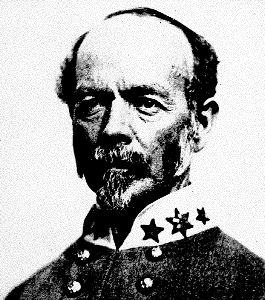
Joseph E. Johnston
June 1864, Georgia: General Joseph E. Johnston has retreated into the vicinity of Marietta, Georgia, where the Confederate army is preparing entrenched positions on and around Kennesaw Mountain. As Johnston has retreated nearer to Atlanta a trickle of the new black recruits have reached him, but has made no significant impact. Upon reaching the Marietta area, however, a large infusion of manpower reaches his lines, which nearly double in size the Confederate Army of Tennessee. Heavy rains during the weeks from June 9 to June 23 have slowed the advance of Sherman’s Union army, and have also provided cover for the reinforcement of the Confederate lines. General Johnston has learned that Sherman intends to assault his lines at Kennesaw Mountain once the rains stop, and has decided upon a bold plan, suggested by Lt. General John Bell Hood. Hood, a great admirer of Lt. General Thomas "Stonewall" Jackson, suggests a plan which emulates Jackson’s devastating flank march at Chancellorsville. Hood’s Corps (now reinforced and nearly 40,000 strong) will march via back roads, screened by the mountainous terrain and by Major General Joseph Wheeler’s cavalry, around the left flank of the Union army. Meanwhile, with his reinforcements, Johnston will extend the lines of the two Corps under Lt. General William J. Hardee and newly promoted Lt. General Patrick R. Cleburne (who was promoted to the command of the former Corps of Lt. General Leonidas Polk after the latter was killed at Pine Mountain on 14 June 1864) to fill the entrenchments vacated by Hood’s men. Hood energetically carries out his portion of the plan. He leaves the Confederate lines on June 21, 1864, and by June 26 is in position north and east of Sherman’s lines, near the Western and Atlantic Railroad terminal at Acworth, Georgia. Wheeler’s cavalry continues to screen Hood’s force, skirmishing heavily with Sherman’s cavalry. Sherman’s cavalry commanders send reports of heavy skirmishing in the area of Acworth, but Sherman...who distrusts his cavalry commanders and doubts the effectiveness of his mounted arm...concludes that his cavalry is skirmishing with Confederate cavalry raiders which pose no real threat to his plans, and decides to proceed with his attack the next day.
June 19, 1864: The Confederate commerce raider, C.S.S. Alabama, is sunk by the U.S.S. Kearsarge in battle off the French port of Cherbourg, France. Captain Raphael Semmes is picked out of the sea by the English yacht Deerhound and taken to England.
27 June 1864, Battle of Kennesaw Mountain, Georgia: At 9:30 a.m., Sherman launches his assault on the Confederate works at Kennesaw Mountain. At 11:00a.m., as Sherman’s assault is reaching its peak, Hood’s force arrives, via the line of the Western and Atlantic railroad, in the rear of Sherman’s army. Hood immediately launches a devastating attack. Hood’s force assaults the Union army’s entrenchments, which are lightly held, as most of the Union troops are now assaulting the Confederate lines on Kennesaw Mountain. The Union defenders are scattered, and Hood occupies the Union entrenchments. The attacking Union forces now find themselves between two strongly entrenched and defended lines, receiving fire from both front and rear. Whole regiments melt away under the withering fire from the two Confederate lines. Desperate to escape the trap, many Union regiments and brigades attempt to assault the lines held by Hood’s men. Some of these assaults are successful and force their way through, and in this way approximately half of Sherman’s force will escape. Most, however, are slaughtered, and panic soon ensues. By 5 p.m. the battle is over. Sherman has lost over 20,000 killed and wounded, against Confederate losses of less than 10,000. Almost 20,000 men, trapped between the two Confederate lines, surrender. About 70,000 of Sherman’s men have escaped and are fleeing toward Chattanooga. Unable to retreat directly north via the line of the Western and Atlantic, they march to the west. They will finally halt near Dallas, Georgia on 28 June, where their new commander, Major General George H. Thomas, attempts to restore order. Their old commander, Major General William T. Sherman, lies dead on the field of Kennesaw Mountain, his red head drilled by a Confederate sharpshooter in the first moments of Hood’s assault on the Union entrenchments.
28 June 1864, Georgia: General Johnston sends Hood and Wheeler in pursuit of the fleeing remains of the Union army. However, he has ambitious plans for the rest of his forces. Leaving their entrenchments, the Corps of Generals Hardee and Cleburne (a total of over 70,000 men) now march northward along the line of the Western and Atlantic Railroad, against virtually no opposition. Johnston aims to place his army, by rapidly moving north, between the remnants of the Union army and its supply base at Chattanooga. If successful, he hopes to bring the rest of the Union force to battle, destroy it, and then move to capture Chattanooga itself.
June 28 to July 8, 1864, Georgia: What becomes known to history as "The Race to the Oostamaula" continues as Thomas’s Union army, pursued by the Confederates under Hood and Wheeler, leaves Dallas and heads north toward the crossings of the Oostamaula River south of Resaca, Georgia. Constant probing attacks on the Union flanks by Wheeler’s cavalry force the Union army to take a much longer and more circuitous route to avoid being cut off from its line of retreat. Meanwhile, General Johnston, marching unopposed via the much more direct route along the line of the Western and Atlantic, makes better time. On July 6, Johnston arrives at the crossings, and his army takes up position on the north shore of the river, near the old battlefield of Resaca. Thomas and the Union Army, closely pursued by Hood and Wheeler, arrive on July 8, and find Johnston entrenched across their line of retreat. The stage is set for the Second Battle of Resaca.
July 1864, Virginia and Maryland: Early’s Washington Raid proceeds much as it did in OTL.
--July 2, Early enters Winchester, Virginia.
--July 3, Early defeats a Union force under Franz Sigel sent to intercept him, driving them back toward Harper’s Ferry. Panic begins to spread among civilians north of the Potomac.
--July 5, Early crosses the Potomac near Shepherdstown, Maryland. Union Generals Halleck and Grant now begin to take the threat seriously, and reinforcements are sent to the Washington defenses. Militia is called up to defend Maryland.
--July 6, Early captures Hagarstown, Maryland and demands a $20,000 ransom from the citizens.
--July 9, Battle of the Monocacy River: Early routs a Union force under Lew Wallace. Early presses on to Frederick, Maryland, where he demands a $200,000 ransom.
--July 11, Early arrives at Silver Springs, MD, on the outskirts of Washington. He attacks Fort Stevens, where President Abraham Lincoln is sight-seeing, and Lincoln comes under enemy fire, but is not injured. Washington is virtually defenseless, and if Early had pressed his attack, might easily have been taken. But Early, seeing reinforcements entering the city (a Corps of the Army of the Potomac under General Wright) decides against it.
--July 12, Early again skirmishes near Fort Stevens. Lincoln, standing up to watch, is pulled down by by an officer who shouts, "Get down, you fool!" Lincoln is again uninjured.
--July 13, Early begins to retreat toward the Potomac at Leesburg. Union General Horatio Wright is ordered to pursue.
--July 14, Early crosses the Potomac at Leesburg. Wright decides not to pursue them into Virginia.
9 July 1864, Second Battle of Resaca, Georgia: Union General Thomas orders an assault on the Confederate lines south of Resaca. The Yankees are repulsed with heavy losses. Late in the afternoon, Hood and Wheeler arrive from the south, and launch an assault on the rear of the Union force. Although this assault is also repulsed with heavy losses, the Union army is now essentially surrounded by a much superior force and cut off from any avenue of retreat.
10 July 1864, outside of Resaca, Georgia: At first light Union General Thomas sends out a flag of truce, requesting terms for the surrender of his army to General Johnston. Johnston, mindful that General Ulysses S. Grant has recently canceled the prisoner exchange cartel between the Union and Confederate armies, demands unconditional surrender. Thomas delays for another two hours, but finally agrees. Johnston and Thomas meet at 10:00 a.m. in a log cabin in the woods near Resaca, where they sign the instrument of surrender. By nightfall his men have laid down their arms and are on their way, under guard, to Atlanta. More importantly, the Confederates have captured over 80,000 modern rifle muskets in usable condition (including those captured at Kennesaw Mountain and at Resaca) and almost 100 cannon, which are shipped to Atlanta in preparation for eventual shipment to Richmond, where they will be used to equip the Negro troops which are to be integrated into the Army of Northern Virginia. Johnston issues a proclamation announcing the victory which is telegraphed to Atlanta, where it is read to jubilant crowds. In the proclamation Johnston makes special mention of the "new sable arm of our grand Southern army, without which our victory would have been impossible." News of the victory soon finds its way throughout the South.
July 11, 1864, Georgia: General Johnston orders the Army of Tennessee to march for Chattanooga.
July 15, 1864, Washington, D.C.: President Lincoln, upon hearing of the disaster in Georgia, calls a Cabinet meeting. It is clear now that the Confederacy’s efforts to recruit Negroes for its armies have been more successful than Lincoln would have dreamed possible, and Lincoln admits he made a mistake when he decided to ignore the issue when it was raised in an earlier Cabinet meeting last May. He orders Secretary of War Stanton to take all measures to disrupt the Confederacy’s recruiting efforts and to secure as many black recruits as possible for the Union armies. However, it is too little, too late, as the Confederacy has already completed its recruiting effort. Nevertheless, Union army units are sent to round up the slaves in those areas under Federal control and to place them in camps where they can be watched.23 These camps, where slaves are concentrated in one place, become known as Contraband Concentration Camps. Disease soon breaks out, and several thousand slaves die in these Camps. Press gangs are sent into the Camps to round up able-bodied males for conscription into the Union army.24 However, this only serves to create fear and hatred among the slaves, and most of the "recruits" thus gained for the Union forces desert to the Confederate lines at the first opportunity. Local army commanders, in an attempt to halt these desertions, begin threatening to take reprisals against the families of the Union black soldiers who are held in the Concentration Camps. When Lincoln hears of this, he immediately issues orders barring any reprisals. Some local Union commanders are found dead in mysterious circumstances shortly afterward. And the desertions continue.
Several other significant decisions are also made at the July 15 Cabinet meeting. First, with the loss of Sherman's army, Lincoln realizes that there is now no significant force in place to prevent the invasion of Kentucky...or even Indiana, Illinois, or Ohio...by the victorious Army of Tennessee. The War Department issues a flurry of orders, and soon a Union army is being cobbled together at Nashville, Tennessee from bits and pieces of garrisons from all over Alabama, Mississippi, Tennessee and Kentucky. Major General Edward R. S. Canby is sent from Mobile to organize the forces at Nashville.
Second, General Grant is ordered to abandon the siege of Petersburg and to take up a position to protect Washington. Grant is also ordered to detach one Corps and send it to join the army forming at Nashville.
July 15-31, 1864, Virginia: Grant’s army begins to withdraw to City Point, Virginia, where it can obtain seaborne transport to ferry Hancock’s Corps (which Grant is detaching) back to Washington. The rest of the army will cross the James River on pontoon bridges and will march overland back to the old camps on the Rapidan, where it can protect Washington. Grant also orders Union forces operating in the Shenandoah Valley to abandon their operations there and to rendezvous with the Army of the Potomac on the Rapidan. Confederate General Robert E. Lee detects the movement, but is unable to find a suitable spot to launch an attack. He shadows the Union Army as it marches toward the Rapidan, and by the end of the month the two armies are once gain back at their starting point...facing each other across the Rapidan. And, with the threat to the Valley gone, Lee orders General Early to join him on the Rapidan. The security of the Valley will be left in the capable hands of Colonel John S. Mosby’s Partisan Rangers.
July 15-31, 1864, Nashville, Tennessee: Under the able direction of Major General Edward R. S. Canby, who is an excellent organizer, by the end of July a motley army of 50,000 (including Hancock’s Corps of the Army of the Potomac, which has been sent, by train, from Virginia) has been assembled. There is the question of who is to command this force. Most of the best Union generals in the West...Sherman, Thomas, McPherson, Schofield, and many others...are either dead or captured. And there are two roughly equal-ranked Major Generals at Nashville now...Hancock and Canby. Canby enjoys a slight seniority over Hancock, and it is decided that Major General Canby will command the army. Canby is a conservative commander, and decides to wait in his entrenchments at Nashville to see what the enemy will do.
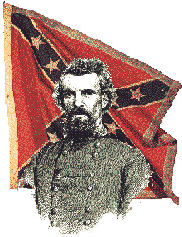
Nathan Bedford Forrest
July 16-31, 1864: One of the forces which is ordered to join the new Union army forming at Nashville is the expedition of Major General A.J. Smith, which had been sent in pursuit of Confederate cavalry commander Nathan Bedford Forrest. Smith had, on July 14-15, clashed with Forrest at Tupelo, Mississippi, winning a marginal victory in which Forrest was slightly wounded. But now he is forced to retreat hastily to Nashville, pursued and harassed by Forrest’s cavalry. Forrest manages to get ahead of Smith’s force near Spring Hill, Tennessee, and in the ensuing battle on July 28, Smith’s force is routed. Forrest orders a pursuit ("After ‘em, boys! Keep the skeer on ‘em!"), and within the next two days most of Smith’s force is either killed or captured. Forrest then moves to link up with the Confederate forces holding Chattanooga.
July 16, 1864, Chattanooga, Tennessee: The Confederate Army of Tennessee arrives outside the Union fortifications at Chattanooga. General Johnston orders an immediate assault, and the lightly-held Union works are carried. The city of Chattanooga, and the huge Federal supply depots there, fall into the hands of Johnston’s army.
July 20, 1864, Tennessee: After resting and refitting for a few days at Chattanooga, General Johnston orders the Army of Tennessee on the road again, this time headed for Nashville. However, before the army has gotten very far on its march, a courier catches General Johnston with a telegram from Richmond. Johnston is ordered to leave one Corps to hold Chattanooga, and to send the rest of his army, via railroad, to Virginia, there to link up with the Army of Northern Virginia at Petersburg. Johnston turns the army back toward Chattanooga. He decides to leave Hood’s Corps at Chattanooga, and to take Hardee’s and Cleburne’s Corps with him to Virginia. Johnston smiles. He will have to thank the Yankees for leaving so many locomotives and so much rolling stock at Chattanooga, and for keeping the rail lines between Chattanooga and Atlanta in such good repair, despite the best efforts of Johnston’s cavalry raiders to break the line.
July 20, 1864, Washington, D.C.: Hancock’s Corps arrives at Washington, and begins to entrain for the journey to Nashville, where they will arrive on August 1.
July 20, 1864: London, England: News of the surrender of Sherman’s army reaches Britain. Confederate Commissioner Duncan Kenner again approaches the British Government with the proposal that the Confederacy will commit to emancipate the slaves in exchange for recognition and support. This time, the British agree, and the next day, Great Britain formally recognizes the Confederate States of America as an independent nation. Napoleon III of France follows suit the next day.
July 21, 1864, Virginia: The train containing the captured arms and munitions taken from Sherman’s army arrives in Richmond. The rifle muskets are soon distributed to the waiting Negro recruits at the C.N.R.B. training depot at Richmond, and after a short period of training with these new weapons, these troops begin to be assigned to the various regiments of Lee’s Army of Northern Virginia. By the first week of August, the Army of Northern Virginia has been reinforced to a strength of slightly over 100,000 men.
July 21, 1864, Chattanooga, Tennessee: The Corps of Lt. Generals Hardee and Cleburne begin to entrain at Chattanooga. General Johnston will go with them, and the force will retain the name of Army of Tennessee. Hood’s force at Chattanooga will now be called the Army of Georgia...which will, it is hoped, help to keep the Yankees guessing as to how many Confederates are actually there. The trip to Virginia on the South’s rickety railroad network, on a circuitous route through Georgia and the Carolinas, will take 12 days.
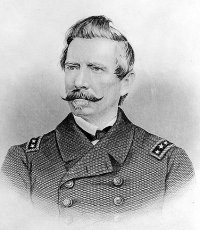
Raphael Semmes
July 22-August 15, 1864, England and France: Having obtained recognition for the Confederacy, Commissioner Kenner now tries to translate that into tangible aid for the Confederate struggle for independence. Both England and France are reluctant to commit to anything that might involve them directly in the war itself, especially since, even with the Confederate victory in Georgia, it is by no means clear that the Confederacy will be able to maintain its independence. They send messages to their ambassadors in the United States instructing them, in the event that the Confederacy should win a decisive victory in Virginia....to "offer mediation" with the object of arranging a peace based on Confederate Independence, with the strong implication that direct military support of the Confederacy will follow if the mediation is rejected. Although both nations balk at providing immediate direct military support, Britain and France do allow the Confederates to have unrestricted access to arms and equipment, and provide loans for the purchase of said arms and equipment. As a first gesture, both governments return to the Confederate States the various ironclad warships which had been built for the Confederacy in British and French yards (under the pretense that they were being built for various neutral nations), but had been confiscated when Union agents had exposed the fact that the purchaser of these vessels was in fact the Confederacy. Thus by early August, 1864, the Confederacy is in possession of a sizeable fleet of ocean-going ironclad warships, commanded by Confederate naval officers and crewed by "volunteers" from the British and French navies....C.S.S. North Carolina and C.S.S. Mississippi (turreted ironclad rams built by the Laird Brothers yard in England); C.S.S. Stonewall and C.S.S. Albert S. Johnston (ironclad rams built by the Arman Brothers yard in France); and the flagship of the fleet, C.S.S. Alabama II (a massive ironclad frigate built in Glasgow, Scotland on the traditional broadside plan, similar to the British Warrior, the French Navy’s Gloire, and the Union Navy’s U.S.S. New Ironsides). The flagship is named by the commander of the Confederate fleet, newly promoted Admiral Raphael Semmes, in honor of his previous ship, the raider C.S.S. Alabama, which was sunk by the U.S.S. Kearsarge on June 19. In addition, several other non-ironclad ships which were being constructed in British and French yards and existing ships which had been purchased for use as commerce raiders instead join the ironclads as support ships. These include C.S.S. Pampero, C.S.S Cyclone, C.S.S. Rappahannock, C.S.S Waccamaw, C.S.S. Black Prince, C.S.S. Georgia, C.S.S. Texas, C.S.S. Louisiana, and C.S.S. South Carolina (which had originally been named C.S.S. Mississippi, but had been renamed when the ironclad Mississippi joined the fleet).25 These vessels are armed, with assistance from the British and French, with from 8 to 20 heavy cannon each, and are roughly equivalent to U.S. Navy cruisers such as the Hartford or the Kearsarge (although in general they are more lightly armed than their U.S. counterparts). The flotilla of wooden vessels is placed under the command of Commodore Matthew Fontaine Maury, who reports to Admiral Semmes. By August 15, the Confederate fleet is completely outfitted, armed and equipped, and Admiral Semmes sets sail for America the next day. His target: the Union fleet at Charleston, South Carolina.
August 1864, Tennessee: Nathan Bedford Forrest arrives at Chattanooga on August 1, where he reports to General Hood. The Confederate Army of Georgia at Chattanooga now numbers nearly as many as the new Federal army forming at Nashville. Hood orders his cavalry generals, Forrest and Wheeler, to raid in the direction of Nashville, and more importantly, to harry communications between Nashville and Kentucky, in an effort to keep the Federal army pinned down. This they do with great success throughout the remainder of the month. The new Union Army of Tennessee (as the force at Nashville has styled itself) and its conservative commander, Major General Canby, will not stir from its fortifications.
August 2, 1864, Danville, Virginia: General Joseph Johnston’s Army of Tennessee (the Corps of Lt. Generals Hardee and Cleburne) arrive in Virginia. Within a few days they will join General Lee on the Rapidan.
August 2, 1864, New York City: A fast steamer brings dispatches from the U.S. Ambassador to Great Britain, Charles Francis Adams, announcing the recognition of the Confederacy by England and France. Adams also advises his government that the British and French have turned over to the Confederacy the various vessels they had previously seized, and forwards reports from Union spies of the intent of the Confederacy to use these vessels to attack the blockading squadron at Charleston. Orders are relayed, via telegraph and fast steamer, to Admiral Farragut at Mobile Bay, directing him to take his fleet to Charleston Harbor.
August 10, 1864, Virginia: General Johnston and the Army of Tennessee arrive on the Rapidan and unite with General Lee’s army. The Confederates now have approximately 165,000 men on the Rapidan, facing General Grant’s army of approximately 90,000 (the loss of Hancock’s Corps has partially been made up by this time, but the Union Army of the Potomac is still smaller than it was prior to detaching said Corps).
August 11, 1864, Virginia: Generals Lee and Johnston confer on how to best use this temporary advantage in numbers. Both commanders recognize that Johnston’s strength is in dogged defense, and it is decided to keep Johnston’s Army of Tennessee in the entrenchments along the Rapidan to pin the Union Army in place while General Lee and the Army of Northern Virginia slip away to cross the Rapidan away to the west, thereby hoping to get behind the Union force, or at the very least, strike it on the flank. Preparations are made for pontoon bridges to be rapidly laid across the river to facilitate the crossing of artillery so that Johnston’s army can pursue if the Union force leaves its Camps and retreats toward Washington. Preparation of the pontoons will take over a week, thus delaying the implementation of the Confederate plan. In the meantime, the Army of the Potomac will be further reinforced, and will, by August 20, number slightly over 110,000.
August 14, 1864: Admiral Farragut arrives at Charleston Harbor. After conferring with the commander of the blockading squadron there, he decides to take his fleet to Bermuda, and await the Confederates there. He knows that the Confederate fleet will need to restock their coal bunkers at Bermuda, and if he can force them to fight there, he might have them at a disadvantage. He sets sail for Bermuda on August 16 with a large fleet of 12 wooden steam cruisers, towing 8 monitors, and accompanied by the broadside ironclad U.S.S New Ironsides. Farragut’s flagship, as always, is the U.S.S Hartford. His fleet will outnumber the Confederate ironclads by almost 2-to-1, and he will also have a numerical advantage (as well as a substantial advantage in gun power) over the Confederate wooden warships. Farragut is confident of victory.
August 20, 1864, Virginia: The pontoons are completed and in position, ready to be laid, and General Lee begins to move west, behind the cover of the Wilderness, toward Orange Courthouse. The plan is to cross the Rapidan on the bridges of the Orange and Alexandria Railroad, north of Orange Courthouse, well to the west of the Union army’s encampments, then march northeast along the line of the Orange and Alexandria toward Bealeton, where Lee can entrench and block the line of retreat of the Union army toward Washington. General Johnston and the Army of Tennessee will demonstrate and conduct an artillery barrage to distract attention from Lee’s movement and keep the Union force pinned down.
August 20, 1864, near Bermuda: Admiral Farragut’s fleet arrives at Bermuda and takes station nearby. Scout ships are sent out to look for the expected arrival of the Confederate fleet.
August 21, 1864, Virginia: The Army of Northern Virginia reaches Orange Courthouse.
August 22, 1864, Virginia: The Army of Northern Virginia crosses the Rapidan north of Orange Courthouse, and by the end of the day the Confederates reach Culpepper Courthouse. Despite effective screening by Lt. General Wade Hampton’s Cavalry Corps, Union cavalry under Phillip Sheridan detect the movement late in the afternoon and a courier is sent to inform General Grant.
August 23, 1864, Virginia: The courier finds General Grant at about 3 a.m. and informs him of the movement of the Army of the Northern Virginia toward his rear. Grant, who is unaware of the arrival of General Johnston and the Army of Tennessee, at first finds this difficult to believe, as he knows there is still a large Confederate force facing him across the Rapidan. But more reports come in of Lee’s movements in his rear, and furthermore, at about 8:30 a.m. some Union officers, scanning with fieldglasses the Confederate lines across the Rapidan, spot the unusual "silver moon" flags of Cleburne’s Corps across the river, and Grant begins to put the pieces together. He now knows he is in deadly danger, and at 10 a.m. orders an immediate retreat toward Bealeton. His army begins crossing the fords across the Rappahannock by noon. However, by that time, Lee and the Army of Northern Virginia are nearing Bealeton. When Grant’s army arrives there at 6pm, they find the Army of Northern Virginia, firmly entrenched across the direct route to Washington, waiting for them. Both armies go into bivouac for the night, in preparation for the blood-letting both know will happen on the morrow. Meanwhile, Joe Johnston observes the last of the Army of the Potomac moving north toward the fords at about 2pm. He orders the pontoon bridges to be put in place, and by 6pm he begins crossing, with the Army of Tennessee, in pursuit. The Army of Tennessee crosses the fords over the Rappahannock and halts, about 10 miles from Bealton, at midnight.
August 23, 1864, near Bermuda: Union scout ships make contact with the Confederate fleet off Bermuda. Admiral Semmes, not expecting to find Union vessels near Bermuda, correctly suspects that they are the scouts of a fleet sent to intercept him. One of the scouts gets back to Admiral Farragut and advises him of the approach of the Confederate fleet. Both admirals are now aware of the presence of the other, and both order their fleets to prepare for battle.
August 24, 1864, Battle of Bealeton, Virginia: Beginning at first light, General Grant orders several assaults on the Confederate lines in an attempt to break through toward Washington. These are repulsed with heavy losses. At 2pm Joe Johnston and the Army of Tennessee arrive and attack the rear of the Union army. The Army of the Potomac begins to disintegrate in a rout, but Grant with about 60,000 men manages, by making yet another assault concentrated on a small portion of Lee’s lines, to break out of the trap and flee toward the defenses of Washington. About 20,000 Union troops are left dead or wounded on the field, and a further 30,000 are trapped and captured, against losses of 15,000 for the Confederates. Among those killed are Generals George Meade and Phillip Sheridan. General Ambrose Burnside is captured. General Lee is disappointed that the Union army has once again escaped his grasp, but, with General Johnston, sets out in pursuit.
August 24, 1864: Battle of Bermuda: At mid-day the two fleets come in sight of each other. The battle quickly breaks into separate fights. The Confederate wooden ships under Commodore Maury attack the Union’s wooden cruisers, but the Union ships have the advantage over their more lightly armed and less numerous Confederate counterparts, inflicting heavy damage on them and sinking two (Rappahannock and Texas). Maury is killed by a Union marine sharpshooter while trying to rally his force. The two broadside ironclads (New Ironsides and Alabama II) line up and start pounding each other, without either making much of a dent in the other. The decisive encounter, however, proves to be that of the remaining four Confederate ironclads as they take on the Union monitors. While the Union monitors are more heavily armored and have bigger guns in the form of 15 inch Dahlgrens, the Confederate ironclads have a decisive advantage...they are equipped with rams.26 The Union monitors, which are designed for use in the protected waters of coastal harbors, do not handle well in the heavy seas of the mid-Atlantic, are unable to maneuver out of the way, and in the first hour of the battle four of them are rammed and sunk. After a fifth monitor is also sunk in this way, Farragut signals the survivors to flee for the sanctuary of nearby Bermuda Harbor (once they arrive there they are granted sanctuary, but are interned by the hostile British authorities and not permitted to leave). The four Confederate rams do not pursue, but then turn on the U.S.S New Ironsides, which is rammed 3 times and goes down with all hands. The five Confederate ironclads then advance on the Union wooden steam cruisers. Seeing the approach of certain destruction, Farragut orders his fleet to disengage and flee to Charleston. The Confederate vessels do not pursue, and the battle is over. The whole battle takes less than 3 hours. Admiral Semmes has won a great victory, but his fleet has suffered, especially the wooden component of it. He puts into Bermuda for repairs and to restock his supplies.
August 25, 1864, Virginia: General Grant and the shattered remnants of the Army of the Potomac retreat along the line of the Orange and Alexandria Railroad. Meanwhile, Generals Lee and Johnston have decided on a plan for the pursuit of Grant’s army. It has been decided that General Johnston and the Army of Tennessee will pursue the Yankees along the line of the Orange and Alexandria Railroad, while General Lee and the Army of Northern Virginia will take the Warrenton Turnpike and try, by hard marching, to get ahead of the retreating Federal force. The Union army halts for a few hours at Bristoe Station, Virginia, where Grant tries to restore some semblance of order to the army. However, it soon becomes clear that the Confederates (in the form of Johnston’s Army of Tennessee) are in pursuit, and the Union force resumes its march. Because of the disorganized condition of the Union force, they make slow progress, and since most of the cavalry was lost at Bealeton along with their commander, General Sheridan, they are operating essentially blind. Unknown to them, Robert E. Lee and the Army of Northern Virginia have outdistanced them. By nightfall the Yankees are encamped outside of Manassas Junction, south of the old Bull Run battlefield, but their foes are encamped near Centerville. By first light the next day, Lee’s exhausted men will be firmly entrenched across all the avenues of retreat toward Washington. Scouts from Hampton’s cavalry confirm that the Union Army is still on the west side of Bull Run, and Lee knows that Grant must pass through the Centerville area if he is to reach safety in Washington. He has his adversary trapped, and he knows it.
August 26, 1864, Battle of Centerville, Virginia: At first light, Lee sends an officer under a flag of truce to the Union lines. He advises Grant that all the avenues of retreat to Washington are blocked, and that the Confederate Army of Tennessee will soon be approaching his rear, and offers to meet Grant to discuss terms for the surrender of the Army of the Potomac. Grant’s few remaining cavalry scouts are sent out to verify this news, and quickly return with confirmation. But Grant is a fighter, and it is not in his nature to give up without making one last effort to escape. He sends the Confederate officer back to Lee with his compliments, but says "I do not think it has come to that point just yet." Lee is saddened at the prospect of more, essentially useless, blood-letting, but he gives orders to his men to prepare for an assault. The assault is not long in coming. But the Army of the Potomac is exhausted, morale is virtually non-existent, and many units simply refuse to advance. Those which do advance make no impression on the Confederate defenses, while losing over 5,000 men in less than an hour. It is all over by noon. Grant, realizing that he is not going to break out of the trap, and with reports coming in of the approach of the Army of Tennessee upon his rear, sends out a flag of truce with a message requesting a meeting with General Lee. A place and time are arranged, and the two Generals meet. General Lee offers very generous terms. Officers and men will be paroled and allowed to return to their homes, provided they take an oath not to fight against the Confederacy until properly exchanged. Officers can keep their side-arms, but the rest of the Army of the Potomac’s arms and equipment must be turned over to the victors. General Grant accepts these terms.
August 27, 1864, outside Centerville, Virginia: At a ceremony held the next morning, the Army of the Potomac formally lays down its arms, and furls it’s colours. The Army of the Potomac is no more.
August 28, 1864, Virginia: The Army of Northern Virginia and the Army of Tennessee march north, headed for White’s Ford over the Potomac. Their objective....Washington.
August 29, 1864, Virginia: The Army of Northern Virginia and the Army of Tennessee cross the Potomac at White’s Ford and turn southeast, heading toward Washington. By nightfall they are at Rockville, Maryland.
August 30, 1864, District of Columbia: The Confederate armies reach the defenses of Washington. An assault is made, but fails...over the past month the defenses of Washington have been strongly reinforced. Even though most of the forts around Washington are manned with new conscripts, the defenses of Washington, when fully manned even by raw troops, present a formidable obstacle. Generals Lee and Johnston begin siege operations.
September 1, 1864: Lord Lyons, ambassador of Great Britain to the United States, pays a visit to President Lincoln at the White House. He has with him a note which he was instructed to present to President Lincoln in the event of a decisive Confederate victory in Virginia. By now, news not only of the surrender of the Army of the Potomac, but also the disaster suffered by the Union fleet at Bermuda, has reached Washington, and the city itself is now under siege by the Confederate armies. The note states...
"Her Majesty’s Government urgently desires a cessation of hostilities between the United States and the Confederate States, and is willing to act as mediator during the negotiation of a settlement based on the recognition of Confederate independence. Her Majesty’s Government has already recognized the independence of the said Confederate States, and if the United States insists on continuing the useless struggle to deny those States their independence, Her Majesty’s Government is prepared to take whatever measures are necessary to secure the independence of the Confederate States."
Lincoln at first angrily denounces this "meddling in our internal affairs by the British government," and flatly refuses to agree to negotiations. Lord Lyons, however, decides to lay diplomacy aside and to be brutally frank. "President Lincoln," he says, "the United States have lost their two primary armies. A Confederate fleet is about to raise your blockade of the Confederacy’s Atlantic coast. Your own capital city is under siege by two Confederate armies. Sir, it is time this wasteful struggle came to an end. Her Majesty’s Government, as well as that of the Emperor Napoleon of France, are determined that it SHALL end. If you will not negotiate, we WILL intervene militarily to see that it DOES end. The United States has not proven successful even in defeating the Confederacy. Do you now think it capable of defeating the Confederacy together with Britain and France?" Lincoln, shocked by this naked declaration, is speechless for several seconds. Then, dejectedly, he looks down at the floor. "No, I don’t suppose that it is. Although I would rather die a thousand deaths, I will accept the offer made by Her Majesty’s Government to mediate between my government and that of the Confederacy." Lord Lyons stands, and bows. "You have made a wise decision, worthy of the leader of a great nation." He then tips his hat, and leaves the office.
September 2, 1864: Flags of truce are sent out from Washington to the Confederate lines surrounding the city, advising Generals Lee and Johnston of the acceptance of the British mediation proposal and proposing an immediate cease-fire on all fronts while negotiations between the United States and the Confederate States commence. General Lee telegraphs these proposals to President Davis in Richmond, who immediately accepts. The ceasefire will take effect at midnight, September 3, 1864, with the various armies to remain in their present locations pending the outcome of negotiations. The war is essentially over, but several months of tense negotiations lie ahead before a final peace treaty is hammered out.
September 1864, London, England: The London Conference between representatives of the United States and the Confederate States is hosted by the British Government beginning on September 30, 1864. The conference is acrimonious, and nearly breaks down at several points over the next several months, but the British mediators manage to get the negotiations back on track. The Union negotiators seem to be stalling, pending the outcome of elections to be held in the United States in November.
November 1864: Elections held in the United States. Democratic candidate George B. McClellan defeats Abraham Lincoln and is elected the 17th President of the United States. President Lincoln, fearful that the new Democratic President-elect will "give away the farm" at the negotiations in London, presses his negotiators to reach an agreement before the new President is inaugurated in March 1865.
January 5, 1865, London, England: After over three months of negotiations, a peace treaty is now ready to be signed. Key points include...
---The independence of Virginia, North Carolina, South Carolina, Georgia, Florida, Tennessee, Arkansas, Alabama, Mississippi, Louisiana, and Texas are immediately recognized, and the existence of the Confederate States of America is also recognized.
---Elections to determine the fates of Maryland, Kentucky, West Virginia and Missouri will be held within 1 year. An election commission, to be composed of representatives of the United States, the Confederate States, and a neutral power to be named later, will oversee these elections to see they are conducted in a fair and fraud-free manner. All Federal and Confederate troops will be withdrawn from these States immediately pending the results of these elections.
---The Confederacy renounces all claim to its Territory in Arizona and to all other territory in the far West beyond Texas (this had been a major point of contention, but the Union negotiators, at the insistence of President Lincoln, held fast and in the end, carried the point. The Confederates had not been in possession of any of this territory since late 1862 anyway, so they were in a bad negotiating position to start).
---The Indian Territory (present-day Oklahoma) is attached to the Confederacy as a self-governing protectorate.
---Each side agrees not to provide safe haven to hostile Indians which might be raiding the other, and to cooperate in the pursuit of hostile Indians which cross the international border.
---The United States will not be required to return fugitive slaves which escape into its territory.
---Federal troops will be immediately withdrawn from all territory belonging to the Confederate States of America. Confederate troops will likewise be immediately withdrawn from territory belonging to the United States (specifically the District of Columbia).
---The United States will not be required to pay reparations to the Confederacy for damage caused by the war. In exchange, the Confederacy will not be required to pay the United States for Federal property seized by the Confederate States within their borders, and will be absolved of obligation to pay for any portion of the national debt of the United States incurred prior to the secession of the Confederate States from the Union.
---Free navigation of the Mississippi River is guaranteed to shipping from the North, and the two nations agree to maintain tariffs of no more than 5% on goods imported from each other. Neither the Union or the Confederacy are permitted to maintain warships or fortifications on the Mississippi River.
---The District of Columbia will remain in Federal hands pending the outcome of the election determining the final status of Maryland. If Maryland votes to join the Confederacy, the District of Columbia will be turned over to the Confederacy, otherwise it will remain in the possession of the United States.
January 20, 1865, Washington and Richmond: The Treaty of London is presented to the Senates of the United States and the Confederate States for ratification.
February 15, 1865: The Confederate States Senate ratifies the Treaty of London. During the debates leading up to ratification, the Texas delegation has strongly protested the provision of the treaty which abandons the Confederacy's claim to the Arizona and New Mexico Territories. Texas has long had an outstanding claim to all the portion of the New Mexico Territory east of the Rio Grande, and Texas Senators loudly proclaimed that the Confederacy is abandoning Texas interests in favor of those of other States. But the vote by the Senators from other States is virtually unanimous in favor of the treaty, so it passes by a wide margin.
March 1, 1865: The United States Senate ratifies the Treaty of London. The War of Secession is officially at an end.
GO TO PART TWO--THE GILDED AGE

NOTES FOR PART ONE--"FROM A SINGLE ACORN..."
1
In actual history, Cleburne’s Memorial was never made public, and only became known when it was discovered, years later, during the compiling of the OFFICIAL RECORDS. However, the editorial by the RICHMOND ENQUIRER which starts the nationwide debate over black recruitment and emancipation is historical. It actually was published in October 1864, in response to a letter by Louisiana Governor Henry Watkins Allen which advocated the recruitment of slaves as soldiers for the Confederate army. I am merely substituting Cleburne’s Memorial for Allen’s letter as the catalyst which caused the ENQUIRER to act. An excellent resource for information about the process which lead to the passage of the black recruitment law in the Confederacy and Confederate views toward the twin issues of black recruitment and emancipation is Robert F. Durden, THE GRAY AND THE BLACK: THE CONFEDERATE DEBATE ON EMANCIPATION, Baton Rouge, LA: LSU Press, 1972. This work is a compilation of reprints of very nearly everything written or published on the issues of black recruitment and emancipation within the Confederacy during the war, including newspaper editorials, legislation, political speeches, etc.2
In real history, events unfolded identically between October 1864 and January 1865, but not a result of Cleburne’s proposal, of course. I am compressing the time frame here a little, but not much.3
Happened exactly one year later in OTL.4
Happened 1 year later in OTL.5
As happened exactly 1 year later in OTL.6
As happened exactly 1 year later in OTL.7
As happened exactly 1 year later in OTL.8
As happened exactly 1 year later in OTL.9
In OTL, Congressman Kenner was dispatched with an identical proposal in January 1865, after the failure of the Hampton Roads Peace Conference. And it was rejected by the British and French for the identical reason.10
As happened exactly 1 year later OTL.11
The practice of using new recruits as replacements in existing units, rather than (as was the practice in the Union Army) using them to form new regiments, helped to maintain unit esprit de corps. It also meant that new Confederate recruits became effective soldiers much quicker than in the Union army (where General Sherman estimated it took a full year for a new recruit to become an effective soldier), because they were able to learn from the veterans to whose units they were assigned. So it makes complete sense that the Confederates would continue the practice with their new black recruits, and this is what General Order #14 indicates.12
All of these provisions were in the actual General Order #14, issued exactly one year later in OTL.13
There was no C.N.R.B. in OTL, but Lt. General Ewell was put in charge of the Confederacy’s recruiting efforts. I am theorizing that the C.N.R.B., or something like it, would have been created if the Confederacy had more time to work on the issue.14
The reaction of free blacks and black slaveholders is based on the fairly general patriotism and support for the Confederacy shown by these people throughout the war in actual history.15
The reactions of slaves and slaveholders is also per OTL.16
Such editorials were beginning to appear as the war ended...I am theorizing that the ‘shame factor" would have compelled most owners to fall in line fairly quickly.17
Paraphrasing an actual Lee quote made during the Battle of the North Anna River in May 1864.18
This is a fairly accurate estimate of the reserves available.19
Forrest had earlier, in 1863, promised any of his slaves who served with him faithfully through the war that he would free them, and most of the slaves did so. They went with him and served as cooks and teamsters, etc., but not as actual fighting troops. It is a logical assumption that with the passage of the Barksdale bill, he would have freed them and armed them.20
Louis Napoleon Nelson was an actual black soldier with Forrest’s command. His grandson, Nelson Winbush, is a member of the Sons of Confederate Veterans today.21
Forrest did speak thusly after the war of the black soldiers under his command in OTL.22
The views expressed by Lincoln are as per OTL.23
In some areas camps for slaves rounded up in different areas by Union forces (as well as those who ran away to seek sanctuary with the Union armies) were set up in OTL. Most of the slaves there were used to work local plantations for the Union authorities...they basically exchanged one master for another. I am theorizing that this practice would have been expanded.24
Similar things actually happened in OTL. Indeed, the practice of forcing slaves into the Union army at gunpoint became so prevalent that in OTL President Lincoln himself attempted to halt the practice, without success.25
All of these vessels would historically been available to the Confederates at this time in 1864, if the British and French governments had chosen to release them.26
That rams could be the decisive factor in a battle between ironclads (at least in the days before the invention of powerful, high-velocity, long-range artillery rendered such tactics suicidal) is illustrated by the Battle of Lissa, July 1866, between the Austrians and the Italians. The Austrian ironclads, through ramming tactics, sank or heavily damaged several Italian ironclads with no loss of their own.
Some clipart on this page is courtesy of

The music file of THE BATTLE CRY OF FREEDOM was composed and is copyrighted by Barry Taylor. For more great tunes like this one, check out THE CONTEMPLATOR'S FOLK MUSIC SITE.
Copyright 2003-2005 by Robert Paul Perkins. All rights reserved. Last Updated on 28 May 2006.