Producing Non-Projected Display Materials
How non-projected displays can be used in different teaching/learning situations
Like printed and duplicated materials, non-projected displays can be used in a wide range of teaching/learning situations, covering all three of the basic classes (mass instruction, individualised learning and group learning). Let us now examine their potential roles in each.
Mass instruction
This is probably where non-projected displays are capable of making their most important contribution. Indeed, many of the displays that fall into the category are specifically designed for use as visual aids during expository teaching of one form or another. In such teaching, their role is, of course, entirely supportive. It must be added, however, that with mass instruction now being delivered to classes of up to several hundred, even large non-projected displays have relatively limited usefulness when numbers of this magnitude are involved. Getting round this by using multiple non-projected displays tends to be unwieldy and expensive.
Individualised learning
Although some types of non-projected display are of little or no use in individualised instruction, others are capable of playing an extremely useful role. Models, for example, can be used in a wide range of self-instructional situations, as can various types of realia (eg geological and biological specimens). In most cases, such materials play a key role in the instruction process by providing the actual objects of study. Kits of standardised non-projected materials have clear uses in distance-learning situations, for example.
Group learning
Many non-projected display materials can also play a useful supportive role in group-learning situations, eg by providing visual aids during presentation/discussion-type activities such as seminars and tutorials, or providing the subject matter for small-group exercises.
All these various uses of non-projected displays will be discussed in greater detail in the sections that deal with specific types of display.
Chalkboards and markerboards
The first group of non-projected display media that we will consider are the various dark-coloured surfaces on which displays can be written or drawn using chalk (chalkboards) and the various light-coloured surfaces on which similar displays can be produced using suitable markers, pens or crayons (markerboards). Let us now look at these in turn.
Chalkboards
The chalkboard (or blackboard as it was called until it was realized that such boards were seldom black any longer) is so much a part of the learning environment that it has become a symbol for education itself. Indeed, until the development of the overhead projector during the 1940's and its subsequent spread into virtually every classroom and lecture theatre, the chalkboard was probably the most important of all instructional aids (apart from the printed page). Even today, such boards are still a standard fixture in teaching and training environments, although their use is by no means as automatic and universal as was the case in the past.
The different types of chalkboard. Until the 1950's, practically all chalkboards were still black, consisting of large sheets of wood covered with matt-black paint. Since then, however, most such boards have been replaced by other types of surface, such as cloth, various forms of plastic and other synthetic materials. In addition, most chalkboards are now coloured, the most common colour being green and other widely-used colours being blue and brown. This is because coloured boards have been found to produce less glare and reflection, are less prone to 'ghosting' (marks left when the chalk is rubbed out), and, in general, provide greater legibility than the traditional 'blackboard'.
Another comparatively recent development in the evolution of the chalkboard has been the appearance of the magnetic chalkboard - a surface made of ferromagnetic material covered with a thin layer of dark-coloured vitreous particles. This can be used in the same ways as magnetic markerboards, and will be discussed later in the booklet.
How chalkboards should (and should not) be used. Traditionally, the chalkboard was used in virtually every situation where textual, mathematical or graphical material had to be displayed to a class or small group - and, in some establishments, is still so used. Certainly, it is a versatile, inexpensive and useful teaching aid, and, if a teacher, instructor or trainer so wishes, can be used for such straightforward expository purposes as:
- The systematic display of virtually the entire subject matter of a lecture or taught lesson to a class.
- The display of a 'skeleton guide' to such a lecture or lesson, eg in the form of a set of section and sub-section headings.
- The display of specific items (maps, diagrams, tables, etc) during such a lecture or lesson.
It can, however, be argued that all these functions can be fulfilled just as effectively - and a great deal more conveniently - by use of an overhead projector or data projector. What, for example, is the point of laboriously copying a lengthy mathematical proof, scientific derivation or complicated map or diagram onto a chalkboard, only to have to rub it out after it has been used once? Would it not be much more sensible to produce a permanent copy of the material so that it can be used again and again?
It is now generally acknowledged that the most appropriate - and most effective - way of using the chalkboard in the modern classroom or lecture theatre is as a means of displaying impromptu material (words, equations, diagrams, etc that have become necessary due to an unexpected turn in a lesson) and material which is developed in the course of the lesson by interaction with the class (ideas produced by buzz groups, experimental results, solutions to tutorial exercises, and so on). Thus, it is still strongly advisable that teachers, instructions and trainers should take the trouble to become reasonably proficient in the use of the chalkboard so that they can cope effectively with such 'off-the-cuff' requirements.
How to develop basic chalkboard skills. Despite its long tradition of use, many teachers and trainers find the chalkboard a difficult medium to handle - often simply because they have never taken the trouble to master the necessary basic techniques. Many people, for example, hold the chalk the wrong way - holding it like a pen or pencil rather than in the correct way shown in Figure 1. As can be seen, the chalk should be held between the fingers and thumb, with the non-writing end pointing in towards the palm of the hand, and should be presented to the board at a fairly low angle.
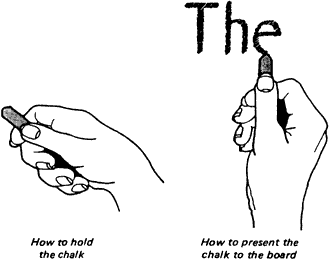
Figure 1 : How to use chalk correctly
Also, many people make the mistake of trying to use the fingers to write with the chalk, as they would with a pen or pencil. The correct technique is to use the fingers and thumb simply as a chuck to hold the chalk, and to use the entire hand to make the writing stroke, executing the stroke by movements of the shoulder joint and (to a lesser extent) by wrist, elbow and body movements. Some other useful points of technique are given below.
- Rotate the chalk slightly as you make each stroke, and change to a new facet of the chalk face for each new stroke or word (this helps to keep the lines of uniform thickness).
- Always try to place the chalk length in line with the stroke being drawn, so that the chalk is pulled across the board (note that this may necessitate the wrist being placed in an awkward position).
- Stand in such a position that you can reach the board easily with the elbow of your writing arm only slightly bent.
- Use body sway and bending of the knees to reach different parts of the board during a stroke, keeping a balanced stance throughout.
- Try to develop a clear writing or printing style that can be read without difficulty from the back of the classroom in which you are working; check this by going to the back of the room yourself.
- Leave generous spaces between words - this greatly increases legibility.
- Always try to achieve a neat, systematic lay-out, with level, uniformly-spaced lines of writing; if necessary, draw light guidelines on the board using a chalkboard ruler or T- square.
The subject of basic chalkboard technique is dealt with in much greater length in the book by Pringle that is listed in the 'Further Reading' section, and interested readers are referred to this. The book by Mugglestone also provides useful information on how to use the chalkboard effectively.
Some useful methods of producing graphic displays. For the benefit of those who still like to use the chalkboard to display graphic material such as maps and diagrams, let us now examine some of the 'tricks of the trade' that can be used to produce such displays. Some people, of course, have no need to resort to such methods, since they possess the artistic and graphic skills to produce all such material freehand, but most of us need all the help we can get.
The grid method (see Figure 2). This is one of the simplest methods of producing an enlarged version of graphic material, whether on a chalkboard, markerboard, or any other medium. It involves covering the material to be copied with a pattern of square grid lines, either by drawing the lines on the material itself or by covering it with a transparent sheet on which the grid has been drawn. (The latter method is recommended, since the grid, once prepared, is available for future use.) If a similar grid, scaled up by whatever factor is required, is now lightly drawn onto the surface on which the enlarged copy is to be made (or, even better, projected onto the surface using an opaque or overhead projector), the resulting grid lines will probably enable even the least talented of artists to produce a reasonable copy of the original material. Many roller-style chalkboards have a section which is grid referenced so that enlargement becomes a matter of technical accuracy rather than artistic skill.
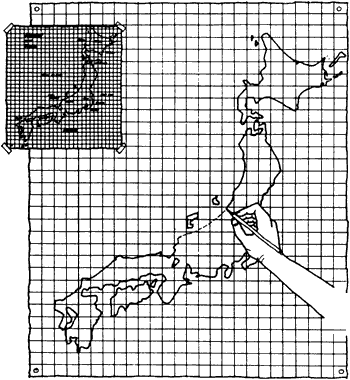
Figure 2 : The grid method of producing enlarged copies of graphic material
The projection method. This is another standard technique that can be used to produce enlarged versions of graphic or photographic materials on surfaces of all types. It involves projecting a suitably-enlarged image outline and whatever other detail one wishes to reproduce. Note that the method can be used with both transparent and opaque originals by using the appropriate type of projector - a slide projector for photographic slides, a filmstrip projector for filmstrip frames, an overhead projector for large transparencies and an art-aid or opaque projector for photographic prints and other opaque items. Also note that an ordinary overhead projector can be used as a makeshift opaque projector by placing the material to be copied on the platen, image side upwards, and illuminating the material from above using a portable lamp of some sort (see Figure 3).

Figure 3 : The projection method of producing enlarged copies of graphic material
The template method. Another technique that can be used to draw outline figures on both chalkboards and markerboards is the template method. This is particularly useful in cases where standard shapes (eg maps, scientific apparatus, geometrical figures or dress patterns) have to be drawn repeatedly with some accuracy. It involves preparing a template of the shape using some suitable stiff, lightweight material such as thin sheet metal, thick card, plywood or rigid plastic, a template that can then be placed on the board and traced round whenever the shape has to be drawn. Templates can be produced from smaller originals by drawing them on a sheet of the chosen material using the projection method described above. It is, incidentally, a good idea to fit such templates with a handle of some sort to make it easier to hold them against the board while in use.
The pounce pattern method. This is another method that can be used to reproduce standard shapes which have to be drawn repeatedly and with accuracy. It involves first producing a line drawing of the required shape on a large sheet of paper or thin card, and then punching small holes along the lines at regular intervals (between 1cm and 2cm apart, depending on the detail required). With paper, this can be done using a special tool fitted with a spiked wheel, which is run along the lines when the paper is placed on a suitable surface (eg a sheet of soft wood). With card,the holes can be punched out using a leather worker's punch or similar device. If the completed pounce pattern is now placed flat against the surface of the chalkboard, held in position using strips of adhesive tape, and the lines to be drawn lightly tapped with the face of a dusty chalkboard eraser, the outline of the shape will be transferred onto the board in the form of lines of dots. These can then be joined up to produce the required figure. By preparing such pounce patterns before lessons, it is possible to impress classes considerably by the ease and skill with which you apparently draw complicated diagrams freehand!
The above techniques are all described in much greater detail in the books by Wittich and Schuller and by Minor and Frye that are listed in the 'Further Reading' section at the end of this booklet.
Markerboards
These boards, which are also known as whiteboards, are common in training rooms and are sometimes now fitted in teaching rooms instead of or additional to conventional chalkboards. They consist of large sheets of white or light-coloured plastic material with a surface texture suitable for writing or drawing on using appropriate felt pens, markers or crayons, and can be used in much the same way as chalkboards. They have, however, a number of advantages over the latter. There is, first of all, none of the mess that always results when chalk - even the 'dustless' variety - is used. Second, a much wider range of colours and tone strengths can be used, and the resulting display is invariably sharper, better-defined and clearer than is possible using chalk. Third, a markerboard - unlike a chalkboard - can double up as a projection screen if required.
There is, however, one possible problem that can arise with markerboards: difficulty in cleaning the surface properly so that 'ghost' marks are not left behind. For this reason, it is strongly advisable to use only the types of marker pens or crayons that are recommended by the manufacturer of the particular board you are using, and to make sure that you know how the board should be cleaned. In some cases, this can be done simply by wiping with a dry or damp cloth, while in others, a special cleaning fluid or solvent is required. In both writing and cleaning, always make sure that suitable supplies are readily available - pens, cloths and erasers; replacement costs for ruined markerboards are high.
The techniques for producing displays on markerboards are basically the same as those just described for chalkboards.
Electronic markerboards
A recent 'high tech' advance has been the appearance of the electronic markerboard. This is similar to an ordinary markerboard, but has the facility to carry out a photoelectronic scan of whatever is written or drawn on its surface.
One form of electronic markerboard uses this scanning facility to produce a reduced-size hard copy of the material so produced. Multiple copies of this can then be run off using an ordinary photocopier, so that the members of a class or group can be given individual copies of the material. Because of their high cost, such markerboards are generally only found in conference centres, high-powered commercial training organisations and other similar settings, and it is unlikely that they will ever become standard fittings in ordinary classrooms and lecture theatres. If you are fortunate enough to have access to one, however, you will find it a most versatile and useful device.
Another form of electronic markerboard continuously scans the material that is written or drawn on it as it is actually produced, so that it can be fed into a communications network linking it with other locations, where it can be viewed using a suitable display system. Electronic markerboards of this type provide an extremely useful method of communicating interactively with distance-learning students, and are so used by a number of organisations that deliver distance-learning courses. They are particularly useful for working with local groups of distance learners in remote areas.
Adhesive displays
The second major class of non-projected display media that we will look at consists of those where display material is stuck to the display surface in some way (other than by drawing pins or glue). The most important members of the class are feltboards, hook-and-loop boards and magnetic boards, which will now be examined in turn.
Feltboards
The feltboard (which is also known as the flannel-board or flannel-graph) relies on the fact that shapes cut out of felt, flannel or similar fabrics will adhere to display surfaces covered with like material. Such systems can be used both to create permanent or semi-permanent wall-mounted displays, but their most important application is in situations requiring the movement or rearrangement of pieces. They are, for example, ideal for displaying things like table settings, demonstrating changes in plant layouts or corporate structures, showing how words can be joined together to form phrases and sentences, and illustrating basic arithmetical and geometrical concepts. One such application (demonstration that the area of a triangle is equal to half the product of the length of its base and its height) is shown in Figure 4. As can be seen, it simply involves displaying a felt triangle that is composed of three pieces (Figure 4(a)) and then moving the two smaller pieces to the positions shown in Figure 4(b).
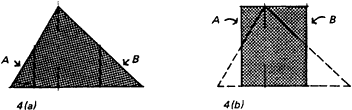
Figure 4 : Use of a feltboard to show that the area of a triangle = 1/2 base x height
Making your own feltboards. Although ready-made feltboards can be bought from educational suppliers, it is a very simple matter to make your own. All you need is a large sheet of felt or flannel, which can either be pinned to a convenient wall or bulletin board or stuck to a suitably-sized sheet of plywood or hardboard, thus producing a portable display surface that can be set up on an easel wherever it is required.
Producing feltboard display materials. Feltboard materials, designed for use in a wide range of instructional situations, are available commercially, but it is again a very simple matter to create your own. The required shapes (like the ones shown in Figure 4) can simply be cut from any convenient sheet of felt or flannel (of a different colour from the display surface) and can be made even more cheaply from felt-embossed wallpaper. If you are planning to make regular use of home-produced feltboard displays, purchase of a roll of this wallpaper will provide you with an almost unlimited supply of the necessary raw materials at very low cost - especially if you can get hold of an 'end-of-line' bargain roll. Use of embossed wallpaper for the preparation of feltboard display materials has the added advantage of providing a light surface on which words or letters can be written, images drawn, etc. If you want to produce more rigid display materials, these can be cut from thin card and then backed with felt or embossed wallpaper in order to make them stick to the feltboard. Do not underestimate the raw impact of such materials, especially in creative situations.
Hook-and-loop boards
The hook-and-loop board (which is also known as a teazle board or teazle-graph) works on the same basic principle as the feltboard. In this case, however, the display materials are backed with special fabric (such as velcro) which incorporates large numbers of tiny hooks, while the display surface is covered with material incorporating tiny loops with which the hooks can engage. This creates a much stronger bond than that which is formed between two pieces of felt, thus allowing much heavier display materials to be attached to the surface of a hook-and-loop board. Such boards can be used for much the same purposes as feltboards, but only offer a real advantage over the latter in situations where the material being displayed is heavy - demonstrating the components of an actual piece of equipment, for example, or displaying items of realia as shown in Figure 5.
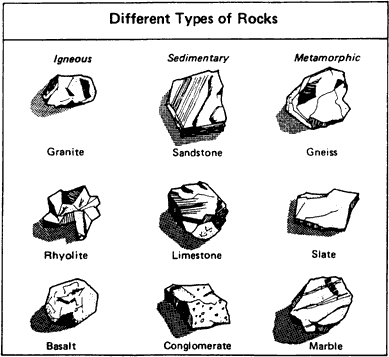
Figure 5 : Use of a hook-and-loop board to display rock samples
Making your own display board. Hook-and-loop display boards can be made in exactly the same way as feltboards, ie by getting hold of a suitable piece of fabric (available from educational supply companies) and either pinning this to a convenient wall or bulletin board or producing a portable board by sticking or pinning it to a piece of plywood or hardboard.
Producing display materials. Objects of virtually any type can be prepared for use in hook-and-loop displays by attaching suitable strips or pads of hook tape to their backs. Such tapes are available in a number of forms, including dry adhesive-backed, pressure-sensitive adhesive-backed, solvent-activated adhesive-backed, and non adhesive-backed.
Magnetic boards.
Even more useful and versatile than feltboards and hook-and-loop boards are the various forms of magnetic board. These come in two main forms - the magnetic chalkboards that were described earlier and magnetic markerboards (sheets of ferromagnetic material with specially-painted light surfaces on which material can be written or drawn using suitable markers or pens). Both types of board enable display items made of (or backed with) magnetic material to be stuck to and moved about on their surfaces, and both enable this movable display to be supplemented by writing or drawing on the board. Thus, magnetic boards can be used to produce highly sophisticated displays that enable movement and change in systems to be clearly demonstrated to a class or small group. They are, for example, an ideal medium for demonstrating military tactics or carrying out sports coaching. For coaching a basketball or football team, for example, the field of play can be painted permanently on the board, with the individual players being identified by clearly-marked magnetic discs that can be rearranged and moved about as and when required, and the various movements, run patterns, etc being shown by adding suitable arrows or lines using chalk or marker pen.
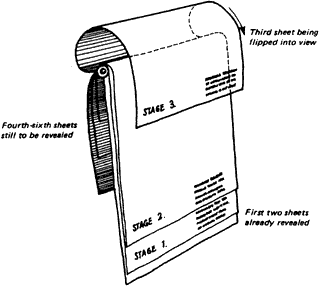
Figure 6 : Use of a magnetic board in sports coaching
Making your own magnetic board. Both magnetic chalkboards and magnetic markerboards can be made using readily-available materials, and, although such boards will probably not prove as satisfactory as commercially purchased versions, they can be used to fulfil exactly the same basic functions. In both cases, the display surface should be made from a thin sheet of ferromagnetic material such as mild steel, which should preferably be mounted on a thicker sheet of wood or chipboard in order to give it the required rigidity. To produce a magnetic chalkboard, the surface should be painted with a suitable dark-coloured matt paint, while to produce a magnetic marker board, a suitable light-coloured silk or gloss paint should be used.
Producing magnetic display materials. There are two main ways of producing such materials. The first is to make them out of special 'magnetic rubber', which is available in sheet and strip form. The second is to make them out of non-magnetic material such as stiff card and then to stick strips of magnetic rubber or small magnets to their backs, so that they will adhere to the board. A wide range of ready-made materials such as magnetic letters and numbers that can be used to form displays is also available from educational suppliers.
Charts, posters and similar flat displays.
The various forms of chart, poster and other flat pictorial display have always been among the most useful and versatile visual aids at the disposal of teachers and instructors of all types. Let us now look in turn at some of the more important varieties.
Flipcharts
These constitute a simple and, when used in an appropriate context, highly effective method of displaying information to a class or small group. Such charts consist of a number of large sheets of paper, fixed to a support bar, easel or display board by clamping or pinning them along their top edges so that they can be flipped backwards or forwards as required.
Such charts can be used in two basic ways. First, they can be used to display a succession of pre-prepared sheets, which can be shown in the required order either by flipping them into view from the back of the suspension system one by one, or by revealing each successive sheet by flipping the previous one over the back of the suspension system out of the way. If the former method is to be used, as in Figure 7, the sheets should be clamped to the display system in reverse order of showing, ie with the one to be shown last uppermost. With the latter method, the sheets should be clamped to the display system in the correct order of showing, ie with the one to be shown first uppermost. When preparing such flipchart sequences, it is best to keep the message or information on each sheet fairly simple, since this increases their impact. Also, it is obviously essential to make sure that they can be read or seen clearly by all the members of the class or group; you should check this by inspecting them from the back of the class, from the furthest distance in the room from which they have to be viewed, or from appropriate positions around table-top versions.
Figure 7 : Use of a set of pre-prepared flipcharts to show the various stages of a six-stage process by progressively building up the complete process
The other main way in which flipcharts can be used is by providing an instantly-renewable series of blank surfaces on which material can be jotted down on an impromptu basis in the course of a lesson, group discussion or other activity. They can, for example, be used to list replies from class members to questions or ideas generated by buzz groups.
When a series of flipcharts is produced arising from discussions and questions, it is often useful to arrange that they can continue to be visible. This can be done by using 'Blutack' or adhesive tape to stick completed charts onto doors, walls, window frames and other surfaces of the room. With flipchart pads, there are usually two holes punched near the top of the chart that are then placed over protruding bolts built into the flipchart easel. A bar is then screwed on, to retain the flipchart pad securely. However, when you intend to paste up flipchart sheets round the room, it is useful to remove the bar, so that you can tear off sheets neatly at the very top of each sheet, leaving the holes intact. This means that if you later wish to bring back a particular chart for detailed discussion, you can replace it over the bolts on the easel. (If the metal bar is left in place, and flipcharts are simply torn off, the holes will be lost, and a ragged edge will be obtained at the top of the charts, giving an impression of untidiness or unprofessionalism).
Charts and wallcharts.
The various forms of chart and wallchart have always been popular in all sectors of education and training because of their versatility and ease of use, and, even with the spread of more sophisticated visual aids such as slides, videos and multimedia, are still capable of playing an important role in such work. Although the distinction between charts and wallcharts is sometimes a bit blurred, the former term is generally taken to refer to displays on large sheets of paper or cloth that are designed to be shown to a class or group in the course of a lesson or briefing, as with a military manoeuvre. The latter term is used to describe similar displays that are pinned to a wall or bulletin board and are mainly intended for casual study outside the context of a formal session.
Another distinction between the two types is that the material on charts is usually larger and easier to see or read than that on wallcharts, since the former has to be clearly distinguishable or legible at a distance whereas the latter can be studied at close quarters. Apart from this, however, the principles that underlie the design of the two are essentially the same.
One of the great advantages of both charts and wallcharts is that they can be made fairly large, and can thus contain far more complicated and more detailed displays than it would be possible to incorporate on (say) an overhead transparency or a 35mm slide. They can, for example, be used to show highly-detailed maps (one of their most important and most universal uses), and detailed structural, taxonomic, and organizational diagrams of all types.
How to produce your own charts and wallcharts. Although a wide range of charts and wallcharts is available commercially or as good-will 'giveaways' from industrial and other organizations, it is still often necessary to make one's own in order to cover a given topic in a specific way - particularly if the topic to be taught is of a specialized or unusual nature. Before embarking on the task of making up a chart or wallchart, however, it is always worthwhile investigating whether one that could be used for the job you have in mind is already available, either within your own organization or from an external source (from a central resources centre, an educational supplier, an industrial or other organization, and so on); if it is, you could save yourself (and your Institution's technical and graphics support services) a great deal of time and effort.
If you do decide to go ahead with the production of your chart, you should bear the following basic principles in mind:
- Consult technical and graphics support staff and use their expertise if it is available.
- Make the chart and all items on it big enough to be seen clearly by the entire class or group that you will be using it with, or, in the case of a wallchart, in the context within which it is to be used.
- Aim for maximum clarity, using a layout and printing technique that make the 'message' that you are trying to get across perfectly clear.
- Do not make the chart unnecessarily complicated, especially with a chart designed for display to a largish group during a lesson; too much detail may well lead to loss of clarity and/or confusion.
- Try to make the chart visually attractive, using colour if at all possible.
Some useful standard formats that can be used as the basis of charts are shown in Figure 8.
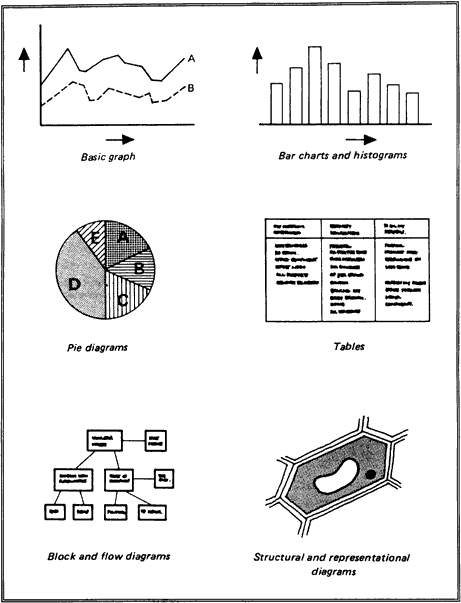
Figure 8 : Some standard formats that can be used in charts
Producing the graphic material. In many cases, the main graphic content of a chart or wallchart can be produced using simple drawing aids such as a ruler, T-square and compasses. In some cases, however, it may be necessary to reproduce a complicated drawing or schematic diagram, often from a smaller original contained in a book or magazine. In such cases, two of the techniques suggested earlier for producing similar drawings on chalkboards and markerboards - the grid method and the projection method -should prove useful.
If the original drawing is larger than the version that you want to produce, however, a variation of the projection method known as reverse projection may be employed. This makes use of the fact that all optical systems are reversible, so that a system such as the lens of an overhead projector which is normally used to throw an enlarged image of the material on its platen onto a screen, can also be used to produce a reduced image of a poster, chart, etc on the surface of the platen. This technique, which may have to be carried out in a partially-darkened room, involves illuminating the material to be copied with floodlights and copying the resulting reduced image behind a suitable shield. The set-up is shown in Figure 9.
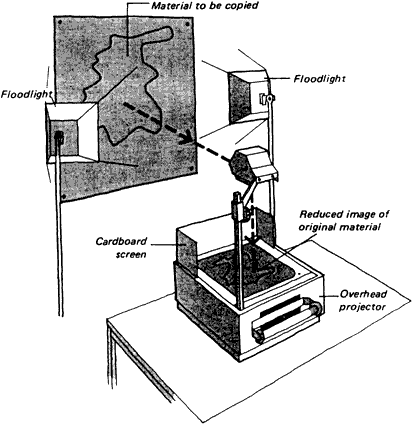
Figure 9 : The reverse projection technique for producing reduced images of graphic material
It is also now becoming increasingly practical to use desktop-publishing systems to produce graphic display materials. For example, with Macintosh computers, there is a range of graphic packages available, including 'MacDraw' and 'PowerPoint', and there are also libraries of graphic materials available in software such as 'HyperCard'. With modern laser printers, it is generally possible to print out large copies of diagrams, charts, pictures and so on, after editing them on-screen as desired. The copies can then be pasted onto large sheets for display. Figure 10 shows a simple illustration adapted from a HyperCard file, for use as part of a graphic display.
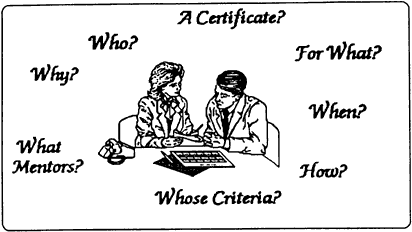
Figure 10 : Part of a computer-generated graphics display
Producing lettering on charts. If you possess the necessary graphic skills, it is possible to produce perfectly clear and acceptable lettering on charts by freehand use of appropriate pens or markers. Most people find this difficult, however, and prefer to use one of the many lettering aids that are available. These include the following:
- Instant lettering, in the form of dry transfer letters on plastic sheets that can be transferred to the work by rubbing with a burnisher, rounded pencil point or ballpoint pen. This produces high-quality results if used properly, but is expensive and time-consuming. The method is now very rarely used, since electronic methods are both cheaper and much easier to use.
- Stencils, usually in the form of transparent plastic strips carrying the complete alphabet in a given style and size. These can produce reasonably good results,but not of the quality of transfer lettering or the other methods described below. They have again largely been displaced by electronic methods.
- Lettering machines, which operate on the 'Dymo' principle and can be used to print lines of lettering on special adhesive ribbon; the ribbon can then be cut into sections, and laid out in the required way. These can also produce very good results, but are again comparatively expensive to use. They have again been largely superseded by electronic methods.
- Phototypesetting: use of a word processor-like device to compose text, which is produced in the form of a photographic negative that can be used to produce a positive print of whatever size is required. This again gives excellent results, but the equipment is expensive.
- Desktop publishing: use of desktop-publishing techniques to generate text in the required form, the final copy being produced using a laser printer. This is now by far the most commonly-used method.
- Zoom photocopying: use of a photocopier with a zoom enlargement facility to produce text of the required size from smaller copy.
Adding colour to charts. This can be done by a wide range of methods, some of the most useful of which are outlined below.
- Poster paint, applied with a brush: the standard method of producing bold colours on a poster or chart.
- Water-colour paint: useful for more subtle colours, or for producing subdued washes of colour.
- Coloured adhesive paper: this is available in a wide range of colours; if cut to the shape required, it can produce a sharpness and finish that is difficult to achieve using paint; it is also relatively cheap.
- Coloured transfer films: these can be used in the same way as adhesive paper, but are much more expensive.
Using ready-made material and photographic prints. In many cases, it is possible to make use of ready-made material such as photographs or diagrams from magazines in the preparation of charts and wallcharts. This can not only save a great deal of time, but can also produce excellent results. Copyright should not be a problem in standard up-front teaching situations, although it will almost certainly need to be checked if commercial gain is involved. Specially-prepared photographic prints can also prove useful on occasions, especially on wallcharts and other permanent or semi-permanent displays. Such material can also be increased (or reduced) in size if necessary by making use of a 'zoom' photocopier.
Posters
These are similar in many ways to charts, but are usually smaller, simpler and bolder in content and style. Their main uses in the learning environment are as a means of providing decoration, atmosphere and motivation, although they can also be used to make or remind students of key points.
Producing your own posters. As with charts and wallcharts, ready-made posters are available from a large number of sources - very often free of charge. Nevertheless, there are occasions when it is necessary to produce 'home-made' posters for specific purposes. When doing so, you should bear the following points in mind.
- To attract attention, a poster should be dramatic, with any prominent or central feature(s) standing out sharply.
- Having caught the viewer's attention, the poster should get across its message clearly and quickly; this message should therefore be a simple one, capable of being taken in at a glance.
- A poster should also be visually attractive, even though its subject matter may be anything but pleasant (warnings about health hazards, the dangers of equipment, etc).
Apart from these points,the techniques for producing posters are basically the same as those described above for producing charts and wallcharts.
Lamination
Posters, charts and wallcharts can all be laminated. Lamination involves the addition of a transparent plastic coating by passing display materials through heated rollers.
The advantages of laminating are:
- Preservation. Materials are kept rigid and in mint condition.
- Professional appearance. The gloss and sheen of lamination are literally that, reflecting commercial and conference standards.
The disadvantages of laminating are:
- Reflection. The surface produces glare, providing reduced legibility.
- Subsequent mounting. Lamination makes materials heavier and smoother. Adhesive tape and pliable pads such as Blutac no longer work, so that pins or combination velcro are required.
Three-dimensional display materials
The final group of non-projected displays that we will look at differ from those described so far in that they are all three-dimensional. The group includes four basic types of materials - mobiles, models, dioramas and realia - which will now be described in turn.
Mobiles
A mobile is, in essence, a three-dimensional wallchart in which the individual components can move about. Instead of displaying a related system of pictures, words, etc on the flat surface of a wall, they are drawn on card or stencilled on metal, cut out or moulded, and hung independently from the roof (or a suitable beam) using fine threads. The resulting display, which turns and changes shape as it is affected by random air currents, acquires a vitality which can never be produced in a flat display of the same material. Such mobiles can be suspended in a corner of any learning room, where they will not get in people's way, but will still be clearly visible.
How to create a mobile. Producing a mobile involves three basic stages.
- Conceptual design. This involves choosing the basic theme for the mobile, deciding what items to include, and establishing the patterns that you want to illustrate.
- Production of components. This involves designing and producing the individual components, which may be simple word cards, cut-out models, plastic rods, symbols or even items of realia (which can make extremely effective mobiles).
- Assembling and mounting. This is the most difficult part, and is best done by first assembling the simplest groups of items, then combinations of such groups,and so on until a balanced, freely-moving display is achieved. At each stage, the correct position for suspension should be determined by trial and error (a knowledge of basic physics helps here!). The final display should be hung from a hook or drawing pin firmly fixed into the ceiling, or from a wooden rod fixed across a corner of the room at a suitable height (such a rod can be used as a permanent suspension system for mobiles).
Models
Models (ie recognisable three-dimensional representations of real things or abstract systems) can play an extremely useful role in a wide range of instructional situations. They are, however, particularly useful in three specific roles, namely, as visual support materials in mass instruction, as objects for study or manipulation in individualised learning, and as construction projects for individuals, small groups or even entire classes. When using models in the first of these roles, however, it should be remembered that even the best three-dimensional model invariably appears two-dimensional except to those who are very close, so it is usually worthwhile getting the learners to gather round the model when its salient features are being demonstrated; unless you do this, you could probably achieve the same objectives in most cases by using a two-dimensional representation such as a slide, OHP transparency or projected computer graphic.
Some specific applications of models are listed below:
- They can be used to reduce very large objects and enlarge very small objects to a size that can be conveniently observed and handled.
- They can be used to demonstrate the interior structures of objects or systems with a clarity that is often not possible with two-dimensional representations and at a cost that is not yet matched by virtual-reality products.
- They can be used to demonstrate movement - another feature that it is often difficult to show adequately using two-dimensional display systems and that is more expensive in virtual-reality experiences.
- They can be used to represent a highly complex situation or process in a simplified way that can easily be understood by learners; this can be done by concentrating only on essential features, eliminating all the complex and often confusing details that are so often present in real-life systems.
Making your own models. The range of methods available for making models for instructional purposes is enormous, but readers may find some of the following standard techniques useful.
- Use of commercially-available kits of parts, such as the ball-and-spring systems that are used to make models of molecules and the various types of tube-and-spigot systems that can be used to make models of crystals.
- Use of construction systems such as 'Meccano' and 'Fischer-Price' to make working models.
- Use of inexpensive materials such as cardboard, hardboard, wood and wire to make up static models of all types (models of buildings, geometrical bodies, three-dimensional shapes, and so on).
- Use of materials like modelling clay and plasticine to produce realistic models of animals, anatomical demonstrations, and so on.
- Use of materials like Plaster of Paris and papier maché to produce model landscapes.
Dioramas
These are still-display systems that combine a three-dimensional foreground of model buildings, figures etc. with a two-dimensional painted background, thus creating a highly-realistic effect. They can be used in the teaching of a wide range of subjects, including:
- History, drama, religious studies (representations of historical or dramatic scenes, stage sets, battles, etc.).
- Architecture, geography and geology (representations of buildings, towns, landscapes, pre-historic landscapes and scenes, etc.).
- Biology and natural history (representations of plants or animals in their natural habitats).
Producing a diorama. Although sophisticated dioramas of the type that are seen in museums can be extremely expensive, time-consuming and difficult to make up, it is perfectly possible for anyone possessing even the most basic of graphic and artistic skills to produce highly effective displays of this type. This can be done as follows.
- Make a semi-circular base of the required size out of chipboard, hardboard, thick card or some other suitable material.
- Make a strip of thin white card of suitable height that is capable of extending all the way round the curved side of the base, draw and/or paint the required background scene on this, and fix it to the base (eg with drawing pins).
- Build up any landscape required in the foreground using Plaster of Paris or papier maché, and paint this in the required colour(s).
- Produce or acquire any materials that are required for the foreground and set them in position; such materials can include model figures (cardboard cut-puts, plasticine models, etc), model buildings, model trees, model ships, tanks or other vehicles, pieces of rock, and any other materials that you feel will enhance the realism of the scene being depicted.
Realia
The supreme instructional 'model' is, in some cases, the article itself, since there are often considerable advantages to be gained from letting learners see or handle the 'real thing' as opposed to a mere representation thereof. In many cases, of course, this will not be practicable on grounds of availability, accessibility, safety, expense and so on, but there are many other cases where no such objections apply, and, in such cases, serious consideration should be given to the use of realia. Such materials can be used both to support expository teaching and in individualised- and group-learning situations, where they can provide learners with the sort of direct experience that can seldom be obtained through mediated learning, no matter how well contrived or expensive. When studying geology, for example, there are few satisfactory substitutes for actually handling and examining real rock specimens, while the same is true of many aspects of the study of veterinary science, biology, and physiology. Examining 'virtual' horses and bodies is still futuristic for most people.
Acquiring items of realia for instructional purposes. The way in which one sets about getting hold of items of realia for teaching or training purposes will, of course, depend on a number of factors, including the nature of the item(s) required, the existence (or otherwise) of convenient local sources of supply, the financial resources one has at one's disposal, and so on. It is, however, often possible to acquire specific items - or even whole collections of items - at very little cost merely be exercising a little resourcefulness (eg building up a collection of geological specimens by obtaining what you can locally and persuading colleagues, relatives and friends who you know will be visiting certain areas to bring you back specific items). Other types of material can sometimes be obtained from industrial firms and other organisations, who are often only too pleased to help.