We recently aquired our first Pearl/ Split Pearl pairing and we hope to get some interesting birds out of them next year.As with the Pearl variety the Pastel Silver is also a new addition and it is hoped that over several years we will be able to add the new colour to all our existing varieies.
Our Breeding & Show Season Outcomes
Our birds are generally allowed to breed from late July to early March although we don�t hesitate removing pairs from breeding avairies when we decide that they have done enough for the year. These birds are then replaced with fresh pairs. Last season we started placing closed aluminium rings on one leg, these rings being numbered and coded with our avairy code. This comming season we have had our rings made with the year and carryon numbers as well as the avairy code. The rings enable us to keep the right records that we need to manage our birds, they are also good identifcation for people that recieve one of our quality hand reared birds.
This year we again took some Cockatiels to our local cage bird society for the Diploma night show, we had three members competing in the section. Our birds were judged First, Second & Third we got the Trophy for the Diploma win and Sashes for Champion and Reserve Champion Birds this is almost the same result as last year when we had missed Third place.
Hand Reared Birds - How & Why?
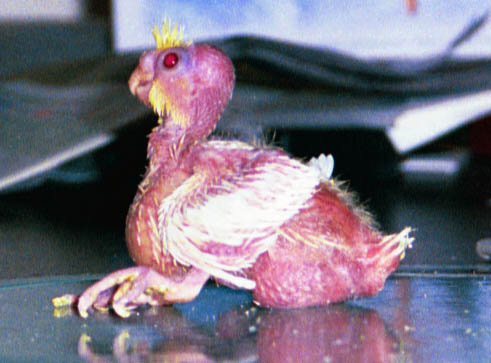
Hand rearing of Cockatiels is a time consuming job that requires a lot of patience. The best results are obtained by removing the chicks from the nest at 14 to 18 days old and using a teaspoon with a proper hand rearing food for parotts, they can usually be fed untill they reach 8 weeks old an extra week on seed and they are ready for new homes. When we started hand rearing several years ago the idea had been to do one for a bird dealer friend to sell, after all the effort we kept that bird as our own pet. We continued taking the occassional chick for friends that saw our bird Rose and wanted one. This project has now turned into a near full time venture during the breeding season that makes money for our labour.
Breeding Better Birds by Understanding Modes of Inheritance
As with all living creatures there are certain known facts concerning inheritance of sex, colour and variety in Cockatiels. At this point I will cover the Sex-Linked and Recesssive Varieties that I keep and know of.
With Sex-Linked varieties Cock birds can carry the Gene in either visable or split form while the Hens can only be visibly carrying the gene. This occurres because the gene for Sex-Linkage attaches itself to the male sex chromosome. When breeding these varieties we can selectivly predetermine the sex of some chicks. By using a cock that is visable or split for the sex linked variety to a hen of a different variety we can be assured that only hens displaying the desired variety will be produced, and any cock birds will be split for or possibly split for the variety.
In practice we use this to breed better lutino�s. Many people have seen and disliked the way lutino�s have a genetic baldness on their heads. This is commonly belived to be a genetic weakness brought about by inbreeding that ocurred when the mutation was being developed and the need for large numbers to satisfy demand for them. Most knowlegable breeders have now accepted as much and won�t pair two Lutino�s together and prefer to breed only hens by using strong splits or Lutino cocks that have good head feathering with hens of other varieties. In some instances some of us will, due to request, pair a lutino hen to a split cock to be able to supply a lutino cock as a pet for someone. Although light head feathering can and does occurr on all Cockatiel varieties it is only Lutino�s that have a major problem.
The Recessive varieties can be produced from two birds neither of which displays the variety to the untrained eye, I say untrained, because in many cases there are small signs which we can used to advantage whether it be a slightly paler shade of yellow on a bird that is split Whiteface or a odd yellow or white feather on the back of the head of a bird that is split Pied. Although these little tell tale faults occurr on some birds there are many more that have no such signs, and as breeders we must rely on breeding records that we keep or are supplied with birds that are bought in to determine what is split or possibly split for the given variety.
For people that like to see and breed combination varieties there is plenty of scope for a rewarding hobby if for example you want to breed Whiteface Pearl Pied in hens and cocks. A sound understanding of the basics of bird genetics will make it achievable.
Sexing Young Birds
Hopefully you are able to tell the sexes of adult birds with normal greys the cock has a yellow face and the underside of tale feathers being black and how with pieds the face colour rule being discarded although it still has the black or solid colour on the underside of tail feathers and hens always having the barring under the tail. For juvenile birds the feathering is the same as hens and it take around 12 months for a cock bird to gain his full adult plumage with young Normals and Whiteface the feathering on the face will be lighter in cock birds than hens. It is the not much use if youv�e just bred some lutino�s to be able to garantee a bady cock bird for someone, and it is through known behaviour that we can listen for known cock bird calling from chicks as young as 9 weeks. For some beginners buying birds at that age without the experience, relying on a bird dealer or pet shop sales assistant to supply the gender that you desire can somtimes result in phrases like I think it�s a --- still gives a 50 / 50 chance if you like the odds it�s just strange that it happens when they only have one of the colour you were looking at.
Back to Birds
