
DSV Jason
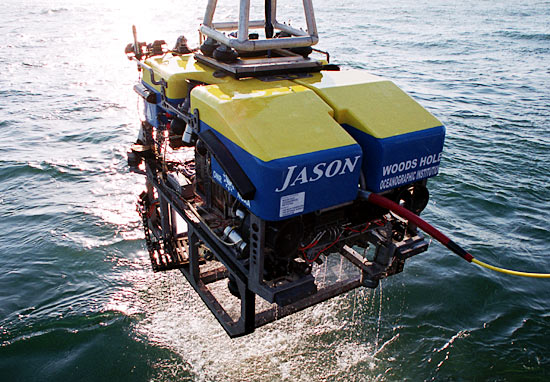
Jason is a remotely operated vehicle (ROV) designed and built by WHOI’s Deep Submergence Laboratory to allow scientists to
have access to the seafloor without leaving the deck of a ship.
Jason is a two-body ROV system. A 10-kilometer (6-mile) electro-optical-mechanical tether delivers electrical power and commands
from the ship through Medea and down to Jason, which then returns data and live video imagery. Medea serves as a shock absorber,
buffering Jason from the movements of the ship, while providing lighting and a bird’s eye view of the ROV during seafloor operations.
Built and operated by the Woods Hole Oceanographic Institution, Jason is equipped with sonar imaging as well as video, still, and
electronic cameras and appropriate lighting gear. It carries precision navigation equipment and sensors for depth, vehicle attitude
(tilt), and altitude from the seafloor. Jason's manipulator arms can collect samples that may be put in a small basket attached to
the vehicle or, for heavier items, on an attached "elevator" platform that carries them to the surface.
A prototype of Jason called Jason Jr. was used with Alvin to explore the Titanic in 1986
Design
Jason is a two-body ROV system. A 10-kilometer (6-mile) reinforced fiber-optic cable delivers electrical power and commands from the ship
through Medea and down to Jason, which then returns data and live video imagery. Medea serves as a shock absorber, buffering Jason from the
movements of the ship, while providing lighting and a bird’s eye view of the ROV during seafloor operations.
Jason is equipped with sonars, video and still imaging systems, lighting, and numerous sampling systems. Jason’s manipulator arms collect
samples of rock, sediment, or marine life and place them in the vehicle’s basket or on “elevator” platforms that float heavier loads to the
surface.
Pilots and scientists work from a control room on the ship to monitor Jason’s instruments and video while maneuvering the vehicle. The average
Jason dive lasts one to two days, though operators have kept the vehicle down for as long as seven days.
