DSV Alvin
Alvin (DSV-2) is a manned deep-ocean research submersible owned by the United States Navy and operated by the Woods Hole Oceanographic Institution (WHOI) in Woods Hole, Massachusetts. The vehicle was built by General Mills' Electronics Group[2] in Minneapolis, Minnesota. Named to honor the prime mover and creative inspiration for the vehicle, Allyn Vine, Alvin was commissioned on 5 June 1964. The submersible is launched from the deep submergence support vessel RV Atlantis (AGOR-25), which is also owned by the U.S. Navy and operated by WHOI. The submersible has made over 4,400 dives, carrying two scientists and a pilot, to observe the lifeforms that must cope with super-pressures and move about in total darkness, as well as exploring the wreck of Titanic. Research conducted by Alvin has been featured in nearly 2,000 scientific papers.
Design
Alvin was designed as a replacement for bathyscaphes and other less maneuverable oceanographic vehicles. Its more
nimble design was made possible in part by the development of syntactic foam, which is buoyant and yet strong enough
to serve as a structural material at great depths.
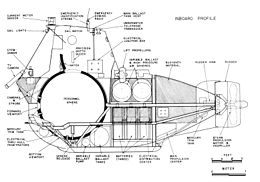
The vessel weighs 17 tons. It allows for two scientists and one pilot to dive for up to nine hours at 4,500 metres
(14,800 ft). The submersible features two robotic arms and can be fitted with mission-specific sampling and experimental
gear. The plug hatch of the vessel is 0.48 metres (1 ft 7 in) in diameter and somewhat thicker than the 2 inches (51 mm)
thick titanium sphere pressure hull;[1] it is held in place by the pressure of the water above it.
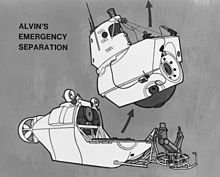
In an emergency, if Alvin were stuck underwater with occupants inside, the outer body, or cladding, of the submersible
could be released and discarded using controls inside the hull. The titanium sphere would then rise to the surface
uncontrolled. It is unknown, however, if a human could survive the rapid trip to the surface.