X-rays are electromagnetic waves of short wavelength, capable of penetrating some thickness of matter. Medical x-rays are produced by letting a stream of fast electrons come to a sudden stop at a metal plate; it is believed that X-rays emitted by the Sun or stars also come from fast electrons. Both light and radio waves belong to the electromagnetic spectrum, the range containing all different electromagnetic waves. Over the years scientists and engineers have created EM waves of other frequencies--microwaves and various IR bands whose waves are longer than those of visible light (between radio and the visible), and UV, EUV, X-rays and g-rays (gamma rays) with shorter wavelengths. The electromagnetic nature of x-rays became evident when it was found that crystals bent their path in the same way as gratings bent visible light: the orderly rows of atoms in the crystal acted like the grooves of a grating.
On 8 Nov, 1895, Wilhelm Conrad R�ntgen (accidentally) discovered an image cast from his cathode ray generator, projected far beyond the possible range of the cathode rays (now known as an electron beam). Further investigation showed that the rays were generated at the point of contact of the cathode ray beam on the interior of the vacuum tube, that they were not deflected by magnetic fields, and they penetrated many kinds of matter.
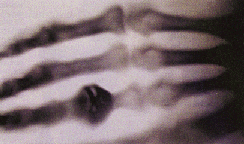
A week after his discovery, Rontgen took an X-ray photograph of his wife's hand which clearly revealed her wedding ring and her bones. The photograph electrified the general public and aroused great scientific interest in the new form of radiation. R�ntgen named the new form of radiation X-radiation (X standing for "Unknown"). Hence the term X-rays (also referred as R�ntgen rays, though this term is unusual outside of Germany). |