| Von Braun Wernher 1912 -- 1977 |
| Biography |
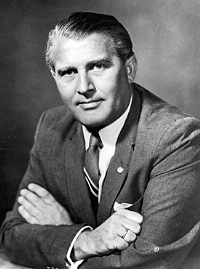 |
| Wernher Von Braun was one of the world's first and foremost rocket engineers and a leading authority on space travel. His will to expand man's knowledge through the exploration of space led to the development of the Explorer satellites, the Jupiter and Jupiter-C rockets, Pershing, the Redstone rocket, Saturn rockets, and Skylab, the world's first space station. Additionally, his determination to "go where no man has gone before" led to mankind setting foot on the moon. Living in Huntsville, Alabama from 1950 to 1970, Dr. von Braun first directed the technical development of the U.S. Army's ballistic missile program at Redstone Arsenal, and later served as Director of NASA's Marshall Space Flight Center. When he transferred to Washington, D.C., he left Huntsville with a rich legacy: the research institutions at the University of Alabama in Huntsville, the Alabama Space and Rocket Center, and the Von Braun Civic Center. Wernher von Braun was the second of three sons born to Baron Magnus von Braun and Baroness Emmy von Quistorp. Born March 23, 1912 in Wirsitz, Posen. Wernher was always a visionary, and at ten years of age he decided his goal in life would be to "help turn the wheel of time." His interests led him to explore many paths in his early life including composing several pieces of music and recycling old automobile parts to build a new car. As a result of spending so much of his time building a car, he flunked in mathematics and physics. However, it was his decision to explore rocketry that led to his great impact on history. After reading Hermann Oberth's Rocket into Planetary Space, and the gift of a telescope from his mother, he decided to become a space pioneer and physicist. Von Braun's natural leadership and ability to encourage and inspire others led him, at the age of 16, to organize an observatory construction team. His volunteers built a complete observatory in their spare time, working as diggers, bricklayers, and carpenters. Later, he enrolled at the Berlin Institute of Technology in 1930. In 1932, at the age of 20, he received his bachelor's degree in mechanical engineering, and was offered a grant to conduct and develop scientific investigations on liquid-fueled rocket engines. Two years later, Wernher received his PhD in physics from the University of Berlin. In the early 1930's, rocket clubs sprang up all over Germany. One of these clubs, the Verein fur Raumschiffarht (Rocket Society), had the young engineer Wernher von Braun as a member. During this same period of time the German military was searching for a weapon which would not violate the Versailles Treaty of World War I, and at the same time defend Germany. Artillery captain Walter Dornberger was assigned to investigate the feasibility of using rockets. Dornberger went to see the VfR and, being impressed with their enthusiasm, gave them $400 to build a rocket. Wernher von Braun worked through the spring and summer of 1932, only to have the rocket fail when tested in front of the military. However, Dornberger was impressed with von Braun and hired him to lead the military's rocket artillery unit. By 1934 von Braun and Dornberger had a team of 80 engineers building rockets in Kummersdorf, about 60 miles south of Berlin. Von Braun's natural talents as a leader shone, as well as his ability to assimilate great quantities of data while keeping in mind the big picture. With the successful launch of two rockets, Max and Moritz, in 1934, von Braun's proposal to work on a jet-assisted take-off device for heavy bombers and all-rocket fighters was granted. However, Kummersdorf was too small for the task, so a new facility had to be built. Peenemunde, located on the Baltic coast, was chosen as the new site. Peenemunde was large enough to launch and monitor rockets over ranges up to about 200 miles, with optical and electric observing instruments along the trajectory, with no risk of harming people and property. By now Hitler had taken over Germany and Herman Goering ruled the Luftwaffe. Dornberger held a public test of the A-2 which was greatly successful. Funding continued to flow to von Braun's team, developing the A-3 and finally the A-4. In 1943 Hitler decided to use the A-4 as a "vengeance weapon," and the group found themselves developing the A-4 to rain explosives on London. Fourteen months after Hitler ordered it into production, the first combat A-4, now called the V-2, was launched toward western Europe on September 7, 1944. When the first V-2 hit London von Braun remarked to his colleagues, "The rocket worked perfectly except for landing on the wrong planet." The SS and the Gestapo arrested von Braun for crimes against the state because he persisted in talking about building rockets which would go into orbit around the Earth and perhaps go to the Moon. His crime was indulging in frivolous dreams when he should have been concentrating on building bigger rocket bombs for the Nazi war machine. Dornberger convinced the SS and the Gestapo to release von Braun because without him there would be no V-2 and Hitler would have them all shot. On arriving back at Peenemunde, von Braun immediately assembled his planning staff and asked them to decide how and to whom they should surrender. Most of the scientists were frightened of the Russians, they felt the French would treat them like slaves, and the British did not have enough money to afford a rocket program. That left the Americans. After stealing a train with forged papers, von Braun led 500 people through war-torn Germany to surrender to the Americans. The SS were issued orders to kill the German engineers, who hid their notes in a mine shaft and evaded their own army while searching for the Americans. Finally, the team found an American private and surrendered to him. Realizing the importance of these engineers, the Americans immediately went to Peenemunde and Nordhausen and captured all of the remaining V-2's and V-2 parts, then destroyed both places with explosives. The Americans brought over 300 train car loads of spare V-2 parts to the United States. Much of von Braun's production team was captured by the Russians. On June 20, 1945, U.S. Secretary of State Cordell Hull approved the transfer of von Braun's German rocket specialists. This transfer was known as Operation Paperclip because, of the large number of Germans stationed at Army Ordnance, the paperwork of those selected to come to the United States were indicated by paperclips. They arrived in the United States at New Castle Army Air Base, just south of Wilmington, DE. Afterwards, they were flown to Boston, and then taken by boat to an Army Intelligence Service post at Fort Strong in Boston Harbor. Later, with the exception of von Braun, the men were transferred to Aberdeen Proving Grounds in Maryland to sort out the Peenemunde documents. Those documents would enable the scientists to continue their rocketry experiments where they had left off. Finally, von Braun and the 126 Peenemunders were transferred to their new home at Fort Bliss, Texas, a large Army installation just north of El Paso, under the command of Major James P. Hamill. They found themselves in a strange situation as they began their new lives in America. Because they could not leave Fort Bliss without a military escort, they sometimes referred to themselves as "PoPs", Prisoners of Peace. While at Fort Bliss, they were tasked to train military, industrial, and university personnel in the intricacies of rockets and guided missiles and to help refurbish, assemble, and launch a number of V-2's that had been shipped from Germany to the White Sands Proving Grounds in New Mexico. Further, they were to study the future potential of rockets for military and research applications. During this time, von Braun mailed a marriage proposal to 18-year old Maria von Quirstorp. On March 1, 1947, he married her in a local Lutheran church. In December 1948, his first daughter, Iris was born at Fort Bliss Army Hospital. In 1950, von Braun and his team were transferred to Huntsville, Alabama, his home for the next twenty years. Between 1950 and 1956, von Braun led the Army's development team at Redstone Arsenal, resulting in the Arsenal's namesake: the Redstone rocket. Still dreaming of a world in which rockets would be used for peaceful exploration, in 1952 Dr. von Braun published his concept of a space station in Collier's magazine. This station would have a diameter of 250 feet, orbit in a 1075 mile-high orbit, and spin to provide artificial gravity. In his vision, it would be the perfect jumping-off point for lunar expeditions. Dr. Von Braun also worked with Disney studios as a technical director for three television films about Space Exploration. Over the years von Braun continued his work with Disney, hoping that Disney's involvement would bring about greater public interest in the future of the space program. As Director of the Development Operations Division of the Army Ballistic Missile Agency (ABMA), von Braun's team then developed the Jupiter-C, a modified Redstone rocket. The Jupiter-C successfully launched the western hemisphere's first satellite, Explorer 1, on January 31, 1958. This event signaled the birth of America's space program. NASA was established by law on July 29, 1958. One day later, the 50th Redstone rocket was successfully fired off Johnson Island in the South Pacific as part of Project Hardtack. Two years later NASA opened the new Marshall Space Flight Center in Huntsville, Alabama and transferred von Braun and his development team from the ABMA at Redstone Arsenal to NASA. Dr. von Braun was the center's first Director, from July 1960 to February 1970. The Marshall Center's first major program was development of the Saturn rockets, capable of carrying astronauts to the moon. Von Braun's childhood commitment to "turn the wheel of time," and his later dream to help mankind set foot on the moon became a reality on July 16, 1969 when a Marshall-developed Saturn V rocket launched the crew of Apollo 11. Over the course of the Apollo program, six teams of astronauts explored the surface of our moon. After the Apollo program, the Saturn 1B, also developed at Marshall under von Braun's leadership, lifted the Skylab, the world's first space station, and its crews into orbit. The final use of the Saturn was during the historic Apollo-Soyuz mission in 1975, when an Apollo spacecraft linked up with a Russian Soyuz craft. After the Apollo space program, von Braun felt that his vision for future spaceflight was different than NASA�s, and he retired in June 1972. He became the vice-present of Fairchild Industries in Germantown, Maryland, where he was active in establishing and promoting the National Space Institute. At the peak of his activities, von Braun learned he had cancer. Despite surgery, the cancer progressed, forcing him to retire from Fairchild on December 31, 1976. On June 16, 1977, Wernher von Braun died in Alexandria, Virginia, leaving behind his wife, 3 children, 2 brothers, and a legacy of personal vision, dedication, and accomplishments. |