| Stalin, Joseph 1879 -- 1953 |
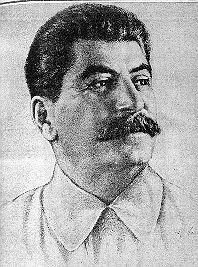
| The Man of Steel", Joseph Stalin the great revolutionary was born on December 21, 1879 to Catherine and Vissarion Djugashvili. His father was a cobbler by profession and wanted Joseph to take up his profession. The boy grew up in poverty at a cheap family home. At the age of seven Joseph fell in with small pox which left indelible marks on his face. He was a small and slim child with a bold, brazen expression in his eyes, which were slightly Asiatic. The second and third toes of his left foot had grown together and being a poor cobbler�s child, he was often bare footed and so other children would often notice this and make fun of him. Stalin spent his childhood in the town of Gori in the Caucasus. It was an imperial Russian colony. The only child of his parents, Stalin was more his mother�s child than his father�s. It is to her that he owed his ambitions, repression and inhibitions that colored his entire life and career. At the age of eight, he was sent to the local Church school. His mother, who nicknamed him Soso, said about him, "Soso was always a good boy. Yes, he was always a good boy. I never had to punish him. He studied hard, was always reading or talking and trying to find out everything � Soso was my only son. Of course I treasured him. Above everything in the world� I didn�t want him to be a cobbler. I didn�t want him to be anything but a priest." Stalin�s father died when he was 11. The mother and son left for Tiflis in 1894, where he enrolled in the Tiflis Theological Seminary.There, in first, year Joseph�s conduct was exemplary and his report cards showed that he received the highest marks for it. At the age of 15, Stalin became a revolutionary. "I joined the revolutionary movement," he remembered, "at the age of 15, when I established connection with certain underground groups of Russian Marxists then living in Transcaucasia. These groups exerted a great influence on me and instilled in me a taste for illegal Marxian literature." The same boy who had received a prize for his conduct was now reported to be rude and disrespectful and was also punished for the same but in vain.Once the officers searched his room and discovered a book written by Karl Marx. As a result of persistent revolutionary activities, Joseph was finally expelled from school on May 29, 1899. His expulsion shattered his mothers dreams. But full of love for her only son, she did not reveal the true reason for expulsion. Thirty one years later, when Stalin had established himself as a revolutionary dictator of Russia she said, "Soso was always a good boy� He was not expelled. I brought him home on account of his health. When he entered the Seminar he was fifteen and as strong as a lad could be. But overwork up to the age of nineteen pulled him down, and the doctors told me he might develop tuberculosis. So I took him away from school. He did not want to leave. But I took him away. He was my only son." This was the period when Marxism had begun to spread widely through Russia along with the development of industrial capitalism and the growth of working class movement. Lenin led the foundation of the St. Petersburg League of Struggle for the Emancipation of the Working Class and thus gave a powerful impetus to the development of the Social-Democratic movement all over the country. Tiflis already had Marxist circles. Subversive leaflets were secretly in circulation. Stalin entered the hotbed of restoration and mutiny to receive his baptism for priesthood. Stalin imbibed the Socialist doctrines and studied Karl Marx. He became one of the leaders of the secret Marxist band in the seminary. He attended meetings and was engaged in such subversive activities as distributing revolutionary proclamations and pamphlets. The atmosphere during that time was, "saturated with hatred of Tsarist oppression", and Stalin threw himself "wholeheartedly into revolutionary work." The espionage system was well established in the seminary. The monastic inspectors spied the reliability of their charges and as a result, Stalin was put under suspicion. He rapaciously and stealthily read books on sociology, natural sciences and the labor movement. Stalin worked hard to enhance his knowledge. He read extensively Capital, the Communist Manifesto and other works of Marx and Engels. He also acquainted himself with Lenin�s work, which was against Narodism, Legal Marxism and Economism. Lenin�s writings left an indelible mark on his life. "I must meet him at all costs," one of Stalin�s close friends is reported to have told him after reading an article by Tulin (Lenin). Joseph was not a candidate for priesthood. He found a job as a minor clerk in Tiflis observatory but the job did not pay him well, even for basic necessities.Joseph had talent for organization. He was a man of action and felt special attraction for secrecy and subversion. Stalin�s life was busy as a revolutionary. He turned to Bolshevism, ushered in the world by Lenin in 1903.Lenin who was thirty three, wanted his party to become a stable organization of leaders. Stalin, who was only nine years younger to Lenin was a devout disciple of Lenin.By 1903 Joseph and already gained recognition as the master of mind communist movement. He launched strikes and taught discontented working men the tactics of revolt. The primary impulse of Bolshevism was the will to revolt. Stalin had all the attendant qualities that furthered the cause. The primary impulse of Bolshevism was the Leninist interpretation of the dictatorship of the proletariat and the theory of seizure of power. Stalin accepted that principle of Bolshevism. He attended three policy making assemblies of the Russian Social Democrats � in Tammerfors, 1905; Stockholm, 1906; and London in 1907. During these conclaves, he was unable to make any impression on the leaders then. He kept a low profile and was active behind the scenes. Stalin also helped in plotting a hold-up in Trifles, on June 25, 1907. The motive behind the hold-up was to "expropriate" funds for the party. In 1908, 1910, 1911 Stalin was imprisoned again for revolutionary activities. Between 1913, 1917 he was imprisoned again but the success of Bolshevik revolution ended Stalin�s career as a transient prisoner of the Czar and gave him a permanent apartment in the Czar�s Moscow Kremlin Stalin�s first noticeable appearance in politics was in February 1912, when Lenin co-opted him to serve on the first Central Committee of the Bolshevik Party. Stalin came into direct contact with Lenin during the three assemblies of the Russian Social Democrats. Stalin was exiled seven times, for revolutionary activities. His longest term of exile was in 1913, for four years. When he returned to Petrograd from Siberia, (where he was exiled) in 1917, he resumed editorship of the Bolshevik newspaper, Pravda. Stalin published Pravda at the behest of Lenin during 1913. Pravda was an important vehicle that propelled Marxism in its spread throughout Russia. Pravda then and even today is considered as the voice of Russia and is one of the largest circulated newspapers in the world. During the Communist years, it played an important role not only in propagating the Communistic ideology but also became the official mouthpiece of the Russian subcontinent, and achieved an unimaginable number of committed readership. Joseph Stalin was a political organizer. He advocated the division of large feudal estates into small, private capitalistic peasant holdings. His ambition was to overthrow monarch. Due to this drive, he offended the Czarid police who seized him in 1913 and imprisoned him beyond the Arctic Circle. He remained a prisoner throughout 1914, 1915, and 1916. In 1917, Stalin advocated Bolshevik co-operation with the establishment of the provincial government of middle class liberals. The liberals had succeeded to uneasy power on the last Tsar�s reassignment, during the February Revolution. Stalin did not continue with the job of editor for long. Under Lenin�s influence, he joined the militant policy of armed seizure of power by the Bolsheviks. In the coup d�etat, that took place in November 1917, Stalin played a significant role. However, it was less prominent than that of his chief rival, Leon Trotsky. Stalin and Trotsky had mutual political rivalry. Trotsky underestimated Stalin and regarded him as a provincial. Both fought for succession even while Lenin was alive. Lenin was aware of this antagonism between the two. Stalin was active as a politico-military leader on various fronts during the Civil War of 1918 to 20. He also held two ministerial posts in the new Bolshevik government. His position as secretary general of the party�s Central Committee, from 1922, to the rest of his life provided the sound base for his dictatorship. Stalin was also member of the then powerful Politburo and of many other interrelated and overlapping committees. His rivals Trotsky and Zinoviev despised such meticulous and bureaucratic organizational work. From 1921 onwards, Stalin began scoffing at the ailing Lenin�s desires. A year before his death, Lenin wrote a political testament and publicly asked for Stalin�s removal from the post of Secretary General. Such a testament from Lenin would have ruined Stalin�s career, but to his luck and skill, Stalin was able to overpower every dissidence that raised its voice against him. Such was the skilful and effective leadership qualities of maneuvering tactics that helped Stalin crush the opposition. On January 21, 1924 when Lenin died, Trotsky was on his way travelling through Carcasis and suffered from some mysterious infection which kept his temperature high.Stalin informed Trotsky that the funeral was on January 27, Saturday and he would not be able reach in time, whereas the funeral was actually to be held on Sunday 28. Trotsky could have reached in time but it appeared as if Stalin deliberately kept him away from the funeral to weaken the association of Trotsky and Lenin in the minds of people. After Lenin�s death in January 21, 1924, Stalin supported a profligate, quasi-Byzantine cult of Lenin. In 1925, Stalin promoted his own cult, renaming the city of Tsaritsyn as Stalingrad. His chief rival Trotsky was in confinement. Trotsky was deposed by the ruling triumvirate of Zinoviev, Kamenev and Stalin. Stalin later joined rightist leaders Nikolay Bukharin and Aleksey Ryrov, in an alliance directed against his former co-triumvirs. Stalin advocated a policy of "Socialism in one country". He dismissed his most powerful rivals, Bukharin and Ryrov, while following Zinoviev and Kamenev. Stalin expelled Trotsky from the Soviet Union in 1929 and got him assassinated in Mexico in 1940. |
| Stalin�s personal life also witnessed many changes. After the death of his first wife, he remarried Nadezhda Alliluyeva, in 1919. They had two children. The son, Vasily, perished as an alcoholic, after rising to an unmerited high rank in the Soviet Air Force. The other child, a daughter Svetlana, became the object of her father�s alternating affection and bad temper. Stalin led an active life of 74 years. He was a shrewd politician. His domestic terror-filled regime (the Stalinist system) left a deep chasm on Soviet society and politics after his death. Stalin met a natural death on March 5, 1953, in Moscow. PERSONAL LIFE Stalin�s capacity for love and affection, limited by nature. He had grown to be an atheist. In 1904, while Stalin was busy with revolutionary he married a Georgian girl, Catherine Svandize. To them was born a son called Jacob in 1906. Their marriage was a happy one. But within a year of the child�s birth Catherine died of tuberculosis. Jacob was brought up by Catherine�s parents. In his teen, Jacob stayed with Stalin but was beaten by his father often for smoking. Stalin married Nadiezhada Sergeiven Alliluyev in 1918. Stalin sacrificed Friends and family to power. He was basically not a very affectionate man and revolutionary traits hardened him even more. He had four simple rules of success in life to achieve desired end men must be discarded when they are no longer useful, alienators are made to be broken, any method is justified if it helps to achieve the ultimate goal and, ideas have no existence under the chariot of power. Stalinist Soviet Union With his sharp intellect and lady luck favoring him, Stalin somehow managed to succeed Lenin. There was a time when Lenin was unable to pass a single moment without Stalin. However, as time passed by, there came a phase where differences cropped up between them. A time came when Lenin found Trotsky, a follower of Bolshevism, more trustworthy than Stalin. Lenin during his last days was much worried about the state of his nation after him. He wrote an article on the same, which attacked Stalin�s policies. Lenin sent a copy of that article to Trotsky. Trotsky wanted to show the copy to one of the triumvirate, Kamenev. But Lenin said, "Kamenev will immediately show everything to Stalin and Stalin will make a rotten compromise and then deceive us." Trotsky was taken aback at Lenin�s reply. Lenin�s secretary said, "He does not trust Stalin and wants to come out against him openly, before the entire party. He is preparing a bomb." From all this, it would not have been surprising that Trotsky would have been an heir apparent to Lenin. But nature had other things in store. Trotsky, full of theoretical knowledge of politics, was far from practical experience. The devious means adopted by Stalin and his cronies in successfully aborting his (Trotsky) election to the highest position in the party speaks volumes of his abilities to emerge victorious in the leadership struggle that ensued. Lenin�s health was on the decline. His early death would have resulted into Trotsky succeeding to power. Unfortunately for Trotsky, Lenin did not die early. Shortly, he relapsed into coma, which instigated Stalin to prepare for an emergency. Lenin was of the opinion that Stalin should be removed from his position of Secretary General. Stalin nonchalantly agreed to it, but Zinoviev and Kamenev strongly supported Stalin and he was re-elected as the Secretary General. Trotsky was re-elected to the Central Committee and the Politburo. Stalin, slyly managed to expel Trotsky from the Soviet Union in 1929. In 1940, Trotsky was assassinated in Mexico. Stalin gradually abandoned Lenin�s quasi-capitalist New Economic Policy. He favored state-organized industrialization under a succession of Five Year Plans. The results were devastating for some two and a half billion rustic households. Uncooperative peasants were arrested in masses and were shot, exiled or absorbed into the rapidly expanding network of Stalinist concentration camps. The prisoners, who were absorbed in those concentration camps, worked to death in the most atrocious conditions, a grim reminder of the Auschwitz Concentration Camp of Nazi Germany. Industrialization on the other hand was equally disastrous. Stalin arraigned industrial managers in a succession of show trials. The accused were tortured and brainwashed to confess hypothetical crimes. Those accused served as scapegoats for catastrophes arising from the Secretary General�s policies. Somehow, Stalin was successful in rapidly industrializing a predominantly backward country like Russia, then. In late 1934, Stalin launched and stepped up a new campaign of political terror against those very Communist Party members who had brought him to power. He stage-managed the assassination of one of his leading colleagues and potential rival, Sergey Kirov. Stalin used the show trial to unleash new terror on leading Communists of the day. In August 1936, Zinoviev and Kamenev were paraded in court to repeat and make imaginary confessions. They were sentenced to death and were shot dead. Two more major trials followed in January 1937 and March 1938. In June 1937, Marshal Mikhail Tukhachevsky and other leading generals were court-martialed on charges of treason and executed upon conclusion of their summary trial. Stalin used inhumane methods to tame the Soviet Communist Party members and the Soviet elite as a whole. He not only "liquidated" veteran semi-independent Bolsheviks, but also many party leaders, military officials, industrial managers and high government officers, who denied being totally subservient to him. |
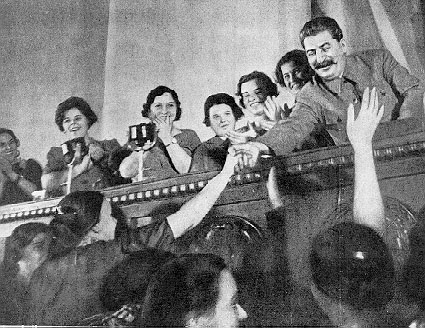
| Though the war was disgusting, it gave an opportunity to Stalin to emerge as the most successful leader. In August 1939, Stalin tried to form an anti-Hitler alliance with the Western powers, but finally concluded a pact with Hitler. The pact encouraged Hitler to attack Poland and World War II began. Hitler annexed the western frontiers of Poland, whereas Stalin annexed the eastern part, Estonia, Latvia, Lithuania and parts of Romania. Soviet Union then faced the apprehension of German attack in 1941, when Stalin appointed himself chairman of the Council of People�s Commissars. It was his first governmental office since 1923. Germany attacked the Soviet Union on June 22, 1941. The invasion exposed the defensive measures taken by Stalin as incompetent. After a short period of shock and inactivity, Stalin appointed himself as the Commander in Chief. Stalin was present at Moscow and helped to organize a great counter-offensive strategy. The Battle of Stalingrad (1942) and the Battle of Kursk (1943), were won by the Soviet Union under Stalin�s leadership. Stalin�s supreme direction turned the tide of invasion against the retreating Germans, who capitulated in May 1945. During the war time, Stalin maintained personal control over the Soviet battle fronts, military reserves and war economy. He participated in high-level Allies meetings, including those of the "Big Three" with Churchill and Roosevelt in Teheran (1943) and Yalta (1945). An arduous negotiator, Stalin outwitted Churchill and Roosevelt. After the war, he imposed on Eastern Europe a new kind of colonial control, based on native Communist regimes. The regimes were only nominally independently submissive to Stalin. He thus increased the number of his subjects to a hundred million. Tito, a Yugoslav Marshal and statesman, organized a Communist resistance movement after the war ended. He established Yugoslavia as a non-aligned Communist state with a federal Constitution. To prevent other states from following Tito�s example, Stalin provoked local show trials. The show trials were similar to the Great Purges of the 1930s in Russia, when Communist leaders, who confessed to Titoism, were mercilessly executed. Stalin�s attitude towards the United States and Great Britain underwent a drastic change. He regarded the US and Britain as unrivaled enemies. Thus, Stalin�s role in World War II and his foreign policies were quite political. At home, he severely reasserted the Marxist ideology. Andrey Zhdanov, a secretary of the Central Committee, began a reign of terror in the artistic and intellectual field of the Soviet Union. Foreign achievements were ridiculed and the pre-eminence of Russians as inventors and pioneers in practically every field was asserted. All these strategies dashed the hopes of domestic relaxations and personal freedom that had aroused during the war. Achievements and Failures in other fields � However savage Stalin�s policies may have been, certain achievements which seemed impossible must be credited to him. Foremost among his accomplishments was the industrialization of a country which, when he assumed control in 1928, was backward compared to other leading industrialized nations of the world. Within a decade�s rule of a totalitarian dictator, he enhanced Soviet Union�s industrial output to a point, where it was next, only to the US. The achievement was indeed a significant one. In 1913, Russia held fifth position for overall industrial output. Thereafter, it suffered years of great devastation, in the form of world war, civil war, famine and epidemic. Even under such trying circumstances the Soviet Union, under Stalin�s leadership, played a major role in defeating Hitler, and thereby maintaining its supremacy as the world�s second most powerful industrialized nation in the world. In 1949, Russia, under Stalin�s leadership emerged as the second nuclear power of the world, after successfully exploding the atomic device. In spite of such achievements, Soviet Union faced certain failures. Though industrial outputs were produced at record levels, very little of it was made available to the ordinary Soviet citizen, in the form of consumer goods. A substantial proportion of the national income was used by the state to meet military expenditure, maintenance of the police apparatus and to carry out reforms during industrialization. The method of collectivization adopted by Stalin did not heap any positive economic results in agriculture. Collectivization was a justifiable means to control the politically intractable peasantry. Stalin�s policies were so accurate that they were in practice for decades even after his death. In 1937, 56 per cent of the population was engaged in agriculture and forestry. By 1958, the ratio fell to 42 per cent. The credit, or otherwise, goes to Stalin. The fact that Stalin�s strategies and policies remained unchallenged, were chiefly due to the strong arm tactics he employed. His administration left an indelible mark in the minds of succeeding Soviet dictators. Stalin, as the name suggests, was in every sense of the word, a man of steel. |
 |
 |
 |
| Joseph Stalin died in 1953 . He had been leader of the Soviet Union for nearly 30 years. Though he is now considered responsible for the deaths of millions of his own people through famine and purges, when his death was announced to the people of the Soviet Union on March 6, 1953, many wept. He had led them to victory in World War II. He had been their leader, the Father of the Peoples, the Supreme Commander, the Generalissimo. And now he was dead. Through a succession of bulletins, the Soviet people had been made aware that Stalin was gravely ill. At four in the morning of March 6, 1953, it was announced: "The heart of the comrade-in-arms and continuer of genius of Lenin's cause, of the wise leader and teacher of the Communist Party and the Soviet Union, has ceased to beat." Joseph Stalin, 73 years of age, had suffered a cerebral hemorrhage and died at 9:50 p.m. on March 5, 1953. Stalin's body was washed by a nurse and then carried via a white car to the Kremlin mortuary. There, an autopsy was performed. After the autopsy was completed, Stalin's body was given to the embalmers to prepare it for the three days it would lay-in-state. Stalin's body was placed on temporary display in the Hall of Columns.Thousands of people lined up in the snow to see it. The crowds were so dense and chaotic outside that some people were trampled underfoot, others rammed against traffic lights, and some others choked to death. It is estimated that 500 people lost their lives while trying to get a glimpse of Stalin's corpse. On March 9, nine pallbearers carried the coffin from the Hall of Columns onto a gun carriage. The body was then ceremoniously taken to Lenin's tomb on the Red Square in Moscow. Only three speeches were made - one by Georgy Malenkov, another by Lavrenty Beria, and the third by Vyacheslav Molotov. Then, covered in black and red silk, Stalin's coffin was carried into the tomb. At noon, throughout the Soviet Union, came a loud roar - whistles, bells, guns, and sirens were blown in honor of Stalin. |

|
| Total number of visitors |