| Pope John Paul II 1920 -- 2005 |
| Biography |
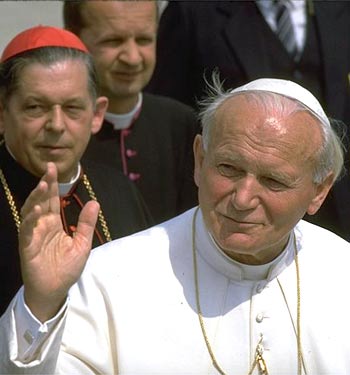
| Pope John Paul II, né Karol Józef Wojty?a (born May 18, 1920), was the bishop of Rome and head of the Catholic church from 1978 to 2005 , the first non-Italian pope in 455 years and the first ever from a Slavic country. His crusades against political oppression have been widely praised, and his trips abroad—100 by the year 2003—have attracted enormous crowds (some of the largest ever assembled). With these trips, Pope John Paul covered a distance far greater than that traveled by all other popes combined. They have been an outward sign of the efforts at global bridge-building between nations and between religions that have been central to his pontificate. John Paul II has beatified and canonised far more saints than any other previous pope in history. Whether he has canonised more saints than all his predecessors put together, as is sometimes claimed, is difficult to prove as the records of many early canonisations are incomplete or missing. On 14 March 2004-2005 his pontificate overtook Leo XIII's as the longest in the history of the papacy other than Bl Pius IX and St. Peter. The length of his term is in extreme contrast with that of his predecessor John Paul I, who died suddenly after only 33 days in office (and in whose memory John Paul II named himself). Personal background Karol Józef Wojty?a (pronounced: voy-TIH-wah) was born in Wadowice, Southern Poland, a son of a former officer in the Hapsburg army. His youth is marked by intensive contacts with the then thriving Jewish community of Kraków, and the experience of Nazi occupation, during which he worked in a quarry and a chemical factory. An athlete, actor and playwright in his youth, Karol Wojty?a was ordained a priest on November 1, 1946. He taught ethics at the Jagiellonian University in Kraków and subsequently at the Catholic University of Lublin. In 1958 he was named auxiliary bishop of Kraków and four years later he assumed leadership of the diocese with the title of vicar capitular. On December 30, 1963, he was named Archbishop of Kraków by Pope Paul VI. Both as bishop and archbishop, Wojty?a participated in the Second Vatican Council, making contributions to the documents that would become the Decree on Religious Freedom (Dignitatis Humanae) and the Pastoral Constitution on the Church in the Modern World (Gaudium et Spes), two of the most historic and influential products of the council. In 1967 Pope Paul VI elevated him to cardinal. In August 1978, following Pope Paul's death, he participated in the Papal Conclave that elected Albino Luciani, the Cardinal Patriarch of Venice, as Pope John Paul I. At 65, Luciani was a young man by papal standards. While Wojty?a at 58 could have expected to participate in another papal conclave before reaching the age of eighty (the upper age limit for cardinal electors), he could hardly have expected that his second conclave would come so soon, for on 28 September 1978, after only 33 days in the papacy, Pope John Paul I died, in circumstances that still remain mysterious. In October 1978 Wojty?a returned to Vatican City to participate in the second conclave in less than two months. The conclave itself was divided between two particularly strong candidates: Giuseppe Siri, the reactionary Archbishop of Genoa, and Giovanni Benelli, the liberal Archbishop of Florence and close associate of Pope John Paul I. In early ballots Benelli came within nine votes of victory. Wojty?a however secured election as the compromise candidate, in part through the support of liberal cardinals like Franz König and conservatives who had previously supported Siri. On election, the first non-Italian pope for nearly half a millennium was referred to by many simply as the man for a far country. In terms of his age, his nationality, and his rugged health, the former athlete and playwright broke all the papal rules. He was to become the dominant twentieth-century pope of the Catholic Church, eclipsing Pope Paul VI in travels, Pope Pius XII in intellectual vigour, and Pope John XXIII in charisma. The first Polish playwright-Pope When on October 16, 1978 (first Mass on October 22), at age 58, he succeeded Pope John Paul I, he fulfilled a prophesy made to him decades earlier by Padre Pio that he would one day be pope. There was also another part to the prediction. The monk with the stigmata also predicted that Wojty?a's reign would be short and end in blood, a prophesy that almost became true when on May 13, 1981 he was shot and nearly killed by Mehmet Ali Agca, a Turkish gunman, as he entered St. Peter's Square to address a general audience. But far from having a short reign, John Paul II became one of the longest reigning Popes in history. There have been unproven speculations that the assassination was ordered by the Soviet Union. Two days after Christmas in 1983, Pope John Paul went to the prison and met with his would-be assassin. Like his predecessor, John Paul II opted to simplify his office to make it a less regal institution. He also opted not to use the Royal Plural, instead he refers to himself as "I". John Paul also opted for a simple inauguration ceremony instead of the formal coronation. He has not worn the Papal Tiara either during his term in office. This was done to emphasize the servant role that is expressed in Servus Servorum Dei (Servant of the Servants of God). Travels During his reign, Pope John Paul II made more foreign trips than all previous popes put together. While some of his trips (to the United States and the Holy Land) were to places previously visited by Pope Paul VI ("The Pilgrim Pope"), many others were to places that no pope had ever visited before. He became the first reigning pope to travel to the United Kingdom, where he met Queen Elizabeth II, the Supreme Governor of the Church of England. In a dramatic symbolic gesture, he knelt in prayer in Canterbury Cathedral, founded by Augustine of Canterbury and the See of the Church of England, alongside the then Archbishop of Canterbury, Robert Runcie. Throughout his trips, he stressed his devotion to the Blessed Virgin Mary through visits to various Marian shrines, notably Knock in the Republic of Ireland, Fatima in Portugal and Lourdes in France. His public visits were centered around large Papal Masses; one million people, one quarter of the population of the island of Ireland, attended his Mass in Phoenix Park in 1979. There was a plot to assassinate the Pope during his visit to Manila in January 1995, as part of Operation Bojinka, a mass terrorist attack that was developed by Al-Qaida members Ramzi Yousef and Khalid Sheik Mohammed. A suicide bomber would dress up as a priest. He would then use the disguise to get closer to the Pope's motorcade so that he could kill him by detonating himself. Before January 15, the day which the men would attack the Pope during Philippine visit, an apartment fire led investigators led by Aida Fariscal to Yousef's laptop computer, which had terrorist plans on it, as well as clothes and items that suggested an assassination plot. Yousef would be arrested in Pakistan about a month later, but Khalid Sheik Mohammed was not arrested until 2003. Relations with the Jewish people John Paul II has written and delivered a number of speeches on the subject of the Church's relationship with Jews, and has often paid homage to the victims of the Holocaust in many nations. One of the few popes to have grown up in a climate of flourishing Jewish culture, one of the key components of pre-war Kraków, his interest in Jewish life dates from early youth. His visit to the Synagogue of Rome was the first by a pope since the founding of the Catholic Church. The Anti-Defamation League recently stated, "The Anti-Defamation League congratulates Pope John Paul II on the 25th anniversary of his papacy. His deep commitment to reconciliation between the Catholic Church and the Jewish people has been fundamental to his papacy. Jews throughout the world are deeply grateful to the Pope. He has defended the Jewish people at all times, as a priest in his native Poland and during his pontificate....We pray that he remains healthy for many years to come, that he achieves much success in his holy work and that Catholic-Jewish relations continue to flourish." Criticising a 'culture of death' He was considered a conservative on doctrine and issues relating to the ordination of women, and has been critical of Liberation Theology and those who regard themselves Catholics while questioning the church's teachings on faith and morals. In the 1995 encyclical Evangelium Vitae (The Gospel of Life) he reasserted the church's condemnation of abortion, euthanasia, and capital punishment, calling them all a part of the "culture of death" that is pervasive in the modern world. His stood on capital punishment, world debt forgiveness, and poverty issues are considered politically liberal, showing that 'conservative' and 'liberal' labels are not easily assigned to religious leaders. In 2003, John Paul II also became a prominent critic of the U.S. war against Iraq. He sent his Peace Minister, Pío Cardinal Laghi, to talk with George W. Bush to express opposition to the war. The Catholic Church says that it is up to the United Nations to solve the international conflict through diplomacy and that a unilateral aggression is a crime against peace and a violation of international law. Serious health problems As the youngest pope since Pope Pius IX was elected in 1846, John Paul entered the papacy as an exceptionally healthy, relatively young man who, unlike previous popes, swam and skied. However, after over twenty-five years on the papal throne, two serious assassination attempts, the first of which injured him, and a number of cancer scares, John Paul's physical health deteriorated over the years. In May 2003, the Vatican confirmed that, as international observers had suspected, Pope John Paul was suffering from Parkinson's disease. He had difficulty speaking and hearing. He also had severe arthritis in his right knee, which he developed following a hip replacement. Nevertheless, he continued to tour the world. Despite speculation that he may resign, he remained in office until his death . Those who have met him say that, though physically in poor shape, he remained mentally in full health till the end . He passed away on the 2nd of April 2005 . |
 |