| Explosives |
 |
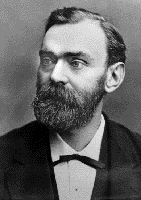
| Some ancient Asian alchemists were mixing some ingredients together to form a toffee they thought would make them live forever. They put their mixture on a small fire, not knowing they had made a mistake. The mixture started to bubble and boil, and then it burst into flames, burning down their hut and singeing their beards. Without knowing it these ancient alchemists had made the first explosives. The ancient Asians realized after a long while that the mixture that the alchemists had made could be used. They mixed many other things together and after many tried and failed attempts they found the answer.They tried mixing saltpeter and sulfur, two common materials, and found that the mixture actually detonated. They were very pleased with their accomplishment. The Asians did not use their new creation for war. They made the first fireworks out of the substance. They used their fireworks as signals for many things such as signaling that another army was approaching. The Asians kept developing their creation, not using their knowledge for war. The Asians finally designed a weapon for the need for one was so great. They took a hollowed piece of bamboo and filled it with the powder. Then they stuffed arrows in it. These were the first rockets. The Asians tried to keep their new invention to themselves, not letting the outside world know of it. But their secret couldn�t last forever. The information leaked to the Arabs who absorbed the new knowledge quickly. The Arabs made the Asian weapons and brought the knowledge westward. The Arabs transferred the knowledge on to the Europeans who, just like the Arabs absorbed it quickly.The era of explosives had begun. In the 1200�s Roger Bacon, a European, was interested in the new knowledge. He studied it and tested it over and over again. After many months he found the perfect ratio of saltpeter, sulfur, and a new ingredient, charcoal. After he found out the perfect ratio he wrote the ingredients and the amounts in code in his diary. Roger Bacon had made,and recorded, the first black powder(the early form of gunpowder). One-hundred years after the discovery of Roger Bacon, a man named friar Berthold Shwarts looked into this black powder. Bacon did not get credit for the making of black powder because he didn�t use his invention. Berthold Schwarts saw this and put his mind to work. He thought and tried many things and finally thought of a great idea. Schwarts took a long iron tube and closed one end except for a tiny hole. He filled the tube with black powder and stuffed a small pebble in it. He touched a flame to the tiny hole and the pebble shot through the air with great speed. Schwarts had invented guns. Soon guns became cannons which could launch boulders through stone castle walls. The age when the rich barons could sit in their castles and feel safe was over. The age when nights could don their armor and feel like a winner before the battle was over. A new age of brutality had begun. Gunpowder also sped up the very slow process of digging up stones. With gunpowder they could blow the stones out of the ground. Before, only the rich people could have stone houses because it took so long. Now even some poor people cold have a house of stone. This was a great technological step. Five hundred years after Berthold Schwarts ever made guns and six hundred years after Roger Bacon ever played with sulfur and saltpeter, an Italian scientist named Ascano Sobrero, thought of a new idea. He mixed nitric acid and glycerin together to see what would happen. The new substance nearly exploded in his face! Sobrero called his new creation nitroglycerin. He was then added to the list. Ascano Sobrero did many tests on the new liquid. He saw that the highly unstable mixture was very powerful. He knew that nitroglycerin was very dangerous. Sobrero played with the nitroglycerin, but didn�t use it. This was the same mistake that Bacon had made. Many years later, in the 19th century to be exact, a Swedish scientist tried his luck with nitroglycerin. Alfred Nobel tried putting dry substances into the unstable mixture. He tried putting many things in it, including jelly. This did fairly well but it didn�t burn well. He then tried putting in wood shavings and charcoal, but they didn�t help in making it safer to handle. The wood shavings actually made it more unsafe. This was not an easy job for Nobel. One day the idea popped into his head. Nobel went and got some kieselguhr , a German material that is made of small, fossilized remains of sea animals. When he got back he mixed the dry powder with the nitroglycerin. He tested the new substance and found that it worked. He found that kieselguhr could absorb many times its own weight in nitroglycerin. This was one of the many true great inventions. Nobel named his invention dynamite. This was one of the first high explosives. People used the new explosive for excavating and tunneling. Nobel got the credit for not only nitroglycerin but dynamite, too. Nobel became very rich and famous. Many years later Alfred Nobel died. He left his death money for prizes. The person that did best in some certain categories got thousands of dollars for their work. The prizes were given to the best in Chemistry, Medicine, Physics, Literature, and the promotion of peace. The prizes were, and still are, given out yearly. |
 |