 |
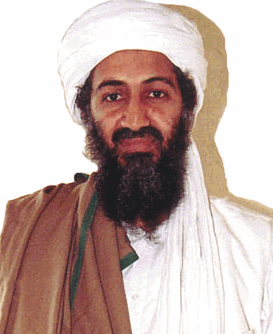
| Militant Islamic leader. Born in 1957 in Riyadh, Saudi Arabia. Osama bin Laden was one of some 50 children born to Mohammad bin Laden, one of the wealthiest construction businessmen in Saudi Arabia, and his various wives. When Mohammad bin Laden was killed in a helicopter crash in 1968, his immense industrial empire, the Bin Laden Group, passed to his children. While studying management and economics at King Abdul Aziz University in Jiddah (Jedda), bin Laden was greatly influenced by one of his professors, the Muslim fundamentalist Sheik Abdullah Azzam. Azzam was dedicated to the cause of liberating Islamic lands from foreign influences and reintroducing young Muslims to the strict tenets of the faith. Bin Laden�s own sense of mission in this regard increased when he worked on behalf of his family�s firm to rebuild several mosques in the sacred cities of Mecca and Medina. In time, his version of the Islamic faith grew more extreme and militant than Azzam�s, with terrifying implications for the future. When the Soviet Union invaded Afghanistan on December 26, 1979, bin Laden was one of thousands of Muslims who answered the call for jihad, or holy war, against what they saw as a godless power that had attacked their brethren in Afghanistan. He traveled to Peshawar, a border town in Pakistan that served as the center of the Afghan war effort. With the resources of his family�s company, bin Laden began organizing and financing an active opposition to the Soviet Union. In addition to buying arms, establishing training camps, and digging trenches for the war effort, bin Laden was responsible for providing food and medical care. As a member of the mujahedeen, or Afghan resistance, bin Laden fought in several battles, including the bloody siege of Jalabad, which marked the end of Soviet occupation of Afghanistan in 1989. For his efforts, bin Laden was celebrated as a hero both in Afghanistan and in his home country, where he returned after the war to work for the Bin Laden Group. He became involved with groups that opposed the ruling royal family of Saudi Arabia, the Fahd family, and was openly and fiercely critical of governmental policies, particularly in regards to American influence in Saudi Arabia. Though the United States had supported the mujahedeen in Afghanistan against the Soviet Union, bin Laden resented the country�s presence there and in Saudi Arabia, seeing it as contrary to everything he believed in about the importance of Muslim independence. After U.S. troops entered Saudi Arabia and its neighboring country, Kuwait, in August 1990, to begin Operation Desert Storm against Iraq, bin Laden�s outrage came to a head, and he became even more outspoken about his anger with the Fahds. Bin Laden saw the U.S. as solely concerned with safeguarding their oil interests in the Middle East, and believed that once they were allowed in, they would never leave. He hated to see a non-Muslim power threaten the Muslim stronghold of Iraq, and feared that the Arabian Peninsula would eventually be used by the U.S. as a staging area to protect Israel, the enemy of much of the Arab world. Because of his outspoken criticism, the Saudi government began putting pressure on bin Laden and threatened to retaliate by bankrupting his family�s company. He was even placed under house arrest in Jedda for a time. In April 1991, bin Laden left Saudi Arabia with his family (by then he had several wives and many children) and moved to Sudan, where a militant Islamic government had taken power. With his inheritance, estimated at $250 million, he invested heavily in the poor country, establishing several legitimate businesses, including a major construction company. He also began expanding al Qaeda (Arabic for �the Base�), a network of veterans of the mujahedeen and other Islamic militants that he allegedly founded near the end of the Afghan-Soviet conflict. Most ominously, bin Laden established a number of terrorist camps for the purpose of training and equipping terrorists from a dozen countries. According to the U.S. government, al Qaeda eventually formed alliances with like-minded fundamentalist groups such as Egypt�s Al Jihad, Iran�s Hezbollah, Sudan�s National Islamic Front, and jihad groups in Yemen, Saudi Arabia, and Somalia, placing bin Laden at the heart of an international coalition of Islamic radicals. Soon, the United States became bin Laden�s primary target in his jihad movement. He saw the presence of American soldiers in any Muslim country as a violation of the principles of the movement, and focused his efforts on eliminating that presence. On October 3, 1993, 18 American servicemen were shot down over Mogadishu in Somalia, where troops had been sent to assist in United Nations famine relief efforts. Their killers were local guerrillas, who dragged the servicemen�s bodies through the streets and also killed several hundred Somalis. The incident resulted in American troops withdrawing from Somalia. Bin Laden was indicted in 1996 on charges of training the people responsible for the attack, and he later admitted to an Arabic newspaper that he had planned it. He had previously claimed responsibility for attempting to bomb U.S. soldiers in Yemen in 1992. By the mid-1990s, bin Laden�s movement was gaining momentum and his name had been linked to a good deal of terrorist activity, including the 1993 bombing of the World Trade Center in New York City, which killed six people and wounded more than a thousand. In 1994, the Saudi government revoked his citizenship and froze his assets within the country. His family subsequently disowned him. In August 1995, bin Laden wrote to King Fahd, calling for guerrilla warfare on the American troops stationed in Saudi Arabia. That November, five Americans and two Indians were killed in the bombing of a National Guard truck in Riyadh. The four men who were accused in the attack and eventually executed claimed to be inspired by bin Laden, though some later said they had been coerced. Bin Laden denied involvement, but praised the act. In the wake of the incident, the U.S. government, supported by the Saudis, began to pressure the government of Sudan to control bin Laden. As a result, bin Laden moved his operations to Afghanistan, where he still enjoys the strongest support. A desperately poor country with no diplomatic ties to the West, Afghanistan was also racked by internal conflict. Bin Laden helped the Taliban, a radical minority of so-called fundamentalist Muslims, take control of the country, earning the group�s loyalty. In addition, bin Laden enjoyed the support of non-Taliban Afghans who were veterans of the Soviet conflict and rallied around their longtime hero. Bin Laden�s hold over his followers in Afghanistan and elsewhere remained strong, as he understood and capitalized on the frustrations, disillusionment, and anger that many Muslims feel against Western influences in their society, particularly America. His followers see him as a true believer in the Muslim faith, unspoiled by such outside influences. Bin Laden has cultivated their loyalty over the years with both strong religious rhetoric and vast amounts of money�not only to finance terrorist operations but also to rebuild homes, roads, military operations, and other parts of their faltering infrastructure. In 1998, bin Laden issued a fatwa, or religious proclamation, calling for the death of all Americans, excluding no one and not differentiating between military personnel and civilians, or between men, women, or children. This decree reinforced a previous fatwa, which he had issued in 1996, calling on his followers to commit themselves to expelling all Americans and Jews from Muslim holy lands. On August 7, 1998, exactly eight years after U.S. forces arrived in Saudi Arabia during the Gulf War, two truck bombs exploded outside the U.S. embassies in Nairobi, Kenya, and Dar es Salaam, Tanzania. The attacks in Nairobi killed 213 people, including 12 Americans, and wounded 4,500; in Dar es Salaam 11 died and 85 were injured. As in other attacks, bin Laden denied responsibility, but prosecutors allege his guilt is evident in several faxes sent by one of his terrorist cells in London and in statements made by convicted bombers and al Qaeda members. Two weeks after the embassy attacks, President Bill Clinton ordered cruise missile attacks against suspected terrorist training camps in Afghanistan and a pharmaceutical plant that was reputed to be a chemical weapons plant in Khartoum, Sudan. The operation, designed to get at bin Laden and his supporters and thwart their suspected attempts to acquire chemical and biological weapons to use against U.S. targets, was unsuccessful�bin Laden and his men had apparently already abandoned the camps and the pharmaceutical company was not found to have been used illegally. In November 1998, the United States government brought indictments against bin Laden and other suspected terrorists with charges including the embassy bombings. At the same time, the U.S. State Department offered a $5 million reward for any information leading to bin Laden�s arrest. In 1999, the Federal Bureau of Investigation also placed him on their Ten Most Wanted Fugitives list. In May 2001, four of bin Laden�s associates in al Qaeda were convicted of the bombings in Kenya and Tanzania and sentenced to life in prison. By that time, he had already been linked to a failed plot to bomb Los Angeles International Airport during the millennium celebrations on New Year�s Eve 1999, as a man who pleaded guilty to the attempt claimed to have been trained at an Afghan camp run by bin Laden. Far more seriously, he was suspected of masterminding the suicide bombing attack on the U.S.S. Cole battleship in Yemen�s port of Aden on October 27, 2000, which killed 17 U.S. naval personnel and injured many more. Subsequent reports from Yemeni officials stated that five suspects in the planning of the Cole attack admitted to being trained in bin Laden�s camps. As devastating as previous terrorist attacks on America had been, they paled in comparison with the events of September 11, 2001, when two hijacked commercial jets headed from Boston to Los Angeles flew into the twin towers of the World Trade Center. The towers collapsed roughly an hour after the attacks, burying lower Manhattan in a blanket of debris. Shortly after the attacks in New York, another plane (initially headed to Los Angeles from Washington, D.C.�s Dulles Airport) hit the Pentagon in the nation�s capital. A fourth hijacked commercial airliner later crashed in Somerset County, in Western Pennsylvania. The death toll of the attacks of September 11, carried out by a suspected 19 hijackers, is estimated to exceed 4,000 people. Bin Laden is suspected to be living in Afghanistan as a guest of the Taliban government. He has denied involvement in the attacks but said he supports those who carried them out. Despite this denial, bin Laden immediately became the prime suspect, due to his well-known hatred of the United States, his campaign of terror against American targets, and evidence linking him to the perpetrators of the World Trade Center bombing in 1993. U.S. officials, including Secretary of State Colin Powell, have indicated they have evidence linking bin Laden and al Qaeda to the attacks of September 11. In the weeks following the attacks, President George W. Bush demanded that the Taliban turn bin Laden over to American authorities and dismantle the operations of the al Qaeda network in Afghanistan. The Taliban has condemned the attacks and refused Bush�s demands, saying they want proof of bin Laden�s involvement. United States began strikes on targets in Afghanistan in early October. As the American offensive drove Taliban forces out of many Afghan cities and strongholds, the hunt for bin Laden intensified, and the U.S. government offered up to $25 million for information about his whereabouts. |
| Laden, Osama bin 1957 -- |
|
| Date of birth: 1957 Place of birth: Saudi Arabia Height: 6'4" -6'6" (1.94-1.98m) Weight: 160 lbs (71 kg) Hair: Brown Eyes: Brown Complexion: Olive Sex: Male Nationality: Saudi Arabian Characteristics: Full beard, mustache; walks with cane Aliases: Usama Bin Muhammad Bin Ladin, Shaykh Usama Bin Ladin, the Prince, the Emir, Abu Abdallah, Mujahid Shaykh, Hajj, the Director Status: Fugitive |
| Up to $25 Million Reward |
| Biography |
 |