 |
| Home Winemaking - The Basics |
Getting started When trying to make wine , the first thing you need is a recipe. You can find recipes on the web or in winemaking books or you can compose your own recipe by combining several recipes. Check if the recipe requires juice fermentation (for white wines) or pulp fermentation (for red or blush wines). Both require their own approach to the first stages of winemaking. Specific procedures for pulp and juice fermentations for red and white wines respectively will be indicated with the bold headings red and white. White Juice fermentation is used when making white wines. In this case juice is extracted from the fruit by pressing the fruits with a wine press and then fermented the juice in a carboy or fermentation bottle (secondary fermentor). Red Pulp fermentation is used to maximize color and flavour extraction, necessary in making red wines. It basically starts by making pulp by crushing the fruit and then fermenting the pulp without extracting the juice first. This can't be done in a carboy (secondary fermentor), but in a primary fermentor like a bucket of tank. This fermentor must be covered to prevent contamination by harmfull bacteria. For beginners, it's best to start with some juice or concentrate bought commercially. This is easy to start with and requires little equipment. This way you can start with juice fermentation without having to press the fruit with a wine press, and avoiding a pulp fermentation. Keep records of all ingredients and all events. |
Preparing the must The must is mixture of ingredients that will go on to ferment and become wine. U need to sanitize the must to kill wild yeast and bacteria. This can be done by means of: Sulphite or crushed campden tablets (1g/10kg), (the most common way) Pouring hot water over the fruit, to kill most wild yeast and bacteria on the fruit skins Boiling the fruit . This helps extracting the juice, but can result in change of flavour and could cause a pectin haze, if not using pectic enzyme . The sulphite is most commonly used and probably the best . In pulp fermentation , crush some of the fruit. In juice fermentation u need to extract some juices . This can be done by boiling or by means of pressing. Next clean the fermenting vessel and the other material that is going to be used and rinse it with sulphite solution to sterilize it. Fill the fermentor with the must and add water, and other ingredients that the recipe calls for except the sugar and yeast. Then take a hydrometer reading . Calculate the amount of sugar needed for the desired alcohol content. Dissolve the right omount of sugar and take a reading of the starting SG (Specific Gravity). If you don't have a hydrometer, add the sugar according to the recipe. Take out some must with a measuring jar, dissolve the sugar and gently pour off the liquid. This way all the sugar gets dissolved properly. You can boil the water before adding to the must and dissolve the sugar in the hot water first. Crush and dissolve one campden tablet and add it to the must if you haven't already done so and let it stand for 24 hours for the sulphite to work. Leave some room (at least 1/5) on top, otherwise foam which forms during fermentation will overflow. Red Cover the primary fermentor with a lid that is not air tight. Air must be able to get in to promote yeast growth during the first few days. Furthermore , the carbon dioxide gas produced by the fermenting process must be able to escape. Vinegar flies must be kept out however . A lid with a hole covered with a piece of cotton works fine. Try making a little more wine than your secondary fermenting vessel can hold because you will need extra wine for topping up purposes when racking later on. White Plug the bottle with some cotton to allow oxygen into the bottle and to keep fruit flies out. This is necessary to promote yeast growth during the first few days. Fill the carboy to 4/5 part. Put the rest of the wine in another bottle, so that you can completely fill the carboy later on in the process. |
Making the yeast starter A yeast starter is prepared 24 hours before fermentation start, but this is not needed if you are not making large batches of wine (less than 10 liters). A yeast starter gives the fermentation a more vigorous start. For a simple yeast starter you'll need: Must (5 to 10 % of the amount to be fermented) Sugar (when the must contains little sugar) Yeast nutrient Citric acid (or some lemon juice) Wine yeast Heat the juice until lukewarm (about 30 degrees Celsius), nutrient and the citric acid. Put this mixture in a sterile bottle. Add the yeast and stir well. Cover with some wadding. Let it stand for about 24 hours untill foam has formed. It is then ready to be added to the must. A yeast starter usually works best and it's necessary for larger quantities. For smaller quantities, simple yeast rehydration is usually sufficient. The faster the must will start to ferment, the better. A yeast starter is the fastest way, rehydration comes next, and just adding the yeast dry takes the longest untill fermentation starts. The longer the period before fermentation gets going, the more likely that bacteria and mold spoil your wine. White Go to the Secondary fermentation paragraph and skip the next one. |
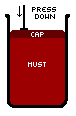
Primary fermentation Red 24 hours after the campden tablet has been dissolved in the must, the yeast starter can be added to the must. The actual start of fermentation will take place after 2 or 3 days . This will be perceptable by the formation of foam at the surface . Pulp fermentation generally takes a few days to a week. Foam will form in the primary fermentation vessel, but as it should be significantly larger than the amount of must to be fermented, the foam shouldn't be a problem. The rising bubbles will cause a cap of fruit pulp to form on top. This must be pressed down at least once a day to keep it submerged to avoid mold growth. This can be done using a clean spoon. Pressing also maximizes color and flavour extraction. |
|
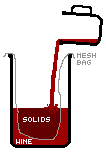
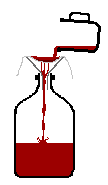
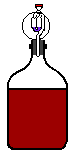
Transfer to secondary Fermentor Red When the color and tannin extraction has been sufficient (a few days to a week after fermentation start) the must needs to be transferred to the secondary fermentor (a carboy ). The sediment and cap have to be separated from the wine. This can be done by straining. You may want to take a hydrometer reading here, if you have one. It should have a SG of 1030 at this point. Before straining clean the secondary fermentor and all equipment that's going to be used and rinse them with a sulphite solution. Clean and sterilize another bucket and put a nylon straining bag into it. Pour the must through the straining bag. You can use a measuring cup to do this. Avoid excess splashing. Take the bag out of the must and gently press the liquid out.Dispose of the solids. Pour the wine into the secondary fermentation vessel . After straining, place an airlock at the top of the carboy. Do not fill the carboy completely yet, because more foam will form. If you've made some excess wine that doesn't fit the carboy, put it into a smaller bottle, also under airlock. You can use it for topping up while racking later on in the process. |
 |
 |
Secondary fermentation Red After primary fermentation and racking the wine is ready for secondary fermentation. This process will continue for a longer period of time but not as vigorously as primary fermentation. Fill your carboy almost to the top, when no more foam is being formed . Place a bung and airlock on top of the carboy. White When fermenting clear juice, there's no primary fermentation. The juice is placed in the carboy from the start. You'll only fill the carboy for 4/5 part. Fill another bottle with juice so you'll be able to fill up the head space later on. Add the yeast starter and get both bottles fermenting. Put a piece of wadding in the neck of the bottles. Foam will form on top of the must due to rising bubbles. That's why you only filled the carboy partially. The amount of foam depends on the ingredients used and fermentation conditions. When fermentation speeds up put a fermentation lock in place of the wadding. When fermentation slows down (you can tell by the bubbling rate of the airlock or by hydrometer readings) it's time to add the rest of the total amount of sugar required if you want to get a higher alcohol content. The SG should be about 1010 now. It's best to add the sugar in several steps. Take a hydrometer reading before and after each sugar addition to be able to calculate the alcohol content when the wine is finished. Siphon off some wine, dissolve the sugar in it and siphon back. Notice that dissolved sugar needs some bottle space. |
 |
 |
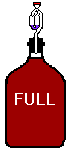
Topping up When the fermentation process slows down further (usually after a month or so) and all sugar has been added, you need to fill the bottle all the way to the top to minimize the surface area. This should be done because the wine doesn't form CO2 blanket any more and oxygen could oxidize your alcohol into vinegar and spoil it. Use the excess wine you've made to top up, |
 |
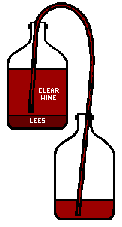
Racking When the wine has stopped fermenting (it has stopped bubbling) it has to be racked. The wine has to be siphoned to another bottle leaving the sediment behind. The process has to be done several times so that you end up with a clear batch of wine. Racking is done like this: Find a carboy or big bottle to take all the wine. Clean the bottle and all equipment and sterilize with sulphite solution. Rinse with water. Dissolve a crushed campden tablet in half a glass of water and pour it into the empty bottle. Then syphon the clear liquid without aspirating the leece at the bottom of the vessel.Discard the leece and siphon the wine back again. You will lose some volume here, so you'll have to refill the bottle to the top. You can use excess wine if available or water. Make sure that you've refilled the fermentation bottle within a day to avoid too much oxidation. You'll have to repeat this sequence every time a reasonably thick layer of sediment has accumulated untill the wine is clear. About three rackings should do. If the wine doesn't clear out , there are fining agents like bentonite to help you out. If you don't mind the haze, don't worry. |
 |
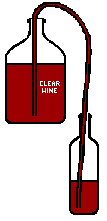
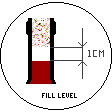
Bottling When the wine is clear, and the fermentation process has fully ceased, the wine can be bottled. Take the hydrometer to check for residual sugars and to be able to calculate the alcohol content. The wine can also be matured in the fermentation bottle (bulk aged). Beware that if you bottle too soon, your corks might start popping out due to re-fermentation in the bottle. So it's best to wait a few months after fermentation stops to make sure that fermentation has fully ceased and the wine is stable. Just before the actual bottling, the wine can be sweetened to taste. Use green or brown glass bottles for red wines, and white or colored bottles for white wines. The easiest bottle to work with is the Bordeaux type (easy to pile up). Here is the bottling procedure: 24 hours before bottling add one crushed campden tablet to the wine. Add potassium sorbate and sugar, if you want to obtain a sweet wine. Prepare the corks and the bottles you will need too. These have to be cleaned and just before bottling rinse them with sulphite solution and drain them. Siphon the wine from the carboy to the bottles.Bottles need to be filled to about 1 cm below the cork. |
 |
 |
Corking Now that you've just finished filling your bottles it's necessary to cork them (if you've chosen to use wine bottles).This is done with corking machine . When you're not making large quantities a hand held corking tool will do. Large quantities require a floor corker. Here's how: 12 to 24 hours before bottling soak your corks in sulphite solution to sterilize them and to make them more flexible. Make sure that the corks are fully submerged, so put some weight on top. Insert a cork in the device. and cork your bottles. Freshly corked bottles are best left standing for a few days in order to prevent wine spillage due to popping corks . Corks could pop due to the force of the wine and compressed air. This risk goes away after a couple of days. Eventually the bottles must be layed on their sides, otherwise the corks will dry out, leak, and the wine will oxidize. |
Labeling and capsuling All bottles should be labeled. It is not only necessary to identify the wine, but the label also makes the bottles look better. Information that should appear on the label includes : type of fruit, sweet/dry, year, month, date of fermentation start and bottling date, type of wine, your name, %vol alcohol. You can buy labels ready made or you can have some custom designed for you. But homemade wine looks good with homemade labels. Labels are best glued on with water soluble glue . This is necessary for getting them off easily in order to reuse the bottle. You can use capsules to cover the top of the bottle neck and the cork. It is mainly for decorative purposes. Most capsules must be heated to attach them to the bottle neck. This is best done by means of a heat gun. Pouring boiling water over them also works. Of course this must be done before labeling. |
Bottle aging Aging means letting your wine lie down for a period of time before consumption so that its quality improves. This can be done before (bulk aging) or after bottling (bottle aging). Almost every wine improves with time. A few months will cause significant change, a year or more will be better. This process doesn't continue into infinity. There is stage where a peak in quality is reached . The time that home made wine will take to age usually depends on how long you can bare to wait. A typical aging time for your first bottle is something between 1 second and one week after bottling. So the more wine you make, the better chance it gets to age. To age wines you need a dark place where temperature is cool and relatively constant. Drinking That's what it's all about! Consuming your wine. You can drink it with some company so that you get opinions from outsiders about your wine. It may taste different from commercial wine, you should be aware that you've really made something a bit special. White wine should be drunk chilled , red wine at room temperature. Enjoy! |