|
16th - 20th July
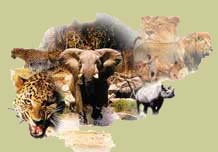
Well, what can one say about one of Africa's best and well
know game reserves. We spent three days in total in the park
and saw a huge variety of game. Etosha is different from every
other game reserve we have been to in that the camps are placed
next to waterholes and a spotlight is shone on the waterhole
all night. This means that the patient amongst us can sit
on a ledge just away from the waterhole and watch the nocturnal
game, all night.
The other difference in Etosha is one which is mirrored around
Namibia and come across unfortunately like a bit of a scam.
The fees for game reserves and even private campsites is something
along the lines of a per site per night fee, a per vehicle
fee, and a per person per day entrance fee. Asking how much
a campsite is for the night is a pretty complex issue. It
generally involves a blank look, a scratch of the head, a
few "hummms" and a dive for the trusty calculator.
Unfortunately the whole structure leaves your earnest tourist
feeling somewhat ripped off.
We didn't manage to get bookings for Etosha because we were
told in Swakopmunt that it was fully booked. Being pretty
African savvy though we were pretty sure we'd find a spot
so off we went, trusting fate and the inefficiencies of Africa.
Sure enough, there are more than enough campsites to go around.
Apparently their computer booking system only has a limited
number of sites listed, but there are substantially more in
reality. Go figure!
Our first night we spent in Halali which is the middle of
the three lodges within the park. The waterhole was a big
social gathering point for all the surrounding game. A chance
to put up their feel, have a cool drink and discuss the days
events - in front of a gasping horde of camera clicking, video
whirling tourists. In a couple of hours watching we saw a
number of black rhino (there are only approx. 2500 surviving
black rhino in Africa), stacks of elephant complete with young,
hyena (ugly bastards), jackal and porcupine. It was such a
joy being able to game view but not being in a stuffy, hot
car. Late at night the hyenas ensured that our sleeptime was
filled with anxious dreams (especially those sleeping under
the stars) with their eerie booooohoooopppp's. Very African
and very unnerving.
The second and third night we spent in Namatoni, which is
the furthest camp East. The site was much more spread out
and had grass - a pleasant change from the dry dust of the
Halali campsite. The Namatoni waterhole suffered badly from
competing waterholes all around though. Scott - the most patient
of us foursome - spent endless hours the first afternoon/night
waiting for game to come down to the waterhole. He was rewarded
with countless jackals (although most of them lived within
the campsite anyway) and a few ducks. The most exciting event
was when one of the jackals made a halfhearted attempt at
snapping up a duck for dinner. The duck didn't stop quacking
for hours after that. It's little ordered life had clearly
been put in complete turmoil.
Scott and Rob spent a reasonably nervous two nights in Namatoni.
Sleeping outside when there seem to be more jackals within
the camp fence than without, can be a bit scary. Sleeping
with a bloody great big hunting knife in a sleeping bag is
equally unnerving (not to mention the comfort factor).
We then said a fond farewell to Etosha and its teeming game,
and made our way to Tsumeb. Tsumeb has a sad little story.
The town was basically supported by a big copper mine. From
the look of the town now, it was once a very prosperous little
place. It is the site where Namibia had its first serious
lesson in capitalism, just after independence. A Union of
mineworkers formed on the mine. The Union was relentless and
during one strike the workers allowed the melted copper to
solidify in the melting pot. After that the mine was put into
liquidation and the mine was closed. Now there is chronic
unemployment in the area, and the town has lost its major
benefactor.
Mom and Sunara are going to be leaving from Tsumeb, for the
comforts of Mom's little house back in George. For non-campers,
they have both done exceedingly well to cope with the dust,
cold and discomforts of being squashed into the old landy.
Many family memories from this trip, that is for sure. For
Scott and Rob, there is another wait in Tsumeb for a starter
motor from South Africa. Once Nyathi is back in 100% working
order (hmmm, questionable that) we head off to the Caprivi
and into Zambia.
|