| History of the RX Mazda Cars
The first Mazda RX models appeared in the late 1960s as prototype vehicles. Sales in Japan began in 1968 and sales in the U.K. began in 1970 with the rotary powered R100. Later that year the RX-2 was introduced as a 1971 model. Road Test, a popular automotive magazine at the time, named the RX-2 the 1972 Import Car-of-the-Year. The next RX model the RX-3 debuted in 1972, available as a sedan, coupe and wagon. For 1974 Mazda debuted the RX-4 as a sedan and wagon followed by the Rotary Pickup. In 1975, Mazda introduced the Cosmo, named after the 1967 Cosmo Sport, Mazda's first commercialized rotary engine car. The legendary RX-7 debuted in 1978 as a 1979 model. It got a face-lift in 1980 for the 1981 MY. The fuel injected 13B rotary was added in 1983 for the 1984 MY RX-7 GSL-SE. The second-generation RX-7 appeared in 1985 with an optional 13B rotary engine featuring Twin-Scroll Turbo and an inter-cooler. The third-generation RX-7, equipped with all-wheel double-wishbone suspensions with a newly-developed dynamic geometry control mechanism, was launched in 1992 as a 1993 MY. It was discontinued in the U.S after 1995 although production for the domestic Japanese market continued with updates. Production on the third generation RX-7 discontinued in 2002. 1967 Mazda builds its first rotary vehicle, the 110S Cosmo Sport. 1968 Vehicle sales with the R100 coupe. 1971 Mazda debuts the rotary-powered RX-2. 1972 Mazda debuts the rotary-powered RX-3. 1974 Mazda debuts the RX-4. 1978 Mazda introduces the rotary-engined RX-7 sports car. 1985 Mazda introduces second-generation RX-7. 1986 Specially prepared Mazda RX-7 sets land speed class record of 238 mph at Bonneville. RX7 awarded 'Best new Sports Car' 1987 Mazda introduces the MX-6 sports coupe and restyles the 626 series. Mazda RX-7 Turbo named one of the best 10 cars. 1993 Mazda RX-7 named as a Car and Driver "10Best." |
|
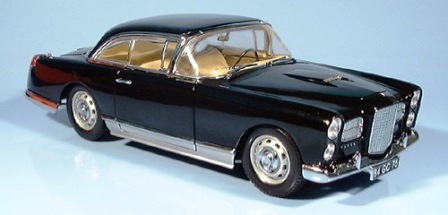
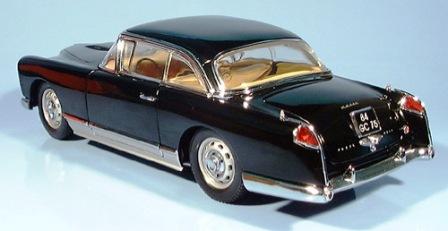
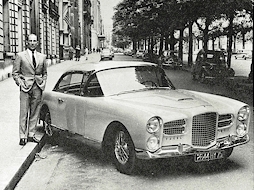
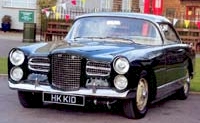
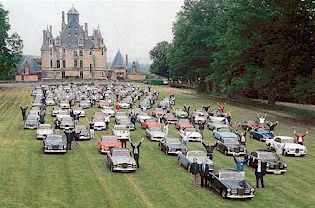
FACEL VEGA 1954 - 1964 The Facel Vega HK 500 was produced from 1958 to 1964. Last of the French builders of luxury cars, the Forges et Ateliers de Construction d'Eure et Loire in Pont-�-Mousson was formerly a body builder for Simca, Ford and Panhard. They started to build complete cars in 1954 using Chrysler V8 engines of 4.5 litres, and then of 5.8 and 6.3 litres. In 1957 Facel presented the 'Excellence'. They also made a smaller model, the Facellia, originally fitted with a Facel-built dohc four-cylinder 1600cc engine. This unreliable engine caused great consternation among Facel's customers, and was mainly responsible for the failure of Facel-Vega. The Facel Vega was the brainchild of Jean Daninos, whose determination led him to recreate the classic French grande routi�re exemplified by Bugatti, Delage, Hotchkiss, Delahaye and Talbot in the years between the wars. After the war, Facel built bodies for Panhard, Simca and Ford-France and also produced Pininfarina-designed coachwork for the Daninos-inspired Bentley Cresta, precursor of the famed Bentley Continental. Building on the experience of these ventures, Daninos unveiled his first Facel - the aptly named Vega - at the Paris Salon in 1954. Over the next 10 years, the range progressed through the FV to the HK500 and Facel II models - all being fitted with the most powerful Chrysler V8 engines available. They were luxuriously appointed 2+2 coupes except for a limited-production limousine, the Excellence, produced from 1958 to 1962, with the remarkable feature of four doors with no central pillar. In 1959 the Facellia was introduced at the Paris Salon. This beautiful two-seater convertible was a major step by Daninos towards his ultimate aim of an all-French car. The 1647cc twin overhead cam engine was designed and manufactured in collaboration with Pont-�-Mousson, who were already producing manual gearboxes for the Chrysler-engined cars. The Facellia range was later expanded to include two- and four-seater fixed-head coupes. Unfortunately, despite some advanced features and high power output for its size, lack of development, and production difficulties caused disappointing reliability and the resultant poor publicity led directly to the demise of the company. Later versions of the small Facel were powered by Volvo or Austin Healey engines. Approximately 2900 cars of all models were hand-built in the short life of Facel. All were stylish, luxurious and fast. Naturally they were also very expensive - prices for the Facel II were comparable to those of the equivalent Rolls Royce - and were bought by the rich and famous seeking something different and distinctive. The exclusive styling and prestigious aura appealed to royalty and other notables - the star-studded list of owners is a miniature "Who's Who", with a shah, a king, ambassadors, princes and presidents, Danny Kaye, Tony Curtis, Brian Rix, Ringo Starr, Lionel Bart, Joan Fontaine, and Ava Gardner (who had no less than three). To complete the grande routi�re image, great racing figures of the time such as Rob Walker, Maurice Trintignant and Stirling Moss, used Facels to cover the distances between the race tracks of Europe at high speed in comfort and safety. In total, 164 of the cars were sold in the UK - only 62 are known to remain. Because of these small numbers the marque has been largely forgotten except by classic car buffs and the few members of the Facel Vega Car Club. In recent years however, some well restored cars have appeared leading to renewed interest in this first of the post-war EuroAmerican hybrids. The supercar appearance of the HK500 and the elegant French style of the Facel II create a stir when displayed today as much as when they were first seen, and the Facellia remains one of the prettiest and most well-appointed small sports cars ever produced. |
| NEXT CAME THE WANKEL ENGINED MAZDA RX7 |
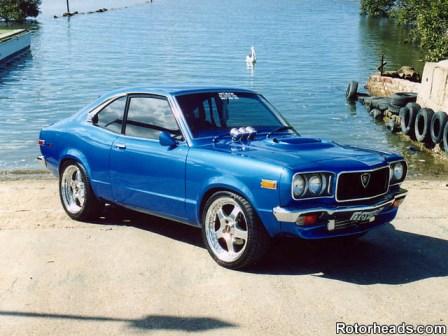
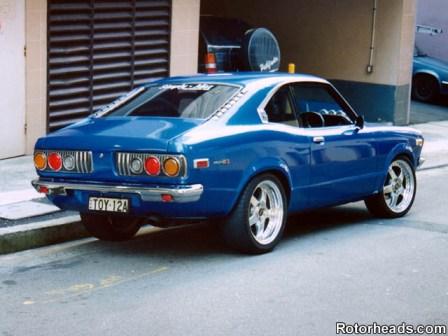
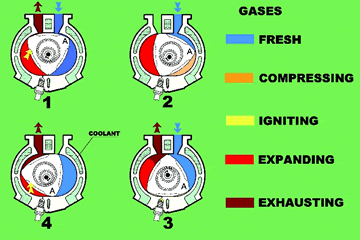
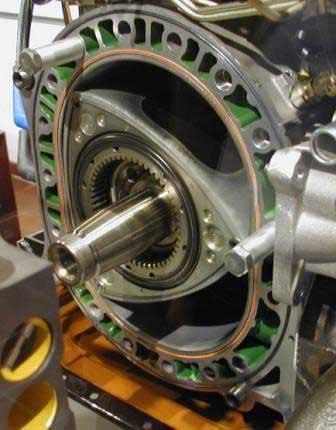
| Father always had a penchant for slightly 'unusual' cars and he arrived home one day with a very attractive blue Mazda Coupe fitted with the little known Wankel rotary engine. The engine developed plenty of power which gave a very sporty drive. These engines were so smooth ( no reciprocating parts as in a conventional piston engine) that when idling it was impossible to tell if the engine was fired up or not, so one tended to check the rev counter before moving off. It was possible to balance an old three pence piece on the running engine without the coin falling over! Unfortuately these early rotor engines suffered from rotor tip seal wear. Later this was solved by using a ceramic seal. Our engine had to be replaced early on as the seals started to fail and the cost of the new engine was about a third of the cost of the car. Father had to dig deap into his pocket! Despite this, the car was a delight to own and drive. |
| THE FRENCH MADE FACEL VEGA HK 500 |
| Sterling Moss & his HK 500 |
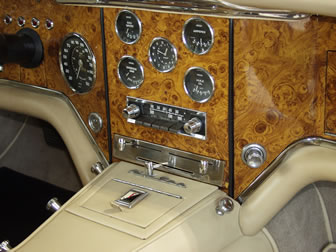
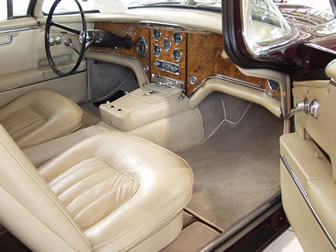
| Very Luxurious Interiors |
| I bought a Facel Vega HK500 myself (details will be found in 'My cars' section). My Father liked it so much that he asked me to find him one. Luckily, just outside Southampton there was an enthusiast who owned three cars, two HK 500's and a very nice Facel 2 which was the last big model made. We did a deal on the best of the HK 500's which was a very nice Royal Blue and in beautifull condition inside and out. The engine and auto box were of course Chrysler and there was a very curious push button pad mounted on the facia behind the steering wheel to select the required P-R-D-2-1 which was very awkward to use. We decided to remove the button pad and replace it with a conventional gear lever mounted on the centre consul. In the pictures of an interior above one can see that there is no gear shift mounted where one would expect it to be! This made life much easier and during the years we had it, the car was always admired wherever it went. |
 |
|
 |
 |
 |
 |
 |
 |
 |
 |
 |
 |
 |
 |
 |
 |