General Information:
Course Content:
Catalog Course Description:
| MAC 1105 |
College Algebra |
3 Credit Hours |
|
Prerequisite: MAT 1033 with a grade of "C" or better or
satisfactory score on the placement test. The major topics
included in this course are linear equations and inequalities;
quadratic equations and inequalities; relations and functions;
graphs; systems of equations and inequalities; exponential
and logarithmic functions; and applications. A review of
algebraic techniques is also included in this course as well
as a review of polynomials, factoring, exponents, roots and
radicals. MAC 1102 cannot substitute for this course. Three
contact hours. (CBE) A.A., A.S., A.A.S.
|
Course Outline:
- Review of Algebraic Techniques (Optional)
- Exponents, Roots, and Radicals
- Equations and Inequalities
- Complex Numbers
- Functions and Functional Notation
- Definition
- Domain and Range
- Operations on Functions
- Types of Functions and Relations and Their Graphs
- Linear
- Circles
- Quadratics
- Cubics
- Absolute Value
- Radical
- Rational
- Piece-wise
- Inverse Functions
- Definition and Notation
- Graphs
- Exponential and Logarithmic Functions
- Properties
- Equations
- Graphs
- Systems of Equations and Inequalities
- Linear Systems of Equations and Inequalities
- Non-Linear Systems
- Applications
- Curve Fitting
- Modeling
- Optimization
- Exponential and Logarithmic Growth and Decay
Course Materials:
Required Materials:
- Textbook
-
|
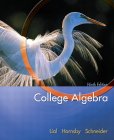
College Algebra 9th Edition
by Margaret L. Lial, John Hornsby, and David I. Schneider,
published by Addison-Wesley, New York, NY, copyright 2005,
ISBN#: 0-321-29311-8.
|
|
- Calculator
-
Texas Instruments TI-83, or TI-83 Plus.
- Each student must have his or her own calculator.
- MyMathLab
- Digital Video Tutor
- Student Solution Manual
- A Review of Algebra
- Internet Access
-
Available through:
- Home
- Computer Labs
- Learning Center
- Library
- Email Account
-
Available through:
- Home account
- FCCJ
- Free email accounts such as Yahoo! or Hotmail
Needed Materials:
- Notebook
-
3-ring binder with paper and pockets (preferred).
- Notebook paper
-
College or wide ruled with size between 10.5 by 8
inches and 11 by 8.5 inches (preferred).
- Pencils or mechanical pencils
-
Bring at least two to class everyday (preferred).
Helpful Materials:
- Straight Edge
- Protractor
- Compass
- Graph Paper
-
Either:
- Quartile - 4 squares per inch
- Quadrille - 5 squares per inch
Course Grading System:
Grading Scale:
| Grade |
Percent |
Points |
| A |
90% - 100% |
1350 - 1500 |
| B |
80% - 89% |
1200 - 1349 |
| C |
70% - 79% |
1050 - 1199 |
| D |
60% - 69% |
900 - 1049 |
| F |
Fail |
| W |
Withdrawal |
W, FN, and I Grade Policy:
- W Grade (Withdraw):
- A student may withdraw without academic penalty at Florida
Community College from any course up to the last withdrawal
date published for each session
The student will be
permitted only two withdrawals or "NP" grades per course.
Upon the third attempt, the student will not be permitted to
withdraw and will receive an "A," "B," "C," "D," or "F" grade
for the course.
- If you must withdraw, do so officially and save your
paperwork.
- FN Grade (Failure due to non-attendance):
- Students who fail to remain active in the course and who
do not withdraw will receive the FN, failure due to
non-attendance, grade. For this
course, failure to remain active is defined as any
student that meets the following criteria:
- not active for in the course for two consecutive
weeks.
This grade may affect financial aid.
- I Grade (Incomplete):
- The grade of "incomplete" is given at the discretion of the
instructor when the student has completed at least 75% of the
course. The student must have a valid excuse with
documentation and consult with the instructor before an "I"
grade will be assigned. The instructor shall prescribe in a
written agreement with the student the remaining course work
required and a time limit for completion and removal of the
"I" grade. All work must be completed within the first eight
weeks of the subsequent term, unless the instructor agrees to
a longer timeframe (not to exceed one year). Failure to
complete the course within the time limit will result in an
automatic F. The instructor may choose not to grant the
request.
Weighting of the components of the course:
Grade Weights:
| Homework Assignments |
100 |
| Chapter Quizzes |
100 |
| Discussion |
100 |
| Practice Test 1 |
100 |
| Practice Test 2 |
100 |
| Mid-Term |
500 |
| Final |
500 |
| Bonus |
|
| Total |
1500 |
Grade Calculation:
- For the homework assignments, I will add the number of
points that the student has gained and divide this by
the total number of homework points. This value
(0% to 100%) will count as the homework score (0 to
100).
- For the chapter auizzes, I will add the number of
points that the student has gained and divide this by
the total number of points from chapter quizzes.
This value (0% to 100%) will count as the chapter
quiz score (0 to 100).
- For the discussion, the discussion grade will be based on
the student's participation in class discussions and
creating a personal webpage (0 to 100).
- For the practice tests, each practice test is worth 100
points. The number of points the student gets on
the practice test will count as the practice test
score (0 to 100).
- For the mid-term, the mid-term is worth 500 points. The
number of points the student gets on the test will
count as the test score (0 to 500).
- For the final, the final exam is worth 500 points. The
number of points the student gets on the final exam
will count as the final exam score (0 to 500).
- For the bonus, the number of bonus points the student
gains during the sememster will count as the bonus
score.
I will add up all of the above scores and divide the total by
fifteen. The result is then rounded to the nearest whole
number.
State Mandate:
- Students have only three attempts per college credit course
(all grades count as an attempt, including audit, IW, AW,
W, NP, F and D).
- A student will be permitted a maximum of two withdrawals per
college credit course.
- The third time a student enrolls in a course he/she must pay
the full cost of instruction, which is equivalent to the
out-of-state tuition (approximately four times the regular
tuition).
- A student cannot repeat a course when a grade of A, B or C has
been earned.
Academic Dishonesty:
Students found cheating on quizzes, tests, or exams will receive a
grade of F in the course and procedures for expulsion from the college
will be followed. Cheating includes (among other things) copying
another individual's work (or allowing someone to copy your work),
using unauthorized references (cheat sheets or programmed information)
on a quiz, test, or exam, or allowing another individual to take a
quiz, test, or exam for you. For the full college policy, visit:
http://www.fccj.edu/resources/catalogs/2005_2006/rights/expectations.html#dishonesty
Course Requirements:
Homework:
Homework will be assigned from every section in the textbook
and is available in
MyMathLab. The grade for an assignment will consist of
the number of correct homework problems. Students may
re-submit homework assignments. The final homework grade
will be calculated by adding the number of points the student
has gained on the homework assignments and dividing this by
the total number of homework points. This value (0% to 100%)
will count as the homework score (0 to 100).
Students are strongly encouraged to work the odd numbered and a
few selected even numbered problems from the
textbook. In the event that
there are technical difficulties, students are expected to be
working the problems out of the textboo.
Chapter Quizzes:
A chapter quizzes will be given at the end of every chapter
in the textbook and is available in
MyMathLab. The grade for a Chapter Quiz will consist of the
number of correct problems. Students may re-submit chapter Quizzes.
The final chapter quiz grade will be calculated
by adding the number of points the student has gained on the
chapter quizzes and dividing this by the total number of
points on the chapter quizzes. This value (0% to 100%)
will count as the chapter quiz score (0 to 100).
Discussion:
Students will be required to take part in class discussions and
create a webpage. Students are required to post at least two original
questions or comments and constructively respond to two other questions
or comments each week. Responses to any leading Discussion Board
Postings by the instructor may also be included as part of your
participation grade. Responses in any forum must conform to the
Courtesy Code (see orientation).
Practice Tests:
There will be two practice tests worth 100 points each.
Mid-Term Exam:
There will be a mid-term exam worth 500 points and will be proctored.
Partial credit will be given for work shown. Students will be required
to either:
- attend one of the arranged mid-term exams or
- arrange to take the mid-term exam at an alternate time and/or
location
Final Exam:
The final exam is comprehensive and is worth 500 points and will be
proctored. Partial credit will be given for work shown. Students will
be required to either:
- attend one of the arranged final exams or
- arrange to take the final exam at an alternate time and/or
location
Bonus Assignments:
Homework:
Homework will be assigned from every section in the textbook
and is available in
MyMathLab. Students are to work the bonus assignments.
Each section is a separate bonus assignment. Each assignment
is worth one point.
Journal:
Students may choose to keep a journal of their educational
experience. The student needs to make a journal entry every
day or two. The journal will be turned in on when the student
takes the final exam.
For every entry the student needs to comment on the following:
- Date of Journal Entry
- Date of the class session
- What material and sections were covered
- What did you understand
- What did you not understand
- What did you like about that day's presentation
- What did you not like about that day's presentation
- How can the material be used in your field of study
- Any other comments the student wishes to make
Use the following guidelines for the journal.
- Name clearly written on the cover
- Name clearly written on the first page in the journal
- Put a place on the first page for your journal grade
The Journal will be graded and the first page (with the grade)
will be returned to the student.
Online Discussion:
Students who take an exceptionally active part in online
discussions will receive bonus points.
Make-up Tests:
I will only give make-up exams in extreme cases, which must be
documented. Make-up exams must be completed prior to the next test.
Only one make-up will be allowed.
Guidelines for Tests:
For the test, you can have pencil, paper, graph paper, calculator,
straight edge, and an eraser. You can show your work on the test or
on your own paper. Use the following guidelines for turning in the
test and scratch paper.
- Your name in the upper right hand corner of every page,
including scratch paper and the test.
- Put you answer on the Test.
- Circle your answer on the scratch paper.
- Turn in all scratch paper.
- Each problem on the scratch paper must be clearly labeled.
- Draw a line between each problem on the scratch paper.
- Do not scribble out your work.
Either erase or put a big X through it.
Incorrect problems that do not follow these guidelines
might
not receive partial credit.
Course Policies:
Electronic Devices:
All cellular or digital phones and pagers are to be turned
off during the exams.
Class Structure:
Online math classes are very different from the traditional
face-to-face math classes. The students must be self-motivated,
independent learners. Without the traditional lecture, students
must learn from the course materials, other students, and
the instructor.
The student needs to utilize all the course materials
- textbook
- MyMathLab
- Digital Video Tutor
- Student Solution Manual
- A Review of Algebra
- Calculator
I encourage questions and student responses to questions. I will
answer as many questions as I can. Most of my answers will be posted
in the discussion boards.
Attendance:
Students are expected to take an active part in the course. Students
who fail to remain active in the course, not active in the course for
two consecutive weeks, will receive a failure due to non-attendance.
Additional Information:
Online Delivery System (Course Platform)
This course is delivered in
MyMathLab.
Technology Requirements
You do not need to install CourseCompass! All you need is an Internet
connection and browser. To work with CourseCompass, your computer must
meet the following system requirements for operating systems,
connection speed and browser versions:
- Operating System
- Windows 2000 or XP
- Macintosh OS 9.2, 10.1, OR 10.2
- Internet connection with 28.8 kbps (kilobits per second) or
faster. The college can provide you wiht Internet access
(no ISP needed). You may choose to use your own ISP; however,
the college's ISP services are free to enrolled students.
- Browser:
- Microsoft Internet Explorer, Version 5.x up to
Version 6.0
- Netscape Communicator or Netscape Navigator, Version 6.2
and 7.0
- Please use the following checklist to determine
your computer readiness. You should own or
have access to:
- a computer with personal access to the
Internet
- an e-mail account
- Web-browser software
- Compatible operating system
- virus-checking software
- plug-ins including Acrobat reader and
Flash Player
- Additional hardware including speakers
CourseCompass uses both cookies and JavaScript technology. Both of
these features must be turned on in your browser, and are usually
turned on by default. For instructions on how to view or change these
browser options, see your browser Help.
Accessibility
If you require specific accommodations to complete
this course, notify your instructor.
First Week
The online course orientation is available under "Course
Information" in Blackboard. You need to complete the
orientation as your first assignment. This orientation will
provide the information necessary for you to use the various
components of this online class.
Upon completing of the orientation, you will complete a
"Course Contract." This statement must be emailed to me
before the end of the first week of classes, by January 16,
2006 to avoid a non-attendance administrative withdraw or a
FN (failure for non-attendance grade.
Learning Communities
People learn through interactions with each other, with the
instructor and with written, auditory and visual learning
materials. To facilitate interactive learning among learners
and between learners and faculty, a major goal of this course
is to encourage the development of learning communities -
i.e., help learners and faculty get to know and better
understand each other. Towards this end, the faculty member
will post an audio/video vignette or a brief written bio
introducing himself/herself; this will be available online as
part of the first day of class. Each learner is asked to
also introduce themselves by posting a brief bio within the
platform - a picture is also recommended. In addition, a
Cyber Café (a separate discussion area) will be
provided for learners to informally discuss things among
themselves without intervention of the faculty member.
Discussion
To use the discussion forums: You will be posting
questions, answers, and comments to the discussion forum
throughout the course. discussion forums have been set up for
each session and for computer questions and answers. When
posting a question or responding, post to the appropriate
forum. There will also be other times that you will be asked
to respond to a math related topic posted by the instructor.
the purpose is to generate discussions with other students.
These discussion forums generally are intended to be open
ended with no right or wrong answers.
Example:
"Describe a time where a working knowledge of arithmetic or
algebra either gave an advantage or a disadvantage for you
outside of the classroom".
Adding an attachment to a discussion thread:
- Click on the "Communication" button, and then click
"Discussion Board".
- Click on the link to the 'forum' your instructor posted;
then click on thread to which you wish to respond
(if one exists).
- Click on the "Add New Thread" button.
- Type in the subject and message.
- You may edit your message
- If you wish to add an attachment, look at the "Options"
section, then click the "Browse" button, locate the
file, click the file once to highlight it, and then
click on "Open". The file will appear in the
"Attachment" field.
- Click on "Submit"
NOTE: You can respond directly to a message by clicking on the
title of an existing message, and then click on "Reply" and
follow the instructions from Step 4 forward.
Methods to Achieve Success:
-
Practice! Practice! Practice! Mathematics is not a
spectator sport. You should do as much work as possible--not
as little as you can get away with.
-
Schedule your studies in the early morning hours instead
of late at night. You will be fresh (to think clearly and
retain more) and the computer response time will be faster.
-
When you encounter a difficult problem, post a question on the
discussion forum. While others see if you can help by
responding to a question posted by a fellow student
- Complete the online practice exercises
- Take notes and then review them before taking a test or
quiz.
- Have a good night's rest before a test or examination.
Try not to fall behind. Schedule some time everyday for this
course and use all available resources.
Instructor Contact Information:
You may contact me by:
- Stopping by my office during my posted office hours.
- Calling me in my office.
If I am not in, leave a message. I will try to
return your call as quickly as I can. Please include
the following information:
- Name,
- Time and Date,
- Course, Campus, and Class meeting time/days,
- Phone number where you can be reached.
- Email.
I will try to respond within 24 hours during the week
or no later than Monday if email is sent on the
week-end. Please include the following information:
- Name,
- Course, Campus, and Class meeting time/days,
- Please use page and problem numbers if requesting
help.
- Catching me in the Learning Center, FCCJ Library, UNF
Library, or other campus locations.
- Yahoo! messenger.
If I do not reply, assume that I am away from the
computer.
Resources at South Campus:
Library (G-300) / 646-2174
The Library is located in G 300 and has resources that may be helpful
for FCCJ math students (such as CD's videos and telecourses).
For more information call, visit or follow this link:
www.fccj.org/library/
Hours of Operation:
| Monday - Thursday |
7:30am - 9:00pm |
| Friday |
7:30am - 5:00pm |
| Saturday |
9:00am - 5:00pm |
| Sunday |
1:00pm - 9:00pm |
|
(hours vary on holidays, breaks, and between terms)
|
Math Lab (G 200) / 646-2083
The Math Lab is located in the Learning Center (G 200) and has many
resources for FCCJ math students. They offer tutoring for courses
from Basic Math to Calculus III, useful handouts, textbooks, and
solution manuals. For more information call, visit or follow this
link:
www.fccj.org/campuses/south/learning_cent/math_lab.htm
Hours of Operation:
| Monday - Thursday |
7:30am - 10:00pm |
| Friday |
7:30am - 5:00pm |
| Saturday |
9:00am - 5:00pm |
| Sunday |
1:00pm - 9:00pm |
|
(hours vary on holidays, breaks, and between terms)
|
Assessment and Certification Center (U 120) / 646-2040
The Assessment and Certification Center is located in U 120. They
provide a variety of testing including the CLAST, CLEP, certification
tests, and make-up tests. For more information call, visit or follow
this link:
http://www.fccj.org/assessment/
- A photo-identification with signature is required.
- All testing must be completed prior to closing.
Hours of Operation:
| Monday |
8:00am - 7:00pm |
Tuesday |
8:00am - 8:00pm |
Wednesday |
8:00am - 8:00pm |
Thursday |
8:00am - 7:00pm | |
Friday |
8:00am - 5:00pm |
Student Services
- Career Development Center
- U 104 / 646-2283
- Disabled Student Services
- U 114 / 646-2191
- Counseling & Advising
- U 110 / 646-2424
- Enrollment Services
- U 169 / 646-2304
- Financial Aid & Scholarships
- U 166 / 646-2020
- Student Activities
- U 209 / 646-2276
Math and Science Resource Room (C 103)
The Math and Science Resource Room is located in the Math and
Science Department in room C 103. It has textbooks, video tapes,
and a couple of solution manuals.
Children on Campus Policy
No children under age 16 will be allowed in instructional areas and
no unsupervised children in non-instructional areas during scheduled
classes or while testing.
Ronald H. Moore
Professor of Mathmatics
Florida Community College at Jacksonville
[email protected]
