History
of RMC
The
Royal Military College, formerly called The Federation Military
College, has been described by various names – some have called it “The
Sandhurst of Malaysia” while others have termed it as The Synthesis of
Eton-Sandhurst. It has attained meteoric rise in practically all fields,
and has earned widespread acclaim not only in academic and military domains,
but equally so on the field, and most of all in quality of its graduants.
It is no exaggeration that RMC today commands the respect of not only the
general public, but also recognation from all other well-known and long
established educational institutions in the country.
Background
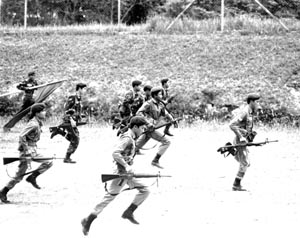 Hence
in July 1952, the Federation Regiment Bill was passed in the Federal Legislative
Council. This Bill opened a new page in Malayan Military history for it
paved the way for the development of the first multi-racial infantry unit
called the Federation Regiment. This was later followed by the formation
of the various support and logistic units, such as the Federation Armoured
Car Regiment, Artillery, Engineers, Supply and Transport, Electrical and
Mechanical Engineers and the Ordinance.
Hence
in July 1952, the Federation Regiment Bill was passed in the Federal Legislative
Council. This Bill opened a new page in Malayan Military history for it
paved the way for the development of the first multi-racial infantry unit
called the Federation Regiment. This was later followed by the formation
of the various support and logistic units, such as the Federation Armoured
Car Regiment, Artillery, Engineers, Supply and Transport, Electrical and
Mechanical Engineers and the Ordinance.
Regarding traning centers,
before 1952, there had been what was called the “Training Depot of the
Malay Regiment” in Port Dickson. Here courses were held in signals, tactics
and administration. The Depot also provide educational facilities to bring
selected members of the Regiment up to the necessary academic standard
for acceptance at the Royal Military Academy, Sandhurst, for higher military
training, with a view to qualifying for commissioned rank.
The
Birth of RMC
As far as the development
of RMC is concerned, the 3rd of July 1952, is of utmost historic significance,
for on this auspicious day an important announcement was made by Mr. M.E.B.
David, the Secretary of Defence, in the Federal Legislative Council Meeting.
He announced the decision to expand the Malay Regiment Training Depot to
be called The Malay Regiment Training Center. The traning center, was to
constitute two additional sections: The Pre-Officer Cadet Traning Unit
(Pre-OCTU) and an inter-racial Boys Company.
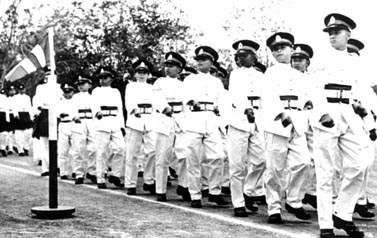 As
for the Boys Company, it was to be part of the Malayan Army, serving the
Malay Regiment and the Federation Regiment. The function of the Boys Company
was to provide education to sons of serving officers and other ranks in
the Malay Regiment, leading to the School Certificate level, coupled with
the rudiments of military traning.
As
for the Boys Company, it was to be part of the Malayan Army, serving the
Malay Regiment and the Federation Regiment. The function of the Boys Company
was to provide education to sons of serving officers and other ranks in
the Malay Regiment, leading to the School Certificate level, coupled with
the rudiments of military traning.
The first intake of 74 Boys
into the Boys Company were recruited in August 1952, from the total of
100 applicants. The aged of the Boys ranged between 14 and 15 years. Their
educational qualification, according to a 1952 newspaper buletin, was to
be the equivalents of Standard 4 (English-medium). In addition to these
academic requirements those who were shortlisted had to undergo various
aptitude tests too.
Establishment
of Federation Military College (FMC)
The college was now to become
seat of learning, as well as a center for traning the nation’s leaders
in government service as well as battlefield, meet the ambition project
to the founder - High Commissioner Field Marshal Tun Sir Gerald Templer
K.G. GCB GC MG KBE DSO DCL.
With the establishment of
FMC, a Charter of the College outlining specific objective of this institution
came into being. It is reported that Tun Templer himself drafted its opening
paragraph which was remained unchanged since the inception of the College
in 1953. The Charter stated:
“The Federation Military College
has been established with the object of preparing young Malayans to take
their places as Officers in the Armed Forces of the Federation, in
the higher divisions of the public service and as leaders in the professional,
commercial and industrial life of the country.”
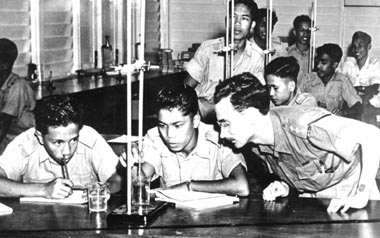 The
task of looking after the academic aspects in the Boys Wing was however
entrusted to a Director of Studies (DOS) – a civilian Senior Education
Officer. He was responsible to the Commandant for carrying out the scholastic
policy down by the Board of Governors of the College and thus adviser to
the Commandant on general educational policies. The DOS had 3 Senior-Assistants
each responsible for the specialist teaching of a group of subjects – called
the Head of Science and Mathematics and Head of Arts.”
The
task of looking after the academic aspects in the Boys Wing was however
entrusted to a Director of Studies (DOS) – a civilian Senior Education
Officer. He was responsible to the Commandant for carrying out the scholastic
policy down by the Board of Governors of the College and thus adviser to
the Commandant on general educational policies. The DOS had 3 Senior-Assistants
each responsible for the specialist teaching of a group of subjects – called
the Head of Science and Mathematics and Head of Arts.”
For the purpose of military
traning, and the co-ordination of domestics military administration required
within the Boys Wing, a Officer-in-Charge (O.C.) was posted. He was responsible
to the Director of Studies (DOS) and thus ultimately to the Commandants.
Furthermore, the emphasis,
as is obvious, was not merely in serving the nation in any manner but in
the capacity as leaders. This aspiration is best epitomized in the motto
the College adopted – “SERVE TO LEAD”.
In September 1954, the Commemoration
Foundation Day was celebrated in a grand manner. Preset to witness the
Commemoration Day Parade were the High Commissioner, Sir Donald Macgilivray,
His Highness, the Sultan of Selangor, the Yang Dipertuan Besar of Negri
Sembilan, The Prime Minister Tunku Abdul Rahman, Tun Abdul Razak and a
large number of dignities from all walk of life.
New
FMC Site
In
1958, reports of a proposal $20 million cantonment, covering an area of
1200 acres, to be located near Sungai Besi (about 10 miles from Kuala Lumpur)
began appearing in local press. Hence with that, the problem of findings
a suitable site was settled once and for all.
 The
entire project, expected to be completed by 1963, was financed by the British
Government under the United Kingdom Grants-in-aid Funds. Two hundred acres
were allocated for the new Federal Military College.
The
entire project, expected to be completed by 1963, was financed by the British
Government under the United Kingdom Grants-in-aid Funds. Two hundred acres
were allocated for the new Federal Military College.
The
site reserved for the College consisted of scenic surroundings. The new
home of the FMC was situated on a hill overlooking of disused mining pools.
The College buldings were to be modelled on the lines of some of the best
military academies overseas. They were to consists of an assembly hall,
dormitories, classrooms, a gymnasium, laboratories, some 140 married-quarters
for all ranks and civilians employees and numerous playing fields.
The
shifting was finally completed from Port Dickson by April 1961 to a new
beautiful FMC costed about $7.5 millions within ten days. About 160 lorry-loads
of special stores and 90 lorry-loads of the families’ personal belongings
On
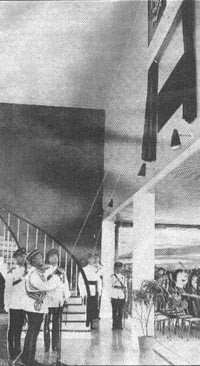
the 20th of June 1961, the Yang Dipertuan Agung, as Supreme Commander of
the Malayan Armed Forces, officially opened the new complex. The colourful
ceremony was watched by some 1000 guests. In acknowledgement of the immense
debt which FMC owed the High Commissioner Field Marshal Tun Sir Gerald
Templer K.G. GCB GC MG KBE DSO DCL., the Assembly Hall was aptly named
DEWAN TUN TEMPLER.
FMC
CONFERRED THE Royal TITLE
On December 9th, 1966, in
a ceremony held at the College, the Yang DiPertuan Agong conferred the
“ROYAL” title to the FMC. This was a great honour for the College for no
other educational institution in the history of this nation has the “royal”
title bestowed upon it. Hence since 1966, the former Federation Military
College came to be known as the ROYAL MILITARY COLLEGE or MAKTAB TENTERA
DIRAJA.
Last
updated: January 2001
Royal
Military College, Malaysia