15/05/08
Logs with Blake.
Prastical.
A little session due to a long assembly. We discussed the way to answer exam questions by reading them carefully. "State", "Calculate", "Show that", "Describe", "Explain" type questions were all discussed (probably in increasing order of difficulty for you guys...)
PHY6 remains the most important, but another prastical tomorrow, except George who will pop in after school on Wednesday to have a look.
We should probably have been on the balcony, but some Biologists colonised it, like mould.
PHY6 condensed packs were delivered. These in conjunction with the Edexcel download site. (Centre no. 10512) should deal with all your markscheme needs.
We looked at synoptic questions mainly. Apparently I just try and derive things from first principles rather than actually answer questions. Prastical next double lesson.
We looked at a few PHY6 type issues including the "surviving" document on the Edexcel website. Blake showed unreserved enthusiasm for the insightful comments on offer.
PHY6, synoptic in particular questions for next time I feel.
BTW - prastical papers must come in for me to mark.
We went through that there PHY5 paper. You are all fine at calculations but exceedingly poor at explanations. "It" is a word best used sparingly.
PHY5 Jan 2007 was sat. Prastical in the next available double.
Blake handed his prastical papers to me. No-one else did though....
We did some more preparation for PHY5 - tomorrow we will sit a Mock version.
You have to hand in your PHY5 practical papers to me by Friday.
We revised PHY5 theory in preparation for a mock paper to be sat next Tuesday.
Crazy.
"Prastical" tm (Blake 2008)
HW Finish the theory part of the practical and hand in for the end of the week if you want it marked....
The last new stuff ever, as we completed some calculations showing the energy released by various nuclear reactions using the mass change. Just make sure you use all the sig fig on your calculator.
This site looks great for further reading on special relativity, including a derivation of e=mc2... Also good stuff on the bits you need to know.
Prastical again tomorrow.
Mass has energy and energy has mass. Radioactive decay, nuclear fission and fusion all exhibit an imbalance in the mass of the ingredients of a reaction and the products. Mass is converted into energy in the process, making the resultant nuclei more stable than the initial ones.
This is a cool little summary.
These calculations are the only ones where you must use all the sig. figs from your calculator. Masses of individual nucleons and the like can be quoted in kg or in Atomic mass units. The energy released can then be found by using the famous e=mc2 NB: The Nagasaki bomb (21kT) was reckoned to convert 1g of mass to energy...
"Prastical".
You said,"What's the difference between a cyclotron and a synchotron?"
I said,"A synchotron varies the frequency of its accelerating metal plates to take into account relativistic effects."
You said,"Oh really?"
I said, "Yes"
The detectors used in particle accelerators were also discussed.
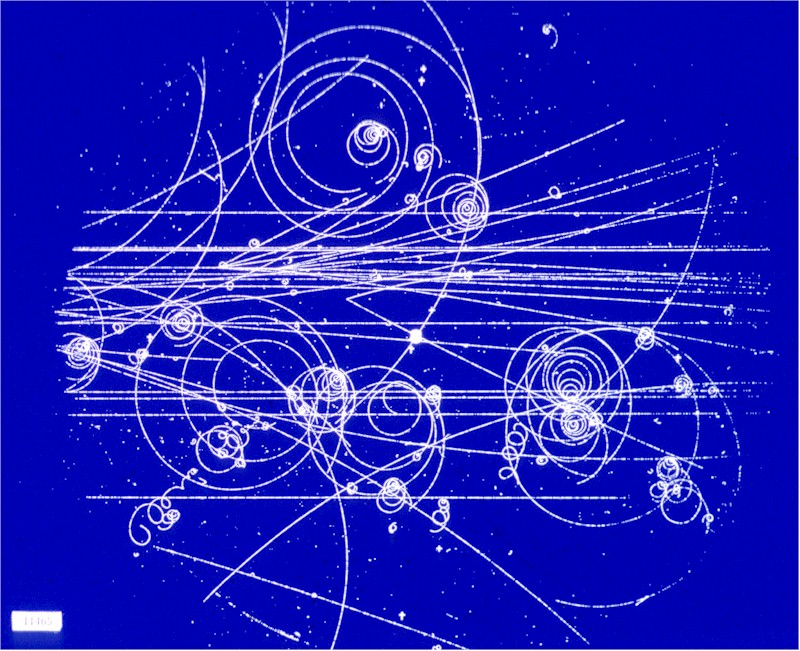
These included cloud chambers ( build your own, perhaps we can look at it in lessons), bubble chambers (all the best inventions are somehow based on or inspired by beer), spark chambers and their more advanced cousins drift or wire chambers.
You need to be able to explain the path of a particle within one of these detectors when subjected to a magnetic field. The circular motion and magnetic force formulae can be equated just like in cyclotron calculations.
Working out what the hell is going on is not straightforward... The particles gradually lose momentum and so spiral inwards.
Simple lab cloud chamber above (no magnetic field here).
Practice practical tomorrow.
HW Do 23.3,4,5
Have you finished the PHY6 course yet? If you have done accelerators with hrsj, then yes, you have.
PHY 5 "Mock" needs setting, PHY6 practice is the next big thing.
Why does mass increase as you approach the speed of light? Think.
It doesn't really. Not if measured in a frame of reference that is moving along with the particle in question. If both time and distance are dilated when observing a moving object (which explained why magnetic forces are just electrostatic forces for charges moving with respect to each other) then quantities such as kinetic energy and momentum will also start playing silly buggers.
We do need to cover accelerators and the like. So we started.
We covered linacs and cyclotrons.
HW Do those calculations on the cyclotron Ch 22.