S6 14/03/05
My word, this hasn't been up to date for a while. In recent weeks, we performed a similar set of experiments to the ones we unsuccessfully attempted with Hall probes. Instead, we used alternating current as the main power source and picked up the size of the changing magnetic field created by using a pick up coil. A coil of wire held in a constantly changing magnetic field will have a voltage induced in it. The size of the induced alternating voltage is a measure of how large the changing magnetic field is.
The field near a long straight wire was shown to reduced as 1/r . The field inside a solenoid is only dependant on the number of turns per metre and the current flowing through the wires. (area of the coil is irrelevant.)
We looked at magnetic flux. It is hard to imagine as a physical entity. However, it is used to calculate how large a voltage is induced in a conductor moving through a magnetic field.
Magnetic flux = B * Area crossed
Magnetic flux is measured in Webers. (or Tesla m2
The induced emf in a conductor is proportional to the rate of change of magnetic flux.
HW Next week we'll do some past paper questions on magnetism, perhaps after some practise.
S6 08/02/05
We attempted to use Hall probes to measure the magnetic fields near a long straight wire and inside some solenoids. They didn't work.
However, magnetic field strength was roughly shown to be proportional to the number of turns per meter in a current carrying solenoid. It was also shown to be proportional to the current flowing in the solenoid.
The magnetic field goes down by 1/r as you move it radially away from a long straight wire. We will attempt to prove this using an alternative method next time....
HW Do assesment Qs 10 and 11 and finish B/I graph.
S6 08/02/05
We completed an experiment to show that the force experienced by a current carrying wire in a constant, external, perpendicular, magnetic field was proportional to the current flowing through the wire. Magnetic forces happen to moving charges - double the current means double the amount of charge moving which means double the magnetic force. Magnetic force on a current carrying wire is proportional to the curent.
Another way to increase the amount of moving charge within the magnetic field is to increase the length of current carrying wire within the field, magnetic force is proportional to the length of wire within the field.
The only other factor that can alter the size of the magnetic force on a wire is the size of the external magnetic field. This is denoted by the letter B. Magnetic force is proportional to B.
Force = Magnetic field strength*Current*length of wire (F = BIl)
The magnetic field strength is defined by this formula. 1 Tesla, the unit of magnetic field strength, is the magnetic field that would put a force of 1 Newton on 1 metre of wire carrying 1 Amp of current.
NB: The current and magnetic field must be perpendicular for this to work.
S6 01/02/05
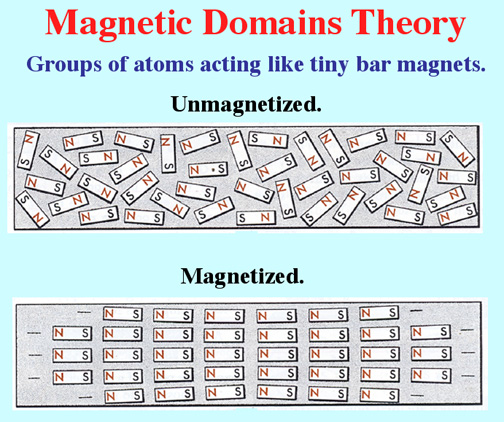
We finally had a lesson! We looked at all of the GCSE style demonstrations of magnetism, and then moved onto some electromagnetism. Iron is the main magnetic element and it is so because it has tiny "magnetic domains" inside it which can align to produce an overall magnetic field.
All magnetic fields are caused by moving charge, and they affect only moving charge. Permanent magnets just happen to have moving charge inside them which creates a magnetic field.
A single wire has a magnetic field which consists of concentric rings. (Right hand grip rule.)
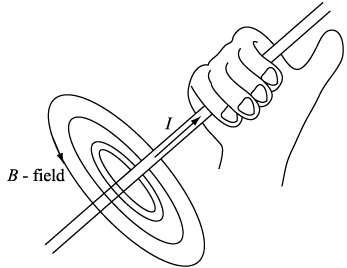
In a solenoid, these fields combine to make a field like that of a bar magnet.
Moving charge always experiences a force from regions of strong magnetic field towards regions of weaker magnetic field. (away from where 2 fields agree, towards where fields counteract each other).
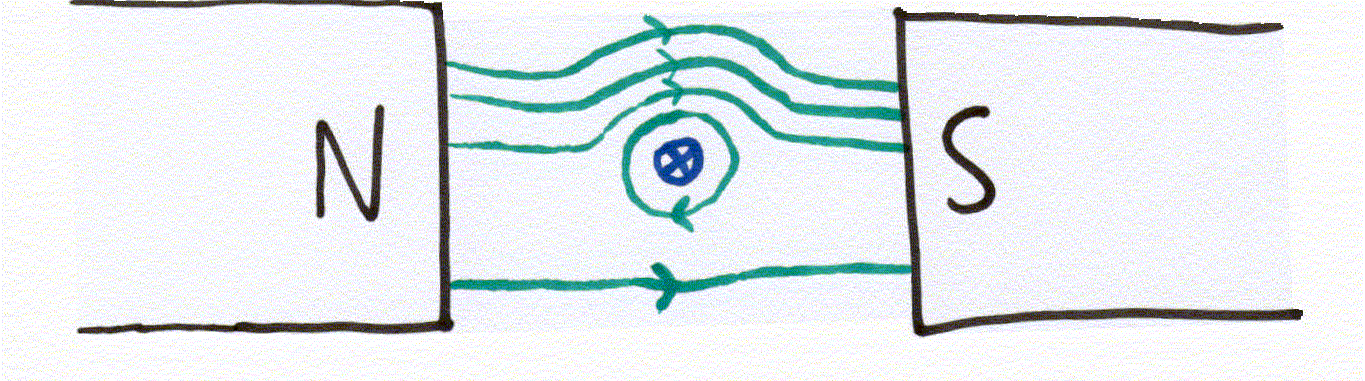
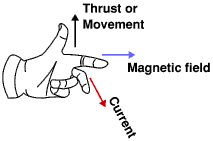
The direction of the force can be found using Fleming's left hand rule.
Next week - more about measuring and calculating the magnetic field strength.