17/06/08
Wave speed vs. depth investigation with ripple tanks.
HW Hand plot your graph.
What an Earth are you guys doing back so soon?
I wibbled about GCSE waves for a full 80 minutes. HRSJ = circular motion and SHM. Me = travelling waves, it seems, for now.
A bonus lesson for non-biologist types.
Remember that you need to meet at 1pm for the practical exam tomorrow. Location as yet undecided.
Our last lesson before the exams! Last minute tips for the practical exam were covered.
A pack of astro papers with mark schemes was distributed. These in conjunction with the Edexcel download site. (Centre no. 10512) should deal with all your markscheme needs.
Good luck all.
We looked at an astro paper. I'm going to have to invent a markscheme for the practical paper - and what better way to spend a Bank holiday weekend?
I gave all present condensed PHY1 and 2 packs.
A practice practical was attempted. 2 more lessons before exam leave... Lets get some astro papers out next time.
Revision website with some relevant stuff.
Highly uneducational animations - but awesome tune.
Or perhaps you prefer this...
Practical Tuesday. Astro papers after.
No practical. Instead, you attended a "Globalisation" conference. An excellent use of your time 3 weeks before exams, I'm sure. Somebody wants shooting.
We watched a vid on the life cycle of stars. When they run out of hydrogen in their core, stars leave the main sequence. The now have to support themselves by fusing heavier elements together.
They will turn into Red giants - very bright stars whose volume has massively increased (which allows their surfaces to cool - hence "red"). The Sun will have a radius which is greater than the present day orbit of Venus.
The relationship bewteen how hot a star is and how much energy it produces in total (its luminosity) is shown in a Hersprung-Russell diagram as seen below.
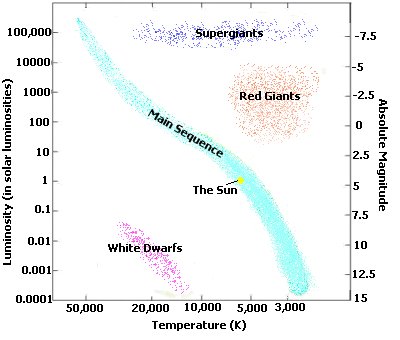
Stars tend to be hotter if more luminous. The larger stars live fast and die young, whereas plodders like our Sun can hang around 1000s of times longer.
Red giants are, well, giant...
Next time - a practice practical.
We did an example calculation using Wien's law, the Stefan-Boltzmann law and then the distance luminosity relation.
Then onto stars.
We started looking at stars and how they get their energy.
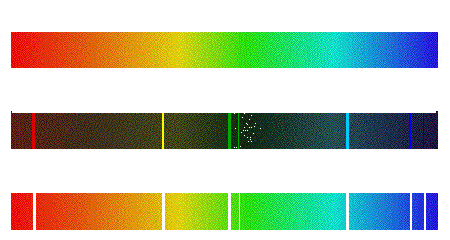
We briefly looked at spectral lamps showing that different hot gases produce only a certain range of colours. This is due to electrons falling down shells after being promoted by heat energy. Starlight contains the opposite - absorption lines where gases have used certain frequencies of light only to promote elctrons up levels around their atoms.
Stars tend to be hotter if more luminous. The larger stars live fast and die young, whereas plodders like our Sun can hang around 1000s of times longer.
The spectra can be used to determine what chemicals are present in a star. The Doppler shift of these various patterns can also tell you how fast the star is moving away or towards the Earth. This is covered in detail in the cosmology section of PHY4 next year.
Gravitational attraction pulls together a cloud a gas (mostly hydrogen). As it moves together, the gas loses GPE and gains KE, the temperature and pressure as the centre of the cloud become enormous until they are large enough for fusion reactions to take place.
Stars on the main sequence all get their energy from fusing hydrogen into helium.
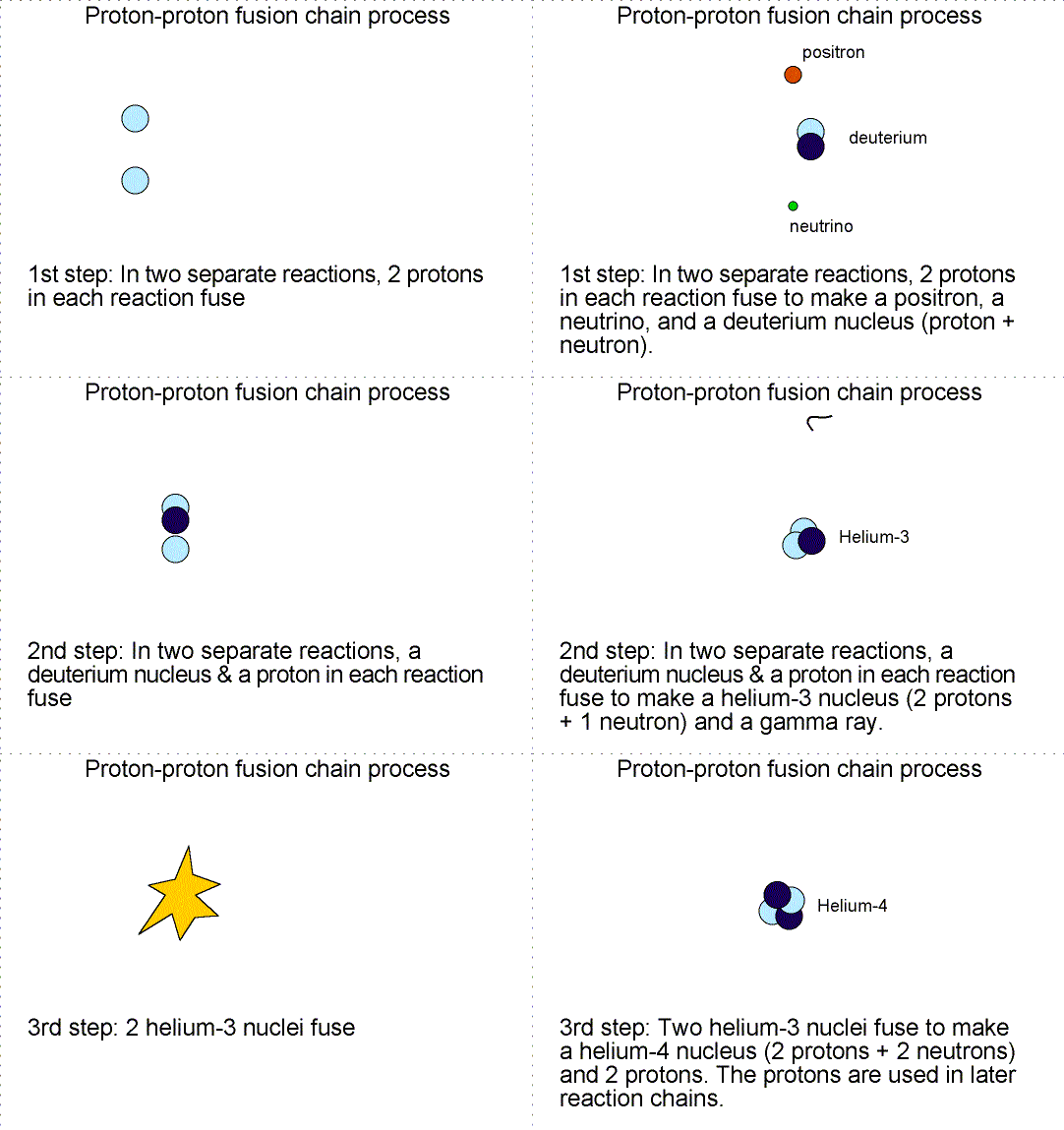
We saw a video which mentioned fusion and the neutrinos produced by stars. Much more on them next time. (Probably more video - star death I feel.)
We went through the first half of the practical that you did last thing last term.
It is well worth having a study of the mark scheme and the example answers to see the most efficient way of getting the marks. It is not enough to have done something, you must show that you have done it. (these things are marked externally)
I have found Dele's now! More astro next time, we aim to finish in 2 weeks.