11/04/05
Well it seems that we're not quite up to date here. However, the gist of things is that we have moved on to revision of the first module. You were sent away with Jan 2004 past paper for PH1 aswell as several astro papers. We'll continue to look at PH1 for a while before doing a complete recap of PH2 later in the term.
08/03/05
We went through the specimen paper for astro. It proved much more difficult than 2001. We'll sit a final paper as a test on Friday. The rest will be for revision.
P.S. Quasars are quasi stellar radio frequency objects and do not blink on and off. They are thought to be from matter acreting around the black holes at the centre of distant galaxies. Don't get them mixed up with pulsars which blink on and off, and are rotating neutron stars.
HW Revise...
04/03/05
We performed some calculations based upon the Sun's luminosity. (Luminosity = Energy radiated per second). We can work out how much energy is released per fusion reaction (hydrogen to helium) in the Sun. This can be done using the mass defect for the reaction and e=mc2. Consequently, you can work out how many reactions there are per second.
Using this information, we found that the Sun is losing millions of tons of mass every second. Even so, the Sun is so massive that it will only convert less than one thousandth of its matter into energy in its 10 billion year lifespan.
We had a go at some passed paper questions. You will need to make an informed choice about which option to go for, so we'll sit a full paper in the near future.
A few nice graphics of simulated blackholes in Sam Neil's Space but not much Physics. Hard to say what is going on inside them due to their inevitable blackness. Known laws of gravity break down at "singularities" such as these.
Photons (light particles) are supposedly massless, but have an equivalent mass due to their energy which means they are certainly affected by gravitational fields. More information can be found here
HW Finish all parts of the past paper.
01/03/05
You can use Wien's law to find the temperature of a star if you know its most abundant colour. You can then use the Stefan-Boltzmann law (if you know the star's radius) or the Hertzsprung-Russell diagram to estimate the total luminosity of the star.
You can measure the intensity of light recieved by the star using a telescope. You can then use the formula: Intensity = Luminosity/4*pi*D2 to calculate the distance at which the star is away.
There can be problems with this kind of measurement, with inaccuracies in the estimate of the stellar temperature and hence luminosity causing problems. Also, you must be sure you are looking at the correct part of the Hertsprung-Russell diagram, so you analyse the spectrum of light produced by the star and see what chemicals are present. This will help you to establish the type of star you are looking at.
In fact, for accurate measurements using this method, a "standard candle" is required. This is an object whose brightness you can establish with a large degree of accuracy. You then need to have an example one of these objects nearby (so you can find its distance by some other method.)
One example is Cepheid variable stars. They have left the main sequence and undergo regular changes in luminosity due to changes in the ionisation of the helium in their atmosphere. The rate at which their apparent intensity swells and falls allows you to calculate the total luminosity of the star. Polaris, the North star is a Cepheid.
Cepheid variable are fine up to a point, but are not bright enough to be singled out beyond a certain distance. However, other similar methods such as assuming the very brightest stars in a galaxy will have a roughly similar total luminosity, or using the very bright type 1 supernovae have allowed us to measure vast distances out into the universe.
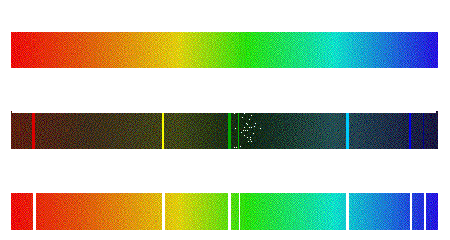
We briefly looked at spectral lamps showing that different hot gases produce only a certain range of colours. This is due to electrons falling down shells after being promoted by heat energy. Starlight contains the opposite - absorption lines where gases have used certain frequencies of light only to promote elctrons up levels around their atoms.
25/02/05
Wien's Law can tell you how hot the surface of a star is if you know what colour it is (what wavelength it produces most of).
The Stefan-Boltzmann law can tell you how luminous a star is if you know how hot it is and its surface area.
Luminosity - The total energy radiated per second by the star.
The intensity of light from a star is equal to the energy recieved from the star per second per meter squared. As you back away from the star, the energy radiated from the star is spread over the surface of an ever increasing sphere.
Intensity = Luminosity/surface area
The surface area of this sphere = 4*pi*D2
Where D is your distance from the star. D is generally massive compared to r, the radius of the star.
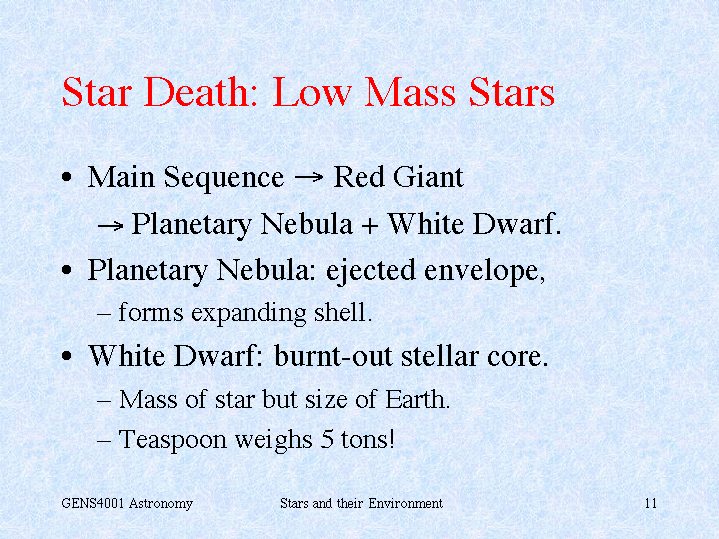
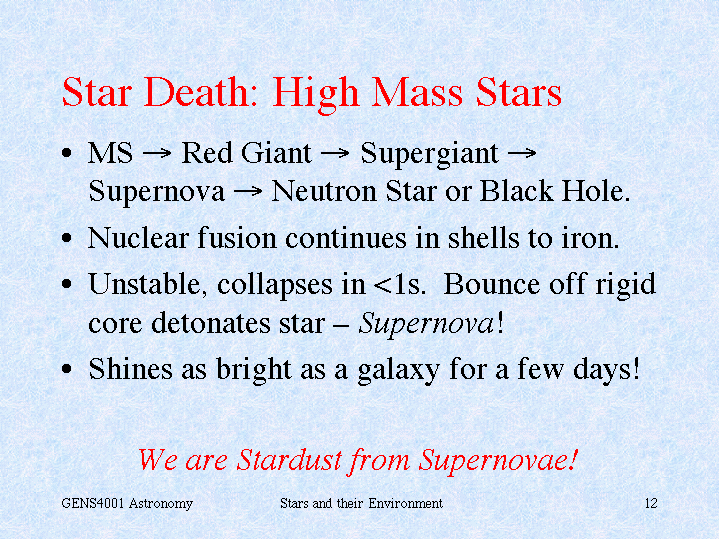
We watched a vid on the life cycle of stars. When they run out of hydrogen in their core, stars leave the main sequence. The now have to support themselves by fusing heavier elements together.
They will turn into Red giants - very bright stars whose volume has massively increased (which allows their surfaces to cool - hence "red"). The Sun will have a radius which is greater than the present day orbit of Venus.
HW Complete questions A6 and A7 from the text book which are on star life cycles.
22/02/05
We discussed the telescopes you had researched over the half term. Important points made were as follows:
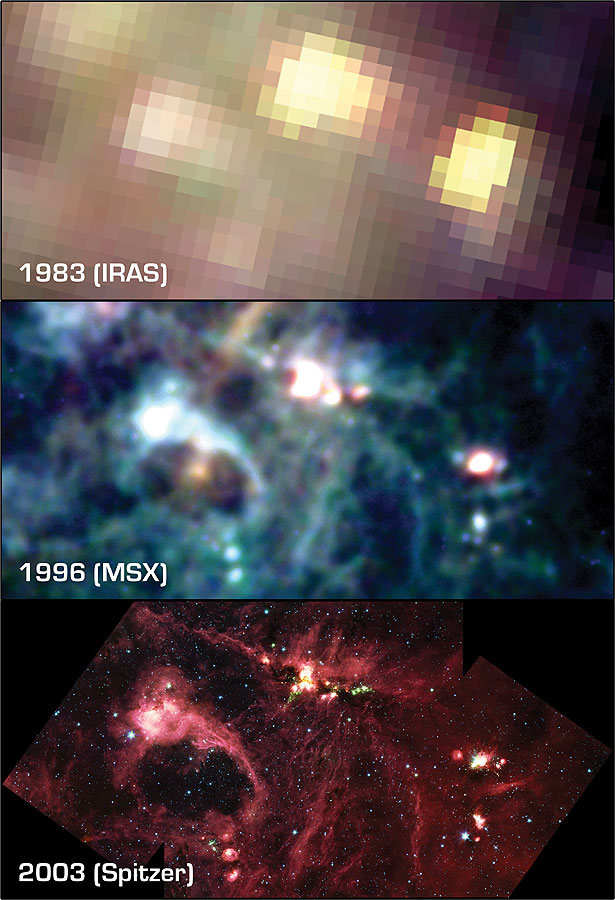
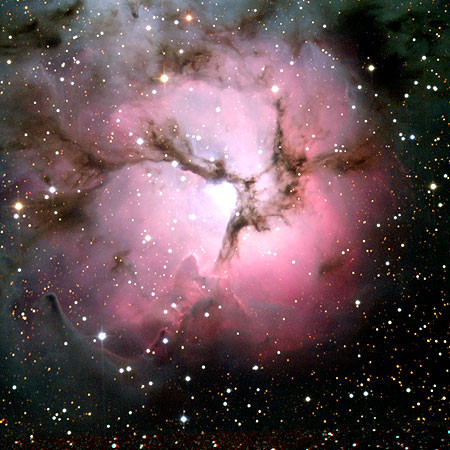
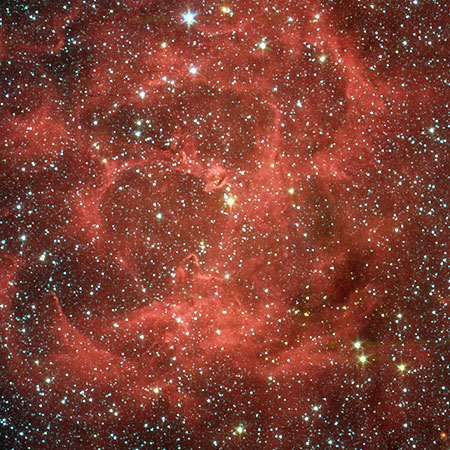
The same object in space viewed in optical light (by HST) and by an infrared space telescope. Different features can be picked out by viewing in a particular frequency range.
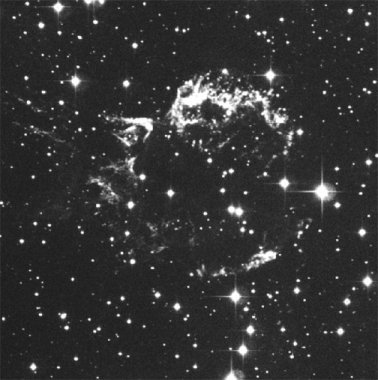
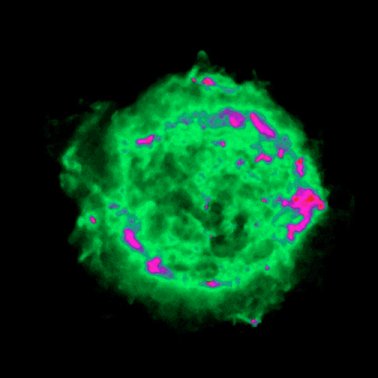
This can be seen more clearly above, the right hand image being taken in the radio spectrum (therfore showing much cooler objects)
Some of these images are from: Here - a university astro course, generally much more detail than you need, but very interesting nonetheless.
Stars produce a range of frequencies of electromagnetic radiation, depending upon their temperature. They follow the shape of the blackbody radiation curve.
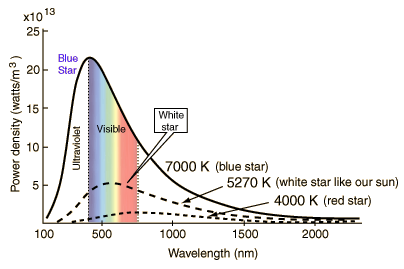
Larger, hotter, stars are bluer.
Wien's Law governs which is the most commonly produced wavelength of light by a star. It is explained: here
The relationship bewteen how hot a star is and how much energy it produces in total (its luminosity) is shown in a Hersprung-Russell diagram as seen below.
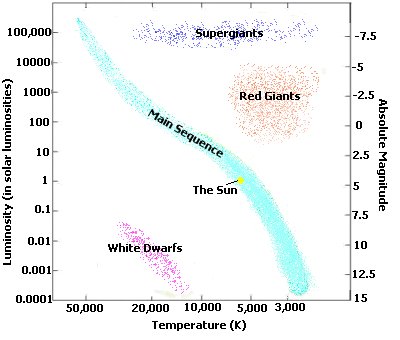
Stars tend to be hotter if more luminous. The larger stars live fast and die young, whereas plodders like our Sun can hang around 1000s of times longer. When out of hydrogen fuel, stars expand, become more luminous and also cool down. These are red giants.
Stars on the main sequence all get their energy from fusing hydrogen into helium.
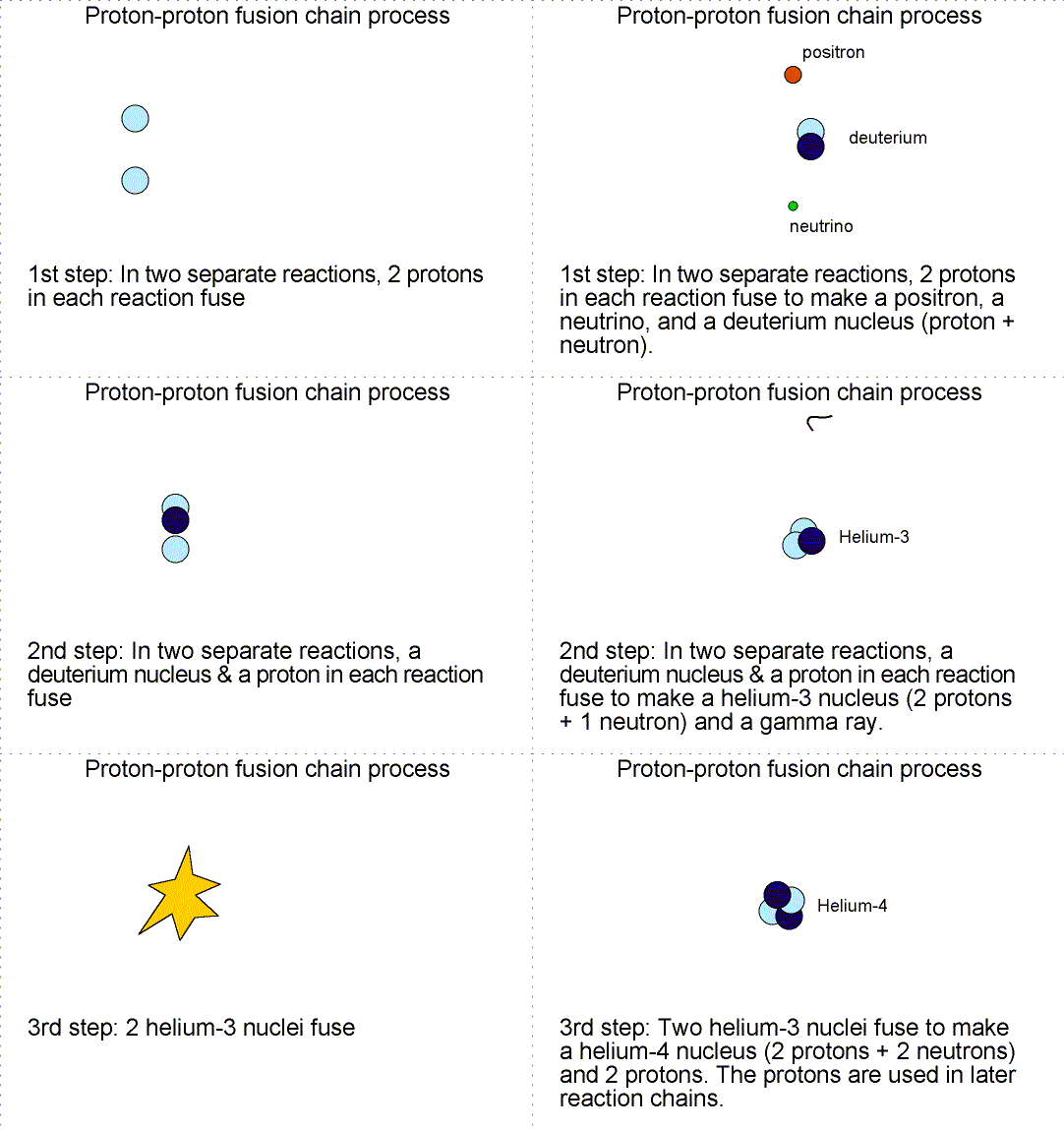
Much more on what happens to stars when they die next time.
08/02/05
We went through the electronics test. Make sure you are clear about the following:
This is a good website summarising most of the work we have done on electronic circuits.
We started astrophysics very briefly, looking at methods of finding out how far away astronomical objects are. Direct measurement by bouncing electromagnetic waves off an object and seeing how long they take to bounce back only works for very close objects indeed.
A geometric method called parallax measurement is used to calculate the distances to nearby stars, based upon the fact that the Earth moves a large distance throughout the year as it orbits the Sun.
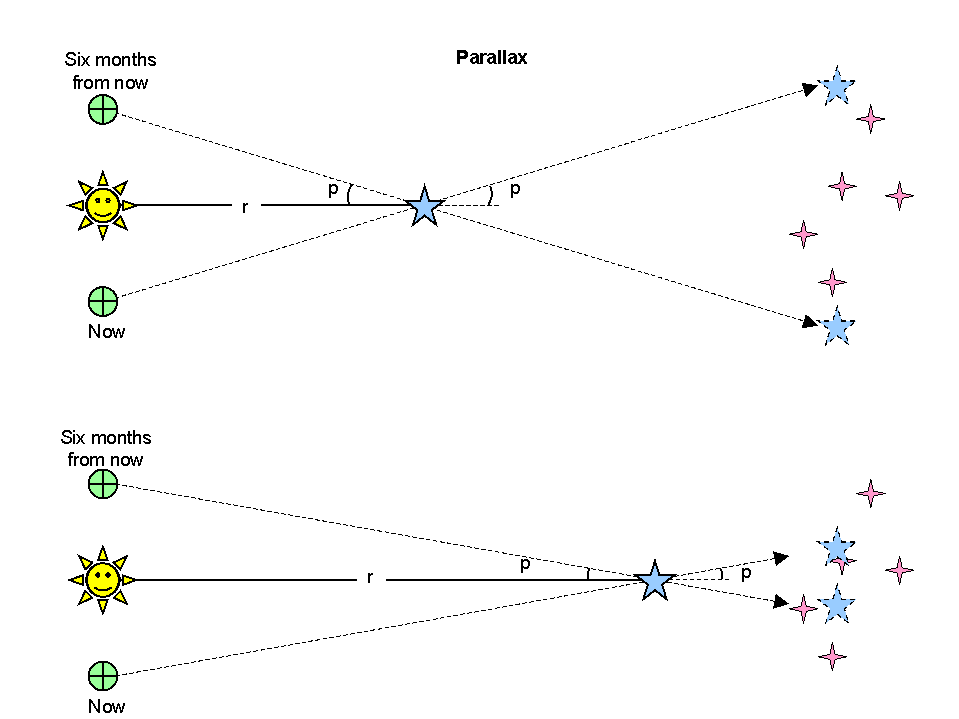
The further away a star is, the smaller the angular change against background stars between different times of the year.
HW Of course we can't see that much with the naked eye. Telescopes are required to bring more of the night sky into view. Do a page or so report on the design of a telescope, taking care to note what it is designed to do, and how it overcomes some of the difficulties of observing the stars. Examples can be found: here
Or elsewhere on the net...
31/01/05
We attempted a recap of all the topics within DC electricity in preparation for a test which will be held on Friday.
Loading a potentiometer/potential divider was discussed (from HW), this means putting a current carrying component across the output voltage, effectively making a parallel path with the 2nd resistor. This will reduce the overall resistance of the 2nd part of the circuit, reducing the proportion of the voltage that it takes. In a nutshell, Vout is reduced when a component other than a voltmeter is connected to it.
HW Revise for an DC electricity test.
29/01/05
Internal resistance was introduced.
A battery produces a certain emf, which is dependent on the number of cells and how much energy each cell gives to charge as it passes through. When a voltmeter is connected across the battery terminals it should measure the emf in volts.
However, if the battery is in use, electrons will be flowing around the circuit including through the battery. Even though a battery provides the electromotive force that causes the current, it has an electrical resistance to current like any other conducting material.
The energy transferred from electrical to other forms per Coulomb of charge passing through a component is the potential difference. (P.D.)
Ohm's law says that the P.D. across a component is equal to the curent passing through it multiplied by its resistance. (V=IR). So, as the battery has a resistance, it must have a P.D. across it as some electrical energy is transferred to heat within the battery.
The higher the current passing through the battery, the higher the P.D. across it.
Kirchoff's 2nd law states that the sum of emfs in a circuit equals the sum of PDs. i.e. the battery voltage must be used up by the components of a circuit.
If the battery itself has a resistance then it must count as a component in the ciruit in its own right. The voltage available to other (non-battery) components in a circuit is called the terminal P.D.
emf = PDbattery + PDrest of circuit
We performed an experiment in which we increased the current flowing through a battery by adding parallel paths containing lamps to it. The current was measured using an ammeter in series with the battery. Meanwhile we measued the voltage across the terminals using a digital voltmeter. The voltage was found to decrease as the current through the battery increased.
Excel workbook with Jonathan's data and a graph plotted
HW Write up the internal resistance experiment in your blue books. Hand in for Tuesday.
25/01/05
Potential dividers were discussed. 2 or more resistant components in series will divide the battery emf between them (Kirchoff's 2nd law). They therefore "divide the potential". The voltage across each component can be calculated if you know the input voltage of the circuit. The component takes the same proportion of the voltage as the proportion of the total resistance of the circuit which it has.
Vout= Vin R2/(R1+R2)
If a potential divider has current drawn from Vout then the voltage will decrease due to the output device forming a parallel path with the 2nd resistor in the circuit.
HW 15.1,15.2,15.4
21/01/05
More on voltage. We solved some problems. e.g. Energy stored by a battery:
Charge that battery will move during operation times voltage of battery
Batteries often have operating spans quoted in Amp hours. 1 Amp hour is the amount of charge that flows through the battery when it 1 Amp is flowing for one hour (so just 3600 Coulombs really).
The PD across a component depends upon the resistance of that component:PD=IR. A component in a series circuit takes the same proportion of the emf, as its own proportion of the total resistance of the circuit.
Total resistance of series circuit = R1 + R2 etc...
In parallel: 1/R1 + 1/R2 = 1/Rtotal
A parallel path offers more space for current to flow so the total resistance of 2 parallel paths must be less than the resistance of either of the paths individually. An alternative formulation of this is:
Rtotal = R1R2/(R1+R2)
A circuit containing an ammeter in series and a voltmeter across a component can be used to measure its resistance. R = V/I
However, ammeters do not have totally zero resistance and so will take a small part of the voltage for themselves (ok as long as you are only measuring the voltage across the component I suppose). However, voltmeters do not have entirely infinite resistance and so a small current will flow through them. These imperfections in meters are much less true about digital meters. Indeed, a digital Ohm meter can be used directly to avoid some of these problems.
Next up, potential dividers and their uses.
HW None except for those with some stuff missing.
18/01/05
We looked at voltage. It can be referred to as several different things. Electromotive force (emf) is a measure of the magnitude of the force provided by the battery in a circuit.
Potential difference (PD) is the difference in potential energy of charge before and after they pass through a component.
PD = Energy loss (joules)/Charge that has passed through component (Coulombs)
The PD of each individual component must equal the emf of the battery in any series circuit.
For parallel circuits, the PDs in any given possible series path must equal the emf of the battery.
Beware: when we look at internal resistance, this situation will become a little bit more complex...
Voltage can be thought of as analogous to height in a water circuit. As height is lost, potential energy is lost until you reach zero. An external energy source and a pump is then required to pump the water back up to the start again.
You can quote how strong an electric field is in terms of the force which would be exerted on 1 Coulomb of charge (Newtons per Coulomb). This is similar to quoting the gravitational field strength of Earth (9.81 N/kg). It can be shown that the units N/C are equivalent to V/m. Voltage is therefore related, but not identical to the eletric field strength.
HW Do Practise Qs 9.1, 9.2, 9.5
14/01/05
We practised some questions based on I = nAvq. Then talked about semi conductors for a bit and how their behaviour relates to the equation. LDRs and thermistors both change their density of free charge carriers in response to external stimulous (light and heat energy respectively) which changes their ability to conduct electricity.
Transistors use silicon, a semiconductor, which has been doped with impurities. In "p" doped silicon, the free charge carriers are actually positive "holes" in the electron structure. "n" type silicon has been doped to provide extra free electrons which can carry current. By sandwiching one type of silicon with another (pnp or npn) an electronic switch can be created. Only when sufficient electrons have been added/taken away from the middle part of the transistor throuh the input leg, can electricity be conducted through the rest of the transistor through the other 2 legs. (Just as a push switch will only conduct electricity when there has been enough physical force exerted on the input.)
We looked at LDRs and thermistors and saw that they change in resistance significantly.
HW Complete Assesment question 1 on page 124. Yellow cards for nondoers of both Practise Qs 12.2 - 12.4 and 1.1,2.1,2.3,2.4.
11/01/05
We looked at the most important new bit of Physics in the electronics course.
Current is a measure of how much charge passes a point in a circuit per second. Amps = Coulombs per second.
The amount of current which will flow through a conductor depends upon how many free charge carriers there are in the conductor.
n : the number of free charge carriers per cubic meter of conductor
Volume of the conductor = Cross sectional area * length (A * l)
The speed at which the charge carriers move also affects how much charge will flow.
v : drift velocity of charge carriers. In 1 second, all the charge carriers in a piece of conductor v metres long will have flowed past.
The number of charge carriers in a piece of conductor v metres long is equal to:
Number of charge carriers = nAv
If each charge carrier has a charge of q......
The charge flowing past any point in the circuit in 1 second = nAvq = current
In most cases the charge on 1 carrier is simply the charge on an electron. The drift velocity is typically very small (less than 1mm per second), however, energy is transferred almost instantaneously when electrical current flows.
HW do 12.2, 12.3, 12.4