Happy New Year.
??/03/08
At the end of term I always appear to run out of steam and fail to update the website duiring the last week. Anyhow, I am convinced that we at some stage covered the next way of calculating cosmic distances - using the inverse square law of brightness. As long as you know how bright something is in total, and how bright it appears to be seen from a distance, you can tell how far away it is.
Wien's Law can tell you roughly how hot the surface of a star is if you know what colour it is (what wavelength it produces most of).
The Stefan-Boltzmann law can tell you roughly how luminous a star is if you know how hot it is and its surface area.
You must be able to look up both these formulae and stick numbers in to them (not too hard really).
Luminosity - The total energy radiated per second by the star.
The intensity of light from a star is equal to the energy recieved from the star per second per meter squared. As you back away from the star, the energy radiated from the star is spread over the surface of an ever increasing sphere.
Intensity = Luminosity/surface area
The surface area of this sphere = 4*pi*D2
Where D is your distance from the star. D is generally massive compared to r, the radius of the star.
However, Wien and Stefan-Boltzmann aren't as great as all that, and are effected as we'll see in a bit by Doppler shift of starlight.
Standard candles are object that we know the total brightness of for other reasons.
Test marked now. Generally happy - 4 or so who need to improve their basic thermal knowledge. We spent the whole lesson going through the test with the markscheme, which was dull but probably useful.
Mechanics revision, above. The hand would undergo forces far too huge if it underwent such a large change in momentum in a very short period of time. As it "crumples" the forces are kept to a tolerable level as the change in momentum is spread over a slightly longer period. More astro next time.
No test marked yet..
We started astrophysics very briefly, starting with telescopes, then looking at methods of finding out how far away astronomical objects are.
You don't need to know about the optics of telescopes, but you do need to know a few things.
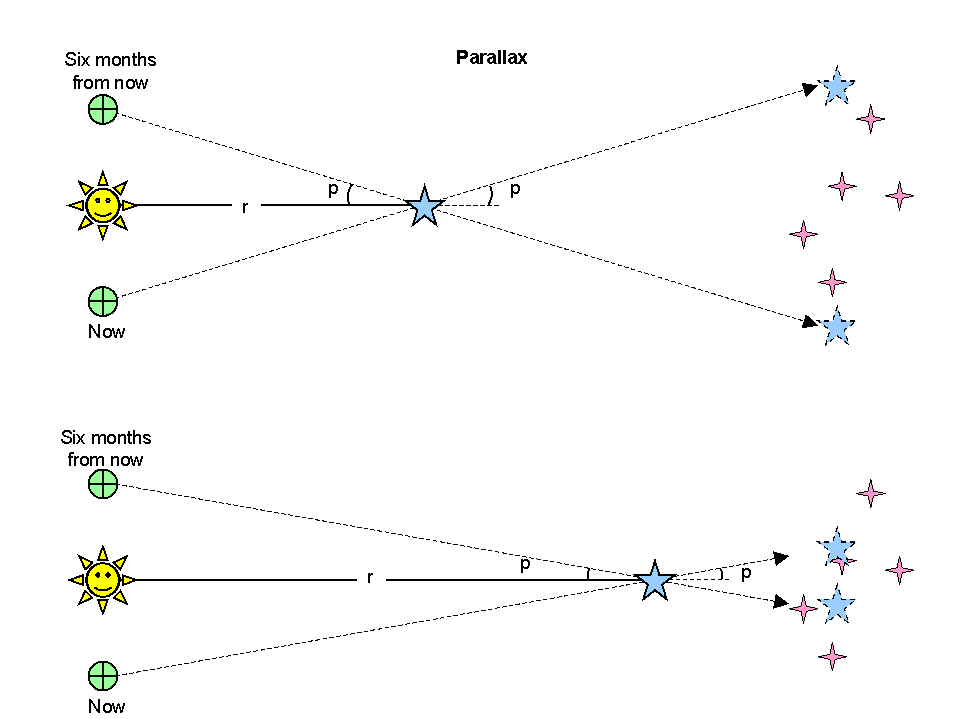
A geometric method called parallax measurement is used to calculate the distances to nearby stars, based upon the fact that the Earth moves a large distance throughout the year as it orbits the Sun.
The further away a star is, the smaller the angular change against background stars between different times of the year.
Thermal test as promised. Interrupted by a poxy fire alarm. It's going to be out of 40 instead of 60 to compensate.
Some practice A level thermal questions as preparation for the test on Tuesday.
Snoop around the pupils area Physics folder and you may well discover the mark schemes in the Edexcel bit.
HW Revise for a test on Tuesday....
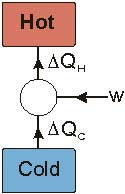
A heat engine is a device that uses heat energy to do work. To get heat energy out of a hot thing, you need something cold for it to flow into.
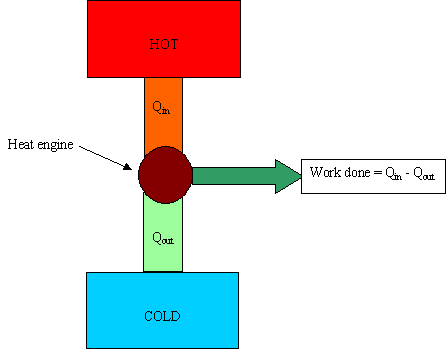
The efficiency of a heat engine is the work it does divided by the energy that flows into it from the cold source.
E = W/QH>
W = QH> - QC
So E = 1 - QC/QH
This can be shown to be the same as E = 1 - TC/TH
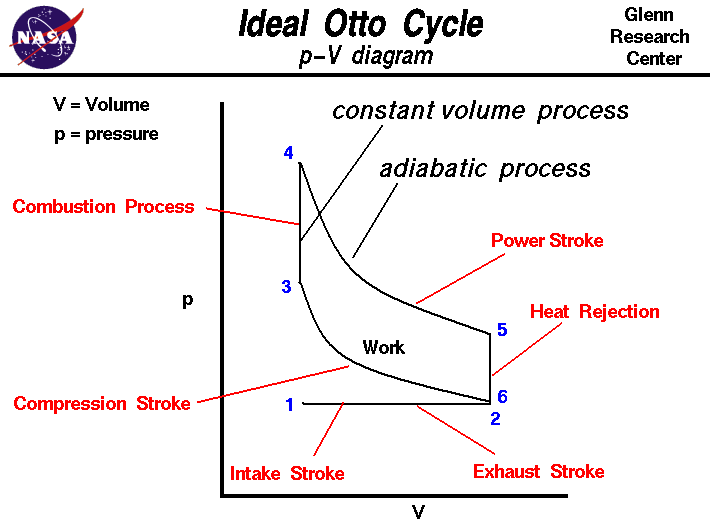
In some engines, the changing properties of gases are used to do work.
The cycle below is used in an internal combustion engine.
A heat pump is a reversed heat engine. Work is done in order to force heat to flow from cold to hot.
HW Answer this nice question please:
A freezer is a heat pump. 2.0 MJ of work is done in order to move 4.5 MJ of energy from within the fridge to the room outside. How much energy is dumped outside the freezer?
State the physical law used to calculate your answer.
The above heat flows and work done are for 1 day of operation. Calculate the power of heat flow out of the freezer.
4 containers, each with 2.3kg of liquid milk in at 0 Celsius are added to the freezer. Milk freezes at 0 Celsius. The latent heat of fusion of milk is 334kJ/kg. Calculate the extra energy needed to be pumped out of the freezer in order to freeze all this milk solid.
The cooling fins in the interior of the freezer are all at the top. Why?
Some examples on the first law of thermodynamics.
I chose stupid numbers for my example which ended up with a filament bulb recieving vast quantities of heat energy from some super hot external source.
Still, never mind. Heat engines next time.
Inspiration for Rohan - some of these are awesome.
HW Finish the Chapter 15 questions, then attempt 28.3+4
19/02/08
Bit of a waffle - the difference between heating and working and a recap on the methods of heat transfer.
Here is the 3rd form recap.....
We began to look at heat transfer.
We talked about heat energy and temperature. Heat energy is the energy something has due to the internal movement of its particles. When you heat something up, you are making its particles move faster, in a solid they vibrate, in a liquid and a gas they are able to move around each other.
The temperature of a body is a measure of the average kinetic energy of its particles. It is often measured in degrees Kelvin in science. They are the same as Celsius except that O Kelvin is the temperature at which particles would completely stop moving, and so things cannot possible be any colder than that. It is at -273 degrees celsius - absolute zero.
A large object at a low temperature will carry more heat energy with it than a small object at a higher temperature.
Radiation of heat: Heat energy can travel through a vacuum in a straight line away from a warm object. This is know as heat radiation; all objects with a temperature above absolute zero produce electromagnetic radiation, the hotter the object, the higher the average frequency of this radiation.
Black objects absorb heat radiation best (as they do light) and so warm up the most when infra red is shone on them. White or silver objects reflect most heat radiation and heat up less.
Black objects emit heat radiation best too, so if a hot object is black, it will emit more radiation than a white or silver object at the same temperature.
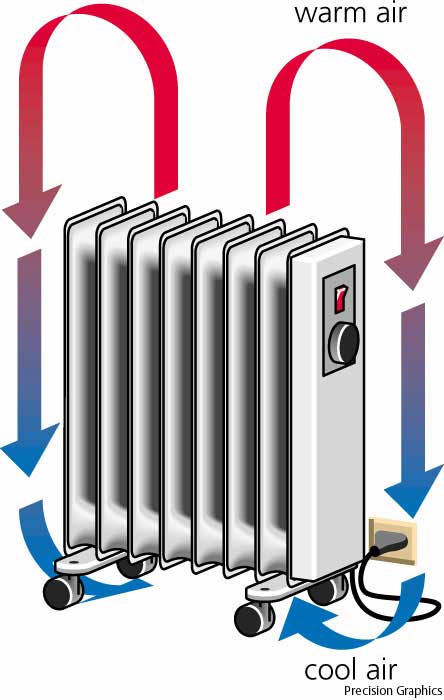
Convection: Happens in liquids and gases (fluids) that are in a gravitational field. One part of the fluid is heated and the particles begin to move faster and in doing so, get further apart. This reduces the density of the warm part of the fluid. The warm part of the fluid therefore starts to "float" up above the cooler less dense fluid surrounding it. Cooler fluid then moves in from the side to replace the warm, less dense, rising fluid. This fluid then starts to be heated, and so rises itself. Once the warm fluid has risen, it may cool and start to drop back down past the warmer fluid being heated beneath it. This causes a circular convection current to be created.
We saw 2 demonstrations of convection: 1 - tea leaves in a beaker of water heated by a Bunsen, 2 - a mock up of a mine with 2 vertical shafts and a candle lit under one of them (this allowed fresh air to be drawn into mines).
"Radiators" actually heat rooms by causing convection currents, hence it doesn't matter what colour they are painted really (although black would be a more efficient emitter of heat radiation).
A system or object can be worked on, or can do work (mechanical, electrical etc.). This will change its internal energy, but is not an example of heat flow.
The total change in internal energy is equal to the sum of heat flow in/out and work done on/by a system. This a really just a statement of the conservation of ebergy and is the 1st law of thermodynamics.
HW Chp 27 Qs 27.2-27.5
Oh dear - theological fracas again...
This is what happens when you let religion and science in the same building...
Somehow, our inaccurate and time consuming experiment to calculate the latent heat of fusion of ice/water yielded results within 20% of the actual value. How we managed this, I can't even begin to guess. However, the formula for latent heat of fusion and vapourisation is dead straightforward.
Latent heat (J/kg) = Energy transferred (J) / Mass which has changed state (kg)
HW Do Qs 1-3 from Muncaster P244
We completed some calculation based tasks on specific heat capacity. Next - latent heat of fusion/vapourisation which is dead simple too.
We began to look at heat capacity.
Heat energy is the energy something has due to the internal movement of its particles. When you heat something up, you are making its particles move faster, in a solid they vibrate, in a liquid and a gas they are able to move around each other.
The temperature of a body is a measure of the average kinetic energy of its particles. A large object at a low temperature will carry more heat energy with it than a small object at a higher temperature.
When you give an object some heat energy, it will warm up. The amount that it warms up by depends on its heat capacity.
The heat capacity of an object is the amount of energy required to heat it up by 1 degree. The specific heat capacity of a material is the amount of energy required to heat up 1kg of the substance by 1 degree.
We heated 2 types of metal - aluminium and brass, using electric immersion heaters. Using Power = Current * Voltage, and Energy = Power * time, you worked out the energy provided to the metal. The mass and temperature were measured.
Specific heat capacity = Energy/(Mass*Temp change)
We found aluminium to have roughly twive the shc of brass.
A metal with heavier atoms will have fewer atoms per kg. The temperature of a substance is a measure of the average kinetic (plus potential) energy of its particles. It will take much more energy to heat up a larger number of particles by the same amount, so the less heavy atomed metal has a larger shc. Al - 25, Brass average roughly 65.
HW 25.1, 25.3, 25.4, 25.5
I tried to introduce you to the concept that the internal energy of a substance was the combination of its constituent particles' kinetic and potential energy.
Also that a non monatomic gas has more degrees of freedom due to rotation and vibration being possible.
Whether Tim knows any of this remains to be seen.
I think Rohan may have learned the principle of checking that an equation is homogenous with respect to its units, but who knows.
We saw an example of Brownian motion (with varying degrees of success). Illuminated smoke particles were viewed through a microscope. Their random jiggling is evidence for the existence of particles of gas in continuous random motion.
I showed you a model of a gas using ball bearings and a vibration generator.
This is a rather better demo of the kinetic theory.
This pdf file contains a more detailed derivation of the kinetic theory equation that you need to know.
HW Chp 20.5, and Chp 22 (all Qs)
We did some stuff on the conditions for an ideal gas. Basically, it can't be too hot or at too high pressure. Intermolecular forces have to be ignored, as does the volume of the particles making up the gas.
The temperature must be above the "critical temperature" above which a gas cannot be liquified under any pressure and the pressure must be reasonably low.
I started a derivation of the kinetic theory of gases, but didn't finish. Next time instead then.
Mr Baines may be amused by this.
Build me one of these, I'll let you flick bands in class....
Nope. RM at hospital. You did some more calculations based on the ideal gas equation, PV=nRT
We attempted some problems on the ideal gas equation. I forgot to tell you about the definition of an "ideal gas" - next time.
Instead, Baines went all neo-Dawkinist on us and I tried to talk you through this Physics 2000 explanation of laser cooling. The rest of that site is also awesome and worth looking at for reading around the subject.
Last term we confirmed experimentally that for a fixed quantity of gas:
Pressure is inversely proportional to volume when temperature is constant (Boyle's law)
Pressure is directly proportional to temperature when volume is constant (Pressure law)
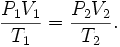
This lead to the general macroscopic gas law.
(only works for temperatures measured in Kelvin).
We did not confirm experimentally that the amount of gas present (number of particles, N) is also proportional to the pressure. This is fairly easy to see, however, as twice as many particles travelling at the same speed collide twice as often, exerting twice the force per unit area.
This extra information can be added to the gas law to say that:
P1V1/T1N1 = P2V2/T2N2 = a constant
This constant is called Boltzmans constant and has a value of 1.38 E -23 J/K
However, it is often more convenient to measure the amount of gas in moles, rather than the number of particles. (1 mole = 6 E 23 particles)
If the unit of "amount of gas" is changed to moles, the value of the gas constant changes too, it get 6 E 23 times bigger.
R, the molar gas constant has a value of 8.31 J/K/mol
n, represents the amount of gas measured in moles
This leads to the molar ideal gas equation:
PV = nRT
HW Do 20.2, 20.3, 20.4 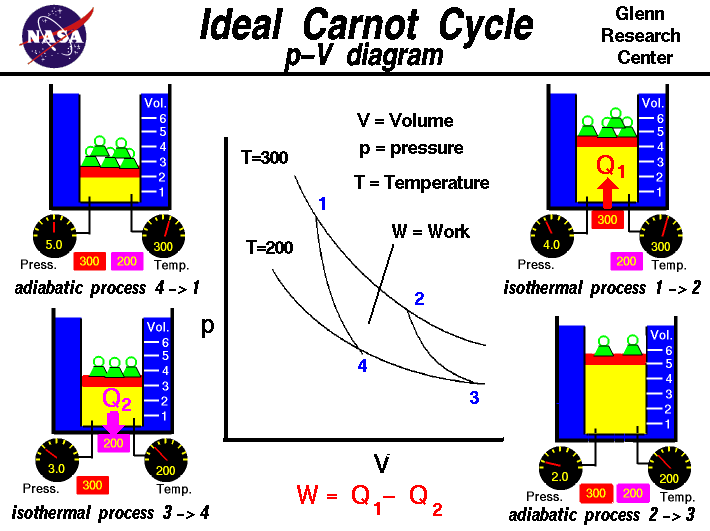
21/02/08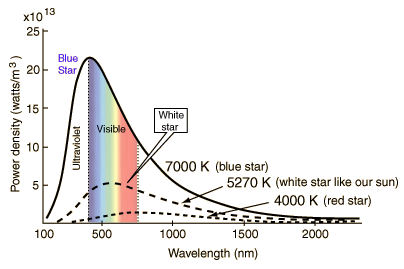
07/02/08
05/02/08
31/01/08
28/01/08
24/01/08
22/01/08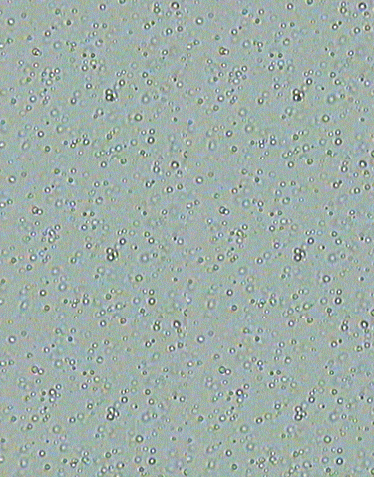
Random jiggling
17/01/08
15/01/08
10/01/08
08/01/08