30/03/06
Wien's Law can tell you how hot the surface of a star is if you know what colour it is (what wavelength it produces most of).
The Stefan-Boltzmann law can tell you how luminous a star is if you know how hot it is and its surface area.
Luminosity - The total energy radiated per second by the star.
The intensity of light from a star is equal to the energy recieved from the star per second per meter squared. As you back away from the star, the energy radiated from the star is spread over the surface of an ever increasing sphere.
Intensity = Luminosity/surface area
The surface area of this sphere = 4*pi*D2
Where D is your distance from the star. D is generally massive compared to r, the radius of the star.
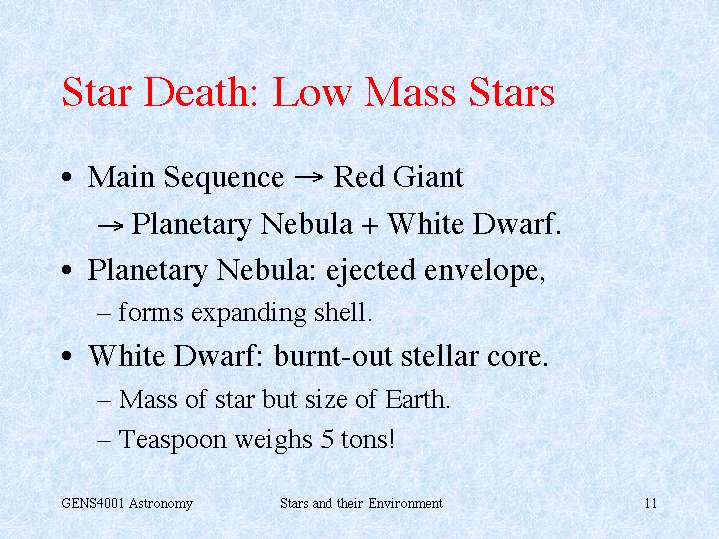
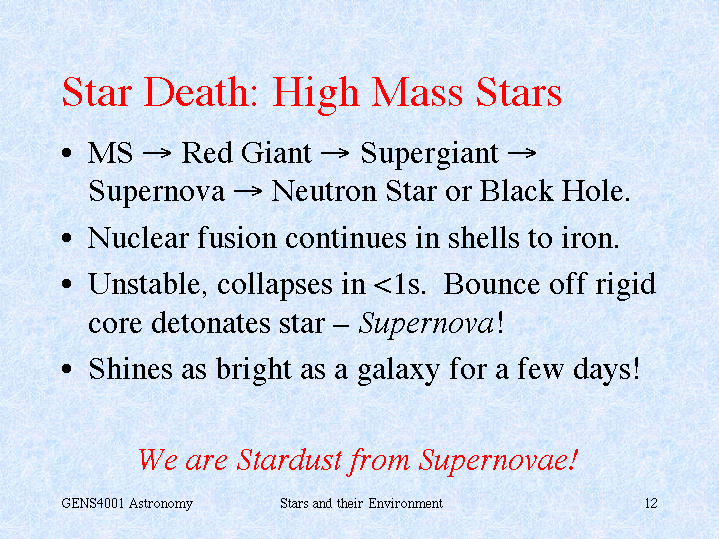
We watched a vid on the life cycle of stars. When they run out of hydrogen in their core, stars leave the main sequence. The now have to support themselves by fusing heavier elements together.
They will turn into Red giants - very bright stars whose volume has massively increased (which allows their surfaces to cool - hence "red"). The Sun will have a radius which is greater than the present day orbit of Venus.
You can use Wien's law to find the temperature of a star if you know its most abundant colour. You can then use the Stefan-Boltzmann law (if you know the star's radius) or the Hertzsprung-Russell diagram to estimate the total luminosity of the star.
You can measure the intensity of light recieved by the star using a telescope. You can then use the formula: Intensity = Luminosity/4*pi*D2 to calculate the distance at which the star is away.
There can be problems with this kind of measurement, with inaccuracies in the estimate of the stellar temperature and hence luminosity causing problems. Also, you must be sure you are looking at the correct part of the Hertsprung-Russell diagram, so you analyse the spectrum of light produced by the star and see what chemicals are present. This will help you to establish the type of star you are looking at.
In fact, for accurate measurements using this method, a "standard candle" is required. This is an object whose brightness you can establish with a large degree of accuracy. You then need to have an example one of these objects nearby (so you can find its distance by some other method.)
One example is Cepheid variable stars. They have left the main sequence and undergo regular changes in luminosity due to changes in the ionisation of the helium in their atmosphere. The rate at which their apparent intensity swells and falls allows you to calculate the total luminosity of the star. Polaris, the North star is a Cepheid.
Cepheid variable are fine up to a point, but are not bright enough to be singled out beyond a certain distance. However, other similar methods such as assuming the very brightest stars in a galaxy will have a roughly similar total luminosity, or using the very bright type 1 supernovae have allowed us to measure vast distances out into the universe.
HW Do all the "A" questions for after Easter.
23/03/06
We started looking at stars and how they get their energy.
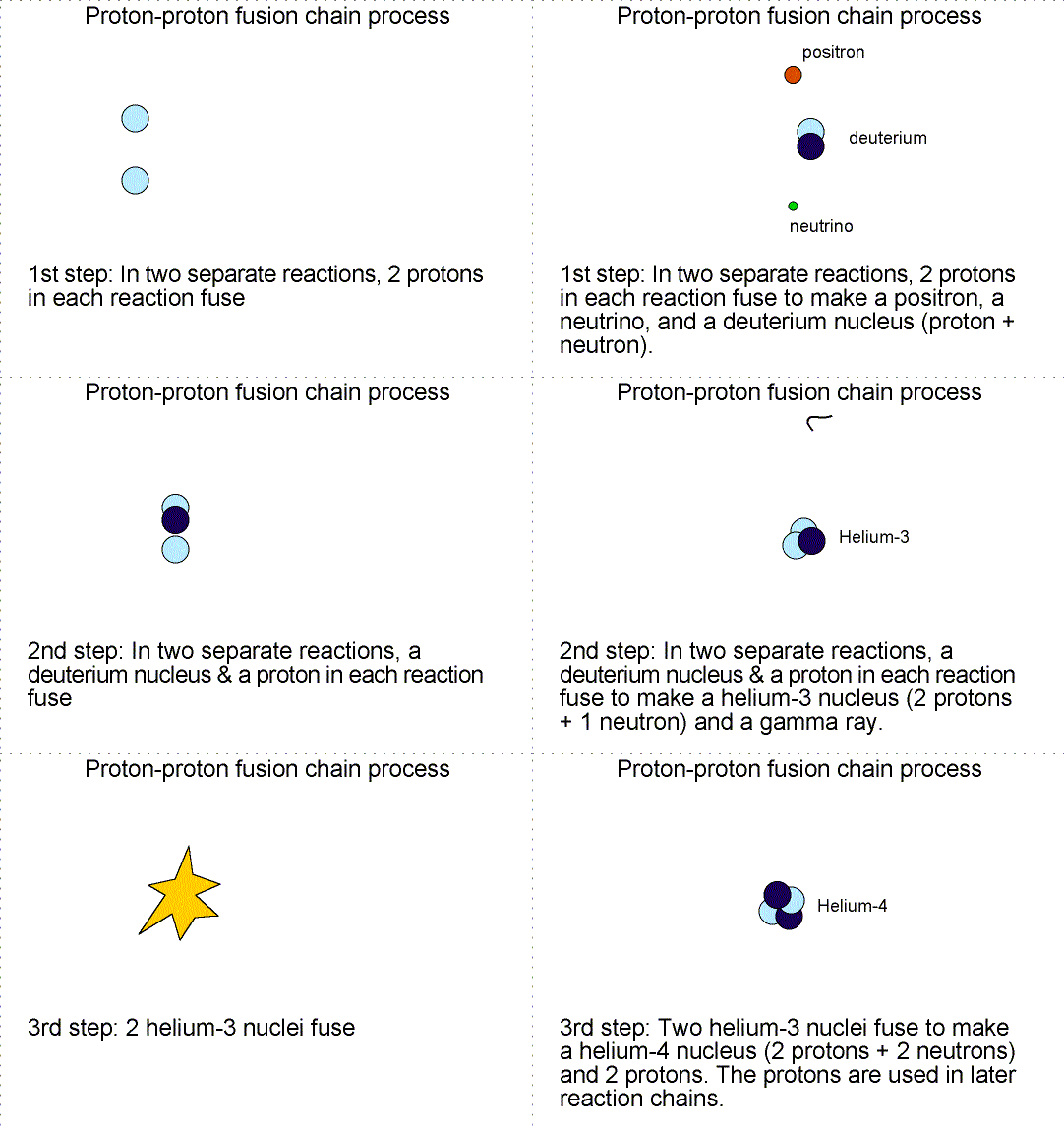
Gravitational attraction pulls together a cloud a gas (mostly hydrogen). As it moves together, the gas loses GPE and gains KE, the temperature and pressure as the centre of the cloud become enormous until they are large enough for fusion reactions to take place.
Stars on the main sequence all get their energy from fusing hydrogen into helium.
The relationship bewteen how hot a star is and how much energy it produces in total (its luminosity) is shown in a Hersprung-Russell diagram as seen below.
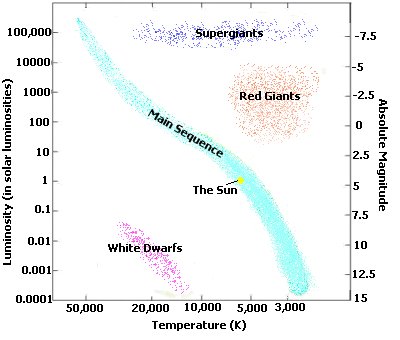
Stars tend to be hotter if more luminous. The larger stars live fast and die young, whereas plodders like our Sun can hang around 1000s of times longer.
HW Telescope talks will be done on Tuesday....
21/03/06
Luminosity of a star: The total power of radiation emitted by the star.
Intensity of light recieved: Power of radiation per m2
You can measure the intensity of light recieved by the star using a telescope. You can then use the formula: Intensity = Luminosity/4*pi*D2 to calculate the distance at which the star is away.
There can be problems with this kind of measurement, with inaccuracies in the estimate of the stellar luminosity causing problems.
In fact, for accurate measurements using this method, a "standard candle" is required. This is an object whose brightness you can establish with a large degree of accuracy. You then need to have an example one of these objects nearby (so you can find its distance by some other method.)
One example is Cepheid variable stars. They have left the main sequence and undergo regular changes in luminosity due to changes in the ionisation of the helium in their atmosphere. The rate at which their apparent intensity swells and falls allows you to calculate the total luminosity of the star. Polaris, the North star is a Cepheid.
Cepheid variable are fine up to a point, but are not bright enough to be singled out beyond a certain distance. However, other similar methods such as assuming the very brightest stars in a galaxy will have a roughly similar total luminosity, or using the very bright type 1 supernovae have allowed us to measure vast distances out into the universe.
We briefly looked at spectral lamps showing that different hot gases produce only a certain range of colours. This is due to electrons falling down shells after being promoted by heat energy. Starlight contains the opposite - absorption lines where gases have used certain frequencies of light only to promote elctrons up levels around their atoms.
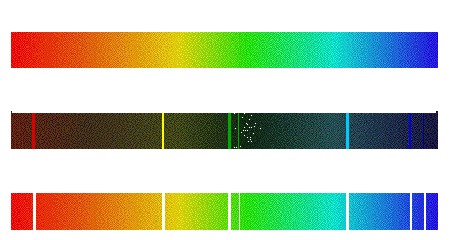
The spectra can be used to determine what chemicals are present in a star. The Doppler shift of these various patterns can also tell you how fast the star is moving away or towards the Earth.
Hubble established in the '20s that the distance of a galaxy away from us is roughly proportional to the speed that it is travelling away from us. This implies an expanding universe and led to Big Bang theory amongst other things.
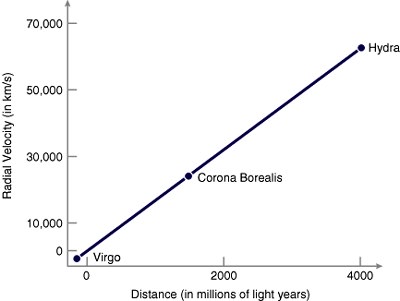
This also gives us another way to estimate the distance of a star, by measuring its redshift.
HW Research a major telescope, explain how it works, what frequencies it uses, how it detects the radiation and what it is used for. For next Tues.
16/03/06
We started astrophysics very briefly, looking at methods of finding out how far away astronomical objects are. Direct measurement by bouncing electromagnetic waves off an object and seeing how long they take to bounce back only works for very close objects indeed.
A geometric method called parallax measurement is used to calculate the distances to nearby stars, based upon the fact that the Earth moves a large distance throughout the year as it orbits the Sun.
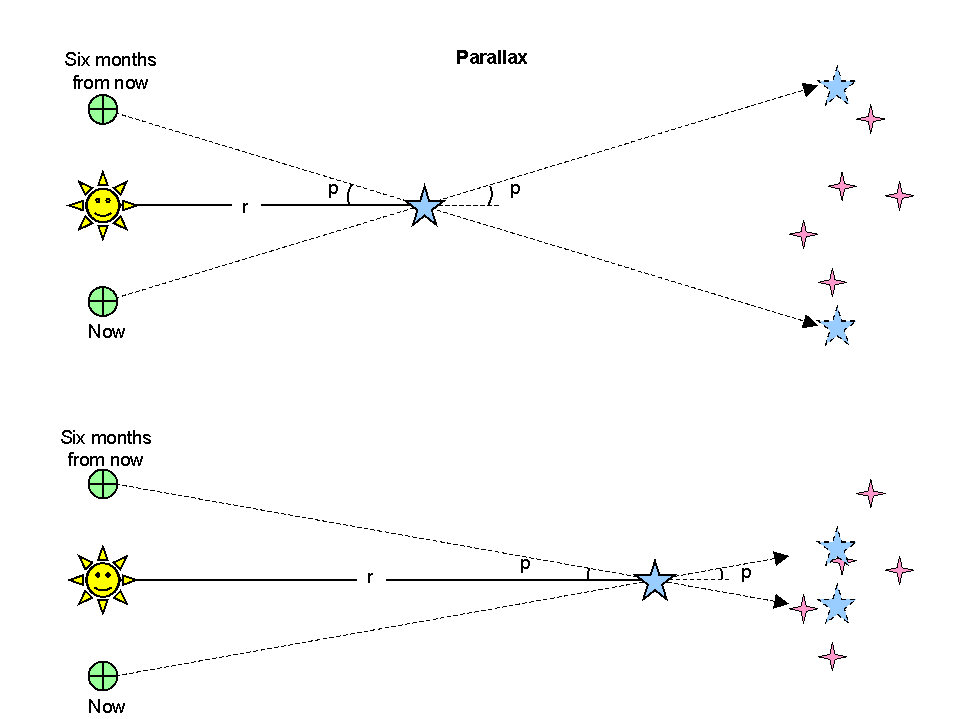
The further away a star is, the smaller the angular change against background stars between different times of the year.
13/03/06
We went through the PHY1 mock test. Answers to questions which were self contained correct statements but that were not in fact the answer to the question being asked were a bit of a problem. Study the mark scheme and try to get a feel for the sort of things they are looking for.
Astro starts on Thursday.
09/03/06
RM absent. You had a starting look at parallax with luck.....
07/03/06
PHY1 Mock was sat. Results by next week........
02/03/06
We went through the radioactivity test, largely done OK.
There will be a full mock PHY1 paper next Tuesday afternoon so make sure you revise well and arrive in plenty of time.
28/02/06
We sat a long test on radioactivity. If you are away and can't be bothered to check the website you are totally to blame for any rubbish mark you may achieve because you haven't revised. Longer term catching up requires making an appointment with me!
We are aiming for a PHY1 mock test next Tuesday. Adequate preparation will be needed!
23/02/06
We covered mass defect (although it may not be on the syllabus). As long as you are aware that mass is lost during a radioactive decay, converted into energy which can be carried away as the KE of the resultant particles. We're ready for a test on radioactivity next time, after which we'll have a Mock PHY1.
HW Revise revise revise radioactivity.
21/02/06
Inelastic scattering was covered.
Basically, if you shoot electrons really fast at a proton, some of them will deflect at a greater angle than expected , much more often than expected if thge proton were a uniform sphere of charge. They also lose some KE in the process (hence inelastic). This provides evidence for some internal structure within the proton. The proton is inferred to be made of 3 "quarks". It is impossible to get a single free quark and measure its properties, so the concept is pretty tricky.
Lawrence asked very many pertinent and deeply philosophical questions.
Start here, have a snoop around, good site.
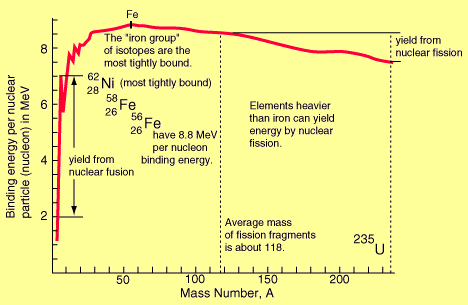
We then learned a bit about the stability of atomic nuclei. All decays have products that are more stable than the original nucleus. They actually weigh a tiny bit less, some energy has been created during the reaction from mass.
As a rule of thumb, small nuclei are most stable with an equal number of protons and neutrons, but bigger ones require more and more neutrons per proton to stay together.
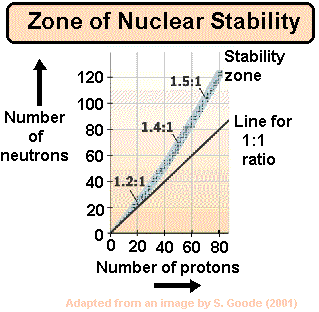
Nuclei which are more tightly bound together are more stable. They have more "binding energy per nucleon" (a nucleon is a neutron or a proton.) Nuclear stability peaks at iron (atomic mass 56)
We did a quick dice experiment to model radioactive decay.
HW Finish expt. graph and do quick exam Q on decay.
9/02/06
I was still quite angry about the lack of possible maths in the half life idea. I tried to explain logarithms to you to show you where the half life equation came from. Many were a bit confused. However, all you need to do is be able to use it (it is given in the back of the exam scripts so I suppose there's nothing to worry about really.
We then briefly discussed radioactive decay equations.
07/02/06
We looked at the 3 different types of radioactive emission.
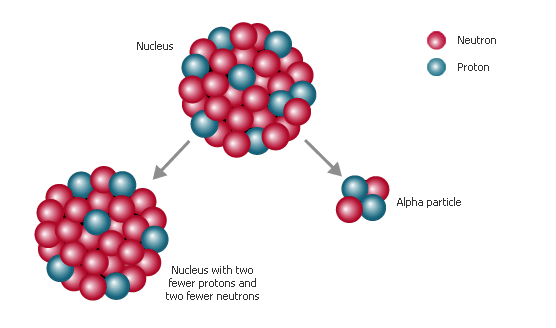
A 2+ charged paticle which is basically a fast moving helium nucleus. Mass number drops by 4 and the proton number by 2.

An electron (or a positron) is produced from within the nucleus moving very fast. For beta minus decay, proton number rises by 1 and there is no mass number change. More on beta plus later.
Gamma radiation is just a burst of very high energy electromagnetic radiation.
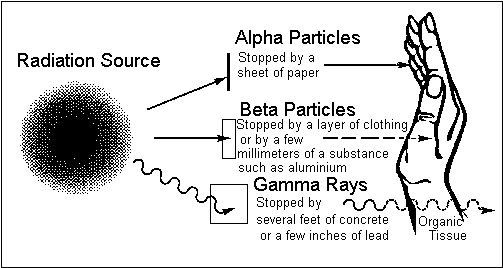
You need to know about the various penetrating powers of the particles. Alpha and beta particles can also be diverted by a magnetic field (moving charged particles experience a force in a magnetic field.
We then moved onto half life, as you need to know about this for your Medical Physics. The half life is the time taken for half of the radioactive nuclei to decay, each one producing one particle. The nature of radioactive decay means that the time is the same whether going from 100% to 50% of the original sample or 60% to 30% or any other "halving".
The half life also refers to the time taken for the radioactive count rate to drop to half of it's present rate for any particular sample. This makes sense as the count rate is proportional to the number of nuclei present. The more nuclei there are, the more chance there is that some nuclei or other will decay sooner than with a smaller sample.
Number of nuclei N is proportional to count rate A
The constant of proportionality is lambda - the decay constant. This is different for each type of unstable nucleus and the probability that any one nuceus will decay in one second.
We tried to go through the maths of it but...
What the bloody hell is the bloody point in the inclusion of formulae in the AS Physics course which you have no hope at all of comprehending the maths involved in deriving? It makes me very angry! I could equally well tell you radiation was caused by invisible tiny dragons farting and you would have no more cause to believe what I was saying. I will have to try and sort something out about the natural logarithms ideas.
HW Do first 2 sides of the set of radioactivity sheet.
02/02/06
We went through the energy and momentum test. Always write down the Physics principal you are using to solve a question, or at least the formula in symbols.
Another exam question which combined x,u,v,a,t equations with momentum and energy conservation was attempted.
HW Complete 2nd exam Q which features much of the mechanics we have done so far.
31/01/06
Momentum and energy test was sat (3 missing though).
We started radioactivity briefly, you saw a demonstration that radioactive particles can ionise air, alllowing it to conduct a current. (Smoke detectors use alpha particles for this job. We also recapped the mass and charge of the fundamental particles in the atom and alpha particle scattering.
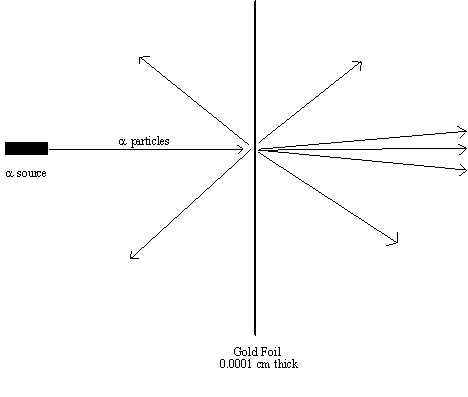
Remember, only 1 in 20000 or so alpha particles "bounce back", most just pass straight through.
GCSE alpha particle scattering recapped
26/01/06
Exam style questions on the conservation of energy were attempted. Click here for answers
The principle of conservation of energy can be stated: In an isolated system (where no energy can get in or out) the total quantity of energy always remains the same.
Some people owe me the odd homework from recent times - 29.1-29.4 (OLD) was due in today.
HW Revise for a test on energy and momentum on Tuesday Good revision website here.
24/01/06
We went through the HW. Nearly all of you don't lay out your answers properly. Remember momentum is only conserved in collisions where there is no net external force acting.
The elastic energy stored in a spring can be calulated by finding the area under its force/extension graph.

If the spring obeys Hooke's law, F = kx
and Energy stored = 1/2Fx (area od triangle)
So energy stored = 1/2kx2
This only works for springs below their elastic limit. We did an experiment to measure how much energy was stored in a stretched elastic band. It didn't obey Hooke's law, but we could still make an estimate of the area under a force/extension graph even though it wasn't a perfect triangle.
Having calculated how much energy was stored we pinged a trolley along the air track using the elastic band and calculated its KE. Very little energy was lost which looked quite impressive.
HW All must get the exam style momentum questions (1+6) sheet to me by next time or yellows. OLD Practice Qs 29.1-29.4 for next time please, there will be a momentum and energy test next Tuesday.
19/01/06
We looked at work, energy and power. Work is what is being done when energy is being converted from one form into another.
Work done by a force (J) = Force (N) * Displacement in the direction of the force (m)
The force does no work unless it moves in the direction of the force.
The area under a force/distance graph also gives the work done for a varying force.
Forms of energy that can be interchanged by forces include:
Gravitational Potential Energy = mgh
Kinetic Energy = 1/2mv2
Elastic PE, heat, chemical PE, electromagnetic PE, nuclear PE
Power is the rate at which work is done.
Power (W) = Energy transferred (J) / time (s)
P = Work done/time = E/t and E = Fd
P = Fd/t
P = F(d/t) and (d/t) = velocity
So, the rate at which a force does work.... Power = Force * velocity
The above can be used to calculate the rate of energy lost moving at a constant speed against a constant frictional force for example.
All class members will provide NEW questions 12 + 15 for me by Friday or yellow tickets will be issued.
HW 2 Momentum exam questions on sheets.
17/01/06
The air rifle calculation gave us a perfectly reasonable figure of 280m/s for the speed of the pellet. Apparently muzzle velocities over the speed of sound (330m/s) are undesirable for accuracy
Momentum is always conserved in all collisions - this is not a weird idea if you already know Newton's laws of motion. N2 and 3 combine directly to prove that momentum must be conserved in a collision.
Principle of the conservation of momentum
Kinetic energy is not always conserved in collisions. If it is, they are called elastic collisions. A collision where the 2 bodies stick to each other (coalesce) is called perfectly inelastic.
We did some questions based on conserving momentum and impulse being equal to change in momentum.
More exam style questions are available here.
HW Do NEW assessment questions 12 and 15 for next time. (Important)
12/01/06
We continued to look at the conservation of momentum.
Reasonable little summary of the ideas here.
We fired an air rifle bullet into a plasticine pendulum. The bullet collided with the plasticine ball and caused it to swing.
We worked out the angle to which the pendulum was swinging by measuring how far it had swung across horizontally.
We used this information to calculate the height gained by the plasticine pendulum as it swung after being hit by the bullet. We also weighed it to find its mass. From this we calculated the gain in gravitational potential energy (GPE) for the pendulum.
We made the assumption that the GPE gained by the pendulum as it swung was all transferred from the kinetic energy which it had after being hit by the bullet.
Kinetic energy after collision = GPE at top of swing
We then calculated how fast the pendulum must have been travelling just after the collision using the formula for kinetic energy (KE = 1/2mv2)
Now we knew how fast the pendulum was moving just after the collision, we calculated its momentum just after the collision.
We knew that momentum was conserved during the collision (because it always is, everywhere in the universe since the beginning of time and forever more.)
Momentum of pendulum after collision = Momentum of bullet before collision (because the pendulum was stationary before we shot it.)
This allowed us to work out a value for how fast the bullet was travelling before it hit the pendulum (since we had measured its mass before the experiment).
HW Your calculation of the bullet's velocity and also the elastic and inelastic collisions sheet please (which I forgot to ask you all to hand in - now I have).
10/01/06
Momentum was covered. GCSE had covered most of it, but the basics are:
1. Momentum = Mass * Velocity (it is a vector)
2. When 2 objects collide,the total momentum of the system is always conserved.
3. Rule 2 is true due to Newton's 3rd law (object A exerts a force on object B during the collision, changing its momentum in one direction, object B exerts an equal and opposite force on body A, changing its momentum an equal amount in the opposite direction. Overall change = zero.)
4. Newton's 2nd law can be written in terms of momentum.
F = ma and a = (v-u)/t
F = m(v-u)/t
F = (mv - mu)/t
e.g. The force on an object is its rate of change of momentum.
5. Exerting a larger force causes a greater change in momentum, as does exerting a force for a longer period of time.
6. Impulse (a new idea) is the product of the force and the time it is exerted for.
Impulse = Force * time
Rearranging Newton's 2nd law from above shows that impulse = change in momentum.
Ft = mv - mu
7. For a varying force, impulse can be found by calculating the area under a force/time graph.
8. Sometimes, the kinetic energy of a system is conserved in a collision. The collision is called elastic when this happens.
9. Mostly some form of energy is given off during the collision (heat, sound) and so the kinetic energy of the bodies before is more than the kinetic energy afterwards. The collision is then called inelastic .
HW Do the few questions on elasric and inelastic question on the back of the sheet.
