11/12/07
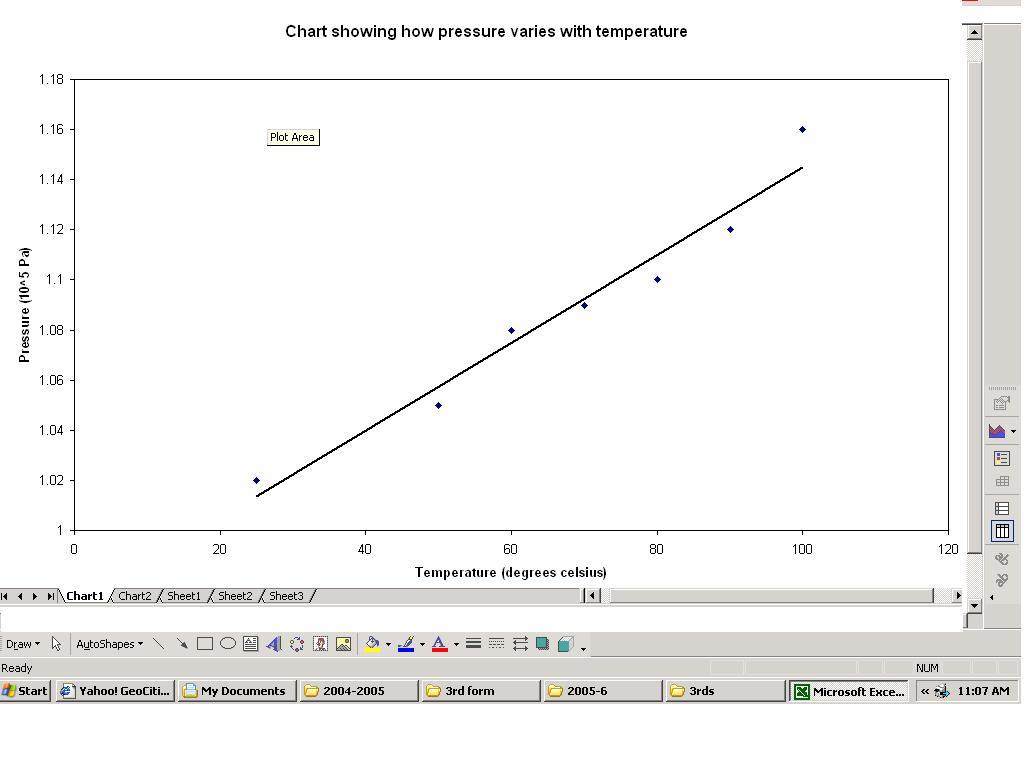
Pressure proportional to temperature is it? Yes, along as volume and amount of gas aren't changed.
We used the data logger to test the relationship between temperature and pressure.
We then looked at what happens if you heat a fixed volume of gas. The hot gas cannot expand, but the particles are moving faster so they bang into the walls of the container faster and more often exerting a larger force.
If a heated gas is not able to expand, it will exert a larger pressure. The pressure rises proportionally with the temperature.
The above graph could have its axes extended to find what temperature the pressure would drop to zero. This would be the coldest temperature possible, where the particles are still.


Pressure is proportional to temperature. (at constant volume)
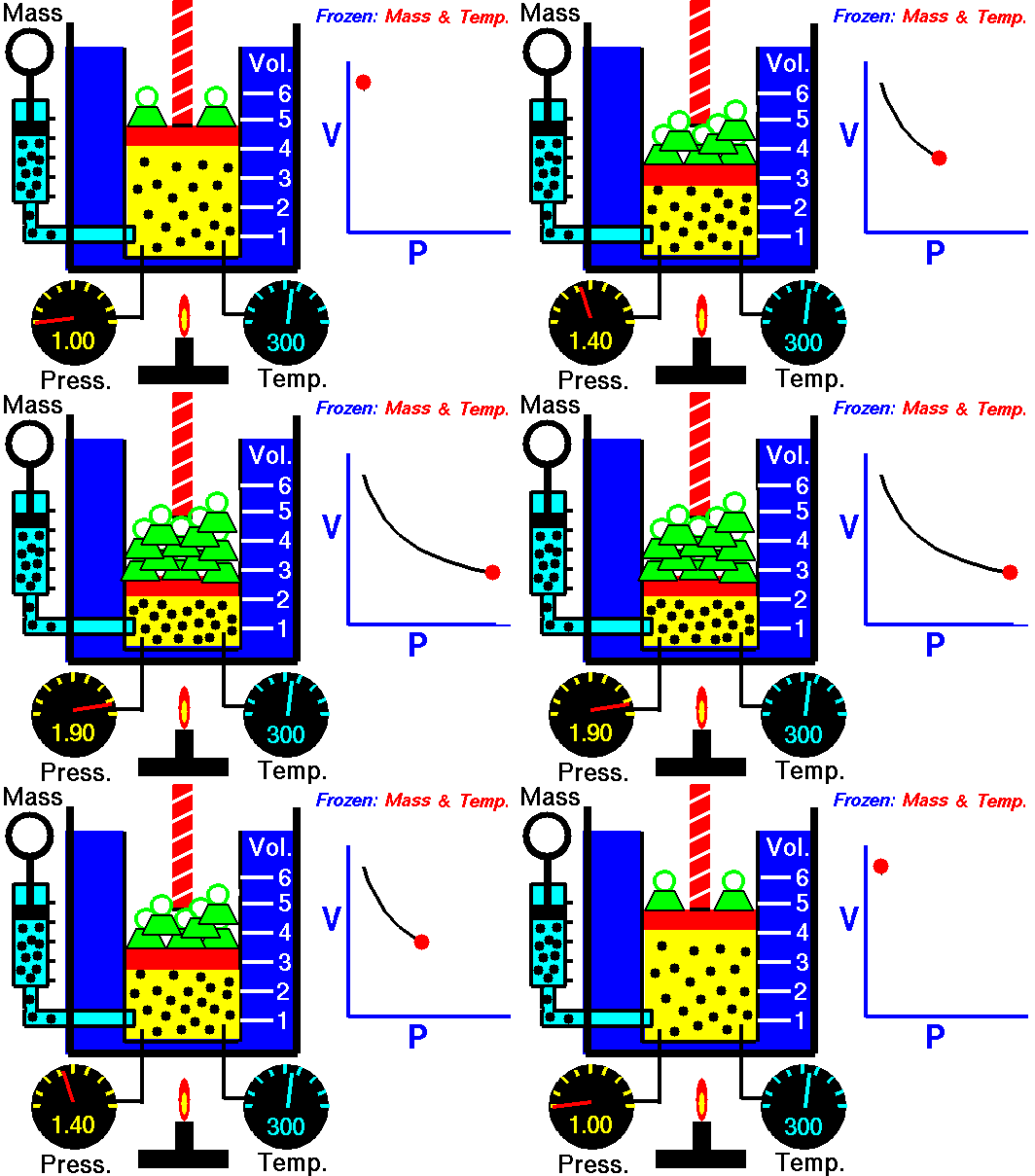
Pressure is inversely proportional to volume (at constant temperature)
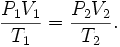
These 2 relationships can be combined into one formula.
HW Plot your graph (temperature on the x axis) and extrapolate to find a value of absolute zero.
We started thermal Physics with chaos. Not the subject, the state of affairs in the classroom.....
Pressure vs. volume.
The pressure exerted by a gas when we squashed it into a smaller and smaller volume was measured using the fancy pants laptops.
We found that if you squashed the gas into half of its original volume, the pressure doubled; the same number of particles are trapped in a smaller volume and so collide with things more often, exerting a greater pressure.
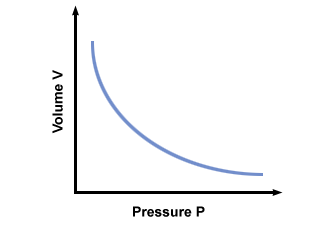
That is, pressure is inversely proportional to volume.
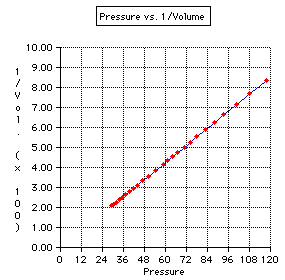
The relationship can be proved by plotting Pressure against (1/volume), getting a straight line.
The data we had was slightly off due to the fact that we had no way of ensuring the gas didn't warm up, temperature is another variable which affects pressure.
This file contains the results that I took.
The second half of the practise practical exam was attempted. Confusion reigned as different people started at different times etc.
Thermal starts next time.
We went through half the test. It turns out that I'd been extraordinarily harsh with the grade boundaries - in fact 80% of your marks were worth an A! Whoop whoop, etc. Anyhow - show your working so you can get all the marks when you know the answer etc. We'll finish this on Thursday.
We then attempted half an assessed practical. You are much worse at these than tests apparently, so we'll have to do lots of practice. We'll finish it next Monday.
HW None - generally pat yourselves on the back if you got an A - pretty good news at this early stage.
Testy testy testy.
I apparently didn't tell you about a test this lesson at all. Still - we looked at past paper questions on electricity for practice instead.
This , this , this, this , are all useful revisiony bits.
I was away for hundreds of thousands of millions of years.
You have done a fairly large number of practice questions on electricity by mow I reckon. There's nothing else new to do really, so we're working towards an electricity test.
We did a little practical to remind you of the shape of current vs. voltage graphs for several components.
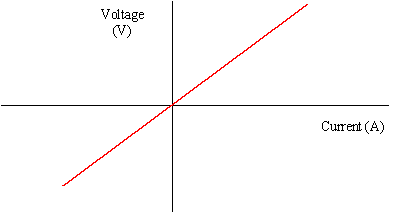
Bulbs gain in resistance as more current is passed through them because they heat up.
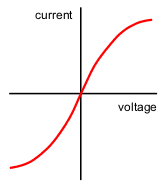
Diodes only allow current to pass through them in one direction. They are normal conductors, obeying Ohm's law in one direction but they have a huge resistance in the opposite direction, not allowing current to flow.
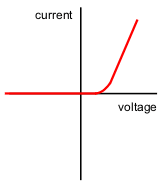
They do require a certain "threshold voltage" to conduct in a positive direction too, after that they act all normal, like they've been doing nothing wrong.
HW Revise for an electricity test. Actually - I made that bit up.
For a long period of time I was away..... Mr Jones has done some electricity with you and we only have one bit to finish really - internal resistance.
A cell, or battery of cells, produce the emf in the circuit which pushes charge. Up until now, we have said that the potential differences across the components in the circuit have taken away the energy from the charge as it passes around the circuit.
However, when charge starts to flow through a cell or battery of cells, it will experience some resistance from inside the cell. Even though the cell is pushing the charge around the circuit, it is also impeding the motion of charge at the same time.

You can think of each cell as a "perfect" cell in series with a resistor which carries its internal resistance.
The more current in the cell, the more voltage loss there will be due to the cell's internal resistance (meaning less voltage to be dropped across the rest of the circuit.)
Voltage across cell = EMF - Lost volts
Lost volts = Current * internal resistance of cell
Cells with a low internal resistance have a high short circuit current.
HW Practice Qs 17.2, 17.3 please.
04/10/07
New Physics for the first time this year!
We looked at the most important new bit of Physics in the electronics course.
Current is a measure of how much charge passes a point in a circuit per second. Amps = Coulombs per second.
The amount of current which will flow through a conductor depends upon how many free charge carriers there are in the conductor.
n : the number of free charge carriers per cubic meter of conductor
Volume of the conductor = Cross sectional area * length (A * l)
The speed at which the charge carriers move also affects how much charge will flow.
v : drift velocity of charge carriers. In 1 second, all the charge carriers in a piece of conductor v metres long will have flowed past.
The number of charge carriers in a piece of conductor v metres long is equal to:
Number of charge carriers = nAv
If each charge carrier has a charge of q......
The charge flowing past any point in the circuit in 1 second = nAvq = current
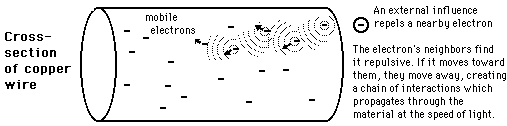
In most cases the charge on 1 carrier is simply the charge on an electron. The drift velocity is typically very small (less than 1mm per second), however, energy is transferred almost instantaneously when electrical current flows.
Even though the charge drifts slowly, the energy is transmitted at the speed of light through the conductor.
HW do 12.2, 12.3, 12.4
We looked at the difference between "ideal" voltmeters and actual real ones. Voltmeters have a large, but non infinite resistance and so are not reliable when measuring the voltage across very large resistances. We built some circuits to demonstrate this. We also discovered that the resistnace of an analogue voltmeter is far less than that of a digital meter (roughly 75 kOhms compared to 10MegaOhms)
HW Practice Qs 11.1 and 11.2 please.
More on Kichoff's 2nd law.
In any closed loop in a circuit, the sum of the emfs will equal the sum of the P.Ds
We talked about why it was just conservation of energy really.
Then I derived the formulae for adding resistances for you which are done using a combination of Ohm's law and Kirchoff's 2 laws.
HW Chapter 9 practice Qs 9.2, 9.3, 9.5
A double lesson! Joy.
We mainly talked through the ideas in Chapter 5 on controlling a large current with a smaller current. I told you how a transistor works, although you don't really need to know it for AS.
A transistor is an electronic switch. It turns on when the input voltage reaches a certain "switching" level, and it then conducts electricity, turning on any devices in series with it.
You are not required to know the details of how a transistor works, however, I gave you a handout attempting to explain this to you anyway. Intel fit many millions of transistors onto their chips, and this is what they have to say about them... I furnished you with a handout that attempts to explain how the transistor works at an atomic level. This is purely for your interest however, and is not required knowledge for the A level.
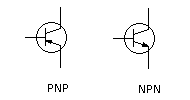
The above are the circuit symbols for transistors (don't worry too much about the different types)
A potential divider circuit can be used to provide the input voltage to the transistor. This is particularly useful if the potential divider contains a component like a thermistor. As the external temperature increases, the resistance of the thermistor falls, and the voltage across the thermistor gets smaller. A transistor can be used to switch on a warning light when the temperature gets too high/low.
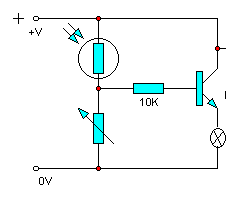
The above circuit turns on the lamp when light levels hitting the LDR get higher.
We then whizzed through Chapter 8 which talks about an analogy for voltage "electrical height", fluff really.
Kirchoff's 2nd law was just about stated before we hit the end of the lesson - a bit more on it next time.
HW Practise questions 5.2, 5.3, 5.4
20/09/07
Another lesson - hooray. We talked through any troubles you may have had with chapters 4 and 6.
We also looked at chapter 7 which is on energy and power in circuits. All the things which were true at GCSE are still true now. P=IV , E = VQ , Q = It, P = E/t etc.
HW I took in some Chp 2 Qs. You should do Chp 7 practice Qs 7.3 and 7.4.
No. CCF - you guys did some work to knock off chapters 3,4,5
I managed to mark (most) of your cover work. It showed good knowledge of Ohm's law and electrical power. However, you could probably do with a recap of adding resistances.
The new Physics is not until chapter 12 sadly. We will try to zoom through the rest of it until then.
We recapped the idea of charge today. It is a fundamental property of the universe and comes in 2 flavours, positive and negative.
A Coulomb is the unit of charge, it is defined as the charge which flows when one Amp flows for one second. (so the Amp was invented first and is known as a "base unit".) The Coulomb is a "derived unit".
An electron carries -1.6E-19 C of charge and a proton +1.6E-19 C.
You chould recall that static charges can be created by friction between 2 insulators (e.g. rubbing a polyethene rod with a cloth). The electrons are the particles which move between the materials leaving an imbalance in charge.
Current is defined as the rate of flow of charge.
HW I'm away (again) on Tuesday, but I'll try to set you some work which covers Chapters 3-5 so we can get a shift on to something a bit more interesting.
Loads of you! It was decided that I would do PHY2 and HRSJ PHY1.
In reality there are only 3 new things to teach you for electricity, but we need to recap all of of the GCSE stuff too.
We discussed the electricity you have already done for a bit, I won't be about on Tuesday so will set some electrcity stuff to do.