Random jiggling
Happy New Year.
13/03/08
You recieved every IGCSE electricity question ever. You also recieved a whole bunch of practice GCSE type questions. You now have about 4 hours worth of pure electricity. I'll get answers to you if I can on Monday.
A whole giant load of electricity problems were given out, if not attempted in any great measure by some of you lazy lot.
Extra revision is after school on Tuesdays, turn up if you didn't get an A.
We started to revise electricity - surprisingly short section of the syllabus. AQA book GCSE Qs were attempted.
The official recap of forces and motion is over. I gave you some materials to help with your revision (shed loads of questions). Some people went and did the Physics Challenge, the rest of us watched ATOM 1 - contained useful stuff on the structure of the atom and interesting stuff on quantum mechanics.
Pressure was recapped.
Pressure (N/m2)= Force (N) / Area (m2)
All sharp cutting devices use a low surface area to be able to cut into materials with very little force.
Liquids and gases can also exert forces on objects, and hence pressures (Pressure = Force/Area)
Brownian motion Their random jiggling is evidence for the existence of particles of water in continuous random motion.
Random jiggling
The particles in a liquid or gas exert a force on solid objects when they collide with them and bounce off.
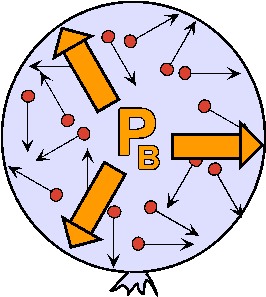
The pressure in a gas or liquid rises as you go deeper into it.
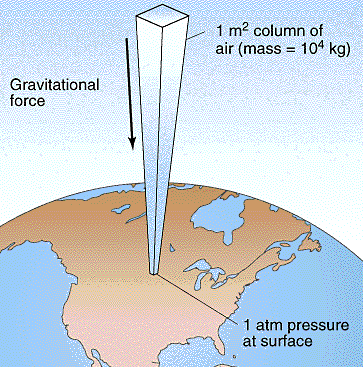
We are many km below the top of the Earth's atmosphere and the pressure exerted is quite large (100000N/m2)
You saw a vacuum pump suck all the air out from inside a metal can. The pressure on the outside was then enough to crush the can. Usually, the inner and outer pressure is equal and opposite.
We did a data logging experiment to test how the pressure exerted by water varies with its depth.
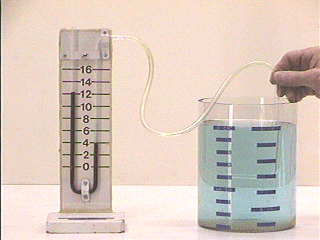
The results showed that the pressure in the water was proportional to the depth under the surface.
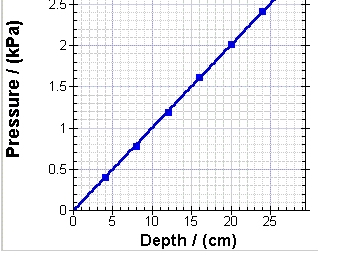
This makes sense, as there is a greater weight of water pushing down from above the deeper underwater you go.
Pressure = Depth times Density times gravitational field strength
The above formula allows you to work out the pressure due to any fluid.
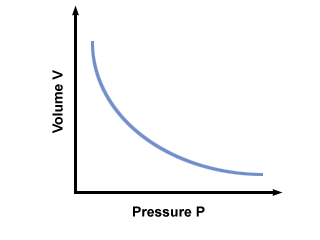
We did some further experiments on pressure, this time the pressure exerted by a gas when we squashed it into a smaller and smaller volume.
We found that if you squashed the gas into half of its original volume, the pressure doubled; the same number of particles are trapped in a smaller volume and so collide with things more often, exerting a greater pressure.
We then looked at what happens if you heat a fixed volume of gas. The hot gas cannot expand, but the particles are moving faster so they bang into the walls of the container faster and more often exerting a larger force.
If a heated gas is not able to expand, it will exert a larger pressure. The pressure rises proportionally with the temperature.
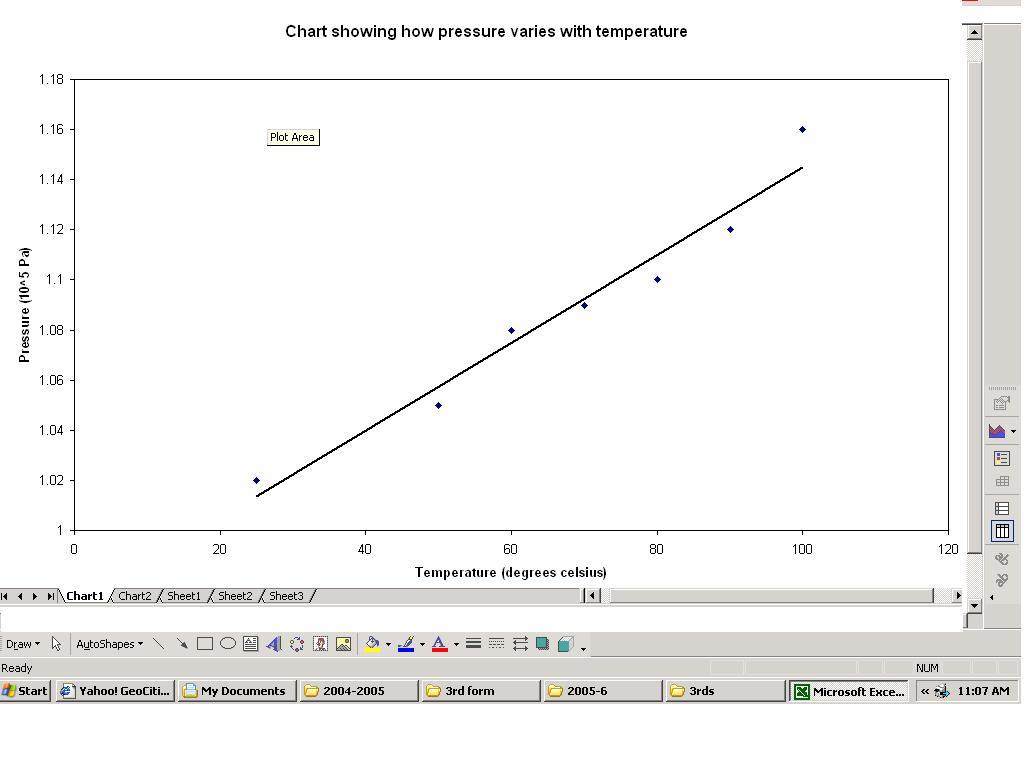
The above graph could have its axes extended to find what temperature the pressure would drop to zero. This would be the coldest temperature possible, where the particles are still.


Pressure is proportional to temperature. (at constant volume)
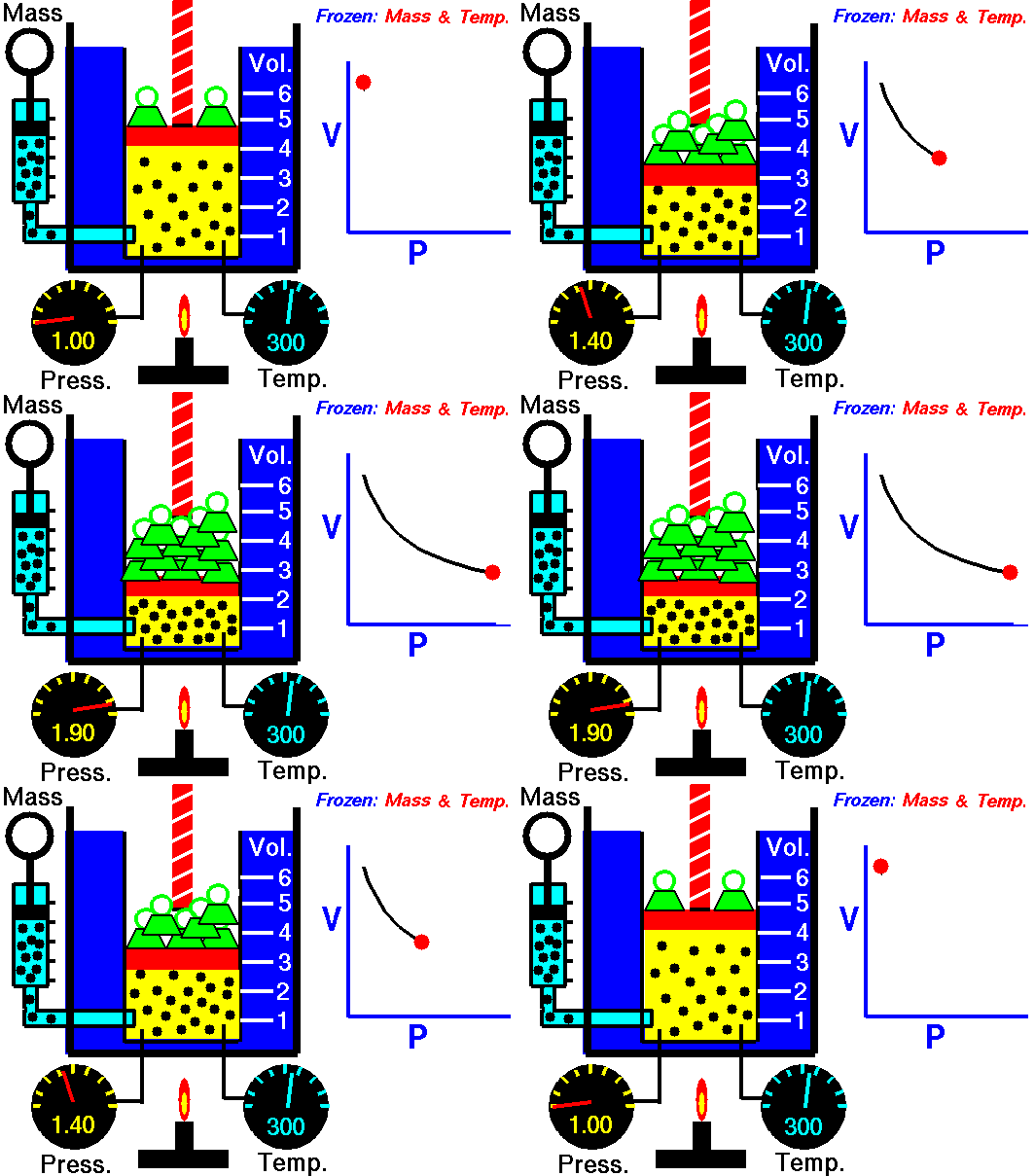
Pressure is inversely proportional to volume (at constant temperature)
These 2 relationships can be combined into one formula.
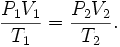
Moments, centre of gravity and springs to finish off forces and motion.
Graffitti has been spotted. Detentions will abound unless it is cleaned soon.
We sat a few Qs as promised. Next - moments and springs.
So, revision was started on forces and motion. There will be a little testlet on the motion graphs and f=ma next time, so we can move onto pressure, springs and moments.
We attempted some GCSE/iGCSE questions on nuclear fission reactors.
Science is hard, just not at iGCSE....

Nuclear power station designs were covered.
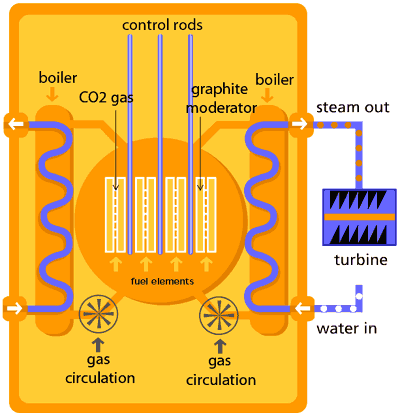
You only need to know the very basics for the exam.
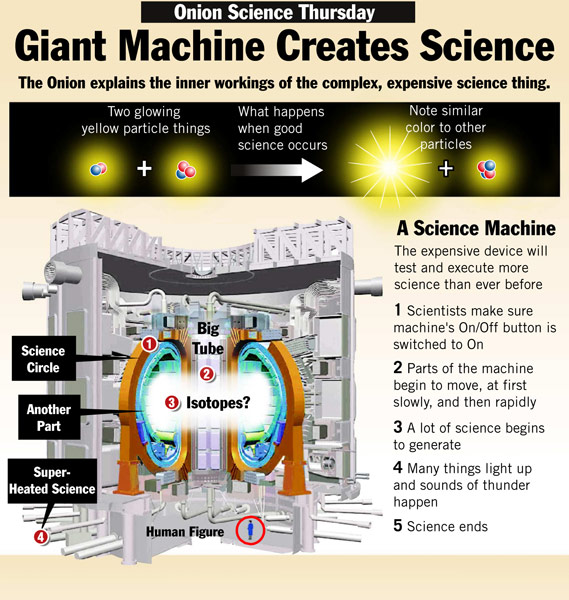
Sadly, this was how the new fusion reactor had to be presented to George Bush.
HW Yep - blowed if I can remember what though.
Last lesson of going through mock exams. It was established that we didn't actually cover the design of nuclear reactors, so we'll have to do that next...
But not this
A truly massive upturn in speed saw us get through nearly 8 whole questions in a double lesson. Mercy, mercy, me. More things in huge ass superconducting electromagnets.....
We went through Q1 and and half of Q2 from paper 2H of the Mock exam. We're going to have to speed up on this....
I had an MRI scan the other day. Check out what happens if you let a steel containing chair into the room. The magnet can't be turned off without heating up the superconducting magnets (which means this can happen.)