27/03/06
We sat a set of GCSE momentum questions. 2003 GCSE paper was given out to do over Easter.
Triple syllabuses and the 2002 paper are photocopied and available for collection from my pigeonhole.
These animations show momentum conservation in collisions.
Tom G and Kyle S need to print coursework and give it to me. Sandro needs to hand his to me with minor changes.
23/03/06
People sorted out their coursework. Kyle and Tom are printing stuff to give to me on Monday.
There were also multitudes of GCSE questions on Momentum for the triplers.
HW Momentum test for triplers on Monday, so revise (do past paper practise questions)
Doublers will do a little test at the same time.
20/03/06
More on momentum for triplers. However much it may pain you, it is a good idea to draw a very simple diagram representing the situation of each body before and after a collision.
You need to remember that momentum is a vector quantity that has a direction aswell as a size. Hence 2 equal sized momentums that are in opposite directions add up to zero.
Doubler (Nat) did a force and motion quiz - he needs to see me about coursework and bring in the double paper from last time.
HW - everyone else needs to get previous 2 sets of momentum HW done. First one was set as cover last Monday, 2nd was due in today. We'll finish momentum on Thursday.
16/03/06
Triplers were shown some demonstration collisions. Apart from some small errors due to friction, the total momentum of bodies before a collision was always the same as the total momentum after a collision.
Momentum = Mass * velocity
Momentum is always conserved in collisions. To solve problems...
1. Draw both objects and mark in their mass and velocity.
2. Calculate the combined total momentum (add them together remembering that only one direction is positive.)
3. Draw a new diagram showing what has happened after the collision.
4. The total momentum afterwards must equal the total momentum before the collision. Use this fact to work out any unknowns.
An elastic collision is a special case where the total kinetic energy of all the bodies stays the same before and after the collision.
KE = 1/2mv2
Kinetic energy does not have direction, so all KEs are positive. (It is a scalar not a vector quantity.)
Kinetic energy is rarely conserved in collisions. If it is, the collision is elastic.
If you are told that a collision is elastic, you have more information to solve problems mathematically.
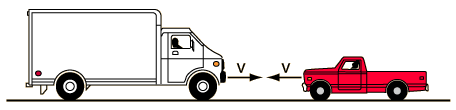
The force between 2 vehicles is equal and opposite during the crash. They experience equal and opposite changes in momentum during the crash (so total momentum must stay the same). The same change in momentum requires less change in velocity for a heavier object.
Occupants of a heavier truck experience less force during a head on crash. This is because the big truck experiences less deceleration, (or negative acceleration). The force on the people in the truck is: F = ma , where m is the mass of the person. People inside the truck must decelerate at the same rate as the truck (unless they go flying out through the windscreen). A large force is what will hurt people in a crash.
When a force acts on a body, it causes a change in momentum. The larger the force, the larger the change in momentum. The longer the force acts on the body, the larger the change in momentum it causes.
Force * time = Change in momentum
Ft = mv - mu
This is a rearrangement of Newton's 2nd law which can help explain why certain safety measures are used. Crumple zones are used in cars to increase the time it takes for the car to slow down and stop as it crashes. A smaller force acts on the car for a longer time - this reduces the chance of occupants injuring themselves.
In a car accident the larger mass vehicle is less likely to change velocity by so much. Both vehicles involved in the crash will experience equal and opposite forces when they collide, and so equal and opposite changes in momentum. However, a lighter vehicle has to change its velocity more to exhibit the same change in momentum as a heavier vehicle. That means the people inside the smaller veicle experince a greater deceleration and so a greater force during the crash and are more likely to die.
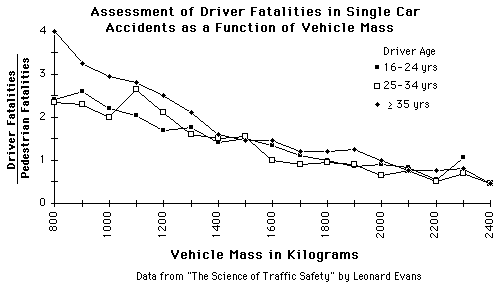
This graph shows the trend of fewer deaths in heavier vehicles.
HW Finish handout questions on momentum. (triplers)
Finish double award paper for next time (doublers)
13/03/06
RM at games due to stupid timetable change. You did some work on momentum and forces and motion for triplers and doublers respectively. Have them ready to hand in to me for Thursday please.
09/03/06
RM absent (ill). You started momentum (triplers) or began to revise forces and motion (doublers).
HW Have your cover work ready to hand in for next time.
06/03/06
We sat the little test on the Earth and beyond.
HW Print out your coursework again and give me a copy on Thursday - even if you haven't improved it recently.
03/03/06
We talked through the cosmology ideas that you need to know.
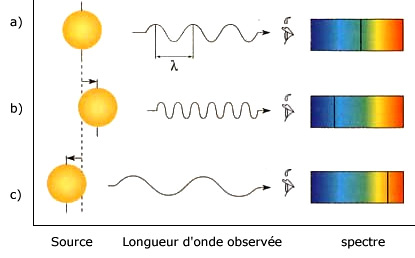
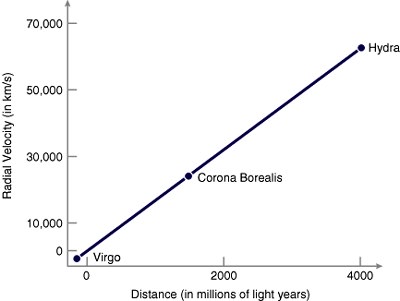
Doppler redshift of light from other galaxies suggests they are travelling away from us at great speed. The wavelength is "stretched" as the galaxies move away from us.
The further they are away, the faster they are travelling away.
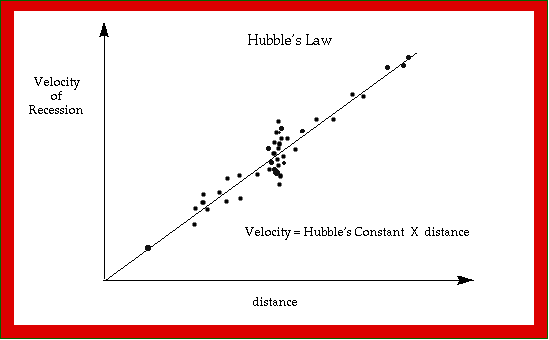
This suggests that the universe is expanding and in the past all the matter was much closer together starting at some point in a collossal Big Bang.
The universe's expansion should be slowed by the gravitational attraction of the mass in it. The fate of the universe depends on how much matter there actually is around the place. Unfortunately, at least 90% of matter us thought to be "dark", so that it can't be easily detected.
HW Revise for a quick past paper question test on all the space topic.
27/02/06
We looked at the idea of spectra. These are certain patterns of light that are produced by each chemical in a heated gas. The light can be split into its constituent colours using a diffraction grating (red light diffracts more than blue due to its longer wavelength).
We briefly looked at spectral lamps showing that different hot gases produce only a certain range of colours. This is due to electrons falling down shells after being promoted by heat energy. Starlight contains the opposite - absorption lines where gases have used certain frequencies of light only to promote elctrons up levels around their atoms.
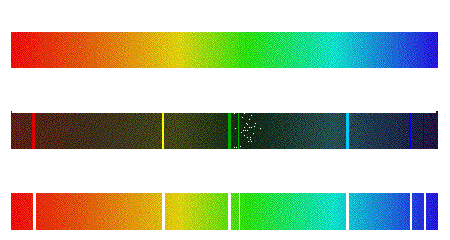
Scientists can look at the patterns of light and tell what chemicals are present in a star. It is also very useful for calculating if the star you are looking at is travelling away or towards you.
When an object is moving compared to an observer, any waves that it produces are shifted in wavelength slightly. If an object is moving away from you, the waves get longer. The Doppler effect occurs in sound when cars drive past you at speed.
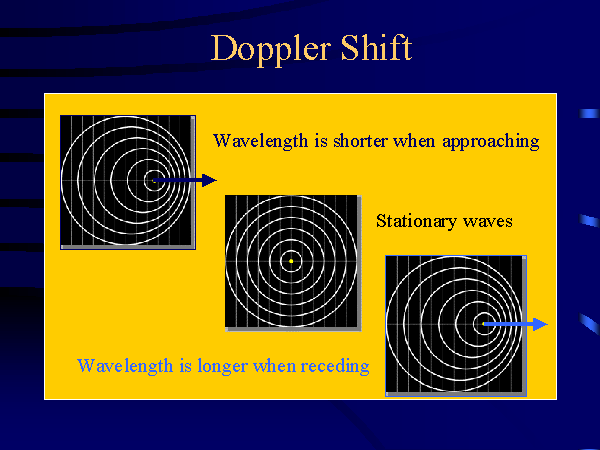
This happens in the light from distant stars and so the light appears redder or bluer than it should do. Edwin Hubble looked at the light in a number of distant objects in the sky. He realised that they were very nearly all moving away from the Earth - the light had been redshifted. The further away the objects were, the more their light was redshifted - the faster they were moving away.
Cosmic distances can be measured in au (distance from the Earth to the Sun) or in light years (distance travelled by a beam of light in 1 year). The nearest star is 4 light years away. Our galaxy is 100000 light years in diameter. Galaxies are separated by millions of light years.
If you were to reverse the direction of everything in the universe (i.e. reverse time), then everything would be travelling back towards a single point in time and space. This is where the Big Bang theory started.
We looked at possible fates of the universe. Redshidt gives us evidence that it is expanding now. We infer from this that it started off much smaller (e.g. the Big Bang.) The future of the universe is dependent on how much matter there is to gravitationally cause it to recollapse.
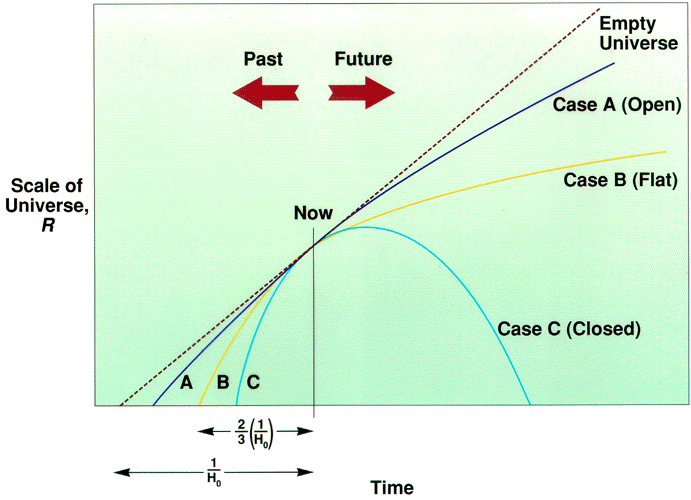
Case A is a universe without enough matter to slow the expansion much. Case C is where there is enough mass to cause a "Big Crunch". Case B is the dividing case between the 2. This is a universe with critical density of matter.
In actual fact recent evidence suggests that the expansion of the universe may be accelerating so there may be other forces at work as yet not understood.
HW Qs 6+7 from handout sheet.
23/02/06
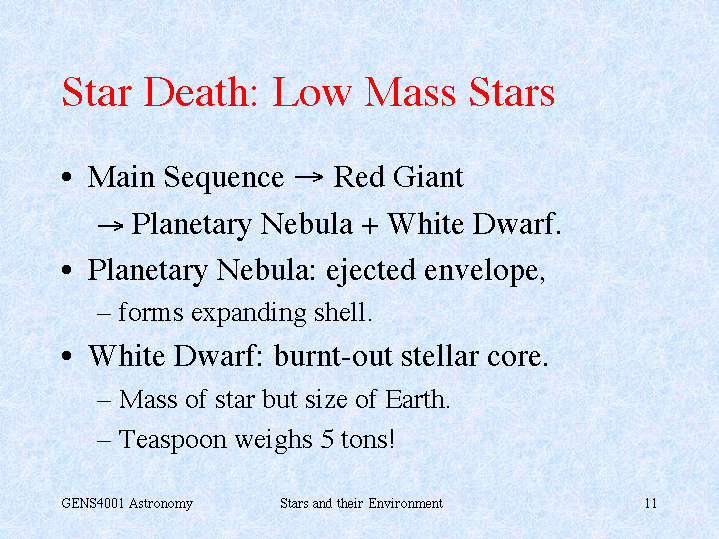
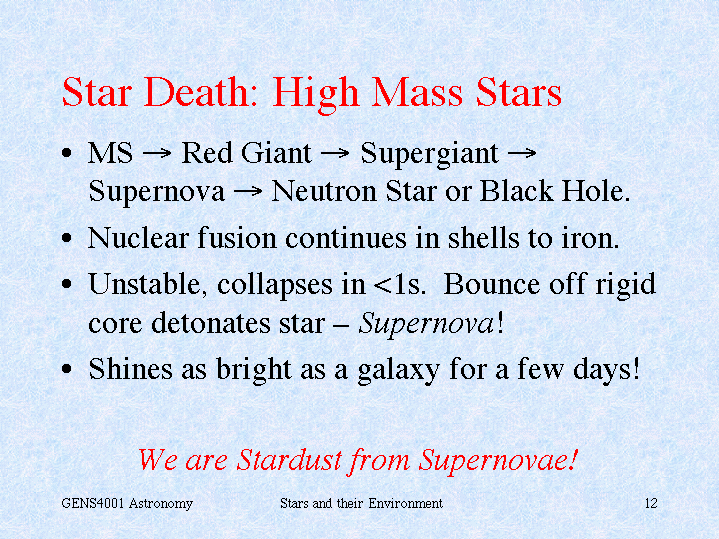
The death of stars was covered.
We watched a vid on the life cycle of stars. When they run out of hydrogen in their core, stars leave the main sequence. The now have to support themselves by fusing heavier elements together.
They will turn into Red giants - very bright stars whose volume has massively increased (which allows their surfaces to cool - hence "red"). The Sun will have a radius which is greater than the present day orbit of Venus.
HW Qs 3-7 from the colourful sheet that also featured last week's HW Qs 1+2.
20/02/06
We recapped the ideas of orbits, particularly geostationary compared to polar.
Then more about how stars are formed. We'll look at how they evolve and end their lives on Thursday.
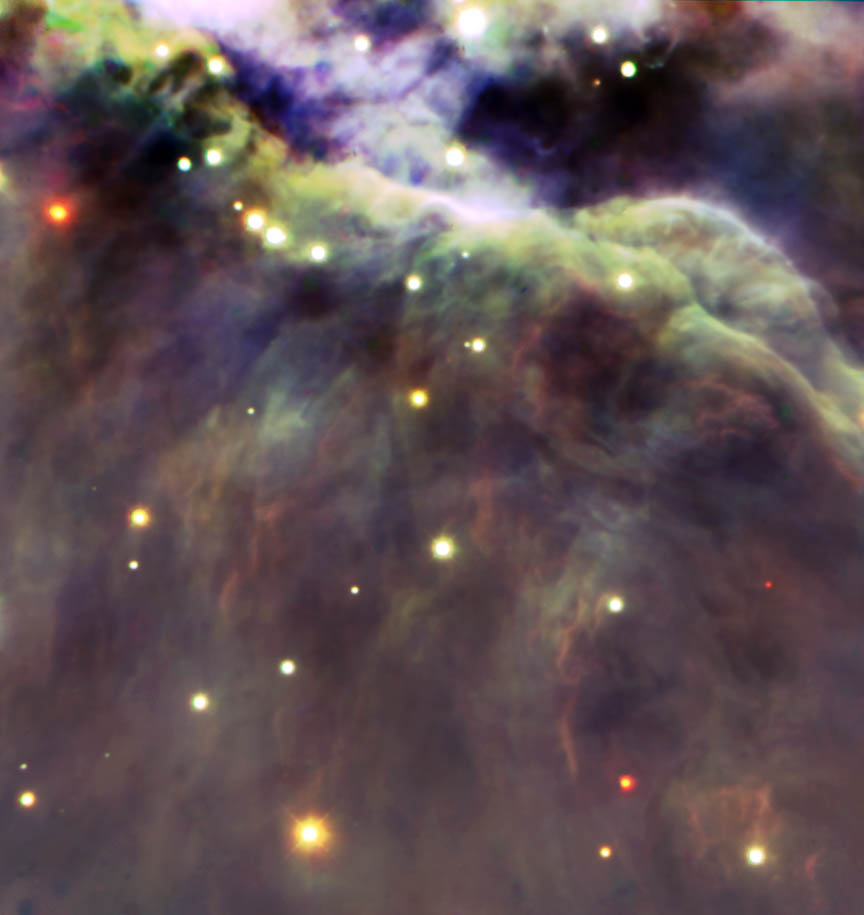
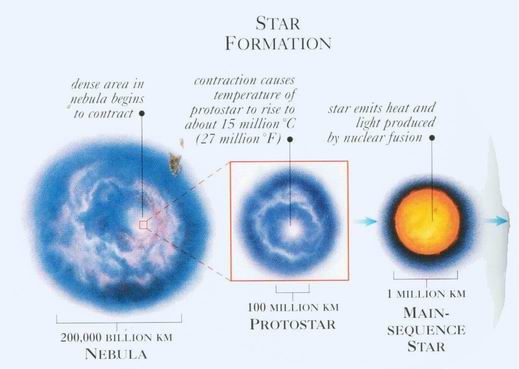
Stars form in large clouds of gas and dust within galaxies.
HW Only those who have to get their coursework sorted - very urgent now!
09/02/06
You saw the film about asteroids, meteorites and comets that you accidently didn't see last Thursday.
Then we started looking at how stars form.
Gravity causes clouds of gas to collapse, they begin to heat up as the do so. Eventually the temperature and pressure at the core becomes enough to allow nuclear fusion to take place.
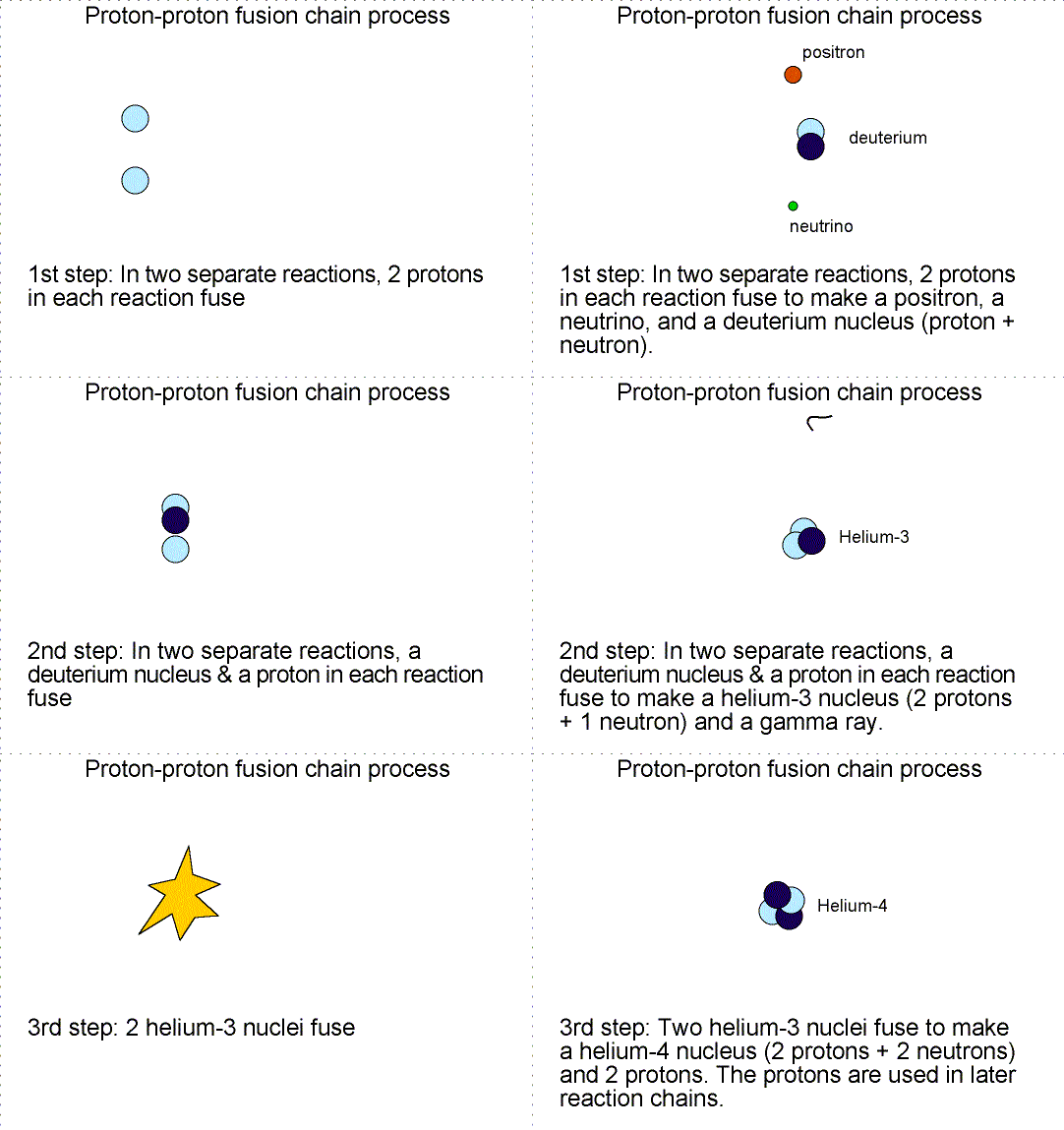
This process converts mass into energy (e=mc2)
So a star is like a truly humongous thermonuclear bomb which is prevented from exploding by its own gravity.
HW Q 1 + 2 from the colouful handouts.
06/02/06
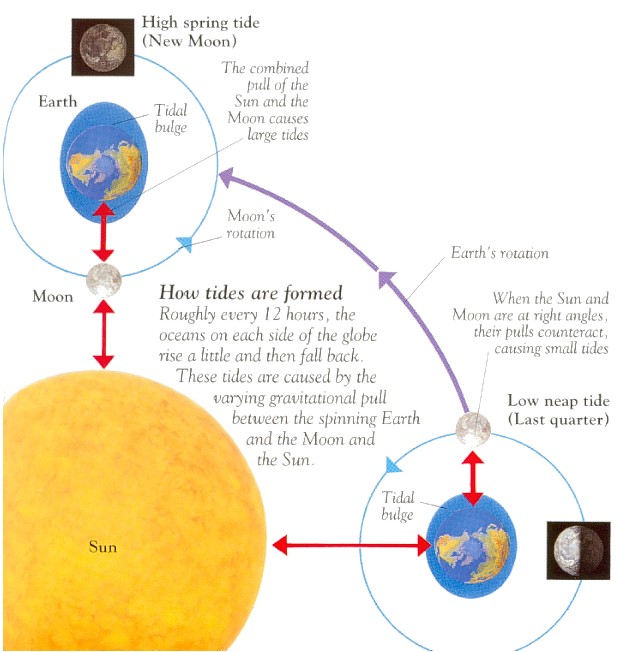
We talked about the force of gravity and how tides are formed.
Gravity gets smaller the further you are away from a mass. (4 times smaller if you double the distance).
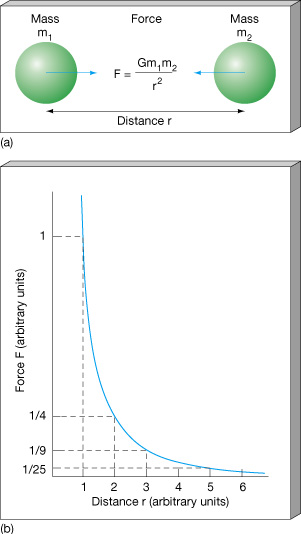
This causes effects like objects that orbit closer to a planet or star moving much faster. It also means that the Moon pulls on the near side of the Earth more than the far side "stretching" it out. It is this variation in the force which causes the tides in the Earth's water.
A load of wrong ideas people have about tides here
HW First 2 Qs on handout.
02/02/06
RM at t.tennis. You saw a film on comets and meteorites. Stuff you have to know is summarised below.
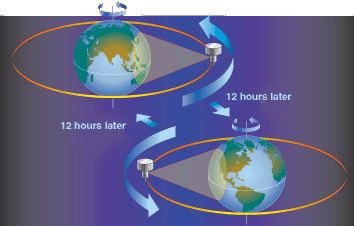
The Earth rotates once every 24 hours. It orbits the Sun once every 365.25 days. Circular orbits are possible due to the force of gravity. If the combination of the motion of a body sideways, and the vertical acceleration it has due to gravity make up a curved path which follows the curvature of the Earth, it is in orbit. It must be above the atmosphere so the only force acting on it is gravity towards the centre of the Earth.
The larger the orbit, the slower a satellite must travel, due to a diminishing gravitational force from the Earth. There are several different types of orbits used by artificial satellites.
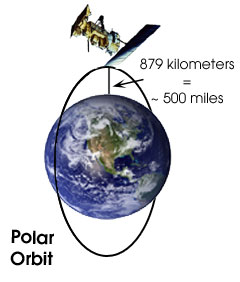
Low Earth Orbit is just high enough to avoid atmospheric drag. They can orbit once in as little as 90 minutes. Polar orbits allow satellites a close up view of the whole Earth (as it spins beneath them). This is useful for weather and spy satellites.
A geostationary orbit is much higher, completing one orbit in exactly one day. This is very useful for communications satellites as they are always above the same point on the Earth.
Site containing lots of information about satellites
Work from page 64/65 and 68/69 AQA was done, followed by 138-144 of the brown AQA book.
30/01/06
The rest of the Mock was gone through. Coursework rears its ugly head again now, I'll prepare a list of people who I think need more marks for Thurs.
26/01/06
Questions 1-9 a) were "gone through".
