5B 18/03/09
Answers for the IGCSE forces and motion papers were given out, although handed in scripts were not returned yet....
Electricity revision was continued. We covered all the basics, but not static charge or electricity in the home.
Answers for the IGCSE forces and motion papers were given out, although handed in scripts were not returned yet....
Electricity revision was continued. We covered all the basics, but not static charge or electricity in the home.
Forces and motion stuff came in from some. Answers next time, we started basic electricity notes (we got as far as V/I graphs for filament bulbs.)
You should have handed in your past paper questions for forces and motion. Some backup notes went out for disorganised people. Example answers will be distrubuted next week at some stage, and we'll move on to electricity.
No - RM = CCF. You did more of those questions from Monday. Hand in next time.
You recieved every past forces and motion question ever from IGCSE. You will hand them in by the end of the next single lesson for marking.
You recieved every past forces and motion question ever from IGCSE. You will hand them in by the end of next double lesson for marking. You also got the answers to the generic questions attempted last time.
More forces and motion questions, generic GCSE standard. Answers too, for you to check. IGCSE ones next time.
Generic GCSE style motion questions were handed out and started. Answers for these next time.
We covered chapter 4, on moments and Hooke's law meaning we are now ready for the IGCSE questions on Forces and motion.
Some were off doing the Physics Challenge. The rest of us therefore rather held fire and did some (Emmanuel) revision questions on the forces and motion topic. We also looked at moments and Hooke's law, meaning we are nearly done for Chapters 1-4.
Here is an example of a GCSE revision website. There are loads, it is well worth your while shecking them out if you are stuck at home.
We have now revised chapters 1 and 3. We will revise 2 and 4 and then move on to past paper questions next time.
We did some past exam paper questions on the solids, liquids and gases chapter. We are now done and have moved onto revision - you have new little revision books. We just got started on forces and motion, did average speed, instantanous speed and velocity. Ready for vector/scalar table.
We looked at what happens if you heat a fixed volume of gas. The hot gas cannot expand, but the particles are moving faster so they bang into the walls of the container faster and more often exerting a larger force.
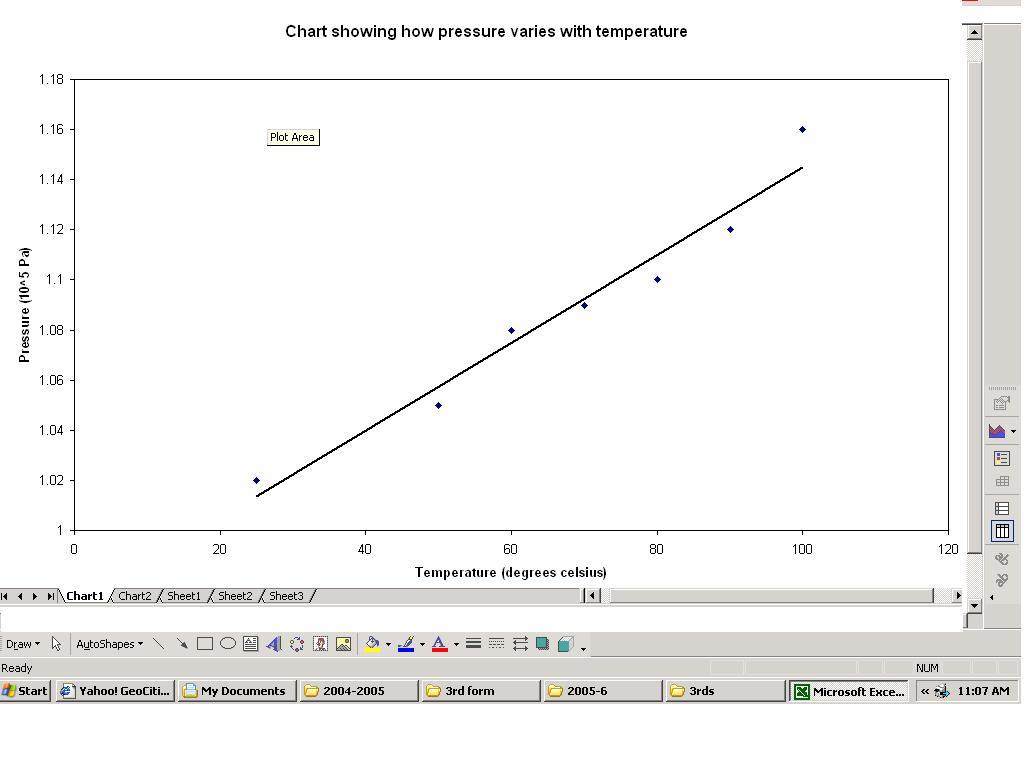
If a heated gas is not able to expand, it will exert a larger pressure. The pressure rises proportionally with the temperature.
The above graph could have its axes extended to find what temperature the pressure would drop to zero. This would be the coldest temperature possible, where the particles are still.


Pressure is directly proportional to temperature, as long as T is measured in Kelvin. (at constant volume)
HW Yep - finish the set of past paper questions on solids, liquids and gases from P159 of the book.
Calculations on gas laws
Boyle's Law, sing the formula: P1V1=P2V2
(Where T and mass of gas are constant.)
and the relation between temperature and pressure:
P1/T1=P2/T2
(Where V and mass of gas are constant.)
HW omplete the sheet of questions,we finish withper qs next time.
We did some calculations on Boyle's Law, sing the formula: P1V1=P2V2
which derives from the fact that pressure is inversely proportional to volume for a fixed mass of gas at a constant temperature.
HW Set of questions on Boyle's law.
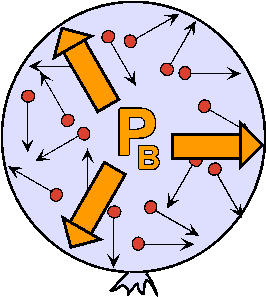
The particles in a liquid or gas exert a force on solid objects when they collide with them and bounce off.
Brownian motion Their random jiggling is evidence for the existence of particles of water in continuous random motion.
Random jiggling
We did some further experiments on pressure, this time the pressure exerted by a gas when we squashed it into a smaller and smaller volume.
We found that if you squashed the gas into half of its original volume, the pressure doubled; the same number of particles are trapped in a smaller volume and so collide with things more often, exerting a greater pressure.
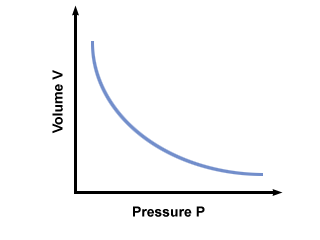
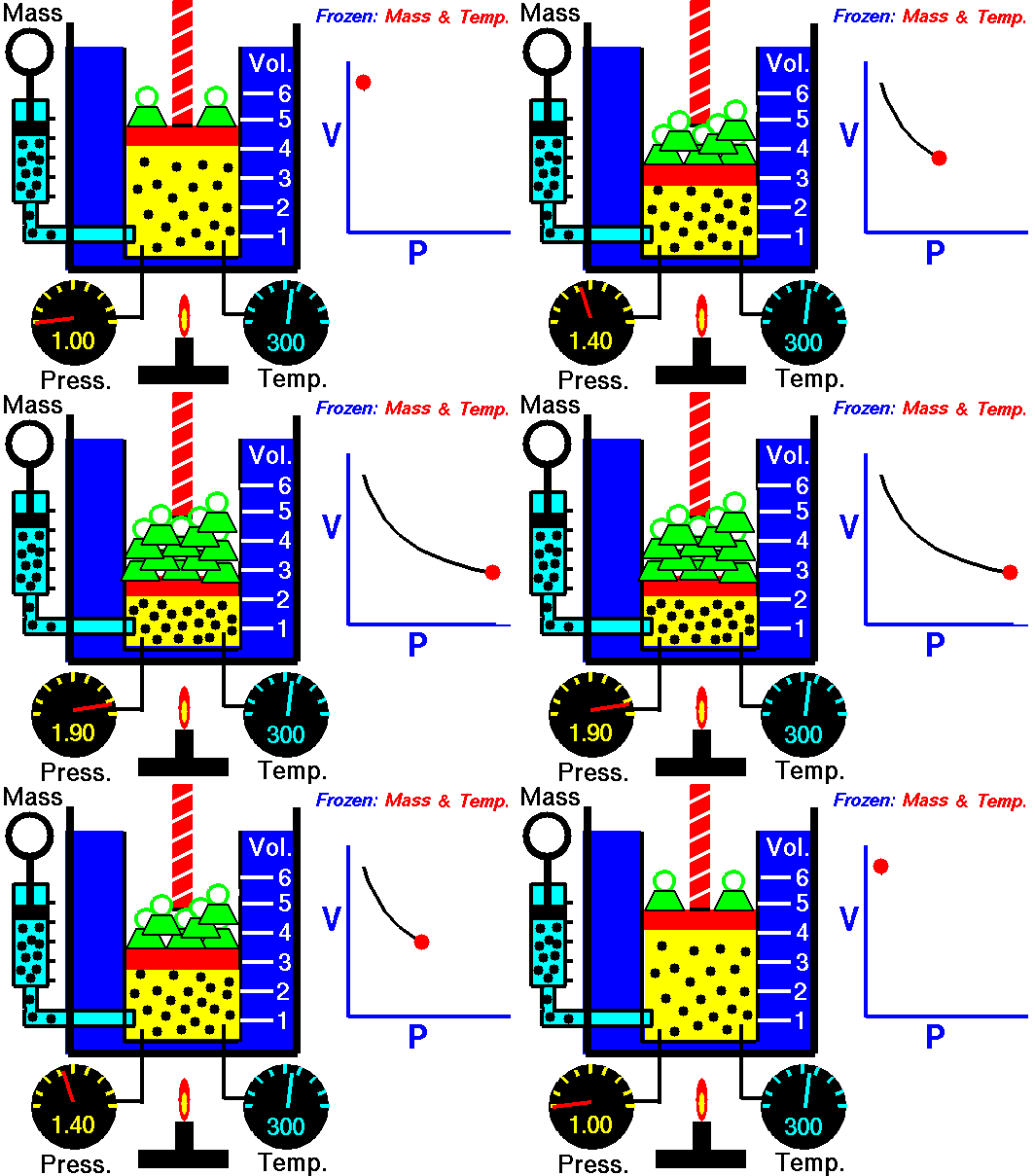
Pressure is inversely proportional to volume (at constant temperature)
HW Yes - finish the nice set of questions on Star Wars related pressure volume issues.
Pressure was recapped.
Pressure (N/m2)= Force (N) / Area (m2)
All sharp cutting devices use a low surface area to be able to cut into materials with very little force.
Liquids and gases can also exert forces on objects, and hence pressures (Pressure = Force/Area)
Brownian motion Their random jiggling is evidence for the existence of particles of water in continuous random motion.
Random jiggling
The particles in a liquid or gas exert a force on solid objects when they collide with them and bounce off.
The pressure in a gas or liquid rises as you go deeper into it.
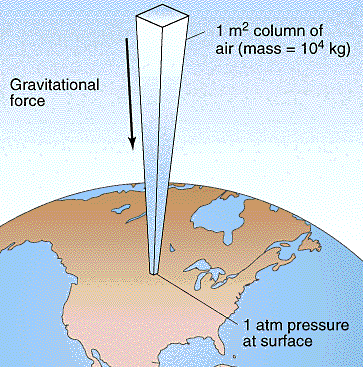
We are many km below the top of the Earth's atmosphere and the pressure exerted is quite large (100000N/m2)
We did a data logging experiment to test how the pressure exerted by water varies with its depth.
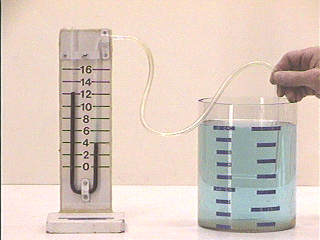
The results showed that the pressure in the water was proportional to the depth under the surface.
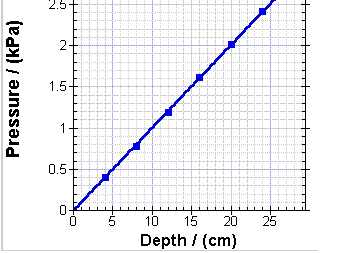
This makes sense, as there is a greater weight of water pushing down from above the deeper underwater you go.
Pressure = Depth times Density times gravitational field strength
The above formula allows you to work out the pressure due to any fluid.
We did some further experiments on pressure, this time the pressure exerted by a gas when we squashed it into a smaller and smaller volume.
We found that if you squashed the gas into half of its original volume, the pressure doubled; the same number of particles are trapped in a smaller volume and so collide with things more often, exerting a greater pressure.
Pressure is inversely proportional to volume (at constant temperature)
HW Yes - was there? Probably to have finished the write up of the Pressure vs. volume expt.
We looked at what happens if you heat a fixed volume of gas. The hot gas cannot expand, but the particles are moving faster so they bang into the walls of the container faster and more often exerting a larger force.
If a heated gas is not able to expand, it will exert a larger pressure. The pressure rises proportionally with the temperature.
The above graph could have its axes extended to find what temperature the pressure would drop to zero. This would be the coldest temperature possible, where the particles are still.
Pressure is directly proportional to temperature, as long as T is measured in Kelvin. (at constant volume)
HW Qs 1,2,3 on the Kelvin scale.
Final topic, Density and Pressure was started.
It is a measure of how tightly the matter is packed into a substance. It is hard to find the volume of irregularly shaped objects by calculation. However, if they are immersed in water, they push exactly their own volume of water out of their way. This causes a rise in the water level, which can be measured if the water is held in a measuring cylinder, or if you catch water that overflows from a Eureka can. This man seems to be trying to measure his own volume. Once you have found out the volume of an object (regular or irregular) you simply measure its mass by placing it on an electronic balance.

A larger object can have less mass, and so feel less heavy if it is less dense.
All sharp cutting devices use a low surface area to be able to cut into materials with very little force.
5B 26/01/09
Final topic, Density and Pressure was started.
It is a measure of how tightly the matter is packed into a substance. It is hard to find the volume of irregularly shaped objects by calculation. However, if they are immersed in water, they push exactly their own volume of water out of their way. This causes a rise in the water level, which can be measured if the water is held in a measuring cylinder, or if you catch water that overflows from a Eureka can. This man seems to be trying to measure his own volume. Once you have found out the volume of an object (regular or irregular) you simply measure its mass by placing it on an electronic balance.
A larger object can have less mass, and so feel less heavy if it is less dense.
Pressure (N/m2)= Force (N) / Area (m2)
All sharp cutting devices use a low surface area to be able to cut into materials with very little force.
Liquids and gases can also exert forces on objects, and hence pressures (Pressure = Force/Area)
The particles in a liquid or gas exert a force on solid objects when they collide with them and bounce off.
The pressure in a gas or liquid rises as you go deeper into it.
We are many km below the top of the Earth's atmosphere and the pressure exerted is quite large (100000N/m2)
We didn't do a data logging experiment to test how the pressure exerted by water varies with its depth.
The results would have showed that the pressure in the water was proportional to the depth under the surface.
This makes sense, as there is a greater weight of water pushing down from above the deeper underwater you go.
These are the results that I got (for absentees and any others who need them.)
Pressure = Depth times Density times gravitational field strength
The above formula allows you to work out the pressure due to any fluid.
HW P49 Q3 and P59 Q3
We finished going through the mock. Onto pressure next time.
Mock paper 3 was looked at....
Onto pressure next time.
We started going through the mock exam.
Welcome back. Going through of the Mock exam.