24/05/06 4C
A second radioactivity test was sat. Then we looked at some of the calculations that you are required to do for work, energy and power.
Revision materials were distributed including last year's paper.
HW Do the 2005 4th form exam paper over half term - it will be marked.
Adam Walls, Adam Rostowski, Otto H-F, Joshua M, Joe C, Sam B and Jamie L are due in room 509 at the start of lunch on Thursday as punishment for gross misbehaviour.
24/05/06 4P
A second radioactivity test was sat. Then we looked at some of the calculations that you are required to do for work, energy and power.
HW Finish the set of energy calculations given to you. Radioactivity revision Qs 5+8 must come in from all people too.
22/05/06 4P
We went through the radioactivity test. Lots to learn about making sure your answers are very clear, even if this seems to mean you are stating the obvious.
Also clearly some extra learning is needed on radioactivity. Therefore we are going to have another 20 minute or so short answer test on Wednesday just to check your knowledge.
We used an electrical motor to convert chemical potential stored energy in a battery into electrical energy, then kinetic energy which finally lifted a mass up, giving it gravitational potential energy.
A joulemeter recorded the total amount of electrical energy taken from the battery. We calculated the amount of gravitational potential energy that was given to the mass.
GPE = Mass * height * g
Where g is the gravitational field strength (10N/kg on Earth)
We found that there was a discrepancy, some energy must have been wasted in the process.
This energy has not disappeared, but may well have been converted into heat or sound energy rather than GPE of the mass.
We calculated the efficiency of the lifting process.
Efficiency = Useful energy out/Total energy in
(multiply by 100 to express as a percentage)
We found that the motor was more efficient at lifting heavier masses, which it did rather slower. Perhaps this reduced the frictional forces involved.
HW Revise radioactivity again for a short test on Wednesday.
19/05/06 4C
We went through the rather dissapointing radioactivity test. We'll just have to do it again.......
Then we started work energy and power, the final topic of the year.
Energy be created or destroyed - only changed from one form to another. When this happens - work is done and a physical change of some sort takes place.
Kinetic energy - due to the movement of a mass. KE = 1/2mv2
Gravitational potential energy - lift something up and it has the potential to fall down again. GPE = mgh
Heat energy - due to the internal movement of particles.
Light energy - carried via an electromagnetic wave.
Electrical energy - carried as the movement of charge through a conductor.
Chemical PE - stored in fuels which are yet to be reacted to release their energy into a more useful form.
Elastic PE - stored when materials stretch or squash (e.g. springs)
Mechanical work is done by forces - but only if they are allowed to move.
Work done (Joules) = Force (N) * Distance (m)
The distance travelled must be in the direction of the force.
HW Revision for another, slightly shorter, radioactivity test on Wednesday. You will hand in answers to Physics Matters P330-331 Q 5 and 8 to prove that you have done some.
17/05/06 4P
We started the new topic - work, energy and power. We talked about the differing types of energy.
Kinetic energy - due to the movement of a mass. KE = 1/2mv2
Gravitational potential energy - lift something up and it has the potential to fall down again. GPE = mgh
Heat energy - due to the internal movement of particles.
Light energy - carried via an electromagnetic wave.
Electrical energy - carried as the movement of charge through a conductor.
Chemical PE - stored in fuels which are yet to be reacted to release their energy into a more useful form.
Elastic PE - stored when materials stretch or squash (e.g. springs)
When energy is tranformed from one type to another - a physical change takes place in the universe. (i.e.) something happens.
Energy can never be created or destroyed. This law is fundamental and is always true throughout the universe.
However, energy can be "wasted" by being transferred into a form which isn't useful to us and cannot be recovered. (e.g. the heat energy created in an electrical motor due to resistance.)
Humans require vast amounts of energy to maintain their lifestyles, and convenient sources of stored chemical potential energy are running out. These are mainly fossil fuels (coal, oil, gas). They also have the problem of producing chemicals which alter the makeup of the atmosphere when they are burned.
Alternatives must be sought - renewable sources such as solar, wind, and hydroelectric energy use the Sun as their ultimate power source so will be available for 5 billion years or so....
Nuclear fission reactions release such a lot of energy for a small amount of fuel that we wouldn't run out for tens of thousands of years. However, radioactive waste is a problem.
Nuclear fusion isn't yet technologically possible, but it is the best long term hope for an energy greedy society.
HW Write an essay entitled "In 50 years, I believe mankinds major source of energy will be....." 1 page A4
17/05/06 4C
We sat the radioactivity test.
15/05/06 4P
We sat the radioactivity test.
Various people owe me P191 questions on half life. Sam B and Adam W both owe me extra work by tomorrow or I put in your detention slips....
12/05/06 4C
Rutherford's alpha particle scattering experiment.
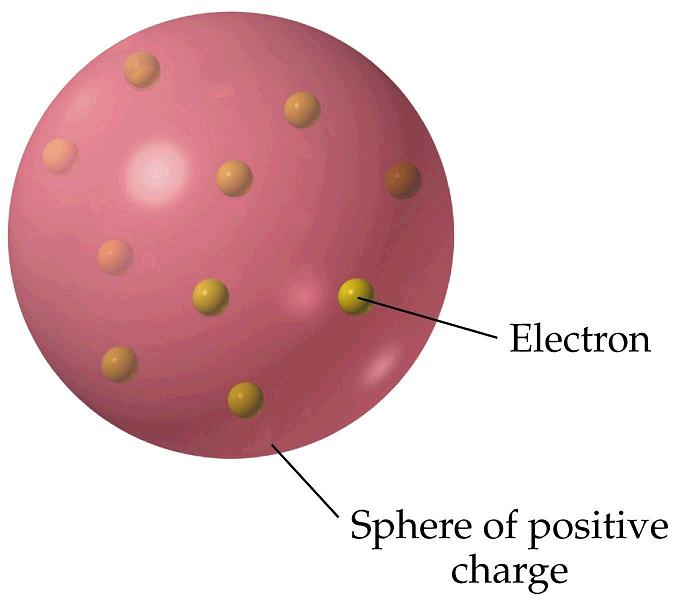
In 1900 or so, it was thought that the atom was made up of negative particles which were uniformly distributed throughout a positively charged sphere.
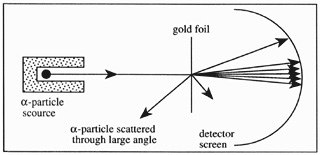
Rutherford fired fast moving alpha particles at a very thin gold foil and found that most of the alpha particles pass straight through the gold foil as they pass directly through the empty space which makes up most of the atom. A tiny proportion of the alpha particles were deflected by a large amount. This proved that the positive charge in an atom must be concentrated at one particular point. We call this the nucleus of the atom. Electrons "orbit" the nucleus at a distance.
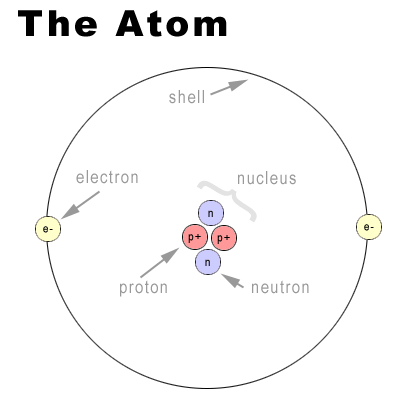
Some are slightly deflected by passing near the positive charge in the nucleus.
HW Revise for a radioactivity test on Monday.
10/05/06 4P
Rutherford's alpha particle scattering experiment.
In 1900 or so, it was thought that the atom was made up of negative particles which were uniformly distributed throughout a positively charged sphere.
Rutherford fired fast moving alpha particles at a very thin gold foil and found that most of the alpha particles pass straight through the gold foil as they pass directly through the empty space which makes up most of the atom. A tiny proportion of the alpha particles were deflected by a large amount. This proved that the positive charge in an atom must be concentrated at one particular point. We call this the nucleus of the atom. Electrons "orbit" the nucleus at a distance.
Some are slightly deflected by passing near the positive charge in the nucleus.
HW Revise for a radioactivity test on Monday.
Adam Walls owes me some interesting work on atomic nuclei from page 230-231 of his Physics Matters book. Sam Blausten owes me every single end of chapter examination question on radiation layed out beautifully. Many of you still owe me some of the previous radioactivity questions.
10/05/06 4C
We saw a real time decay of a radioactive sample. Radon gas was blown into a gas chamber with a voltage across it. An ammeter was conected across the chamber. The radon gas is radioactive, producing alpha particles. The alpha particles ionised the gas in the chamber which allowed a current to flow. The more ionisation there was, the more current flowed.
We plotted a graph showing how the current dropped over time. We were able to calculate the half life of the radon. This is the time taken for the radioactivity to fall to half of its present value at any stage. It was about 80 seconds or so. (2 readings were taken from the graph for greater accuracy). So half of the radon atoms present would decay every 80 seconds. Radon is itself a decay product of thorium, which has a very long half life. A continual supply of radon is therefore released around radioactive thorium deposits.
Radon gas is released around granite rock and is heavier than air. This can increase the natural dose of radiation recieved if a person lives in a granite based area (e.g. Cornwall.)

An example of a decay curve showing several half lives.
HW Plot the decay curve (by hand or on computer) and calculate the half life of the radon source.
08/05/06 4P
We moved on to look at nuclear fission and fusion.
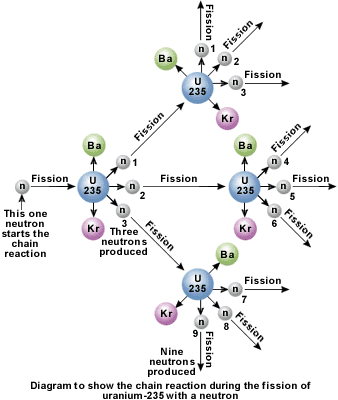
A neutron is absorbed by a large nucleus causing it to become unstable and split into two. The daughter nuclei are more stable than the original one, so energy is released. (They have less mass, E=mc2, so mass has been converted into energy.)
If enough fissile material (uranium-235 or plutonium-239) is present, the neutrons released in one fission will hit other nuclei, causing them to split.
The energy can be released catastrophically as in an A bomb, or in a more controlled manner in a reactor. Control rods are used to absorb some of the neutrons in this case.
The daughter nuclei are radioactive with a long half life which causes problems as what to do with the spent fuel.
Nuclear fusion
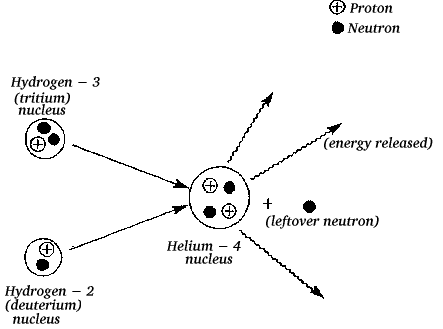
2 small nuclei are slammed together at very high temperatures. They become more stable as a result, turning into Helium. This releases energy. Fusion is the reaction that powers stars, the above reaction is one that humans are trying to harness in order to have an almost inexhaustible supply of energy. (The fuel can be derived from seawater.)
Fusion does not leave radioactive waste and is much more efficient than fusion in terms of the amount of energy released per gram of fuel.
Humanity must harness this power effectively if it is to have any long term hopes of survival.
HW AQA P191 All questions.
05/05/06 4C
We tried to do a demo on radioactive decay. However, it wouldn't work so we'll try half life again next time.
So we moved on to look at nuclear fission and fusion.
A neutron is absorbed by a large nucleus causing it to become unstable and split into two. The daughter nuclei are more stable than the original one, so energy is released. (They have less mass, E=mc2, so mass has been converted into energy.)
If enough fissile material (uranium-235 or plutonium-239) is present, the neutrons released in one fission will hit other nuclei, causing them to split.
The energy can be released catastrophically as in an A bomb, or in a more controlled manner in a reactor. Control rods are used to absorb some of the neutrons in this case.
The daughter nuclei are radioactive with a long half life which causes problems as what to do with the spent fuel.
Nuclear fusion
2 small nuclei are slammed together at very high temperatures. They become more stable as a result, turning into Helium. This releases energy. Fusion is the reaction that powers stars, the above reaction is one that humans are trying to harness in order to have an almost inexhaustible supply of energy. (The fuel can be derived from seawater.)
Fusion does not leave radioactive waste and is much more efficient than fusion in terms of the amount of energy released per gram of fuel.
Humanity must harness this power effectively if it is to have any long term hopes of survival.
HW Finish all non half life related questions on the handout.
This file contains basic notes plus the HW questions.
03/05/06 4P
We finished the video on uses of radioactivity.
A radioactive isotope of an element is one that has unstable nuclei which will decay by producing one of the three different types of radioactive emissions. (eg. carbon-14) Most common isotopes of elements have stable nuclei and so are not radioactive (eg. carbon-12).
Alpha particles have uses in smoke detectors, ionising air within the detector to allow a current to flow. Smoke particles absorb more alpha particles so the current drops when smoke gets in to the detector.
Beta particles are often used to help control the thickness of milled paper or metal. Put a source on one side and a detector on the other. If the material being produced is too thick, more beta particles are absorbed, the count rate goes down and so an adjustment must be made and similarly the count rate goes up if the material is too thin. Carbon dating uses the beta decay of carbon 14 to nitrogen to tell how old organic material is.
Gamma rays are used to sterilise food and medical equipment. They can also be used as medical tracers. Inject a dissolved gamma ray source into someone's blood stream and the gamma rays will be able to pass out through their skin. Using a radiation detector you can tell where most blood flow is going on. They can also be used to test for hairline cracks in machines or to trace the movement of materials within sea currents etc. Gamma rays can also be used to kill cancerous cells within the body.
A radioactive isotope must be chosen with a sensible half life must be chosen for each application. For internal medical use, the half life must be very short. For longer lasting industrial applications it has to be longer.
This file contains basic notes plus the HW questions.
We saw a real time decay of a radioactive sample. Radon gas was blown into a gas chamber with a voltage across it. An ammeter was conected across the chamber. The radon gas is radioactive, producing alpha particles. The alpha particles ionised the gas in the chamber which allowed a current to flow. The more ionisation there was, the more current flowed.
We plotted a graph showing how the current dropped over time. We were able to calculate the half life of the radon. This is the time taken for the radioactivity to fall to half of its present value at any stage. It was about 80 seconds or so. (2 readings were taken from the graph for greater accuracy). So half of the radon atoms present would decay every 80 seconds. Radon is itself a decay product of thorium, which has a very long half life. A continual supply of radon is therefore released around radioactive thorium deposits.
Radon gas is released around granite rock and is heavier than air. This can increase the natural dose of radiation recieved if a person lives in a granite based area (e.g. Cornwall.)
An example of a decay curve showing several half lives.
HW Radioactivity Qs 1-8 from handout (and finish graph of decay if not done).
Josh M, Adam R and Jamie L all owe me apology letters by tomorow or they go into a detention.
02/05/06 4C
We learned about nuclear equations (ish) and then saw a video on the uses of radioactivity.

HW Set of questions on radioactivity.
02/05/06 4P
We learned about nuclear equations and then saw a video on the uses of radioactivity.
HW Set of questions on radioactivity.
28/04/06 4C
We also looked at the 3 different kinds of nuclear radiation.
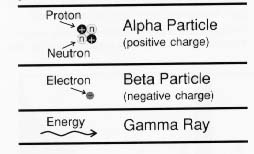
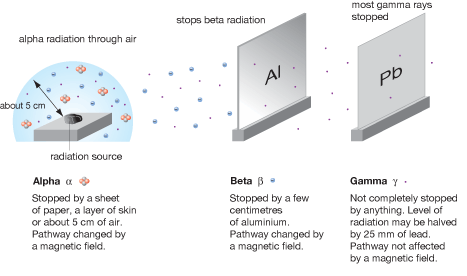
This site has excellent details on the various uses of the different radiations.
All the radiations are dangerous to humans because they can ionise atoms which can kill cells or cause them to become cancerous.
This site has really good details on the dangers of the different radiations.
People also sat the secondary electromagnetism test.
HW Write up your notes on alpha beta and gamma radiation. Also complete questions on transformers if not already done.
26/04/06 4P
The e-m test from last term was gone through.
We also looked at the 3 different kinds of nuclear radiation.
This site has excellent details on the various uses of the different radiations.
All the radiations are dangerous to humans because they can ionise atoms which can kill cells or cause them to become cancerous.
This site has really good details on the dangers of the different radiations.
HW Write up your notes on alpha beta and gamma radiation. Also complete AQA P41 all Qs (on electromagnetic induction) if you haven't already.
26/04/06 4C
The e-m test from last term was gone through.