18/03/05
We had a little revision session for the electromagnetism test which is the first lesson back after Easter. Make sure you revise well....
16/03/05
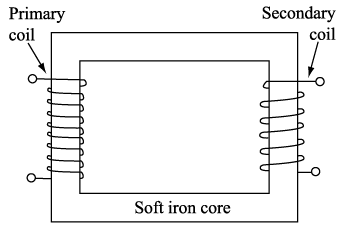
We built transformers and connected them to an alternating current power supply. We checked the transformer equation was true.
N1/N2=V1/V2
The results showed this to true, with any errors due to a small energy loss between the first and second coil. The soft iron core of the transformer is laminated to avoid much energy loss. Thin layers of iron are separated by an insulator. This means that eddy currents cannot be induced within the core which would cause it to heat up and waste energy.
We'll have a electromagnetism practice test on Friday, in preparation for one made of past GCSE questions in the first lesson of next term.
14/03/05
More on transformers.
They have 2 coils joined by an iron core. AC (alternating current) sent into the primary coil causes AC to be induced in the secondary coil. This is due to the changing magnetic field putting a force on the elctrons in the second coil.
We looked at a little mock up of the power distribution system.
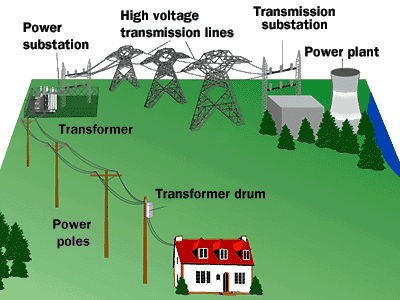
Power is generated by turning coils in magnetic fields. It is then stepped up to very high voltages to be sent long distances around the country.
In a nutshell, you must learn the following points:
N1/N2=V1/V2
09/03/05
RM absent at CCF dinner. You did some work on transformers from the text book. PTA P172-175 and PM P230-233. Your efforts will be marked when you hand your books in on Friday.
04/03/05
We saw some ingeneous electromagnetic induction experiments on a video. The basic point to understand is that if a conductor experiences a changing magnetic field, the electrons inside it will try to move. (There is an induced voltage.) If they are able, the electrons will flow and there will be an induced current.
This induced current will create a magnetic field of its own which will interact with the external magnetic field creating a force on the conductor. The magnetic field of the induced current will always try to oppose whatever it is that caused it in the first place.
Transformers next time.
HW Finish off the sheet on electricity from magnets.
02/03/05
We looked at various examples of electromagnetic induction. The first was as in the lesson of the 23rd below. Moving a straight wire through a perpendicular magnetic field cause a voltage to be induced, which was measured on a sensitive voltmeter (galvonometer). The voltage can be explained as the force which is on a moving charged particle as it passes through a magnetic field.
Moving a magnet through a coil of wire also caused an induced voltage. There was no voltage induced if the magnet was held still, even if it was right inside the coil.
Reversing the direction of movement causes the induced voltage to be reversed. Also turning the magnet around the other way (reversing the magnetic field) will have the same effect.
To increase the size of the induced voltage you can do one of 3 things:
Importantly, it was possible to make the electromagnet induce a voltage in the other coil whilst keeping it totally still. This was achieved by turning it on or off.
A voltage is induced in any conductor which experiences a change in magnetic field.
This change can be caused by the magnet or conductor moving in relation to one another, or by switching the magnetic field on and off (if it is an electromagnet.)
HW Do Qs 1+2 P229 on electricity generators.
25/02/05
We "went through" the mid year test. Performance was slightly dissapointing and some of you clearly applied poor technique to this type of test. Fortunately you won't be expected to do any more multi choices which is an upside I presume...
23/02/05
The mid year test was sat. We very briefly saw a demonstration of electromagnetic induction. We already know that moving charges experience a force in a magnetic field. If a conductor is physically moved through a magnetic field, the free charge carriers inside the conductor experience a force. This force pushes them through the conductor, it is an induced voltage. An induced voltage can cause an induced current if the conductor is connected as part of a complete circuit.
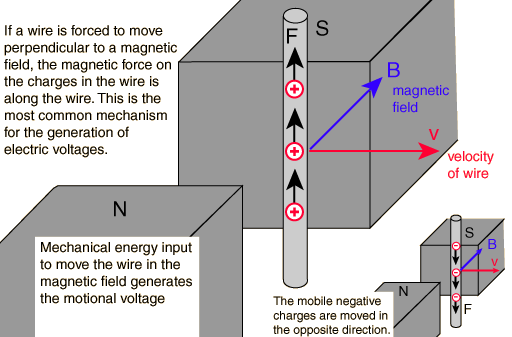
Both positive and negative charges within the wire feel a force (in opposite directions), but only the free electrons are able to move.
The induced voltage is reversed if the wire is moved the other way. The induced voltage is made stronger by moving the wire faster, or having a stronger magnetic field.
09/02/05
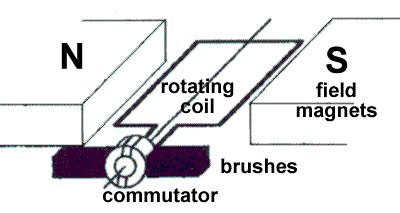
We made motors. This is very fiddly indeed and SM was champion builder. They work by using the same principle as made the wires kick last week, but for a coil of wire.
HW Revision for the mid year test. Electromagnets can be used as resetable fuses, when too high a current flows, they pull open an iron switch, which breaks the circuit. Unlike a fuse, which melts, they don't need replacing every time there is a problem.
04/02/05
An explanation of the operation of an electric motor was recorded. The same effect that caused a force in the "kicking wire" last lesson causes a turning force in a coil of wire within a magnetic field. A "split ring commutator " with brushes is required to allow current to be passed continually to the coil. It also reverses the direction of the current flowing in the coil every half turn, which allows the motor to continue spinning.
02/02/05
A current carrying wire experiences a force in an external magnetic field. The force is always at right angles to the direction of the current and the direction of the magnetic field lines.
The direction of the force can be determined by Fleming's left hand law.
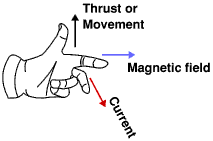
The physical reason for this force is due to the combining of the magnetic field from the the wire and the external magnets. The fields agree on one side of the wire, but cancel each other out on the other. This is known as the catapult field effect.
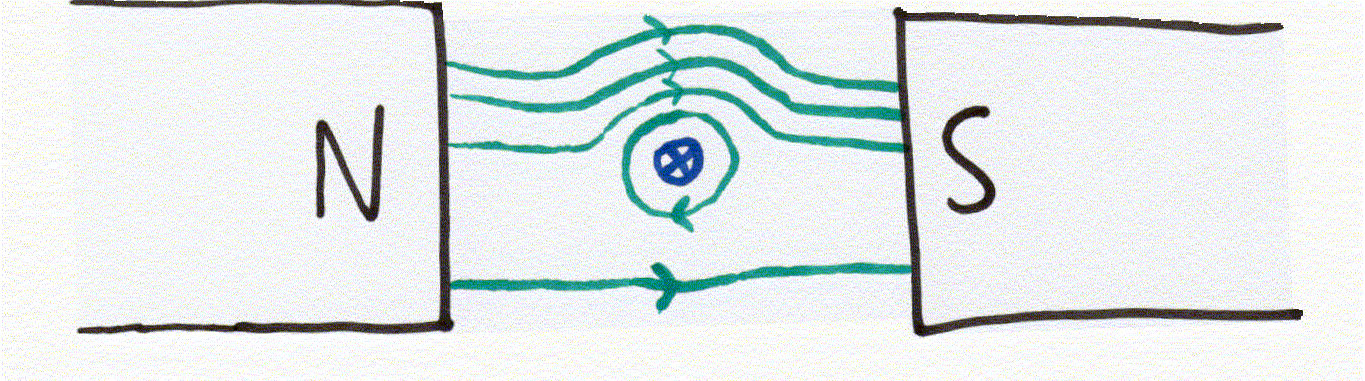
A force is always felt from areas of strong magnetic field to areas of weak magnetic field. Strong fields are shown by the field lines being closer together.
The direction of the force will be reversed if either the current is reversed or the magnetic field is reversed (but not both). The force is made stronger by increasing the current (more moving charge to experience a force) or making the external magnetic field stronger.
HW Draw 2 pictures of motors from page 106 of the AQA book.
28/01/05
We went through the forces and motion test. Largely done OK but be careful with drawing graphs and writing down your workings.
We then saw a Cathode ray tube briefly. It produces a thin beam of electrons travelling at high speed. When a magnet was brought near to the beam, the beam was deflected. The direction which the beam was deflected reversed if the opposite pole of the magnet was held near the beam. The direction was always at right angles to the direction which the electrons were travelling in, and at right angles to the magnetic field lines from the magnet.
TG pointed out that this is the principal behind a mass spectrometer, where charged particles have their paths altered by magnets. Heavier particles are not as affected by the magnetic force and so you can separate out different mass particles. Electrons carry negative charge, but moving positive charge also experiences a force in a magnetic field.
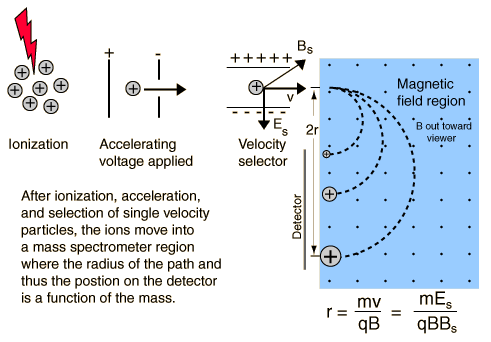
(you don't have to know about mass spectrometers in detail for Physics.)
26/01/05
We sat the forces and motion test. We'll go through that on Friday.
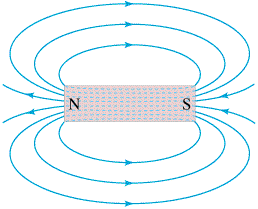
I went through some revision of simple magnetism with some demonstrations.
Important points:
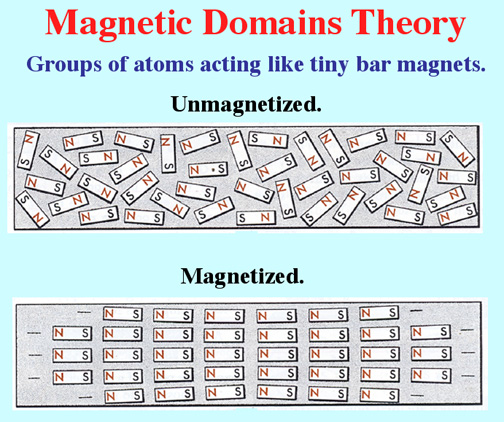
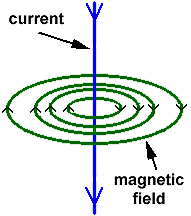
More on car stopping distances. When you slow down your car, your brakes transfer kinetic energy into heat energy.
KE = 1/2mv2
If you double your speed, KE is quadrupled, as is your braking distance.
Anti lock brakes don't allow skidding. Tyres can provide a bigger braking force against the road when they are still rolling. This is because static friction is larger than sliding friction
HW Revise for a forces and motion test on Wednesday.
19/01/05
Final couple of forces and motion things. Frictional forces act on moving bodies and get bigger the faster they move. This leads to bodies eventually reaching a terminal velocity when the drag force is equal to the force trying to accelerate the body. e.g. a skydiver.
The distance in which cars can stop is an important factor in road accidents.
First, thinking distance is the distance travelled when the driver has seen a hazard, but is yet to press the brake down.
Braking distance is the further distance travelled by a car as it slows down.
Total stopping distance = Thinking distance + Braking distance
If you double your speed, you reaction time remains the same, but you will have travelled twice as far before you press the brake down.
The time taken to brake to zero will double, and your average speed whilst braking will double. This means your braking distance will increase fourfold if you double your speed.
HW P39 Q6
14/01/05
We practised doing some calculations on F=ma. Always write down F=ma when faced with a force and motion question. F = Force measured in Newtons, m = mass measured in kg, a = acceleration measured in metres per second squared.
Books were taken in, a few people are going to recalculate their gradients for Tuesday. some results were very good. The gradient of the Force against Acceleration graph should have given us the mass of the system in kg. This was approx. 1.8kg.
12/01/05
We performed an experiment using mechanics trolleys to test Newton's 2nd law. We varied the force acting on a trolley and measured its acceleration.
HW Make sure the graph of your results is complete. Draw a straight line of best fit which passes through the origin and calculate its gradient. The gradient should equal the mass of the system (as long as distance was measured in metres). Comment on the shape of the graph, and how accurate your result was (should be about 1.8kg)
The syllabus for you guys is the 2006 version which is present in the shared pupil docs in the Physics folder on the school network. I'll see about getting it uploaded to a website too.