Happy New Year.
14/03/8 4B
Radioactivity revision.
HW Revise for a radioactivity test first lesson back.
We had a small factual test on radioactivity. You will have an actual set of (I)GSCE questions to do as a test first lesson back after Easter.
HW Revise - practise answering radioactivity questions.
Finally everyone was here (nearly) so we could go through the mid-year test.
A lot of silly marks thrown away when you really knew the answers.
We then attempted a GCSE question on Rutherford's experiments.
HW Revise for a test on the whole radioactivity and atomic structure which will be on Friday. Here perhaps or watch this:
Everyone was back - so we continued with the radioactivity topic.
Rutherford's alpha particle scattering experiment.
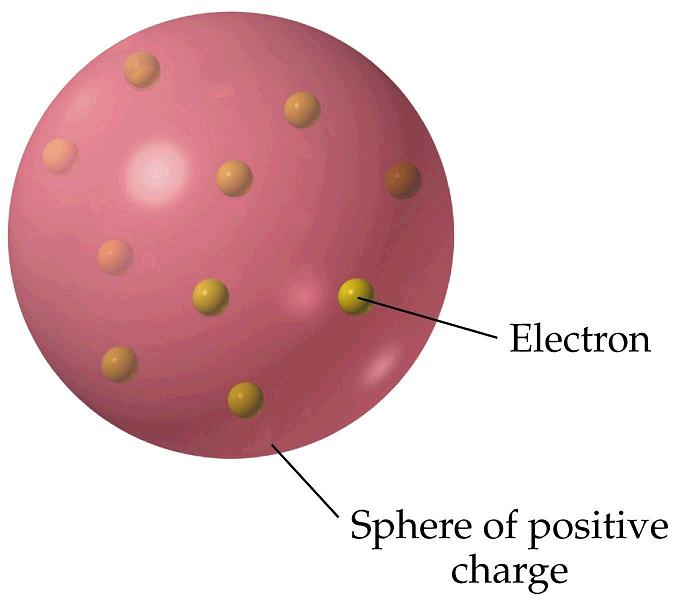
In 1900 or so, it was thought that the atom was made up of negative particles which were uniformly distributed throughout a positively charged sphere.
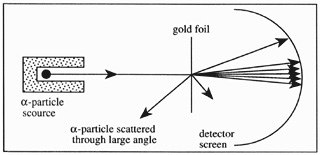
Rutherford fired fast moving alpha particles at a very thin gold foil and found that most of the alpha particles pass straight through the gold foil as they pass directly through the empty space which makes up most of the atom. A tiny proportion of the alpha particles were deflected by a large amount. This proved that the positive charge in an atom must be concentrated at one particular point. We call this the nucleus of the atom. Electrons "orbit" the nucleus at a distance.
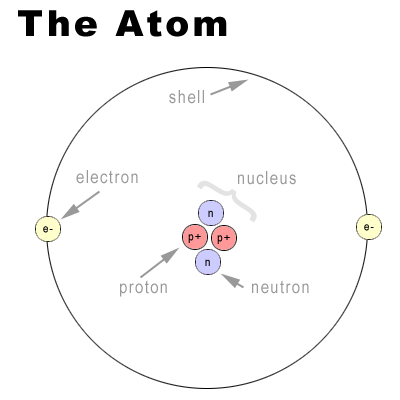
Some are slightly deflected by passing near the positive charge in the nucleus.
See above for musical revision.
I also mentioned the little bit you need to know about nuclear fusion.
Nuclear fusion
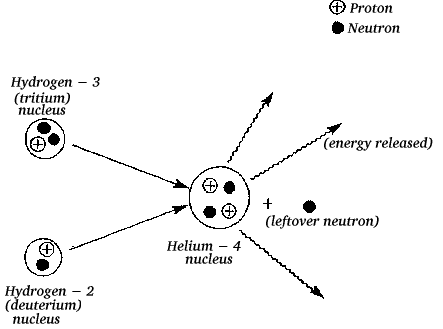
2 small nuclei are slammed together at very high temperatures. They become more stable as a result, turning into Helium. This releases energy. Fusion is the reaction that powers stars.
The above reaction is one that humans are trying to harness on Earth (slightly different from the reaction in stars) in order to have an almost inexhaustible supply of energy. (The fuel can be derived from seawater.)
Fusion does not leave radioactive waste and is much more efficient than fusion in terms of the amount of energy released per gram of fuel.
Humanity must harness this power effectively if it is to have any long term hopes of survival.
HW Answer Qs 1-3 on the Rutherford experiment in your green text books. P213.
Loads of Geographers were off, so we went in unneccessary detail into nuclear fusion and wave particle duality.
Sort it out you guys, or humanity is doomed.
Back to real stuff next time.
People off doing Geography nonsense. We discussed quantum weirdness in light of the nice video you watched on Wednesday.
No - RM =CCF. You watched ATOM 1, for firstly useful and secondly interest purposes.
No - RM =CCF. You watched a video on the structure of the atom.
Mid year "go through".
Mid year was marked and half the people were away having their pictures taken. So we'll go through it properly next time.
First of all we recapped all the work done so far on radioactivity with some printed notes and questions.
We moved on to look at how the atom was discovered to have the structure we currently believe it to have.
Rutherford's alpha particle scattering experiment.
In 1900 or so, it was thought that the atom was made up of negative particles which were uniformly distributed throughout a positively charged sphere.
Rutherford fired fast moving alpha particles at a very thin gold foil and found that most of the alpha particles pass straight through the gold foil as they pass directly through the empty space which makes up most of the atom. A tiny proportion of the alpha particles were deflected by a large amount. This proved that the positive charge in an atom must be concentrated at one particular point. We call this the nucleus of the atom. Electrons "orbit" the nucleus at a distance.
Some are slightly deflected by passing near the positive charge in the nucleus.
HW Copy the diagram of Rutherford's experiment and explain the 3 possible paths of the alpha particles beneath it in you exercise book.
We saw most of a film detailing how nuclear reactors work.
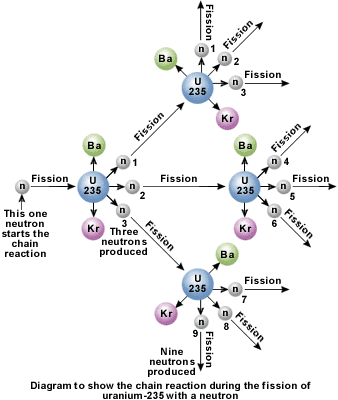
A neutron is absorbed by a large nucleus causing it to become unstable and split into two. The daughter nuclei are more stable than the original one, so energy is released. (They have less mass, E=mc2, so mass has been converted into energy.)
If enough fissile material (uranium-235 or plutonium-239) is present, the neutrons released in one fission will hit other nuclei, causing them to split.
The energy can be released catastrophically as in an A bomb, or in a more controlled manner in a reactor. Control rods are used to absorb some of the neutrons in this case.
The daughter nuclei are radioactive with a long half life which causes problems as what to do with the spent fuel.
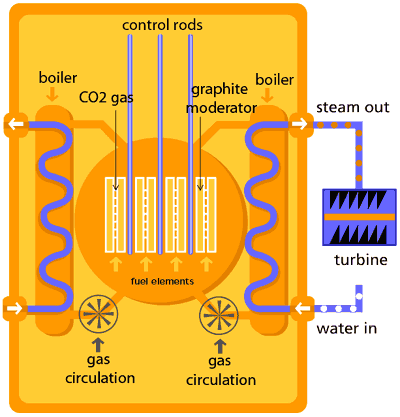
You need to know the basic parts and functions of a nuclear fission reactor.
Phys. Mid year.
No, Chemistry mid-year.
Mo' mid term revision.
Ave. spd = Distance / time
Accel. = Change in velocity / time
Force = Mass * Accel.
Current = Charge/time
Voltage = Energy/Charge
Resistance = Voltage/Current
Current = Power/Voltage
Mid term revision.
With GWO. RM = tt.
We did some little bits of work on the uses of radioactive decay curves, such as carbon dating.
Radioactivity dice, then radon demo.
We continued radioactive decay theory by performing an experiment with dice which was analogous to radioactive decay.
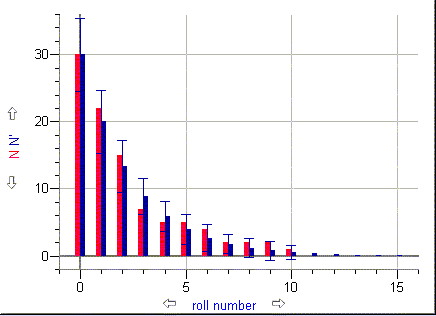
One sixth (approximately) of the dice turned up with a black face each time.
We could calculate the half life of our dice in "number of throws".
We saw a real time decay of a radioactive sample. Radon gas was blown into a gas chamber with a voltage across it. An ammeter was conected across the chamber. The radon gas is radioactive, producing alpha particles. The alpha particles ionised the gas in the chamber which allowed a current to flow. The more ionisation there was, the more current flowed.
You will plot a graph showing how the current dropped over time. You will be able to calculate the half life of the radon. This is the time taken for the radioactivity to fall to half of its present value at any stage. Radon is itself a decay product of thorium, which has a very long half life. A continual supply of radon is therefore released around radioactive thorium deposits.
Radon gas is released around granite rock and is heavier than air. This can increase the natural dose of radiation recieved if a person lives in a granite based area (e.g. Cornwall.)

An example of a decay curve showing several half lives.
The half life is the time taken for half of the radioactive nuclei to decay, each one producing one particle. The nature of radioactive decay means that the time is the same whether going from 100% to 50% of the original sample or 60% to 30% or any other "halving".
The half life also refers to the time taken for the radioactive count rate to drop to half of it's present rate for any particular sample. This makes sense as the count rate is proportional to the number of nuclei present. The more nuclei there are, the more chance there is that some nuclei or other will decay sooner than with a smaller sample.
Number of nuclei N is proportional to count rate A
The constant of proportionality is lambda - the decay constant. This is different for each type of unstable nucleus and the probability that any one nuceus will decay in one second.
HW Physics Matters P319 Qs 1,2,4,5
With GWO, Half life was covered.
HW Revise for a test on all radioactivity so far. Alpha, beta and gamma radiation, their penetrating powers and their uses, Nuclear fission and Nuclear reactors will all feature.
The uses of radioactivity video was indeed finished. You must be aware of the type of radiation required for each use and how it is used.
Radiotherapy and chemotherapy both use radiation to kill cancerous cells in tumours. However, in radiotherapy, gamma rays are shone into the person from the outside to kill the tumour, whereas in chemotherapy, radioactive chemicals are injected into the person so alpha or beta radiation can kill the tumour internally.
This page summarises the uses rather neatly and has a quiz at the end. We haven't covered radioactive dating yet.
HW Finish the HW questions from the A3 handout on uses (also hand in the HW sheet from last time which I forgot to mark....)
We finished the first radioactivity chapter by tackling the end of chapter questions.
We then looked at a film on the uses of radioactivity, which you must be aware of, filling in some skeleton notes on the way.
The film can be reviewed on the school network at:
pupilsharedwork$\Physics\4th form\RM
We didn't quite finish, so the last 5 mins will begin the next lesson. Therefore HW set after next lesson too.
With GWO. HW was to finish the notes on the uses of radioactivity. The film can be reviewed on the school network at:
pupilsharedwork$\Physics\4th form\RM
With GWO. HW was P213 Qs 4, 5 and P206 Qs 3, 8
We looked at the information given in the periodic table of the elements. The atomic mass number given is not always a whole number as it is an average of the masses of the naturally occuring isotopes of an element.
HW Finish the section on your handout about nuclear equations.
More on radioactivity and its uses.
Firstly, gamma rays and penetrating power...
Gamma radiation is just a burst of very high energy electromagnetic radiation. The mass and proton number do not change with a gamma decay.
The summary of the changes to the parent nucleus for alpha, beta and gamma is as follows:
Alpha:
Mass -4
Proton number -2
Beta:
Mass no change
Proton number +1
Gamma:
Mass no change
Proton number no change
Gamma sources are widely used in medicine as tracers and to kill tumours. Gamma radiation can also be used to sterilise food and medical equipment.
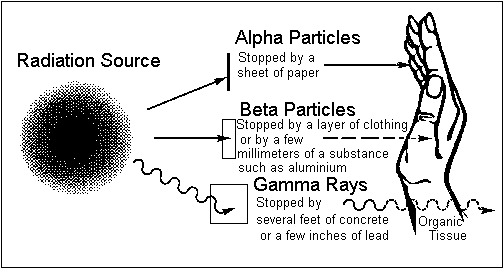
You need to know about the various penetrating powers of the particles. Alpha and beta particles can also be diverted by a magnetic field (moving charged particles experience a force in a magnetic field.)
A radioactive isotope of an element is one that has unstable nuclei which will decay by producing one of the three different types of radioactive emissions. (eg. carbon-14) Most common isotopes of elements have stable nuclei and so are not radioactive (eg. carbon-12).
Alpha particles have uses in smoke detectors, ionising air within the detector to allow a current to flow. Smoke particles absorb more alpha particles so the current drops when smoke gets in to the detector.
Beta particles are often used to help control the thickness of milled paper or metal. Put a source on one side and a detector on the other. If the material being produced is too thick, more beta particles are absorbed, the count rate goes down and so an adjustment must be made and similarly the count rate goes up if the material is too thin. Carbon dating uses the beta decay of carbon 14 to nitrogen to tell how old organic material is.
Gamma rays are used to sterilise food and medical equipment. They can also be used as medical tracers. Inject a dissolved gamma ray source into someone's blood stream and the gamma rays will be able to pass out through their skin. Using a radiation detector you can tell where most blood flow is going on. They can also be used to test for hairline cracks in machines or to trace the movement of materials within sea currents etc. Gamma rays can also be used to kill cancerous cells within the body.
A radioactive isotope must be chosen with a sensible half life must be chosen for each application. For internal medical use, the half life must be very short. For longer lasting industrial applications it has to be longer.
HW Write up your basic notes into an easy to revise from table in your books please.
Message for 4P: Mr Oakley-Brown will be teaching you the radioactivity topic. 4B are doing the same topic with me, so you can look at their entries for useful subject content. I may put up any extra details and HW etc. on here for you too. HW this week was Qs 5-7 from P188 of your text book.
We touched upon the new topic radioactivity.
We looked at the 3 different types of radioactive emission.
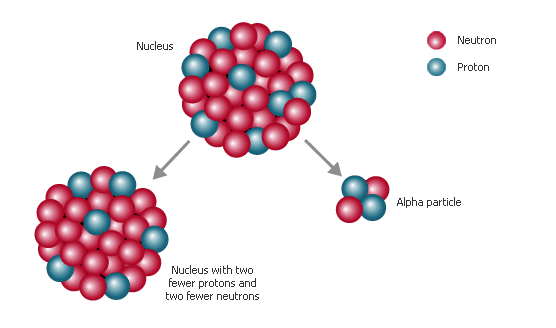
A 2+ charged particle which is basically a fast moving helium nucleus.

An electron is produced from within the nucleus moving very fast.
Gamma radiation is just a burst of very high energy electromagnetic radiation, although we hadn't reached the relevant bit of the video yet...
HW No, not finished on the types of radioactivity yet.
We went through the answers to the electricity test, apart from non doers, who did in the library. New topic next time....
9/1/8
We didn't start radioactivity, but snuck a little extra topic in - stretching materials and Hooke's law.
We performed an experiment to see how the extension of a spring varied as applied larger and larger forces onto it.
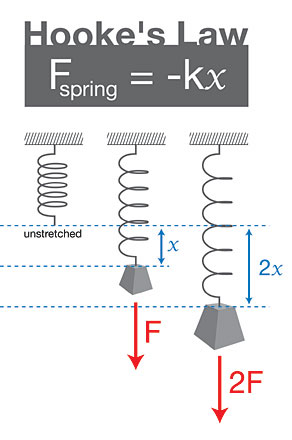
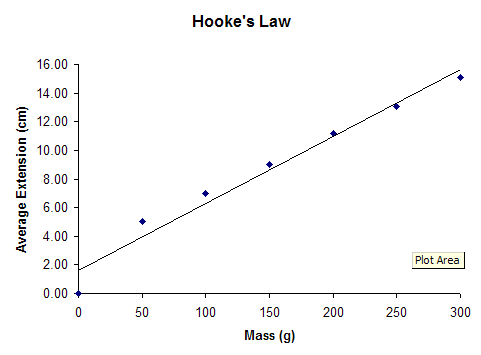
It was found that force was proportional to extension for the most part. The force divided by the extension gives us the spring constant, k of the spring which tells you how stiff it is.
Spring constant(N/m) = Force(N)/Extension(m)
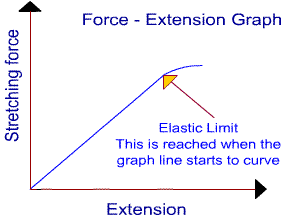
A very large force can permanently deform the spring meaning it has passed beyond its elastic limit. Hookes law no longer applies after the graph has started to curve.
We covered springs in series and parallel. By testing them.
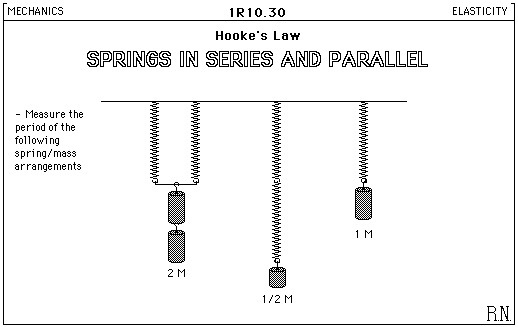
2 springs in parallel extend half as much as one on it's own (the spring constant is doubled). 2 in series extend twice as much (the spring constant is halved).
The Force/Extension graph for an elastic band is not a straight line, showing that it doesn't obey Hooke's law.
HW Write a method with a diagram worth 7 marks as an exam question answer for the experiment to show that a spring obeys Hooke's law.