Happy New Year of the dog
4C 29/03/06
We saw a nice old fashioned video on electromagnetic induction - just entertainment really. We'll start radioactivity next term - SS, LM and TB all take the electromagnetism test in the first double of next term.
4P 28/03/06
We did some practise questions for the electromagnetism test which will take place on Wednesday.
HW Revise the whole of electromagnetism (forces and induction).
4C 24/03/06
We sat the electromagnetism test except SS And LM who will have to do it next week.
4P 22/03/06
We built transformers and connected them to an alternating current power supply. We checked the transformer equation was true.
N1/N2=V1/V2
The results showed this to true, with any errors due to a small energy loss between the first and second coil. The soft iron core of the transformer is laminated to avoid much energy loss. Thin layers of iron are separated by an insulator. This means that eddy currents cannot be induced within the core which would cause it to heat up and waste energy.
HW AQA P41 Qs 1-5
4C 22/03/06
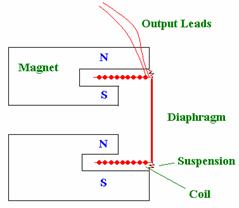
A microphone is basically a speaker in reverse. Sound waves cause a thin membrane to vibrate which is attached to a coil. A permanent magnet nearby induces a voltage in the moving coil, and hey presto, you have converted your sound wave into an electrical signal.
In a similar way, a motor and a simple generator are basically the same device but connected up in reverse compared to each other.
We did a few practise questions on electromagnetism in prepartion for the impending test.
HW Do end of chapter Qs (AQA) 5,6,7 as revision for a test on the whole of electromagnetism on Friday.
4P 21/03/06
We looked at a demo which showed how transformers are used in long distance power lines. All the below is still true.....
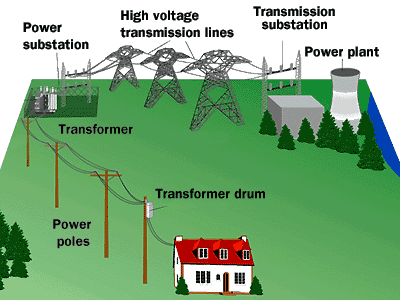
Power is generated by turning coils in magnetic fields. It is then stepped up to very high voltages to be sent long distances around the country.
In a nutshell, you must learn the following points:
N1/N2=V1/V2
4C 17/03/06
We saw another generator that was connected up to a set of light bulbs. It got harder and harder to turn the generator when more light bulbs were turned on. More KE was being converted to electrical energy so a larger force was required to keep the generator spinning. This is another example of Lenz's law, which says that any induced current will always cause a force to try and stop the effect that is causing it to exist in the first place.
We built transformers and connected them to an alternating current power supply. We checked the transformer equation was true.
N1/N2=V1/V2
The results showed this to true, with any errors due to a small energy loss between the first and second coil. The soft iron core of the transformer is laminated to avoid much energy loss. Thin layers of iron are separated by an insulator. This means that eddy currents cannot be induced within the core which would cause it to heat up and waste energy.
HW Finish the questions from the handout sheet.
4P 15/03/06
RM absent - CCF. You did a series of work from the Purple AQA book on electricity distribution. Hand in for next time please.
4C 15/03/06
We saw a simple generator connected up to an oscilloscope.
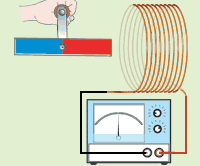
A magnet was rotated quickly near to a coil of wire. The ends of the coil were attached to an oscilloscope which recorded the voltage across the coil and how it changed over time.
Any conductor that experiences a changing magnetic field will have a voltage induced in it (the electrons inside experience an electromagnetic force along the wire.

Several designs are possible. You can rotate the coil of wire, or you can rotate the magnet, as long as the wire is passing through magnetic field lines, a voltage will be produced.
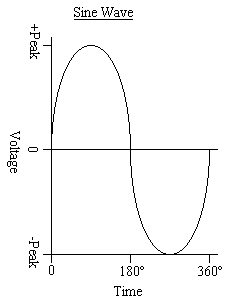
A simple generator like the one we used wil create a alternating current(ac). The frequency of the ac depends on how often the magnet rotates. Rotating the magnet faster increases the number of peaks and troughs per seond in the induced voltage and increase the size of the induced voltage (as magnet is moving faster, putting larger electromagnetic force on the elctrons within the coil.
We then saw an example of a transformer.
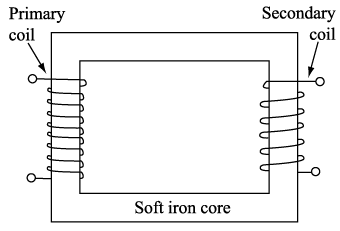
They have 2 coils joined by an iron core. AC (alternating current) sent into the primary coil causes AC to be induced in the secondary coil. This is due to the changing magnetic field putting a force on the electrons in the second coil.
We looked at a little mock up of the power distribution system.
Power is generated by turning coils in magnetic fields. It is then stepped up to very high voltages to be sent long distances around the country.
In a nutshell, you must learn the following points:
N1/N2=V1/V2
4P 13/03/06
We saw demonstrations of some generators working. The first was a device that could be used as both a motor or a generator depending which way it was connected up. If you turn a coil near a magnet then it an alternating voltage will be caused. (KE goes to electrical energy.) If you put a current through the same coil near the same magnet then it can spin. (Electrical energy goes to KE).
We saw another generator that was connected up to a set of light bulbs. It got harder and harder to turn the generator when more light bulbs were turned on. More KE was being converted to electrical energy so a larger force was required to keep the generator spinning. This is another example of Lenz's law, which says that any induced current will always cause a force to try and stop the effect that is causing it to exist in the first place.
We then saw an example of a transformer.
They have 2 coils joined by an iron core. AC (alternating current) sent into the primary coil causes AC to be induced in the secondary coil. This is due to the changing magnetic field putting a force on the electrons in the second coil.
We looked at a little mock up of the power distribution system.
Power is generated by turning coils in magnetic fields. It is then stepped up to very high voltages to be sent long distances around the country.
In a nutshell, you must learn the following points:
N1/N2=V1/V2
Cover work was - Notes on AQA P35-37, Physics Matters P273-275 All Qs, and Physics Matters P266-275.
4C 10/03/06
RM absent (jazz) You did some text book work on transformers.
HW Have work ready to hand in next time!
4P 08/03/06
RM absent (ill) You did some work on transformers from the text book.
HW Have this available to hand in next time.
4C 08/03/06
RM absent (ill). You did some work on generators from text books.
HW Make sure that cover work is available to hand in next week.
4P 06/03/06
We saw a simple generator connected up to an oscilloscope.
A magnet was rotated quickly near to a coil of wire. The ends of the coil were attached to an oscilloscope which recorded the voltage across the coil and how it changed over time.
Any conductor that experiences a changing magnetic field will have a voltage induced in it (the electrons inside experience an electromagnetic force along the wire.
Several designs are possible. You can rotate the coil of wire, or you can rotate the magnet, as long as the wire is passing through magnetic field lines, a voltage will be produced.
A simple generator like the one we used wil create a alternating current(ac). The frequency of the ac depends on how often the magnet rotates. Rotating the magnet faster increases the number of peaks and troughs per seond in the induced voltage and increase the size of the induced voltage (as magnet is moving faster, putting larger electromagnetic force on the elctrons within the coil.
HW Q4 only from handout sheet.
Luke J and Adam R will join me at break tomorrow (11.10am in 509)
4C 03/03/06
As 4P below.
4P 01/03/06
We saw a demonstration of electromagnetic induction. We already know that moving charges experience a force in a magnetic field. If a conductor is physically moved through a magnetic field, the free charge carriers inside the conductor experience a force. This force pushes them through the conductor, it is an induced voltage. An induced voltage can cause an induced current if the conductor is connected as part of a complete circuit.
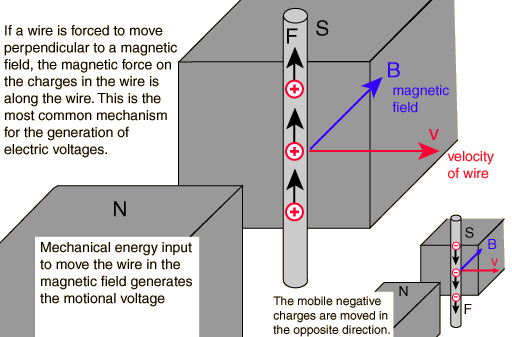
Both positive and negative charges within the wire feel a force (in opposite directions), but only the free electrons are able to move.
The induced voltage is reversed if the wire is moved the other way. The induced voltage is made stronger by moving the wire faster, or having a stronger magnetic field.
Moving a magnet through a coil of wire also caused an induced voltage. There was no voltage induced if the magnet was held still, even if it was right inside the coil.
Reversing the direction of movement causes the induced voltage to be reversed. Also turning the magnet around the other way (reversing the magnetic field) will have the same effect.
To increase the size of the induced voltage you can do one of 3 things:
Importantly, it was possible to make the electromagnet induce a voltage in the other coil whilst keeping it totally still. This was achieved by turning it on or off.
A voltage is induced in any conductor which experiences a change in magnetic field.
This change can be caused by the magnet or conductor moving in relation to one another, or by switching the magnetic field on and off (if it is an electromagnet.)
Finish filling in the practical handout for the last 2 demonstrations seen, using the coils of wire.
4C 01/03/06
We went through the midyear test.....
4P 27/02/06
We went through the midyear test.....
4C 22/02/06
Physics midyear test.....
4P 22/02/06
Biology midyear test.....
4C 22/02/06
Revision of electricity and forces and motion for the test this week...
HW Several people have work to catch up (P261 Physics Matters + Forces and motion work) Yellow sheets appearing very soon.
4P 20/02/06
Revision of electricity and forces and motion for the test this week...
HW Several people have work to catch up (P259 Physics Matters + Forces and motion work) Yellow sheets appearing very soon.
4C 07/02/06
As 4P below except for HW which is just revision of all topics covered so far. Remember, the mid year test can include everything up to electromagnetic forces, but is likely to concentrate on electricity and forces and motion as they are the major topics completed. It will be a multi choice test, but some calculations (and a calculator) will be required.
4P 07/02/06
We looked at a strong solenoid which is used to permanently magnetise objects. For a solenoid to have a strong magnetic field it must have many tighly wound coils and a large current flowing through it. Even more important than that, adding a soft iron core inside a solenoid vastly increases the field strength.
We then looked at a loudspeaker, which uses electromagnetic forces to work.
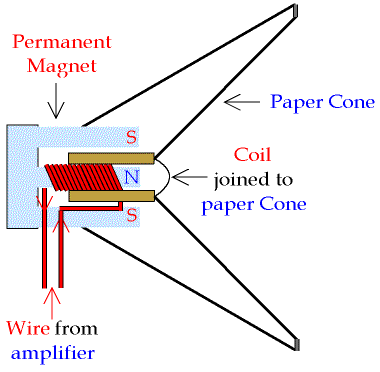
The loudspeaker uses a coil which can slide backwards and forwards over the central pole of a circular permanent magnet. Attached to the coil is the speaker cone.
Sending a current through the coil causes it to develop a magnetic field which means it feels a magnetic force of repulsion or attraction to the permanent magnet.
Sending an alternating current into the coil causes it to alternately be attracted and repelled, so it vibrates at the same fequency as the a.c. The speaker cone therefore generates a sound.
HW Set of electromagnetism questions on sheet.
4C 03/02/06
We built some electrical motors, which are explained below. Building champions were Daniel Offen and Tom Faber.
HW Draw a series of 5 diagrams to illustrate how an electric motor works. Include explanations of each diagram and 3 ways to increase the speed of the motor aswell as 2 ways to make it roate in the opposite direction.
4P 01/02/06
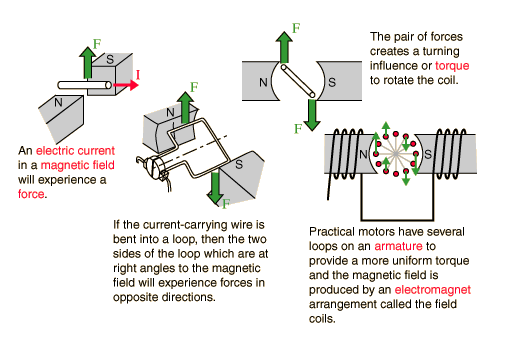
We learned about electric motors. They work by exactly the same principal as the one that caused the "kicking wire" to kick. However, a loop of wire is used which means that the current flows first one way, and then the other as it continues around the loop. An external magnetic field is created using permanent magnets the same as before.
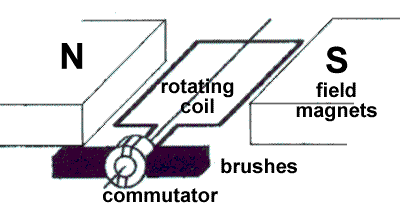
Here is an animation which attempts to portray what is happening.
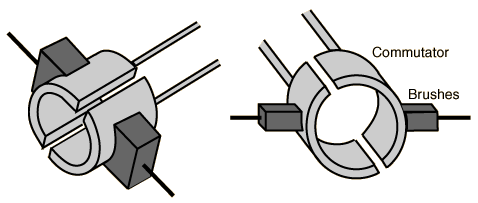
To keep the turning force on a DC motor from reversing every time the coil moves through the plane perpendicular to the magnetic field, a split-ring device called a commutator is used to reverse the current at that point. The electrical contacts to the rotating ring are called "brushes" since copper brush contacts were used in early motors. Modern motors normally use spring-loaded carbon contacts, but the historical name for the contacts has persisted.
Motors can be made to turn faster by increasing the external magnetic field, having more turns in your loop of wire or by having more current flowing through the loop.
If you reverse the direction of the current by switching your power supply around, the motor can rotate in the oppostie direction.
Building champions were Tom Baines and Louis Chartres.
HW Make sure you are up to date, yellow sheets have been issued.
4C 01/02/06
Exactly as 4P below including HW (HW P261 Physics Matters Qs 2,3,4)
Reminder to RM - AB and RC are doing another Forces and motion test on Friday.
4P 30/01/06
We have seen that a straight current carrying wire has a magnetic field shaped in concentric rings. If the wire is curled around into a coil shape (a solenoid), the magnetic field produced when it carries current is shaped exactly like that of a bar magnet.
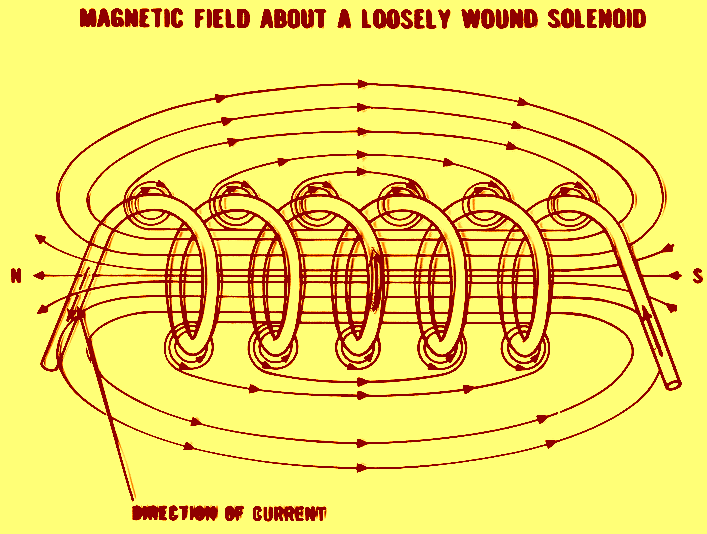
So a coil of wire is essentially a magnet that you can turn on and off by switching the electric current on and off. An electromagnet.
Electromagnets have a great many applications in many areas. They can be strengthened by adding a soft iron core to reinforce the magnetic field, or just by increasing the current flow.
The North pole of the electromagnet can be found by using the right hand grip rule.

Right-Hand Grip Rule for solenoid
When the wire is coiled into a solenoid. Then you grips the solenoid by your right hand, so the fingers curl the same way of the current, the thumb points the north pole of the solenoid.
HW P261 Physics Matters Qs 2,3,4
4R 27/01/06
Exactly the same as 4P, below except HW which was just to finish off the write up by filling in your handout.
4P 25/01/06
We went through the forces and motion test. Marks were a bit on the low side for this quite easy topic.
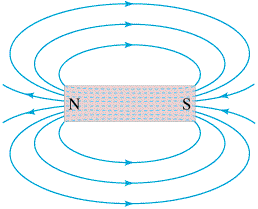
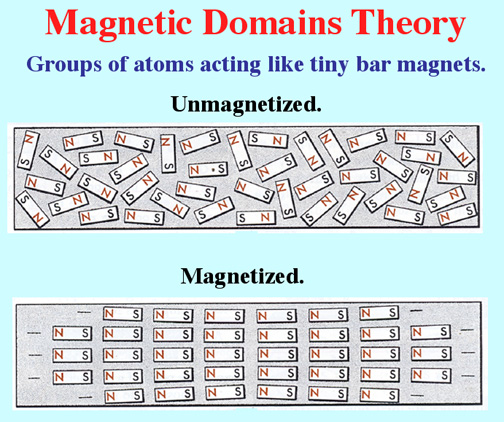
We started electromagnetic forces by recapping simple magnetism.
Important points:
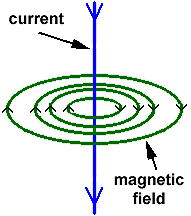
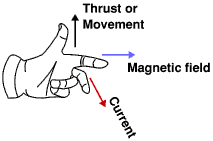
The direction of the force can be determined by Fleming's left hand law.
The physical reason for this force is due to the combining of the magnetic field from the the wire and the external magnets. The fields agree on one side of the wire, but cancel each other out on the other. This is known as the catapult field effect.
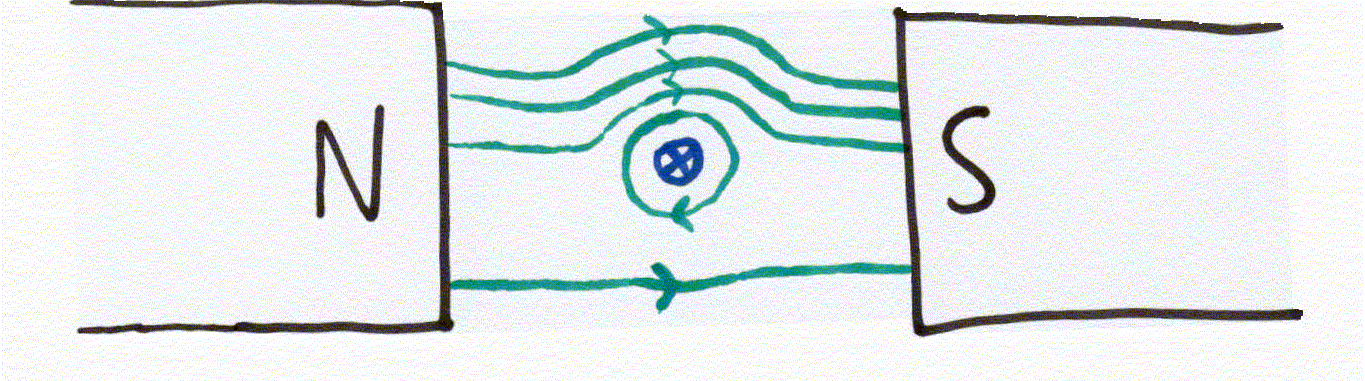
A force is always felt from areas of strong magnetic field to areas of weak magnetic field. Strong fields are shown by the field lines being closer together.
The direction of the force will be reversed if either the current is reversed or the magnetic field is reversed (but not both). The force is made stronger by increasing the current (more moving charge to experience a force) or making the external magnetic field stronger.
HW Qs 1,4,5 P259 Physics Matters
4C 25/01/06
We sat the forces and motion test. AB, SF absent.
Car stopping distances sheet should be handed in by everybody who is yet to do so by next lesson, or yellow sheets go out.
4P 23/01/06
We sat the forces and motion test.
HW Watch out on the homework front please. People still owe me the answers to the Forces and motion practise questions sheet More yellow sheets to follow if I don't see these answers from you all.
4C 20/01/06
We did loads and loads of practise forces and motion questions.
HW Test on forces and motion. Revise motion graphs, F=ma, a=(v-u)/t, s=d/t, frictional forces and car stopping distances.
Some useful summaries can be found here
More practise questions with answers can be found here.
4P 18/01/06
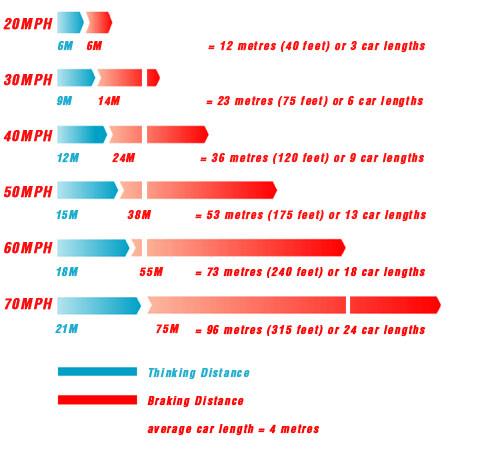
The distance in which cars can stop is an important factor in road accidents.
First, thinking distance is the distance travelled when the driver has seen a hazard, but is yet to press the brake down.
Braking distance is the further distance travelled by a car as it slows down.
Total stopping distance = Thinking distance + Braking distance
If you double your speed, you reaction time remains the same, but you will have travelled twice as far before you press the brake down.
The time taken to brake to zero will double, and your average speed whilst braking will double. This means your braking distance will increase fourfold if you double your speed.
I was irritated by the lack of work done in the lesson by some individuals.
HW Revise for a test on forces and motion on Monday. All HW must be caught up, yellow sheets are going out.
4C 18/01/06
The distance in which cars can stop is an important factor in road accidents.
First, thinking distance is the distance travelled when the driver has seen a hazard, but is yet to press the brake down.
Braking distance is the further distance travelled by a car as it slows down.
Total stopping distance = Thinking distance + Braking distance
If you double your speed, you reaction time remains the same, but you will have travelled twice as far before you press the brake down.
The time taken to brake to zero will double, and your average speed whilst braking will double. This means your braking distance will increase fourfold if you double your speed.
HW Make sure P74 Qs have been handed in. Complete "Car stopping distances sheet"
SF and RC need to revise for a control retest on Friday.
4C and 4P 11/01/06
Drag forces and freefall were covered.
We then went on to discuss free fall. Without air resistance, all objects fall at the same rate with an acceleration of about 10m/s/s (on Earth). However, air resistance changes the way that some objects fall.
We looked at drag forces.
Our example was ball bearings falling through a thick and viscous fluid. The large amount of drag allowed us to see the effect on the rate that they fell.
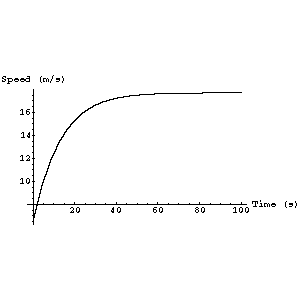
A speed/time graph of the motion would look like this:
In air, (unless the object is very light), much higher speeds need to be reached.
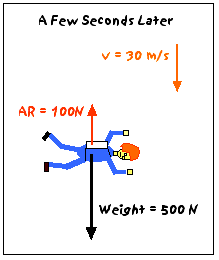
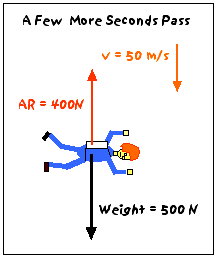
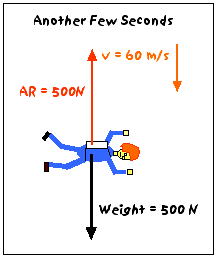
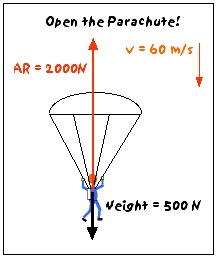
The above shows how a parachutist first accelerates until the air resistance force on him is equal to his weight. He then travels at terminal velocity, a constant speed with balanced forces acting on him. He then artificially increases his air resistance by opening his parachute, so he slows down until air resistance once again equals his weight at a much slower (and safer) speed.
Terminal velocity occurs when the air resistance (sometimes called "drag") force equals the weight iof the falling object. This means that:
heavy, compact, objects will have a higher terminal velocity than light, spread out objects. Therefore, heavy objects will fall faster in air than light objects
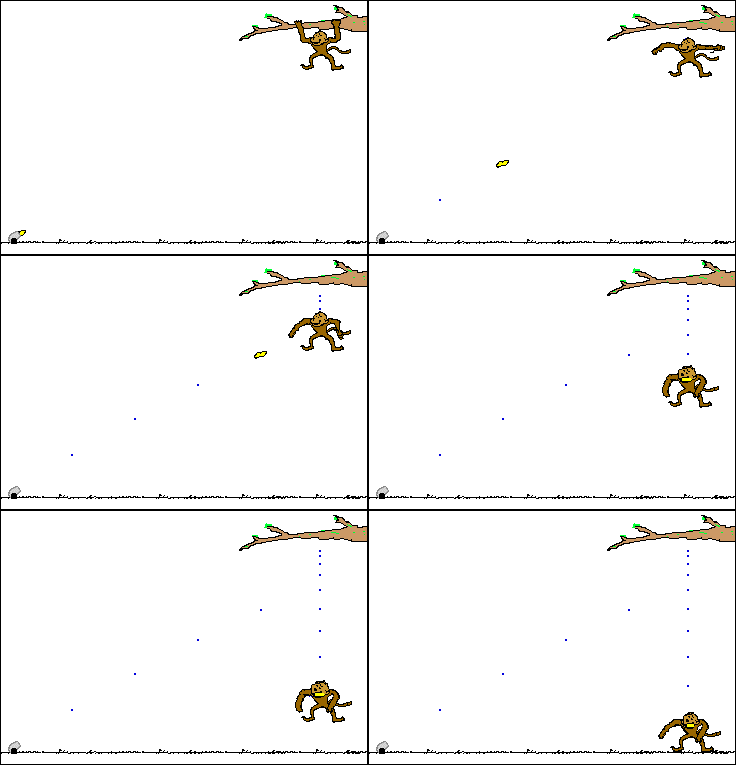
Horizontal and vertical motion are entirely seperate. We talked about the monkey and the hunter example. If the monkey lets go as the hunter fires at it it is doomed.(whatever angle the gun is fired at the monkey from). The bullet and the monkey both accelerate downwards due to gravity, and so end up at the same level.
We also taked about the idea of putting things into orbit. If a big enough gun shoots a bullet fast enough, the curve of the bullet exactly matches the curve of the Earth. It is in constant freefall, never getting any closer to the ground.
The above only works when there is no drag (above the atmosphere) of course.
4C HW Draw 5 diagrams showing the forces acting on a parachutist.
1. Just as he jumps out of the 'plane
2. As he speeds up through the air
3. When he has reached terminal velocity
4. When he has just opened his parachute
5. When he is drifting safely to ground
(also catch up on missing work)
4P HW Finish all of the "Forces and Motion Practise Qs" sheet. (and catch up on possible missing work.
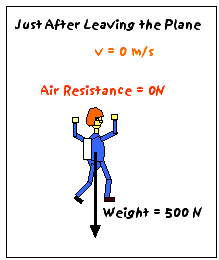
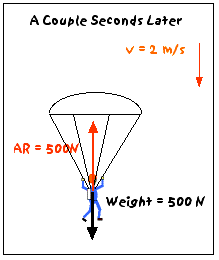
the object is falling with a constant velocity - its acceleration is zero.