
4B 18/05/09
Redioactive decay.
An example of a decay curve showing several half lives.
The half life is the time taken for half of the radioactive nuclei to decay, each one producing one particle. The nature of radioactive decay means that the time is the same whether going from 100% to 50% of the original sample or 60% to 30% or any other "halving".
The half life also refers to the time taken for the radioactive count rate to drop to half of it's present rate for any particular sample. This makes sense as the count rate is proportional to the number of nuclei present. The more nuclei there are, the more chance there is that some nuclei or other will decay sooner than with a smaller sample.
Number of nuclei N is proportional to count rate A
The constant of proportionality is lambda - the decay constant. This is different for each type of unstable nucleus and the probability that any one nuceus will decay in one second.
HW Papers for revision were given out.
We continued radioactive decay theory by performing an experiment with dice which was analogous to radioactive decay.
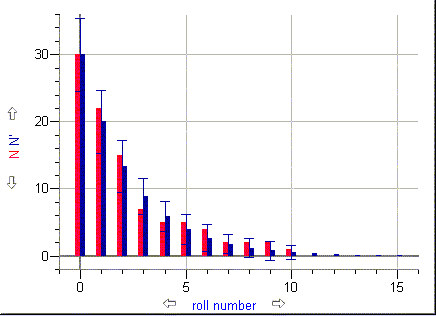
One sixth (approximately) of the dice turned up with a black face each time.
We could calculate the half life of our dice in "number of throws".
An example of a decay curve showing several half lives.
The half life is the time taken for half of the radioactive nuclei to decay, each one producing one particle. The nature of radioactive decay means that the time is the same whether going from 100% to 50% of the original sample or 60% to 30% or any other "halving".
The half life also refers to the time taken for the radioactive count rate to drop to half of it's present rate for any particular sample. This makes sense as the count rate is proportional to the number of nuclei present. The more nuclei there are, the more chance there is that some nuclei or other will decay sooner than with a smaller sample.
Number of nuclei N is proportional to count rate A
The constant of proportionality is lambda - the decay constant. This is different for each type of unstable nucleus and the probability that any one nuceus will decay in one second.
NO HW - in view of your English exam on Friday.
Radioactivity was started.
We touched upon the new topic radioactivity.
We looked at the 3 different types of radioactive emission.
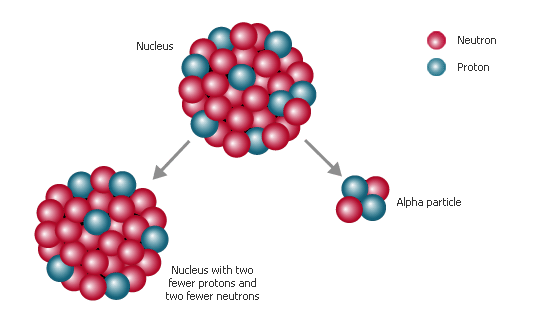
A 2+ charged particle which is basically a fast moving helium nucleus.

An electron is produced from within the nucleus moving very fast.
Gamma radiation is just a burst of very high energy electromagnetic radiation. The mass and proton number do not change with a gamma decay.
The summary of the changes to the parent nucleus for alpha, beta and gamma is as follows:
Alpha:
Mass -4
Proton number -2
Beta:
Mass no change
Proton number +1
Gamma:
Mass no change
Proton number no change
Gamma sources are widely used in medicine as tracers and to kill tumours. Gamma radiation can also be used to sterilise food and medical equipment.
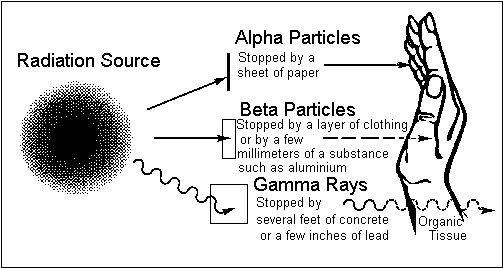
You need to know about the various penetrating powers of the particles. Alpha and beta particles can also be diverted by a magnetic field (moving charged particles experience a force in a magnetic field.)
A radioactive isotope of an element is one that has unstable nuclei which will decay by producing one of the three different types of radioactive emissions. (eg. carbon-14) Most common isotopes of elements have stable nuclei and so are not radioactive (eg. carbon-12).
Alpha particles have uses in smoke detectors, ionising air within the detector to allow a current to flow. Smoke particles absorb more alpha particles so the current drops when smoke gets in to the detector.
Beta particles are often used to help control the thickness of milled paper or metal. Put a source on one side and a detector on the other. If the material being produced is too thick, more beta particles are absorbed, the count rate goes down and so an adjustment must be made and similarly the count rate goes up if the material is too thin. Carbon dating uses the beta decay of carbon 14 to nitrogen to tell how old organic material is.
Gamma rays are used to sterilise food and medical equipment. They can also be used as medical tracers. Inject a dissolved gamma ray source into someone's blood stream and the gamma rays will be able to pass out through their skin. Using a radiation detector you can tell where most blood flow is going on. They can also be used to test for hairline cracks in machines or to trace the movement of materials within sea currents etc. Gamma rays can also be used to kill cancerous cells within the body.
A radioactive isotope must be chosen with a sensible half life must be chosen for each application. For internal medical use, the half life must be very short. For longer lasting industrial applications it has to be longer.
HW Write up your basic notes into an easy to revise from table in your books please.
HW Qs from my hand out on radioactivity basics.
Go through of the waves test.
Radioactivity was begun.
We touched upon the new topic radioactivity.
We looked at the 3 different types of radioactive emission.
A 2+ charged particle which is basically a fast moving helium nucleus.
An electron is produced from within the nucleus moving very fast.
Gamma radiation is just a burst of very high energy electromagnetic radiation. The mass and proton number do not change with a gamma decay.
The summary of the changes to the parent nucleus for alpha, beta and gamma is as follows:
Alpha:
Mass -4
Proton number -2
Beta:
Mass no change
Proton number +1
Gamma:
Mass no change
Proton number no change
Gamma sources are widely used in medicine as tracers and to kill tumours. Gamma radiation can also be used to sterilise food and medical equipment.
You need to know about the various penetrating powers of the particles. Alpha and beta particles can also be diverted by a magnetic field (moving charged particles experience a force in a magnetic field.)
A radioactive isotope of an element is one that has unstable nuclei which will decay by producing one of the three different types of radioactive emissions. (eg. carbon-14) Most common isotopes of elements have stable nuclei and so are not radioactive (eg. carbon-12).
Alpha particles have uses in smoke detectors, ionising air within the detector to allow a current to flow. Smoke particles absorb more alpha particles so the current drops when smoke gets in to the detector.
Beta particles are often used to help control the thickness of milled paper or metal. Put a source on one side and a detector on the other. If the material being produced is too thick, more beta particles are absorbed, the count rate goes down and so an adjustment must be made and similarly the count rate goes up if the material is too thin. Carbon dating uses the beta decay of carbon 14 to nitrogen to tell how old organic material is.
Gamma rays are used to sterilise food and medical equipment. They can also be used as medical tracers. Inject a dissolved gamma ray source into someone's blood stream and the gamma rays will be able to pass out through their skin. Using a radiation detector you can tell where most blood flow is going on. They can also be used to test for hairline cracks in machines or to trace the movement of materials within sea currents etc. Gamma rays can also be used to kill cancerous cells within the body.
A radioactive isotope must be chosen with a sensible half life must be chosen for each application. For internal medical use, the half life must be very short. For longer lasting industrial applications it has to be longer.
HW Write up your basic notes into an easy to revise from table in your books please.
HW Qs from my handout on radioactivity basics.
Go through of the waves test.
Waves test was sat.
We discussed the turning effect of a force - the moment
When an object is still, the up and down and side to side forces on it must balance out to zero. However, if 2 equal and opposite force do not act in the same place, they can produce a twisting effect, or turning force.
We looked at turning forces. This is all based around the idea of balancing seesaws. All the turning forces trying to make an object turn clockwise must be balanced by the forces trying to make it rotate anti-clockwise if it is in equilibrium.
The name for a turning force is a moment
Moment = Distance from pivot times Force
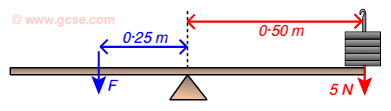
If the system is balanced, the anticlockwise turning effect of force F must equal the clockwise turning effect:
clockwise moment = anticlockwise moment
Clockwise moment = 5 N � 0�50 m = 2�50 Nm.
Anticlockwise moment = F � 0�25 m = 2�50 Nm
Force F = 2�50 Nm � 0�25 m = 10 N
In order to balance the 5 N force acting at 0�5 m from the pivot, we require 10 N acting in the opposite direction but at 0�25 m.
Many machines use the turning effect of forces to useful effect. A simple lever allows a small force exterted far from the pivot to balance a large force exerted nearer to the pivot.
This is simple stuff really.
4C 01/05/09
You sat the promised test on waves.
We then looked at the small topic of the centre of gravity and stability.
4C 28/04/09
We discussed the turning effect of a force - the moment
When an object is still, the up and down and side to side forces on it must balance out to zero. However, if 2 equal and opposite force do not act in the same place, they can produce a twisting effect, or turning force.
We looked at turning forces. This is all based around the idea of balancing seesaws. All the turning forces trying to make an object turn clockwise must be balanced by the forces trying to make it rotate anti-clockwise if it is in equilibrium.
The name for a turning force is a moment
Moment = Distance from pivot times Force
If the system is balanced, the anticlockwise turning effect of force F must equal the clockwise turning effect:
clockwise moment = anticlockwise moment
Clockwise moment = 5 N � 0�50 m = 2�50 Nm.
Anticlockwise moment = F � 0�25 m = 2�50 Nm
Force F = 2�50 Nm � 0�25 m = 10 N
In order to balance the 5 N force acting at 0�5 m from the pivot, we require 10 N acting in the opposite direction but at 0�25 m.
Many machines use the turning effect of forces to useful effect. A simple lever allows a small force exterted far from the pivot to balance a large force exerted nearer to the pivot.
This is simple stuff really.
HW Revise for a test on all of waves.
We discussed the difference between an analogue and a digital signal. Which is entirely seperate to the difference between the comparisons af sending light down an electric cable or an optical fibre.
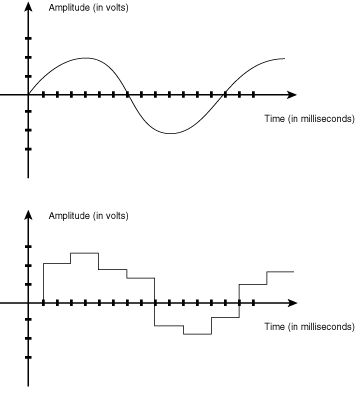
An analogue signal is an exact copy of a signal (such as a sound wave). A digital signal records the level of the original signal many times a second and so the information can be sent as a series of numbers.
The series of numbers is usually turned into binary code which means it is turned into base 2. The only possible numbers in base 2 are 1 or zero.
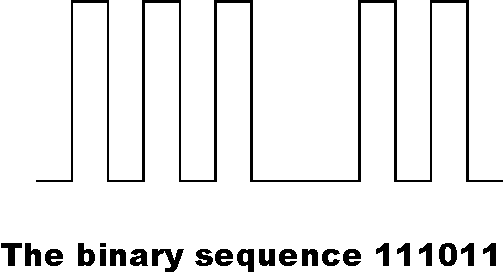
It is much easier to retain the quality of a signal if it is sent in binary code. Any interference does not usually stop the ability of the reciever to tell the difference between a 1 or 0.
HW I think so, damned if can remember what though....
Sound was discussed I believe. We are done with the electromagnetic spectrum and recapped a few things that you need to know about sound.
We discussed the difference between an analogue and a digital signal. Which is entirely seperate to the difference between the comparisons af sending light down an electric cable or an optical fibre.
An analogue signal is an exact copy of a signal (such as a sound wave). A digital signal records the level of the original signal many times a second and so the information can be sent as a series of numbers.
The series of numbers is usually turned into binary code which means it is turned into base 2. The only possible numbers in base 2 are 1 or zero.
It is much easier to retain the quality of a signal if it is sent in binary code. Any interference does not usually stop the ability of the reciever to tell the difference between a 1 or 0.