We went through the remainder of the 2003 paper and a bit of 2001. Good luck......
8/06/05 3A
We finished the 2004 past paper and the 2003 paper was redistributed. 2001 was taken in for marking.
AG gained another detention. AR, AC, WD will all join me for sanding my desks on Thurs lunchtime with apology letters or they too will gained detentions.
JC owes me an essay on the importance of Physics amd SW, JB, RB and PC all owe me revision notes on various topics.
8/06/05 3C
We finished the 2004 paper and did some general revision on pressure and shc.
BN, TS, RP and CM owe me revision notes on one quarter of the syllabus each.
Good quizzes here on various topics of interest.
7/06/05 3C
We started 2004 past paper.
6/06/05 3A
We "went through" the majority of the 2004 paper, just Qs 11 and 12 to finish on Wednesday.
HW 2001 paper to be handed in for marking on Wednesday.
25/05/05 3A
Revision topic lists were distributed. They contain many helpful hints, so read them. We started on the 2001 past paper. Finish this for HW please and we'll look at it after half term.
HW 2001 past paper.
25/05/05 3C
We looked through the topic list sheet, this should help you to revise. We also looked through the 2002 past paper. You can finish this one at home if you like.
HW Do the 2001 past paper which will be marked after half term.
23/05/05 3A
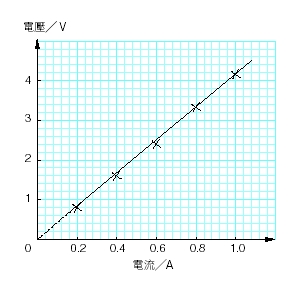
We performed an experiment to see how the voltage (think of as "electrical pushing force") across a component altered the current flowing through it.
We found, unsurprisingly, that the current flowing through our chosen component (a resistor box) doubled when the voltage across it doubled. A straight line going through the origin appeared when a graph of Voltage / Current was plotted. BTW Voltage is represented by the letter V (which makes sense) and current is represented by the letter I (which doesn't).
The gradient of this line (V/I) gives you something called the resistance of the component. We got one line steeper than the other because we set the resistance box to a higher value for the second set of readings.
We will cover much more on this - but not until after the exams now.....
HW Make sure that you have a graph plotted in you book please.
18/05/05 3A
We went through the waves and sounds test. Jeremy C, Anthony C, Adam R and Phil J will all bring me letters of apology before the end of the week or recieve detentions for interrupting me. Tommy B and Ali G have detentions already.
18/05/05 3C
You sat 2003 past 3rd form paper.
17/05/05 3C
I'm away tomorrow so you'll sit a past end of year test. Do your best, it will help you discover what you need to revise.
We built a few circuits recapping past electricity work. If one bulb connect to a 6V battery pack is said to light with normal brightness, then putting 2 bulbs in a row (in series) causes a decrease in brightness. This can be explained by saying that less current is flowing. It is harder for the battery to push current through both bulbs, so less flows, meaning that they don't light up so bright.
If 2 bulbs are put in seperate paths (in parallel) however, they light up with normal brightness. The same current flows through each of the bulbs as flowed through one bulb on its own.
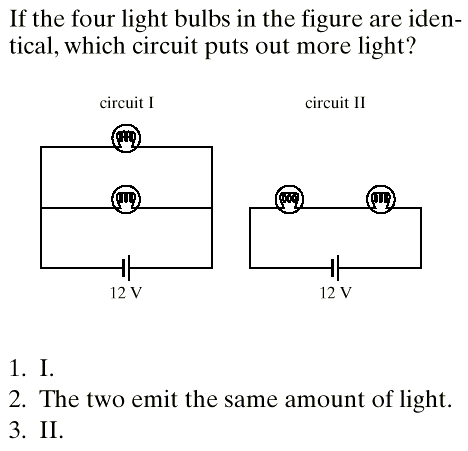
Here, the first cicuit has the brightest bulbs. They have the most current flowing through them. NB We used 6V total from our battery packs not 12V as in this diagram.
There is an alternative explanation which involves the concept of electrical voltage. The battery voltage is the size of the electrical "push" which forces current around a circuit. When 2 bulbs are in parallel, they both get the full extent of the battery voltage. i.e. each has 6V pushing at it. In series, the voltage of the battery is divided between the 2 bulbs, each recieving half (3V) and so lighting up less brightly.
The voltage and current ways of explaining things in electricity are different methods of describing the same thing, as voltage and current are linked as we'll see later.
HW Revision for past paper.
16/05/05 3A
We sat the waves and sounds test. Then we started off the electricity topic by building a few circuits with 6V bulbs. 2 bulbs in series lit up less bright;y than one bulb on it's own. 2 bulbs in parallel light up at the same brightness as 1 bulb on it's own.
HW None
11/05/05 3A
We did a practise Waves and Sounds tests inpreparation for the actual one which will be on Monday.
HW Revise
11/05/05 3C
We went through the waves and sounds test. It was done OK in general apart from JT. Assembly went on too late so we couldn't build circuits. therefore we did some introductory notes on electricity. Electrical current is the movement of electrical charge. Electrical conductors have free charge carriers which can move through their structure allowing an electrical current to pass. In a metal, these are the free electrons. The positive fixed ions stay in one place, vibrating due to heat.
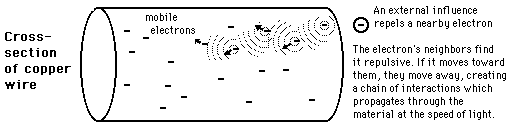
All the electrons in a conductor move almost at the same time when current is flowing.
A complete circuit of electrical conductors is required for a continuous current to flow.
An electrical voltage is the "push" which makes the free charge carriers move around an electrical circuit. We will look at this in much more detail later on.
HW None! RM has to catch up on the waves and sounds marking.
BN and HP owe essays for being noisy.
10/05/05 3C
We sat the waves and sounds test.
09/05/05 3A
We did a little on diffraction as detailed below. We also saw a single laser beam being shone through a very fine grating. The laser light spread out into a series of distinct bright dots.
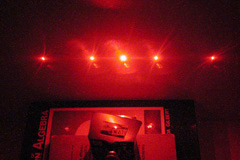
It was showing diffraction by spreading out, but because there were lots of slits, it was also showing another property of all waves - interference. When the waves spread out from each of the slits, they pass over each other and sometimes add up, at other times cancel each other out.
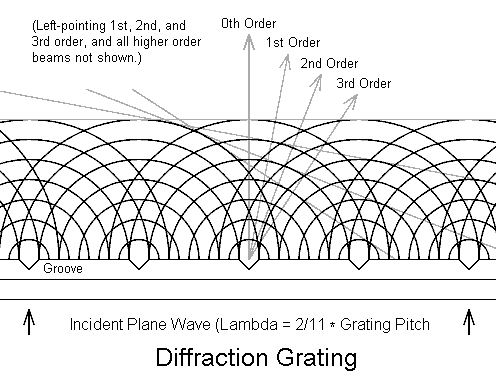
Don't worry about the words in the aove figure just the picture. Where the lines cross, there is positive interference resulting in a bigger wave (bright light). Where the wave front don't cross, there is destructive interference leading to no wave being present.
HW As we missed last lesson please do the Waves and sounds GCSE questions for Wed. We'lll have a test on waves and sounds next Monday.
04/05/05 3C
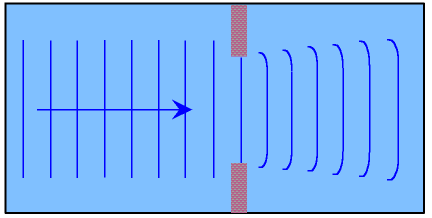
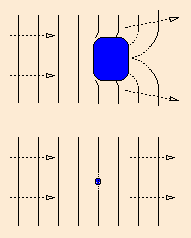
We saw a video on water waves in the sea. They behave exactly as all other waves do. They carry energy but not matter and obey the laws of reflection and refraction. (They change speed when the depth of the water changes.) They also diffract through gaps and around objects which are of a similar size to the wavelength (distance between peaks) of the wave.
When wavs "break" they are no longer true waves and do not behave in the same way. This happens when they hit very shallow water.
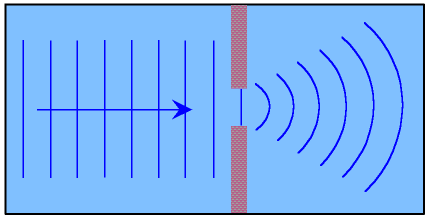
Diffraction is much more noticeable when the gap/obstacle is as small as the wavelength of the wave.
We started working through a practise waves and sounds test. The actual test will be on Tuesday.
HW Revise waves and sounds.
03/05/05 3A
We looked at performing calculations based on waves.
Wavespeed = Frequency times Wavelength
You must be able to use this formula and to rearrange it to make any of the 3 quantities the subject. (this is used in algebra in maths all the time)
Take note that different waves have very different values for speeds, frequencies and wavelengths. Sound in air travels at 330m/s and tend to have wavelengths measured in cm or m. Sound in water travels at more like 1500m/s. Light, and all other electromagnetic waves, travel at 300 million m/s. The wavelengths of visible light vary from 0.4 to 0.7 millionths of a m.
Echo location works by bouncing a wave off an object and listening for the echo. The time taken for the wave to reach the object and come back again can tell you how far away the object is (as long as you know how fast the wave is travelling.)
Distance travelled = Speed times time
Because the wave travels there and back again, the distance to the object is half of the distance travelled by the wave.
Read how bats use echolocation to find their prey.
We echo located the Tate modern. Making a very loud sound with a starting pistol allowed us to hear a faint echo which bounced back from the hard, flat surface which is the wall of the Tate. We measured the time between firing the pistol and hearing the faint echo. It was an imprecise experiment so we repeated it 4 times and took an average time.
The average time was multiplied by the speed of sound (about 340m/s) to work out how far the sound had travelled.
Distance travelled = Speed times Time
We divided the distance by 2 to work out the distance to the Tate. It came to about 300m or so. We checked our results on a map and found our distances to be a slight over estimate. This is probably due to human reaction time.
HW Will be set tomorrow, finishing GCSE sound calculations.
27/04/05 3A
Bell jar in a vacuum demonstration.
We looked at a bell ringing in a glass jar. The air was sucked out of the jar and we could no longer hear the bell. Sound requires a medium to travel, in a vacuum sound cannot propagate. Light, however, travels easily through a vacuum. This is because it is a wave of oscillating electric and magnetic fields.
Light is an electromagnetic wave. Radiowaves, microwaves, infrared waves (those that carry heat), ultraviolet light, X rays and gamma rays are all also part of the electromagnetic spectrum and can move through a vacuum. They all move at the speed of light, which is 300 million metres a second.
27/04/05 3C
We echo located the Tate modern. Making a very loud sound with a starting pistol allowed us to hear a faint echo which bounced back from the hard, flat surface which is the wall of the Tate. We measured the time between firing the pistol and hearing the faint echo. It was an imprecise experiment so we repeated it 4 times and took an average time.
The average time was multiplied by the speed of sound (about 340m/s) to work out how far the sound had travelled.
Distance travelled = Speed times Time
We divided the distance by 2 to work out the distance to the Tate. It came to about 300m or so. We checked our results on a map and found our distances to be a slight over estimate. This is probably due to human reaction time aswell as perhaps a slight overestimate for the speed of sound.
We then looked at a bell ringing in a glass jar. The air was sucked out of the jar and we could no longer hear the bell. Sound requires a medium to travel, in a vacuum sound cannot propagate. Light, however, travels easily through a vacuum. This is because it is a wave of oscillating electric and magnetic fields.
Light is an electromagnetic wave. Radiowaves, microwaves, infrared waves (those that carry heat), ultraviolet light, X rays and gamma rays are all also part of the electromagnetic spectrum and can move through a vacuum. They all move at the speed of light, which is 300 million metres a second.
HW Finish the set of GCSE Waves and Sounds questions for next Wednesday.
26/04/05 3C
We looked at performing calculations based on waves.
Wavespeed = Frequency times Wavelength
You must be able to use this formula and to rearrange it to make any of the 3 quantities the subject. (this is used in algebra in maths all the time)
Take note that different waves have very different values for speeds, frequencies and wavelengths. Sound in air travels at 330m/s and tend to have wavelengths measured in cm or m. Sound in water travels at more like 1500m/s. Light, and all other electromagnetic waves, travel at 300 million m/s. The wavelengths of visible light vary from 0.4 to 0.7 millionths of a m.
Echo location works by bouncing a wave off an object and listening for the echo. The time taken for the wave to reach the object and come back again can tell you how far away the object is (as long as you know how fast the wave is travelling.)
Distance travelled = Speed times time
Because the wave travels there and back again, the distance to the object is half of the distance travelled by the wave.
Read how bats use echolocation to find their prey.
25/04/05 3A
Only 16 in due to passover.
We looked at the Physics of musical instruments. All sounds are produced by an initial vibration. Musical instruments use reeds (woodwind), lips (brass), strings etc. to start the vibration. The vibration must then be amplified by a sound box or tube. The air inside the tube in a saxophone, for instance, vibrates up and down forced by the reed. This creates a much louder sound which can be made even louder by blowing harder. By changing the length of the column of air (putting keys down), the note can be changed. The larger column of air vibrates at a slower frequency and so plays a lower note.
Remember - sound is a longitudunal wave. In order to see the shape of the wave we transfer it to an electrical signal with a microphone. We can look at the shape of the electrical signal and find out things about the sound. A louder sound has a higher amplitude, a higher pitched sound has a higher frequency and a smaller wavelength.
HW Not due in for Wednesday. We'll try and include a few returning people and have all the sound questions from the handout done for next Monday. (Tuesday really of course.)
AR and JC notes to me by tomorrow morning or a detention.
20/04/05 3A
We went through the light test and then saw that sound, a longitudunal wave, can be represented as a transverse wave when it is fed into a microphone which turns the vibration of the air into an electrical signal.
JC and AR will see me on Tuesday lunchtime as punishment for talking vastly too often.
20/04/05 3C
We looked at the Physics of musical instruments. All sounds are produced by an initial vibration. Musical instruments use reeds (woodwind), lips (brass), strings etc. to start the vibration. The vibration must then be amplified by a sound box or tube. The air inside the tube in a saxophone, for instance, vibrates up and down forced by the reed. This creates a much louder sound which can be made even louder by blowing harder. By changing the length of the column of air (putting keys down), the note can be changed. The larger column of air vibrates at a slower frequency and so plays a lower note.
Remember - sound is a longitudunal wave. In order to see the shape of the wave we transfer it to an electrical signal with a microphone. We can look at the shape of the electrical signal and find out things about the sound. A louder sound has a higher amplitude, a higher pitched sound has a higher frequency and a smaller wavelength.
HW Answer all the questions from the handout on file paper for next time. Books were taken in properely this time...
AR and RS both owe me essays. i haven't forgotten.
18/04/05 3C
We went through the light test. Much more on sounds tomorrow. I forgot to get the HW in from all of you so I'll probably take the books in tomorrow instead.
18/04/05 3A
We sat the light test. Then we briefly looked at waves in both a slinky and in a water tank. You need to know that all waves carry energy as a vibration in a material (called a medium).
In transverse waves, vibrations in the medium are at right angles to the direction that the wave is travelling in. Light and water waves are transverse.
In longitudunal waves, the vibrations of the medium are in the same direction as the direction that the wave is travelling in. Sound is a longitudunal wave.
Ace wave animations here showing longitudunal and transverse aswell as some more complex waves
All waves will reflect off a plane surface with an angle of incidience which is equal to the angle of reflection. All waves will spread out (diffract) when they pass through a gap which is a simlilar size to the wavelength of the wave. All waves will change direction (refract) if they pass through into a different medium which causes them to change speed.
13/04/05 3A
We looked at an example light test which will be very similar to the proper test we will sit on Monday. We focussed in particular on the correction of long and short sight using lenses.
This powerpoint file summarises lenses.
HW Revise for a test on Monday on the whole of light.
13/04/05 3C
Waves and Sounds topic was started. You need to know that all waves carry energy as a vibration in a material (called a medium).
In transverse waves, vibrations in the medium are at right angles to the direction that the wave is travelling in. Light and water waves are transverse.
In longitudunal waves, the vibrations of the medium are in the same direction as the direction that the wave is travelling in. Sound is a longitudunal wave.
Ace wave animations here showing longitudunal and transverse aswell as some more complex waves
All waves will reflect off a plane surface with an angle of incidience which is equal to the angle of reflection. All waves will spread out (diffract) when they pass through a gap which is a simlilar size to the wavelength of the wave. All waves will change direction (refract) if they pass through into a different medium which causes them to change speed.
Electromagnetic waves have no medium but are vibrations in electric and magnetic fields. Light is just one type of electromagnetic wave.
The wave equation:
Wavespeed = Frequency times Wavelength
Frequency = Number of vibrations per second (Hertz)
Wavelength = Distance from the peak of a wave to the next peak. (m)
Waves of different frequencies travel at the same speed, so a higher frequency means a shorter wavelength.
Waves which carry more energy have a larger amplitude.
HW Finish Qs 15-17 P100 in your book and hand them in next time.