3A 14/05/08
You sat the promised test on heat transfer and specific heat capacity in the stinky Science lecture theatre.
We then began to do some general revision. I gave you a topic list which will be a good condensed crib sheet of what you need to know. I then gave you the 2003 past end of year paper.
HW Finish the 2003 end of year paper in its entirety (not Q11) using the model answers/mark scheme to help if you are stuck.
You sat the promised test on heat transfer and specific heat capacity.
We then began to do some general revision. I gave you a topic list which will be a good condensed crib sheet of what you need to know. I then gave you the 2003 past end of year paper.
HW Finish the 2003 end of year paper in its entirety (not Q11) using the model answers/mark scheme to help if you are stuck.
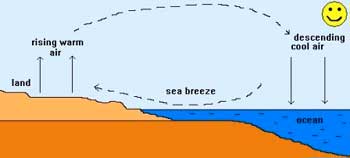
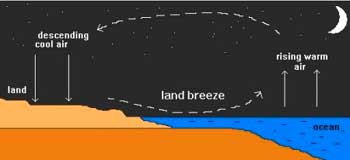
We learned about sea breezes, which occur because the sea has a large heat capacity than the land.
At night, the opposite happens..
We then went on to do some more calculations on specific heat capacity.
HW Revise for a little heat test on temperaure, conduction, convection, radiation and specific heat capacity.
Mr Richardson took you for a lesson in which you recapped insulation, methods of heat transfer and specific heat capacity.
HW Revise for a test on heat. The Kelvin scale, absolute zero, conduction, covection, radiation, insulation and specific heat capacity will all be covered.
Another lesson, so soon? Lucky you.
Heat energy is the energy something has due to the internal movement of its particles. When you heat something up, you are making its particles move faster, in a solid they vibrate, in a liquid and a gas they are able to move around each other.
The temperature of a body is a measure of the average kinetic energy of its particles. It is often measured in degrees Kelvin in science. They are the same as Celsius except that O Kelvin is the temperature at which particles would completely stop moving, and so things cannot possible be any colder than that. It is at -273 degrees celsius - absolute zero.
A large object at a low temperature will carry more heat energy with it than a small object at a higher temperature.
When you give an object some heat energy, it will warm up. The amount that it warms up by depends on its heat capacity.
The heat capacity of an object is the amount of energy required to heat it up by 1 degree.
The specific heat capacity of a material is the amount of energy required to heat up 1kg of the substance by 1 degree.
We performed an experiment, electrically heating some samples of aluminium and copper in order to measure their specific heat capacities.
HW Calculations on specific heat capacity (answers in books please).
We definitely attempted something relating to insulation, avoiding heat transfer away from houses etc.
Too many people failed to hand their books in. Of course, we have another lesson only tomorrow so perhaps I won't mark them anyway.
Mr Richardson took you for a lesson on thermal insulation.
HW ?
Convection: Happens in liquids and gases (fluids) that are in a gravitational field. One part of the fluid is heated and the particles begin to move faster and in doing so, get further apart. This reduces the density of the warm part of the fluid. The warm part of the fluid therefore starts to "float" up above the cooler less dense fluid surrounding it. Cooler fluid then moves in from the side to replace the warm, less dense, rising fluid. This fluid then starts to be heated, and so rises itself. Once the warm fluid has risen, it may cool and start to drop back down past the warmer fluid being heated beneath it. This causes a circular convection current to be created.
We saw 3 demonstrations of convection:
1 - tea leaves in a beaker of water heated by a Bunsen
2 - a mock up of a mine with 2 vertical shafts and a candle lit under one of them (this allowed fresh air to be drawn into mines).
3 - a hot air balloon.
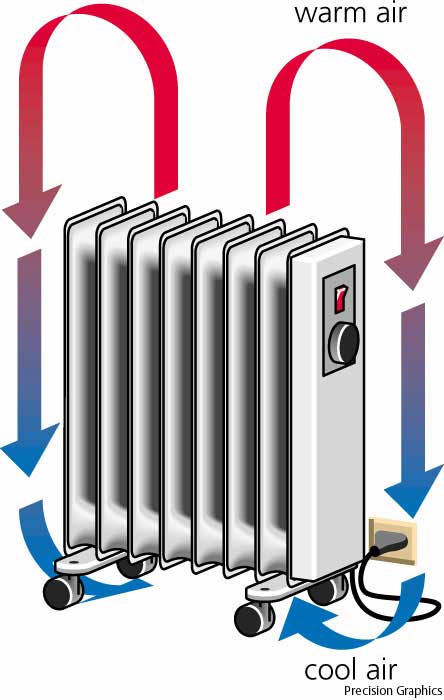
"Radiators" actually heat rooms by causing convection currents, hence it doesn't matter what colour they are painted really (although black would be a more efficient emitter of heat radiation).
You did an experiment to show which was the more important factor when a hot cup of liquid was cooling down, convection or conduction.
HW Write up your little experiment in neat. Draw the apparatus, very briefly describe the method complete the graph (3 cooling curves on the same axes)and then write a conculsion to your experiment.
Mr Richardson on heat transfer.
You first recapped Conduction, convection and radiation., then moved on to talking about ways of avoiding heat transfer.
You did an experiment to show which was the more important factor when a hot cup of liquid was cooling down, convection or conduction.
HW Complete the graph (3 cooling curves on the same axes)and then write a conculsion to your experiment.
More on heat transfer.
Black objects absorb heat radiation best (as they do light) and so warm up the most when infra red is shone on them. White or silver objects reflect most heat radiation and heat up less.
Black objects emit heat radiation best too, so if a hot object is black, it will emit more radiation than a white or silver object at the same temperature.
Convection: Happens in liquids and gases (fluids) that are in a gravitational field. One part of the fluid is heated and the particles begin to move faster and in doing so, get further apart. This reduces the density of the warm part of the fluid. The warm part of the fluid therefore starts to "float" up above the cooler less dense fluid surrounding it. Cooler fluid then moves in from the side to replace the warm, less dense, rising fluid. This fluid then starts to be heated, and so rises itself. Once the warm fluid has risen, it may cool and start to drop back down past the warmer fluid being heated beneath it. This causes a circular convection current to be created.
We saw 3 demonstrations of convection:
1 - tea leaves in a beaker of water heated by a Bunsen
2 - a mock up of a mine with 2 vertical shafts and a candle lit under one of them (this allowed fresh air to be drawn into mines).
3 - a hot air balloon.
"Radiators" actually heat rooms by causing convection currents, hence it doesn't matter what colour they are painted really (although black would be a more efficient emitter of heat radiation).
HW Get your books into me tomorrow with Qs 1-11 from P121-124 of Spectrum Physics if you didn't hand them in today!
We finished the waves topic by looking at a few questions on the speed of sound.
Then we started heat and temperature. Heat energy is the energy something has due to the internal movement of its particles. When you heat something up, you are making its particles move faster, in a solid they vibrate, in a liquid and a gas they are able to move around each other.
The temperature of a body is a measure of the average kinetic energy of its particles. It is often measured in degrees Kelvin in science. They are the same as Celsius except that O Kelvin is the temperature at which particles would completely stop moving, and so things cannot possible be any colder than that. It is at -273 degrees celsius - absolute zero.
A large object at a low temperature will carry more heat energy with it than a small object at a higher temperature.
Cooling curves are my nemesis this year..... This time technology failed me.
Never mind. Heat energy only spontaneously moves from hotter to colder regions. There are 3 main ways that it can do this. We learned about the first, conduction.

A spectacular failure by me to demonstrate cooling curves. If you are doing an experiment to compare 2 things, they must be in some way different......
Never mind. Heat transfer.
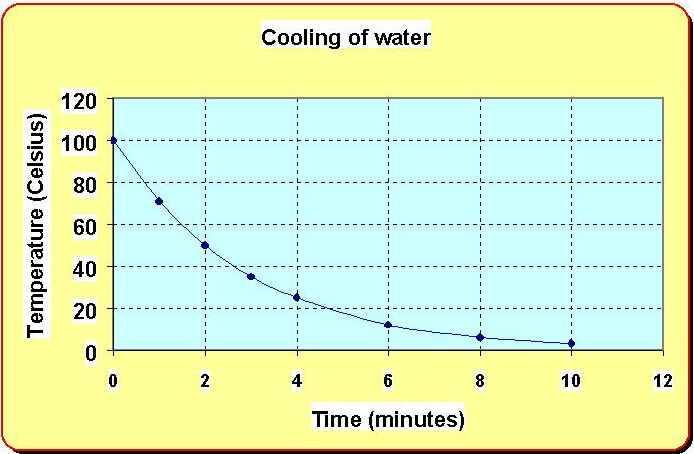
The cooling curve of an object starts off steep and gets less steep as the object gets nearer to the temperature of the atmosphere around it. The rate of cooling is proportional to the difference in temperature between an object and its surroundings.
We talked about heat energy and temperature. Heat energy is the energy something has due to the internal movement of its particles. When you heat something up, you are making its particles move faster, in a solid they vibrate, in a liquid and a gas they are able to move around each other.
The temperature of a body is a measure of the average kinetic energy of its particles. It is often measured in degrees Kelvin in science. They are the same as Celsius except that O Kelvin is the temperature at which particles would completely stop moving, and so things cannot possible be any colder than that. It is at -273 degrees celsius - absolute zero.
A large object at a low temperature will carry more heat energy with it than a small object at a higher temperature.
HW Summarise your conduction and radiation notes into your books and answer Qs 1-11 on P62-64 on conduction from your Spectrum Physics books.
We also saw a video on the use of ultrasound in medical imaging. Echoloaction within the body can build up a detailed picture of what is going on inside without cutting it open.
Ultrasound is any sound above the range of human hearing (20000Hz). It is useful to use because it has a high frequency and a small wavelength (all sound travels at the same speed). It therefore bounces off small sized objects and can be used to pick up fine details.
Other uses include: destroying kidney stones, vasectomies (ouch) and cleaning delicate equipment.
Waves questions were supposed to be handed in. Come and get a spare sheet tomorrow break if you have lost yours.
Mr Richardson took you for more on specific heat capacity. You did a shed load of calculations.
We talked about waves in general for a bit and a property they have - diffraction.
Diffraction: Waves spread out when passing through a gap. The smaller the gap, the more spread out the waves become. If the gap is much larger than the wavelength, then diffraction less noticeable.
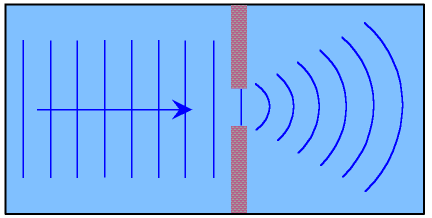
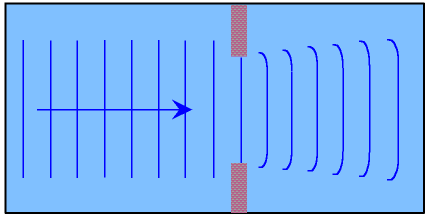
Light is very rarely seen to diffract due to its very small wavelength (between 4 and 7 10 millionths of a metre). In order for noticeable diffraction to occur the wave must pass through a gap which is similar in size to its wavelength. (Note, waves also diffract around obstacles which are similar in size to their wavelength.)
We made a measurement of the speed of sound by bouncing a loud noise made from th top of school off the Tate modern building and timing how long the sound took to get there and back. We used a map to find the distance to the Tate.
Our times were not particularly accurate even though we took an average of 4 readings. Human reaction time may have effected this.
Our speed of sound came out as about 250m/s whereas the true value is more like 330m/s
We did a couple of questions on waves. A new formula was introduced.
Wavespeed = Frequency * Wavelength
HW Complete the sheet of questions on sound, echoes etc. but not the ones on ultrasound.
Crickey. What did we do?
Mr Richardson took you for an introduction to heat and temperature.
Heat energy is the energy something has due to the internal movement of its particles. When you heat something up, you are making its particles move faster, in a solid they vibrate, in a liquid and a gas they are able to move around each other.
The temperature of a body is a measure of the average kinetic energy of its particles. It is often measured in degrees Kelvin in science. They are the same as Celsius except that O Kelvin is the temperature at which particles would completely stop moving, and so things cannot possible be any colder than that. It is at -273 degrees celsius - absolute zero.
A large object at a low temperature will carry more heat energy with it than a small object at a higher temperature.
When you give an object some heat energy, it will warm up. The amount that it warms up by depends on its heat capacity.
The heat capacity of an object is the amount of energy required to heat it up by 1 degree.
The specific heat capacity of a material is the amount of energy required to heat up 1kg of the substance by 1 degree.
HW Finish the writing up of your experiment into your books.
We looked at musical instruments again. The bigger/longer the column of air vibrating in a wind instrument, the lower it plays.
Woohoo!
HW Hand in your books or I keep you in at lunch on Wednesday!
We finished off lenses by looking at short and long sight correction in some more detail. New topic next week.
We looked at the correction of short and long site using lenses.
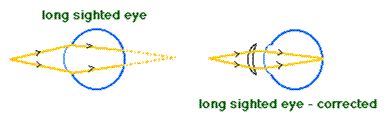
Long sighted people are unable to focus on nearby objects. A convex (converging) lens is used to correct this.
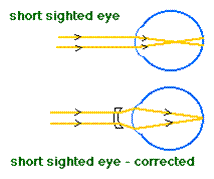
Short sighted people have a retina which is too far away from the front of the eye. A convex (diverging) lens is needed to correct their sight.
I took the books in.
Another pre-emptive post.
We have finished studying lenses, and light in general and so are moving on to look at waves in general and sound.
Light is a type of wave. Waves transfer energy from one place to another without transfering matter from one place to another. The energy is transferred as vibrations in a material, called the medium
We saw 2 different types of waves produced on a slinky.
Waves come in 2 major types, transverse and longitudunal.
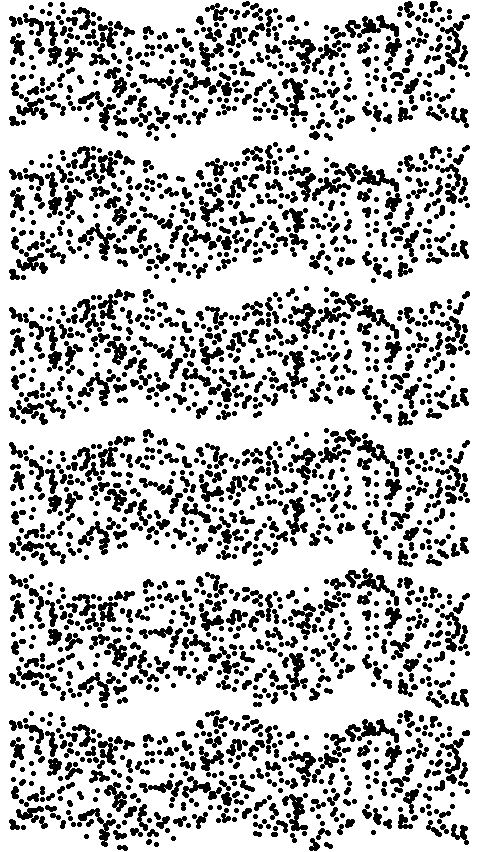
In transverse waves, vibrations occur which are perpendicular to the direction in which the wave is travelling. e.g. water waves, light.
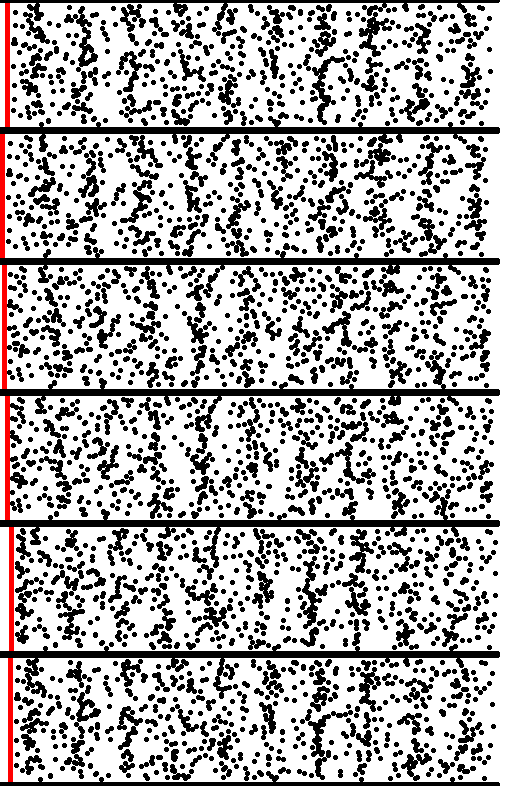
Longitudunal waves have vibrations which are parallel to the direction of wave travel.
We saw several demonstrations relating to sound.
Sound is a longitudunal wave (as above) where the vibrations in the medium take place in the same direction as the wave is travelling.
We saw how a loudspeaker vibrates in order to cause sound and the vibrations travel through the air.
We also tested the range of frequencies that humans can hear using a signal generator and a loudspeaker. Most of you could hear sound between 20Hz and about 20kHz. I could only hear up to about 14kHz because I am old and rubbish.
Important quantities that you know are:
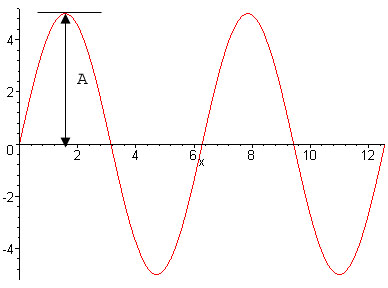
1. Amplitude - the maximum "height" of the vibration. Easy to see in a transverse wave, not so easy in a longitudunal.
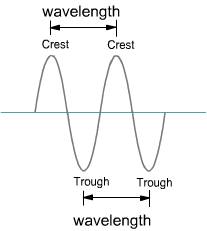
2. Wavelength - The distance from the peak of one wave, to the peak of the next. It can really be measured from any point on the wave, to the next equivalent point.
We played some sounds into a microphone connected to an oscilloscope. This makes it much easier to see things like amplitude and wavelength. The sound is converted into an electrical signal by the microphone and can then be represented as a transverse wave.
Important quantities that you know are:
1. Amplitude - the maximum "height" of the vibration. Easy to see in a transverse wave, not so easy in a longitudunal.
2. Frequency - the number of vibrations a second, measured in Hertz (Hz)
Bell in a vacuum jar and the speed of sound.
We looked at a bell ringing in a glass jar. The air was sucked out of the jar and we could no longer hear the bell. Sound requires a medium to travel, in a vacuum sound cannot propagate. Light, however, travels easily through a vacuum. This is because it is a wave of oscillating electric and magnetic fields.
Light is an electromagnetic wave. Radiowaves, microwaves, infrared waves (those that carry heat), ultraviolet light, X rays and gamma rays are all also part of the electromagnetic spectrum and can move through a vacuum. They all move at the speed of light, which is 300 million metres a second.
We looked at the Physics of musical instruments. All sounds are produced by an initial vibration. Musical instruments use reeds (woodwind), lips (brass), strings etc. to start the vibration. The vibration must then be amplified by a sound box or tube. The air inside the tube in a saxophone, for instance, vibrates up and down forced by the reed. This creates a much louder sound which can be made even louder by blowing harder. By changing the length of the column of air (putting keys down), the note can be changed. The larger column of air vibrates at a slower frequency and so plays a lower note.
Remember - sound is a longitudunal wave. In order to see the shape of the wave we transfer it to an electrical signal with a microphone. We can look at the shape of the electrical signal and find out things about the sound. A louder sound has a higher amplitude, a higher pitched sound has a higher frequency and a smaller wavelength.
We made some test tube pan pipes by filling them with various amounts of water. The vibration in them was started in a similar way to a flute.

HW Ensure that all of today's notes and the little experiment write up have been completed. Answer Qs 1-3 on P103 of Spectrum Physics. Books are to be made up to date if they are missing bits as highlighted last term. Ensure that the optical fibres work is done by tomorrow if I don't have a mark for you.
A pre-emptive post. We are finishing off our work on lenses by doing a practical today. We will learn how to accurately draw a ray diagram first, however.
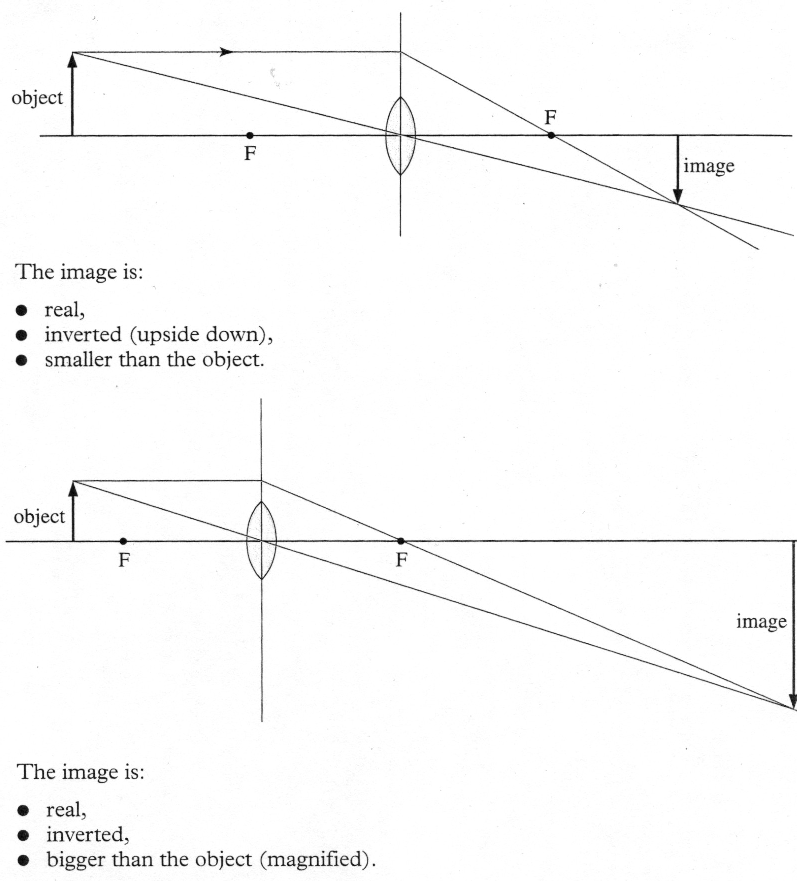
We learned how to draw ray diagrams for convex lenses - exactly as above! We looked at the use of lenses in forming images.
We did an experiment to see how lenses can be used to form images.
Putting an object close to a convex lens means that it acts like a magnifying glass and forms a virtual image if you look through it.
We also tested putting an object at different distances away from the lens. Real images were then projected onto a screen. The image was either smaller than the object with the object far away (acting like a camera) or it was larger (acting like a slide projector). In both cases the image was upside down.
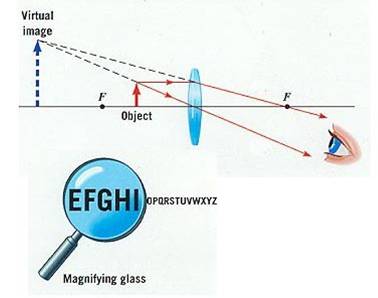
With the object you were looking at close to the lens, a magnified image is seen through the lens. It is "virtual" (not really there).
If you changed the distance of the object from the lens then the image turned upside down.
This animation shows excellently what was happening.
The eye uses a convex lens to form an image on the retina at the back of the eye, hence allowing you to see!

The eye and a camera both operate in the same basic way. All the rays from the same point on an object are focussed onto the same point on the film/retina by a convex lens.
HW
Ensure that you have diagrams showing the correction of long and short sight using lenses in your book and complete the write up of today's experiment. Details for those who didn't finish are below:
The first experiment, where the object was held very close to the lens produced no image. If you looked through the lens the the object looked bigger (it was a magnifying glass)
Example results for the second part. If the focal length of the lens was 12cm, then you may have held the lens 20cm away from the object. If this was the case, the image would have been found 30cm away from the lens. It would have been 1.5 times larger than the object and upside down. In this case the lens was acting like a slide projector.
Example results for the 3rd part. Now, the object was placed 40 cm from the lens, and an image was seen 17cm away from the lens. The image was about 0.4 times the size of the object and was upside down. In this case the lens was acting like a camera.
In both the second and third cases, looking through the lens caused you to see the object upside down.