Welcome to 3rd form Physics. This website will keep you updated with all that's been going on in lessons and tell you what the homework is each week. Bookmark it please!
3B 08/12/08
We looked at diodes and thermistors.
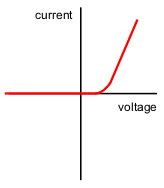
Diodes only allow current to pass through them in one direction. They are normal conductors, obeying Ohm's law in one direction but they have a huge resistance in the opposite direction, not allowing current to flow.
Light emitting diodes do the same thing, but emit light when they pass current. They are much more efficient at producing light tan a filament bulb.
Thermistors lose resistance as they heat up. The opposite of a filament bulb.
They do this because extra free charge carriers are released by the thermal energy. They are made of semi-conductors, not metals.
A high current passing through a thermistor will cause it to heat up, just like in a filament bulb, so when a larger voltage is put across a thermistor, its resistance goes down.
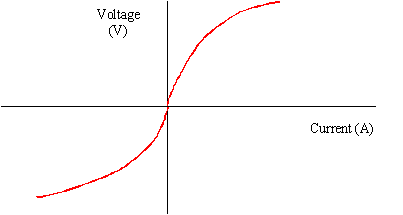
The graph curves the opposite way to the filament one.
HW No - books in.
RM - no. You did some electricity work from the PM GCSE book P233.
We looked at some problems in electricity using the current and voltage rules in series and parallel.
Although metals have electrons which are free to move, they don't pass through the material in straight lines when a voltage is applied.
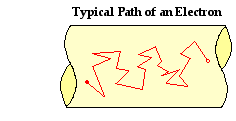
They tend to collide with each other and with the positive ions jostling around within the metal this animation shows the effect more clearly.
The collisions tend to slow the motion of the electrons rather like a kind of electrical "friction". The harder it is for electrons to pass through a metal, the higher its electrical resistance.
An experiment to test how voltage applied across a component effects the current flowing through it was done.
The resistor showed a proportional relationship between the voltage and the current. It is said to obey Ohm's law.
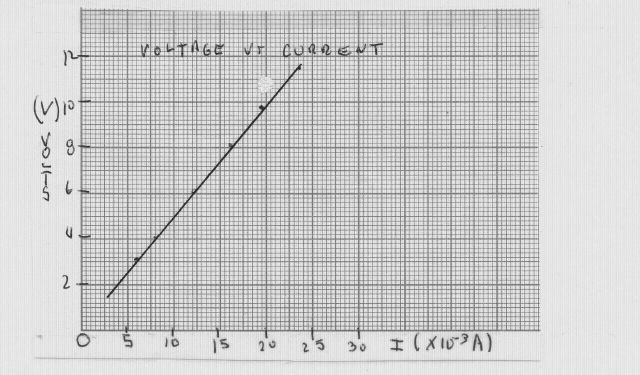
The gradient of line gives the resistance of the component.
Voltage = Current times Resistance, or V = IR, R = V/I
The larger the resistance, the larger steeper the line on the graph.
HW Finish your write up of the experiment, including a conclusion in your book and stick in your graph. Complete Qs 1-4 and 1-4 which are calculations using Ohm's law on the handout.
We looked at more current/voltage characteristics. Bulbs gain in resistance as more current is passed through them because they heat up. Greater particle vibrations in the metal get in the way of electrons trying to pass through the filament as it heats up, increasing its resistance.
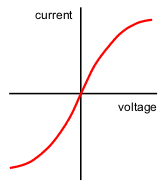
HW Write a conclusion to your experiment, including the details of why the resistance changes and calculations of the resistance at 1,3,5 Volts.
Circuit calculations.
We recapped Ohm's law by doing some calculations.
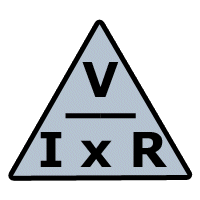
We just wrote down the rules about adding resistors in series and parallel (although we need to explain them in more detail next time)
We did some practical work on voltage.
We discovered the following rules about voltage in series and parallel circuits:
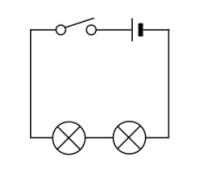
In series, the current is the same at all points.
In series, the battery voltage is shared between all the components in the circuit.
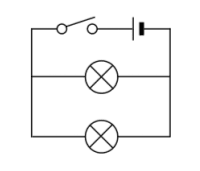
In parallel, each parallel path recieves the full battery voltage.
In parallel, the total current is found by the addition of the currents in each of the parallel paths.
HW Complete the questions from the "Potential dividers sheet." I took book in.
Although metals have electrons which are free to move, they don't pass through the material in straight lines when a voltage is applied.
They tend to collide with each other and with the positive ions jostling around within the metal this animation shows the effect more clearly.
The collisions tend to slow the motion of the electrons rather like a kind of electrical "friction". The harder it is for electrons to pass through a metal, the higher its electrical resistance.
An experiment to test how voltage applied across a component effects the current flowing through it was done.
The resistor showed a proportional relationship between the voltage and the current. It is said to obey Ohm's law.
The gradient of line gives the resistance of the component.
Voltage = Current times Resistance, or V = IR, R = V/I
The larger the resistance, the larger steeper the line on the graph.
HW Finish off the experimental write up by plotting both graphs, finding their gradients and answering the questions on the handout using the Ohm's law formula.
No. RM = CCF. You did some electrical worksheets with EW.
No proper lesson due to TFL safety talk. We may have ventured into analogies to electrical current and voltage.
Mouse and cheese as an analogy.
HW Perhaps....
We did some practical work on voltage.
We discovered the following rules about voltage in series and parallel circuits:
In series, the current is the same at all points.
In series, the battery voltage is shared between all the components in the circuit.
In parallel, each parallel path recieves the full battery voltage.
In parallel, the total current is found by the addition of the currents in each of the parallel paths.
HW P111-113 Spectrum Physics Qs 1-10.
We wrote up some notes on the stuff covered last time (see post below) covering current rules in series and parallel circuits.
Voltage can be physically thought of as the electrical pushing force which causes current.
HW None - books in.
We then just started to look at electricity, building a few simple circuits with light bulbs.
We learned that electric current is a flow of charge around a continuous circuit of electrical conductor.
Electric current is a word describing moving electrical charges. It is the rate of flow of electrical charge. The unit which is used to measure charge is called the Coulomb. (The numbers of individual electrons moving would be very large indeed.)
Current is therefore measured in Coulombs per second. Another word for 1 Coulomb per second is an Ampere
. Electrical conductors are materials that allow the passage of electric current. In order to do this they must have charge carriers (usually electrons) which are free to move.
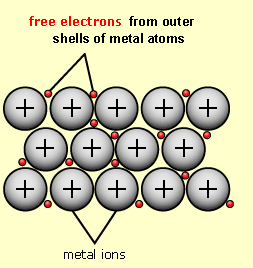
Metals have free electrons as part of their structure which can conduct electricity.
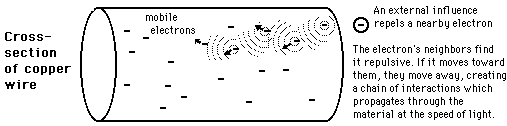
Although electrons move slowly through metal wires, each electron repels its neighbour causing a knock on effect which means that electrical energy is transferred at the speed of light.
Then onto an electricity experiment looking at how different numbers and arrangements of bulbs changed the current in a circuit.
We tested some simple circuits with light bulbs in and came up with the following rules:
1. The current in a series circuit is the same at all points.
2. The bulbs lit up at less than normal brightness in series; less current was flowing through them than in a single bulb.
1. The total current in a series circuit is equal to the sum of the currents in each parallel path.
2. The bulbs in parallel lit up at normal brightness; they had the same current flowing through each of them as flows through a single bulb.
We may have just started voltage...
HW P18 Qs 1,3,4,5,6,7 P25 Qs 1-4 from Spectrum Physics
We actually did cover efficiency this time (as you sneaked away on a trip on Weds.)
We then recapped some 2nd form electricity.
We then just started to look at electricity, building a few simple circuits with light bulbs.
We learned that electric current is a flow of charge around a continuous circuit of electrical conductor.
Electric current is a word describing moving electrical charges. It is the rate of flow of electrical charge. The unit which is used to measure charge is called the Coulomb. (The numbers of individual electrons moving would be very large indeed.)
Current is therefore measured in Coulombs per second. Another word for 1 Coulomb per second is an Ampere
. Electrical conductors are materials that allow the passage of electric current. In order to do this they must have charge carriers (usually electrons) which are free to move.
Metals have free electrons as part of their structure which can conduct electricity.
Although electrons move slowly through metal wires, each electron repels its neighbour causing a knock on effect which means that electrical energy is transferred at the speed of light.
Then onto an electricity experiment looking at how different numbers and arrangements of bulbs changed the current in a circuit.
We tested some simple circuits with light bulbs in and came up with the following rules:
1. The current in a series circuit is the same at all points.
2. The bulbs lit up at less than normal brightness in series; less current was flowing through them than in a single bulb.
1. The total current in a series circuit is equal to the sum of the currents in each parallel path.
2. The bulbs in parallel lit up at normal brightness; they had the same current flowing through each of them as flows through a single bulb.
HW P18 Qs 1,3,4,5,6,7 P25 Qs 1-4 from Spectrum Physics
In W4, we carried on the HW task from last time.
HW Due in next lesson. "In 200 years, most fossil fuel resoures will be exhausted. Research alternatives and conclude the best choices for mankind to invest in now."
We will have looked at efficiency.
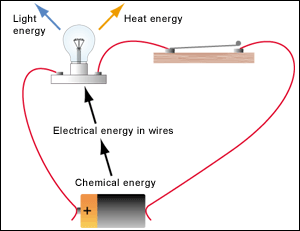
2 energy transfers are involved in a simple light bulb.
Some transducers do not change all of the energy into the required form. Some energy is changed into an unusable form which is wasted (although not destroyed).
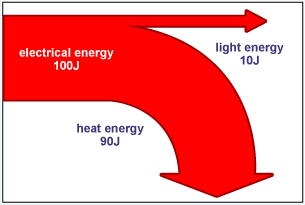
The bulb only converts 10% of the input electrical energy into the useful form, light. It is said to be 10% efficient.
Efficiency = Useful energy out / Total energy in (as a percentage.)
We continued to study possible alternatives to fossil fuels for the ongoing energy needs of humanity. We looked in detail at nuclear fusion and did some work on it.
You must hand in your books with the 3 questions on fusion completed on Friday.
HW "In 200 years, most fossil fuel resoures will be exhausted. Research alternatives and conclude the best choices for mankind to invest in now." This work will be carried out as a homework, but also as a single lesson in the computer room on Friday. Make sure that you are able to carry on your work then.
Watch these 2 videos to help you.
We used the laptops to start a piece of work on possible alternatives to fossil fuels which will be used in the future. Renewables and nuclear fusion essentially.
Watch these 2 videos to help you.
HW Complete your piece of work for next time.
We looked at efficiency.
2 energy transfers are involved in a simple light bulb.
Some transducers do not change all of the energy into the required form. Some energy is changed into an unusable form which is wasted (although not destroyed).
The bulb only converts 10% of the input electrical energy into the useful form, light. It is said to be 10% efficient.
Efficiency = Useful energy out / Total energy in (as a percentage.)
Then we started looking at energy resources, up to fossil fuels on the vid. think.
HW Complete a summary of the 3 fossil fuels, how they are formed, how long they last and how polluting they are.
We saw the remainder of the video, this time detailing renewable energy resources. Wind, wave, hydro-electric, geothermal, biomass.
Jetlagged Mackrell was dazed to say the least. We went through the answers to the test I reckon, then started to look at energy resources by watching a video on fossil fuels.
HW I took your books in - you should word process a summary of the facts about coal, oil and gas.
Who knows? I genuinely have no memory of what occured for this single lesson! I suspect that we did some work on energy from the Spectrum book. I'll have to check your books to confirm.....
No. RM = Brum. You did energy cover work.
We will have sat a test... Then we will have started a new topic - energy.
Energy is "the capacity for things to happen." When ever any physical change takes place within the universe, energy is changing from one form to another. Energy cannot be created or destroyed, only transferred between different types.
Types of energy are: Kinetic (due to movement), Gravitational potential, Chemical potential, Elastic potential, Magnetic potential, Nuclear potential, Thermal (heat) energy, light energy, electrical energy.
A device which transfers energy from one form to another is called a transducer. Often, there is more than one energy transfer involved in the operation of a single transducer.
2 energy transfers are involved in a simple light bulb.
Some transducers do not change all of the energy into the required form. Some energy is changed into an unusable form which is wasted (although not destroyed).
The bulb only converts 10% of the input electrical energy into the useful form, light. It is said to be 10% efficient.
HW No, books in.
I suppose we went through the answers to the test.
We have pretty much finished forces and motion. This means that we are due a test! We did some revision today by looking at an old forces and motion test.
HW Revise for a test for next time. (You'll be let off HW on Wednesday to make up for it!)
Pre-emptive post! We will have sat a test... Then we will have started a new topic - energy.
Energy is "the capacity for things to happen." When ever any physical change takes place within the universe, energy is changing from one form to another. Energy cannot be created or destroyed, only transferred between different types.
Types of energy are: Kinetic (due to movement), Gravitational potential, Chemical potential, Elastic potential, Magnetic potential, Nuclear potential, Thermal (heat) energy, light energy, electrical energy.
A device which transfers energy from one form to another is called a transducer. Often, there is more than one energy transfer involved in the operation of a single transducer.
2 energy transfers are involved in a simple light bulb.
Some transducers do not change all of the energy into the required form. Some energy is changed into an unusable form which is wasted (although not destroyed).
The bulb only converts 10% of the input electrical energy into the useful form, light. It is said to be 10% efficient.
HW None, except to tidy up books etc. and to catch up any missing HW before the grades deadline.
We discussed free fall. Without air resistance, all objects fall at the same rate with an acceleration of about 10m/s/s (on Earth). However, air resistance changes the way that some objects fall.
We looked at drag forces.
A speed/time graph of the motion of a skydiver would look like this:
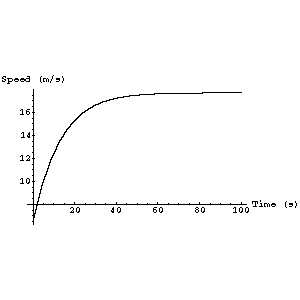
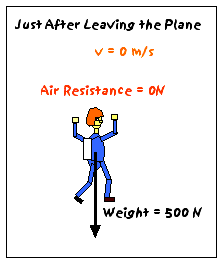
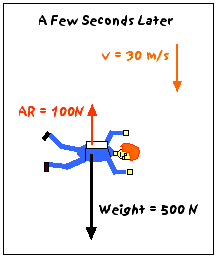
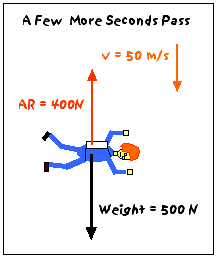
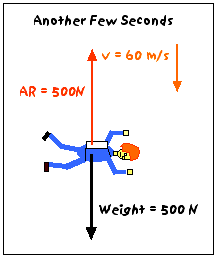
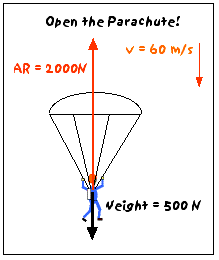
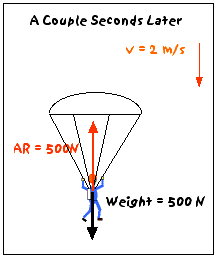
The above shows how a parachutist first accelerates until the air resistance force on him is equal to his weight. He then travels at terminal velocity, a constant speed with balanced forces acting on him. He then artificially increases his air resistance by opening his parachute, so he slows down until air resistance once again equals his weight at a much slower (and safer) speed.
Terminal velocity occurs when the air resistance (sometimes called "drag") force equals the weight iof the falling object. This means that:
heavy, compact, objects will have a higher terminal velocity than light, spread out objects. Therefore, heavy objects will fall faster in air than light objects
HW Sort out your books! Those of you without calculations showing how you found the acceleration due to gravity experimentally must put them into your book, showing clearly how you did it. All must complete the new worksheet on ticker tape acceleration. Those with scrappy books must underline titles, stick in graphs etc.
We have pretty much finished forces and motion. This means that we are due a test! We did some revision today by looking at an old forces and motion test.
HW Revise for a test for next time. (You'll be let off HW on Wednesday to make up for it!)
Your results for the acceleration due to gravity showed no significant difference in the rate of change of speed bewteen your 2 falling objects of different masses.
We saw a video on freefall which went further into this. Books in.
We discussed free fall. Without air resistance, all objects fall at the same rate with an acceleration of about 10m/s/s (on Earth). However, air resistance changes the way that some objects fall.
We looked at drag forces.
A speed/time graph of the motion of a skydiver would look like this:
The above shows how a parachutist first accelerates until the air resistance force on him is equal to his weight. He then travels at terminal velocity, a constant speed with balanced forces acting on him. He then artificially increases his air resistance by opening his parachute, so he slows down until air resistance once again equals his weight at a much slower (and safer) speed.
Terminal velocity occurs when the air resistance (sometimes called "drag") force equals the weight iof the falling object. This means that:
heavy, compact, objects will have a higher terminal velocity than light, spread out objects. Therefore, heavy objects will fall faster in air than light objects
HW Q7 P145 (essentially write a paragraph or 2 about the history of the parachute and how it works.) in your books please.
Using tickertape timers, you recorded the motion of a falling object. You used the resulting information to calculate a value for the acceleration due to gravity on Earth of an object. You then tried the same for another one of twice the mass.
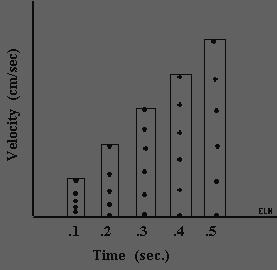
HW Complete the calculation of acceleration due to gravity using my photocopied ticker graph. If not done in lesson, use your 2 tickertapes to calculate the acceleration of your falling objects. Comment on the values of your 2 results.
Your results for the acceleration due to gravity showed no significant difference in the rate of change of speed bewteen your 2 falling objects of different masses.
We saw a video on freefall which went further into this. Books in.
We did some calculations on acceleration. You must be able to re-arrange equations to find an unknown quantity, just as in maths.
Books in - but you must have finished the acceleration questions up to Q8 if you were being lazy in the lesson.
Using tickertape timers, you recorded the motion of a falling object. You used the resulting information to calculate a value for the acceleration due to gravity on Earth of an object. You then tried the same for another one of twice the mass.
HW Use your 2 tickertapes to calculate the acceleration of your falling objects. Comment on the values of your 2 results.
Measuring changing speed using a ticker tape timer.
You rolled some trolleys down slopes and made a "ticker graph" which represented how the speed of the trolley changed as it went down the slope.
Things tend to speed up going downhill.....
We learned about acceleration.
We looked at calculating acceleration.
Acceleration is the rate of change of speed (as long as no change of direction is involved)
Acceleration (m/s2) = Change in speed / time
In symbols : a = (v-u)/t
v = final speed (m/s)
u = initial speed (m/s)
t = time to go between the 2 speeds
Remember: Acceleration = Change in speed / time
a = (v-u)/t
To work out acceleration you must first work out the fastest speed ( s = d/t ) from the longest ticker. Then work out the slowest speed ( s = d/t ) again from the shortest ticker. Then calculate how long the time was between the 2 speeds you have just worked out (You can do this by counting the number of gaps between dots which have happened between your 2 speeds). Finally stick all 3 numbers into the formula for acceleration.
HW Complete the acceleration for your ticker graph.
We learned about acceleration.
We looked at calculating acceleration.
Acceleration is the rate of change of speed (as long as no change of direction is involved)
Acceleration (m/s2) = Change in speed / time
In symbols : a = (v-u)/t
v = final speed (m/s)
u = initial speed (m/s)
t = time to go between the 2 speeds
Remember: Acceleration = Change in speed / time
a = (v-u)/t
To work out acceleration you must first work out the fastest speed ( s = d/t ) from the longest ticker. Then work out the slowest speed ( s = d/t ) again from the shortest ticker. Then calculate how long the time was between the 2 speeds you have just worked out (You can do this by counting the number of gaps between dots which have happened between your 2 speeds). Finally stick all 3 numbers into the formula for acceleration.
We then attempted some questions on acceleration.
HW Sheets came in.
Ticker tape timers.
We looked at ticker tape timers.
Average speed = Distance / Time
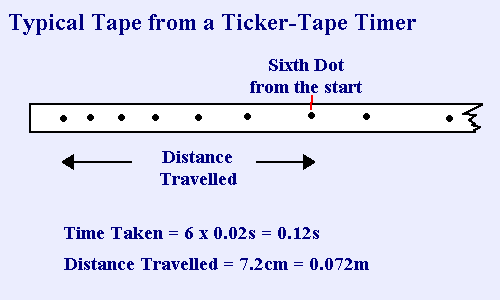
A ttt produces one dot every 1/50th of a second.
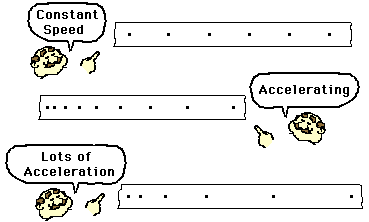
The distance between the dots varies if the speed is changing.
Books in.
Measuring changing speed using a ticker tape timer.
You rolled some trolleys down slopes and made a "ticker graph" which represented how the speed of the trolley changed as it went down the slope.
We didn't quite get to the point of doing formal accleration calculations, so we'll do that in the single lesson.
Things tend to speed up going downhill.....
HW Sheet of ticker tape timer calculations.
Anti-lock brakes prevent car wheels from locking by pumping the brakes on and off. This stops the car from skidding, which means that it is slowed by static, not dynamic friction. Static friction is a larger force than dynamic frction and so the car slows sooner when not skidding.
We looked at 2 methods of measuring speed.
Firstly, to work out the speed of an object you need to know how far it has travelled and how long it has taken.
This can be done using a stopwatch and a ruler. We tried this to measure the average speed of falling objects but found it quite difficult.
We observed a light gate attached to an air track. The light gate times how long a beam of light is cut off for. If you know the length of the object, you can than calculate its speed.
Speed (m/s) = Distance (m) / Time (s)
HW On paper, answer Qs 6,1,3,5,6,8,10,11 over pages 132-135
Ticker tape timers.
We looked at ticker tape timers.
Average speed = Distance / Time
A ttt produces one dot every 1/50th of a second.
The distance between the dots varies if the speed is changing.
Books in.
Anti-lock brakes prevent car wheels from locking by pumping the brakes on and off. This stops the car from skidding, which means that it is slowed by static, not dynamic friction. Static friction is a larger force than dynamic frction and so the car slows sooner when not skidding.
We looked at 2 methods of measuring speed.
Firstly, to work out the speed of an object you need to know how far it has travelled and how long it has taken.
This can be done using a stopwatch and a ruler. We tried this to measure the average speed of falling objects but found it quite difficult.
We observed a light gate attached to an air track. The light gate times how long a beam of light is cut off for. If you know the length of the object, you can than calculate its speed.
Speed (m/s) = Distance (m) / Time (s)
HW Finish light gate write up then Qs 1-9 from P39-41 of Spectrum Physics
We did an experiment investigating friction. The larger the weight of an object, the larger the frictional force it can produce in contact with a surface. We discovered this because it took a larger force to start moving a block when it had masses piled on top.
Once an object has started sliding, the frictional force on it decreases. It took less force to keep the block sliding at a constant speed than it did to start it moving in the first place. Static friction is larger than dynamic friction.
HW Finish off the write up of the sliding block experiment and answer Qs 1-9 P39-41 of Spectrum Phys.
2nd lesson. We looked at the results from last lesson's experiment. We showed that frictional forces are proportional to the size of the contact force between 2 surfaces. We also showed that sliding (dynamic) friction is a smaller force than static friction.
So, to remove friction, you must remove the contact force between 2 surfaces. I showed an example of this using an airtrack, which supports a vehicle on a cushion of air. Without friction, an already moving object will just keep going. An object without an unbalanced force on it will not change speed.
We used our data from last time to extrapolate what mass we would have had to take away from the blocks for there to be no friction at all. This gave us an estimate of the mass of the block.
Boooks were taken in.
Books were issued to all. Numbers were taken in.
Forces can be mechanical or act at a distance (e.g. gravity). When an object has unbalanced forces acting on it, it will accelerate in the direction of the overall force acting on it. If a body has balanced forces on it, it will remain at a constant speed, or at rest.
An object sitting on a table has 2 equal and opposite forces acting on it. Its own weight acts downwards and is counteracted by the reaction force that the table puts onto the object.
We did an experiment investigating friction. The larger the weight of an object, the larger the frictional force it can produce in contact with a surface. We discovered this because it took a larger force to start moving a block when it had masses piled on top.
Once an object has started sliding, the frictional force on it decreases. It took less force to keep the block sliding at a constant speed than it did to start it moving in the first place. Static friction is larger than dynamic friction.
HW Finish off the write up of the sliding block experiment including the graph with best fit lines, a description of the experimental method and questions 7-10 from the sheet, answered in full sentences in your book.
Books were issued to all. Numbers were taken in.
Forces can be mechanical or act at a distance (e.g. gravity). When an object has unbalanced forces acting on it, it will accelerate in the direction of the overall force acting on it. If a body has balanced forces on it, it will remain at a constant speed, or at rest.
An object sitting on a table has 2 equal and opposite forces acting on it. Its own weight acts downwards and is counteracted by the reaction force that the table puts onto the object.